If someone suddenly types “GTG” at the end of a conversation, you may wonder whether it means something specific or is simply another internet abbreviation.
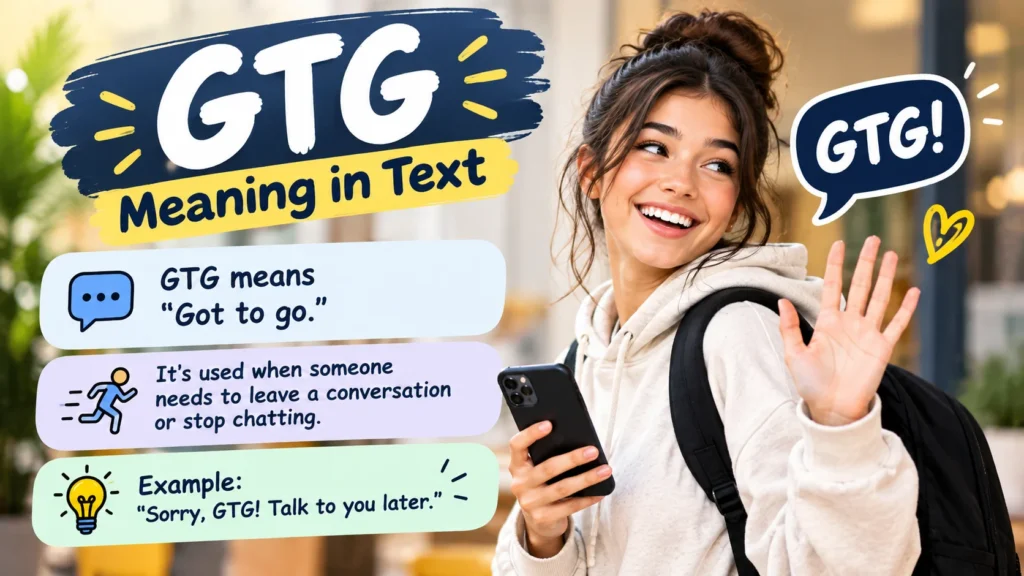
In texting, GTG most commonly means “Got to Go.” It tells another person that you need to leave the conversation, stop texting, or move on to something else.
You might see it in a message such as:
“GTG, my mom is calling.”
The meaning is straightforward: “I have to go now.”
it is popular because texting is built around speed. Instead of writing a complete sentence, people can use three letters to communicate the same idea instantly.
The abbreviation can appear in WhatsApp chats, Instagram DMs, Snapchat messages, gaming conversations, group chats, and everyday text messages.
GTG Meaning – Quick Explanation
What does GTG stand for?
GTG = Got to Go
It is normally used when someone needs to end a conversation or leave a particular situation.
Common examples include:
“GTG, talk later.”
“Sorry, GTG. I have class.”
“GTG, dinner is ready.”
The abbreviation does not usually express anger or dislike. In most situations, it simply means the person has something else to do.
Is GTG the same as “Good to Go”?
Not always.
it can occasionally mean “Good to Go,” especially in work, gaming, planning, or logistical conversations.
For example:
“Are we ready?”
“GTG.”
Here, GTG could mean “Good to Go,” meaning everything is ready.
Context determines which meaning makes sense.
Where Did GTG Come From?
GTG developed alongside the broader culture of internet abbreviations and mobile texting.
As digital communication became faster, people began shortening common phrases such as:
- BRB — Be Right Back
- LOL — Laughing Out Loud
- BTW — By the Way
- TTYL — Talk to You Later
- IDK — I Don’t Know
- GTG — Got to Go
These abbreviations made conversations quicker, particularly when typing on older mobile phones or keyboards.
GTG and early internet chat
Short forms became particularly useful in instant messaging and online chatrooms.
People wanted to respond quickly without interrupting the flow of conversation. A three-letter expression such as GTG was much easier than typing a full sentence.
How social media changed GTG
Modern social platforms made abbreviations even more visible.
Today, GTG can appear in:
- Instagram DMs
- Snapchat
- TikTok comments
- Discord
- Gaming chats
- Group messages
- SMS texts
Younger users may also combine GTG with emojis to make their tone clearer.
For example:
“GTG 😭”
sounds more playful or reluctant than simply:
“GTG.”
GTG in Real-Life Conversations
The easiest way to understand texting slang is to see how people actually use it.
WhatsApp conversation
Person A:
Are you free to talk?
Person B:
Yeah, what’s up?
Person A:
I wanted to tell you what happened today 😂
Person B:
Wait, my dad needs me. GTG for a minute.
Person A:
No worries. Text me later.
Here, GTG simply means the person needs to leave temporarily.
Instagram DM
Person A:
Did you watch the new episode?
Person B:
Not yet!
Person A:
You HAVE to watch it.
Person B:
I will tonight 😂 GTG, I have homework.
The conversation is casual, and GTG creates a quick exit.
Text message
Person A:
Are you coming to the game?
Person B:
Probably. GTG now, I’ll confirm later.
Person A:
Okay, send me a message when you know.
In this case, GTG means the person has to stop texting at that moment.
Gaming chat
Person A:
One more round?
Person B:
Can’t 😭 GTG.
Person A:
Tomorrow?
Person B:
Definitely.
In gaming communities, GTG is useful because players often need to leave quickly without explaining everything.
The Emotional Meaning Behind GTG
GTG is usually practical rather than emotional, but tone can change its meaning.
A simple goodbye
Sometimes it means exactly what it says:
“GTG, see you tomorrow.”
There is no hidden message.
Being busy
A person may use it because they have an appointment, class, work, family responsibility, or another commitment.
Friendly reluctance
Consider:
“GTG 😭”
The crying emoji can suggest:
“I don’t really want to leave, but I have to.”
That makes the message feel warmer.
Excitement
it can also appear when someone suddenly remembers an important task.
“OMG I forgot my meeting. GTG!”
The urgency comes from the surrounding message, not from GTG itself.
A personal-style scenario
Imagine you’re chatting with a friend late at night. The conversation is going well, but they suddenly write:
“GTG, my battery is at 1% 😭”
That does not mean they want to end the friendship or avoid you. They simply need to stop texting.
This is one reason context matters so much with short internet abbreviations.
GTG in Different Contexts
Social media
On social media, it usually appears in private conversations rather than formal posts.
A friend might say:
“GTG, I’ll send you the photos later.”
The abbreviation keeps the message quick and natural.
Friends and relationships
Close friends often use GTG without needing to explain why they are leaving.
For example:
“GTG babe, talk later ❤️”
The affectionate language around the acronym makes the tone clear.
Work and professional communication
GTG can occasionally appear in informal workplace messaging.
For example:
“Everything is checked. GTG for the meeting.”
However, professional environments usually benefit from clearer wording.
Instead of:
“GTG.”
a coworker could write:
“I have to leave for another meeting.”
Casual versus serious conversations
GTG is strongly associated with casual communication.
It is perfectly natural among friends but may sound too informal in a formal email, official document, or academic assignment.
When NOT to Use GTG
Formal emails
Avoid writing:
“GTG now.”
in a professional email.
A better choice would be:
“I need to leave now, but I’ll follow up later.”
Important conversations
If someone is discussing a serious issue with you, simply replying “GTG” can feel abrupt.
A little explanation is more considerate.
For example:
“I’m sorry, I have to go now. Can we continue this conversation later?”
When the meaning is unclear
If you are speaking with someone unfamiliar with internet slang, GTG might confuse them.
Writing the full phrase removes unnecessary ambiguity.
When you need to communicate urgency
If something is genuinely urgent, a complete sentence may be clearer than an abbreviation.
For example:
“I have to leave immediately because of an emergency.”
is much clearer than:
“GTG.”
Common Misunderstandings About GTG
GTG does not usually mean “I don’t want to talk”
Some people worry that it is a polite way of avoiding them.
Sometimes that may be possible, but the abbreviation alone does not prove it.
The person could genuinely need to leave.
GTG isn’t automatically rude
A short message can feel abrupt, but GTG itself is not inherently disrespectful.
Adding a friendly phrase makes the tone softer:
“GTG, talk soon!”
GTG can mean different things
The most common texting meaning is “Got to Go.”
However, “Good to Go” is another established interpretation.
For example:
“Are the files ready?”
“Yep, GTG.”
Here, “Good to Go” makes more sense.
Context is the deciding factor
Compare:
“GTG, my bus is here.”
with:
“Are we GTG?”
The first clearly means Got to Go.
The second can mean Good to Go.
GTG Compared With Similar Texting Abbreviations
| Slang | Meaning | Typical Use |
|---|---|---|
| GTG | Got to Go | Leaving a conversation |
| BRB | Be Right Back | Temporarily stepping away |
| TTYL | Talk to You Later | Ending a conversation |
| G2G | Got to Go | Alternative spelling of GTG |
| CU | See You | Casual goodbye |
| CYA | See Ya | Informal farewell |
| AFK | Away From Keyboard | Temporarily unavailable |
| BBL | Be Back Later | Leaving for a while |
| Later | Talk/see you later | Simple farewell |
| Goodbye | Goodbye | Direct and universal |
Key Insight
GTG is mainly about leaving right now, while abbreviations such as TTYL focus more on reconnecting later. BRB usually suggests a temporary interruption rather than the end of the conversation.
GTG Variations and Related Forms
1. GTG
The standard form means “Got to Go.”
It is short, familiar, and widely used in casual digital conversations.
2. G2G
G2G is another common way to express “Got to Go.”
It uses the number 2 as a replacement for “to.”
3. GTG!
An exclamation mark can make the message feel more urgent.
“GTG! My ride is here.”
4. GTG lol
Adding “lol” makes the exit sound lighter.
“GTG lol, I’ll explain tomorrow.”
5. GTG 😭
The crying emoji can suggest that the person does not want to leave yet.
6. GTG 😂
The laughing emoji gives the message a playful feeling.
7. GTG, talk later
This is a slightly clearer version.
It directly signals that the conversation can continue later.
8. GTG, ttyl
Combining two abbreviations creates a very casual goodbye.
It means:
“Got to go, talk to you later.”
9. GTG for now
This suggests the person may return to the conversation later.
10. Good to Go
In another context, it means that something is ready or approved.
For example:
“Everything is GTG.”
This meaning is especially common in work, gaming, planning, and logistical conversations.
How to Respond When Someone Says GTG
Your response should match the relationship and situation.
Casual replies
“Okay, talk later!”
“Sure, see you!”
“No worries.”
“Catch you later.”
Funny replies
“Escape accepted 😂”
“Fine, I’ll allow it.”
“Go before you get caught 😂”
“Run! 😂”
Mature replies
“No problem. We can continue later.”
“Sure, take care.”
“Okay, message me when you’re free.”
Respectful replies
If someone is busy, the simplest response may be best:
“Of course. Take care!”
You don’t need to force the conversation to continue.
Regional and Cultural Use of GTG
Western English-speaking communities
GTG is familiar in casual digital English and has been used across multiple generations of internet users.
It is especially natural in informal messaging.
Asian digital communication
English texting abbreviations are widely used by multilingual internet users across Asia.
GTG may appear alongside local-language messages, especially among younger users who regularly communicate online in English.
Middle Eastern online communities
it can also appear in English-language chats, gaming groups, and social media conversations.
Its familiarity depends on the user’s exposure to English internet culture.
Global internet usage
Because social media crosses national boundaries, common abbreviations such as it can be understood far beyond traditional English-speaking communities.
Still, not every user will recognize every acronym.
Gen Z and Millennials
Both generations may recognize GTG, although their preferred communication styles can differ.
Gen Z users may combine it with emojis, shortened spellings, and other slang.
Millennials may recognize it from earlier instant-messaging and texting culture.
Individual habits matter more than age alone.
Is GTG Safe for Kids?
Yes. GTG itself is generally harmless slang.
The abbreviation simply communicates that someone needs to leave or stop chatting.
Parents, teachers, and younger users may encounter it in messaging apps, games, social media, and group chats.
The main issue is not safety but context. Children should understand that slang appropriate for friends may not be suitable for teachers, school assignments, or formal communication.
FAQs About GTG Meaning
What does GTG mean in texting?
it usually means “Got to Go.” It tells someone that the speaker needs to leave the conversation or stop messaging.
What does GTG mean on Snapchat?
On Snapchat, it generally means “Got to Go.” Someone may use it when they need to leave the chat or become unavailable.
What does GTG mean from a girl?
If a girl texts “GTG,” it normally means she needs to leave or stop chatting. The abbreviation alone does not indicate whether she is interested or uninterested in the conversation.
What does GTG mean from a guy?
A guy using GTG usually means “Got to Go.” The exact reason depends on the surrounding conversation.
Is GTG rude?
GTG is not inherently rude. It can seem abrupt if used during a serious conversation without explanation, but it is completely normal in casual texting.
What is the difference between GTG and BRB?
it usually means the person needs to leave, while BRB means they plan to return shortly. The distinction can depend on context.
Can GTG mean “Good to Go”?
Yes. In some conversations, GTG means “Good to Go,” meaning something is ready, approved, or prepared. Context determines which meaning is intended.
Conclusion: Understanding GTG Is Easier Than It Looks
The most common GTG meaning in text is “Got to Go.” It is a simple abbreviation people use when they need to leave a conversation, stop texting, or become unavailable.
You might see it in a message from a friend, a Snapchat conversation, a gaming chat, or an Instagram DM.
The phrase is usually casual and practical rather than emotional.
Remember that GTG can occasionally mean “Good to Go,” especially when people are discussing plans, tasks, projects, or whether something is ready.
When you see GTG, look at the sentence around it. A little context usually makes the intended meaning obvious.