If you have come across CRNP online, in a message, on a professional profile, or in a medical context, you may wonder what these four letters actually mean.
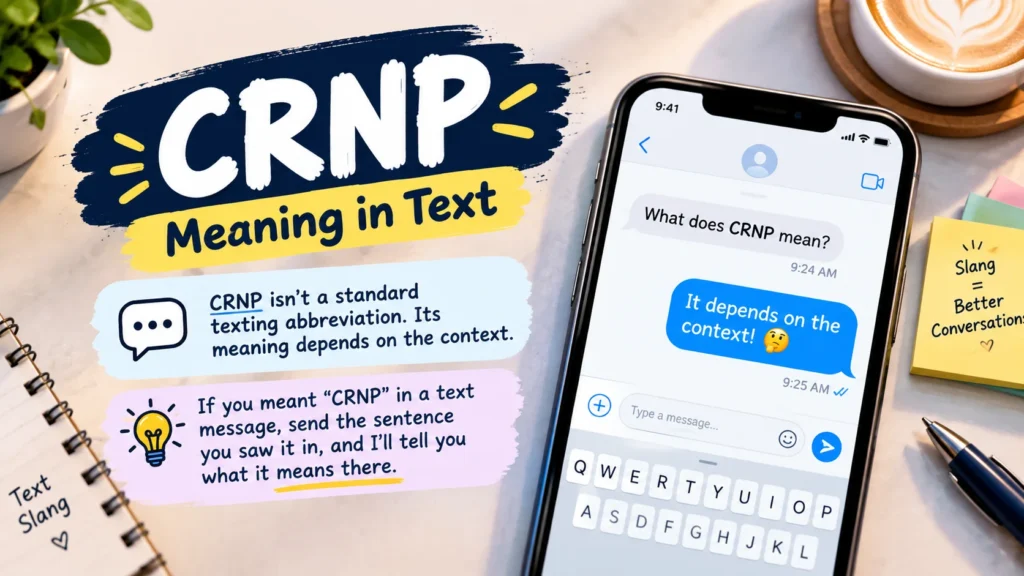
Unlike common texting abbreviations such as “LOL” or “BRB,” CRNP does not have one universal meaning. Its interpretation depends heavily on where you saw it and what the conversation is about.
In healthcare, CRNP commonly stands for “Certified Registered Nurse Practitioner.” It is a professional designation associated with advanced nursing practice.
Outside healthcare, the same letters can represent other phrases, organizations, programs, or specialized terms. That makes context particularly important when searching for the CRNP meaning.
This guide breaks down the most relevant meanings, explains how CRNP is used, provides realistic examples, and shows how to determine the intended meaning when you encounter it online.
CRNP Meaning – Quick Explanation
What does CRNP stand for?
In a healthcare setting, CRNP commonly refers to:
Certified Registered Nurse Practitioner
A CRNP is an advanced practice registered nurse who has additional education and clinical training beyond the level of a basic registered nurse.
Depending on the jurisdiction and professional licensing system, the exact title and credentialing requirements can differ.
Is CRNP a texting abbreviation?
Not usually.
CRNP is not one of the most established general-purpose texting slang terms. If someone sends “CRNP” in a casual conversation, you should not automatically assume it has one specific internet meaning.
The surrounding words are important.
For example:
“My appointment is with a CRNP tomorrow.”
This clearly points toward a healthcare professional.
Meanwhile:
“Does anyone know what CRNP means?”
could be asking about an abbreviation encountered somewhere else.
CRNP in Healthcare
The healthcare meaning is one of the most important uses of CRNP.
What is a Certified Registered Nurse Practitioner?
A nurse practitioner is an advanced practice nurse who has completed additional education and clinical preparation.
Depending on their qualifications, specialty, and local regulations, nurse practitioners may provide services such as:
- Taking patient histories
- Performing examinations
- Assessing health concerns
- Ordering or interpreting certain tests
- Developing treatment plans
- Providing health education
- Managing certain chronic conditions
- Prescribing medications where legally authorized
The exact scope of practice varies by location.
CRNP versus RN
An RN, or Registered Nurse, and a CRNP are not interchangeable titles.
Registered nurses provide essential nursing care and perform many important clinical responsibilities.
A nurse practitioner has additional advanced training and may have a broader scope of clinical practice, depending on local regulations.
The distinction is important because professional titles reflect different education, certification, licensing, and responsibilities.
Where might you see CRNP?
You may encounter CRNP on:
- Medical websites
- Healthcare provider profiles
- Clinic directories
- Appointment portals
- Medical records
- Business cards
- Professional biographies
- Insurance-related documents
- Hospital or clinic pages
For example:
“Sarah Williams, CRNP”
Here, CRNP is functioning as a professional designation after the person’s name.
Real-Life Examples of CRNP
Understanding context makes abbreviations much easier.
Example 1: Medical appointment
Person A:
Who are you seeing tomorrow?
Person B:
A CRNP at the clinic.
Here, CRNP clearly refers to a nurse practitioner.
Example 2: Healthcare profile
Profile:
James Miller, CRNP
Family Medicine
The abbreviation identifies the professional’s healthcare credential or title.
Example 3: Casual conversation
Person A:
Did you see the doctor?
Person B:
Not exactly. I saw a CRNP.
The speaker is distinguishing the nurse practitioner from a physician.
Example 4: Online search
Person A:
What does CRNP mean?
Person B:
I think it’s related to nursing.
The answer would depend on the source where the abbreviation appeared.
The Professional Meaning of CRNP
CRNP is particularly interesting because professional abbreviations often look like internet slang when they appear without explanation.
Why do healthcare professionals use abbreviations?
Healthcare communication contains many specialized terms.
Short professional designations make it easier to identify someone’s qualifications without repeatedly writing the full title.
For example:
“Jennifer Lee, CRNP”
is much shorter than writing the full professional designation every time.
Does every nurse practitioner use CRNP?
No.
Professional titles vary by country, state, licensing board, specialty, employer, and credentialing system.
Some nurse practitioners may use different credentials or abbreviations.
That means CRNP should not automatically be treated as the universal title for every nurse practitioner.
CRNP in Social Media and Online Profiles
Professional abbreviations increasingly appear on social media.
A healthcare professional might include:
“CRNP | Family Medicine | Health Education”
in a profile description.
In this context, CRNP is not slang. It identifies the person’s professional background.
LinkedIn and professional websites
You may also find CRNP next to someone’s name on professional networking sites or clinic websites.
For example:
“Emily Carter, CRNP”
The surrounding information usually makes the healthcare meaning obvious.
Instagram and TikTok
Healthcare professionals sometimes include their credentials in social media bios.
If you see CRNP alongside words such as:
- Nursing
- Healthcare
- Clinic
- Medicine
- Patient care
- Family practice
- Nurse practitioner
the medical interpretation is strongly supported by context.
Could CRNP Be Slang?
This is where things become confusing.
Unlike popular abbreviations such as “FR,” “IDK,” “TBH,” or “GTG,” CRNP does not have one widely recognized standard meaning in everyday English texting.
Someone could potentially create a personal abbreviation or use CRNP within a particular community.
That does not make it a universal slang definition.
Why context matters
Imagine receiving this message:
“I have to talk to my CRNP tomorrow.”
Healthcare is the obvious interpretation.
Now imagine seeing:
“CRNP 😂”
with no other information.
There is not enough context to confidently assign a standard slang meaning.
The safest approach is to check the surrounding conversation or ask the person what they mean.
CRNP Compared With Related Healthcare Abbreviations
| Abbreviation | Common Meaning | General Context |
|---|---|---|
| CRNP | Certified Registered Nurse Practitioner | Healthcare |
| RN | Registered Nurse | Nursing |
| NP | Nurse Practitioner | Healthcare |
| LPN | Licensed Practical Nurse | Nursing |
| LVN | Licensed Vocational Nurse | Nursing |
| CNA | Certified Nursing Assistant | Patient care |
| MD | Doctor of Medicine | Medicine |
| DO | Doctor of Osteopathic Medicine | Medicine |
| PA | Physician Assistant/Associate | Healthcare |
| APRN | Advanced Practice Registered Nurse | Advanced nursing |
Key Insight
CRNP belongs to a larger family of healthcare abbreviations. The exact credential represented by an abbreviation can depend on the professional and jurisdiction, so readers should check the source when accuracy matters.
Common Variations and Related Forms
1. CRNP
This is the abbreviation itself.
It is most strongly associated with a nurse practitioner credential in healthcare contexts.
2. Certified Registered Nurse Practitioner
This is the expanded form commonly associated with CRNP.
It provides the full meaning instead of using the abbreviation.
3. NP
NP stands for Nurse Practitioner.
It is a broader abbreviation and may be used across different healthcare systems.
4. APRN
APRN means Advanced Practice Registered Nurse.
It refers to a broader professional category that can include different advanced nursing roles.
5. RN
RN means Registered Nurse.
It represents a different nursing qualification from an advanced practice role.
6. Family Nurse Practitioner
A family nurse practitioner may provide healthcare across different age groups, depending on training and practice setting.
7. Primary Care Provider
A nurse practitioner may work as a primary care provider where their scope and local rules allow.
8. Advanced Practice Nurse
This is a broader description for nurses with advanced clinical preparation.
9. Nurse Practitioner
This is the plain-language term most people recognize.
10. Healthcare Provider
Depending on the context, a CRNP may be described generally as a healthcare provider.
The exact professional role should still be confirmed rather than assumed.
How to Tell Which CRNP Meaning Is Intended
When you encounter an unfamiliar acronym, look at the words surrounding it.
Look for healthcare words
If CRNP appears near:
- Appointment
- Clinic
- Patient
- Nurse
- Medical
- Prescription
- Healthcare
- Family practice
- Provider
the healthcare meaning is likely.
Check where you saw it
A hospital website and a TikTok comment are very different contexts.
A professional credential is much more likely on a medical profile than in a casual meme.
Look at capitalization
CRNP is usually written in uppercase when used as a professional abbreviation.
However, capitalization alone cannot determine meaning.
Ask for clarification
If someone sends:
“I talked to a CRNP today.”
and you’re unsure what they mean, a simple response works:
“What does CRNP stand for?”
There is nothing wrong with asking.
Common Misunderstandings About CRNP
CRNP does not simply mean “doctor”
A nurse practitioner and a physician are different professional roles.
Both can provide healthcare services, but their education, professional credentials, and scopes of practice are not identical.
CRNP is not always slang
People sometimes assume every short abbreviation they encounter online is internet slang.
CRNP is a good example of why that assumption can cause confusion.
CRNP and NP are related but not identical abbreviations
NP generally means Nurse Practitioner.
CRNP is a more specific professional designation used in certain healthcare contexts.
The title can vary by location
Healthcare licensing terminology is not identical everywhere.
A credential used in one jurisdiction may not be the standard designation in another.
How People Use CRNP in Professional Conversations
Patient conversation
“The CRNP reviewed my test results.”
The abbreviation identifies the healthcare professional.
Clinic communication
“Your appointment is scheduled with a CRNP.”
The message is using CRNP as a professional role.
Professional introduction
“I’m a CRNP specializing in family medicine.”
The person is describing their professional credentials and specialty.
Online biography
“CRNP | Primary Care | Patient Education”
This is a typical professional-profile format.
Regional and Cultural Usage
Professional abbreviations can differ considerably between countries and healthcare systems.
United States
CRNP is encountered in U.S. healthcare contexts, particularly in areas where the credential is used by nurse practitioners.
The exact terminology can vary by state and professional licensing framework.
United Kingdom
The professional terminology used in the UK healthcare system differs from many U.S. credentialing conventions.
A reader should not assume that CRNP has exactly the same professional status or usage there.
Canada
Canadian healthcare terminology also has its own regulatory framework.
A nurse practitioner may commonly be identified as an NP, while specific credential abbreviations can vary.
Asia
English healthcare abbreviations may appear in international hospitals, professional profiles, educational materials, and online discussions.
The meaning should still be checked against the specific healthcare system.
Global internet usage
On the internet, professional terminology travels across borders.
Someone may encounter CRNP on a U.S.-based medical website even if they live somewhere else.
That can explain why an abbreviation appears unfamiliar.
Is CRNP Safe for Kids?
The abbreviation itself is not inherently inappropriate.
If a child sees CRNP on a medical website, clinic profile, or appointment document, it is simply a professional abbreviation.
The main challenge is understanding what the letters represent.
For younger readers, explaining it as a professional title used by certain nurse practitioners is usually enough.
As with any healthcare terminology, specific professional roles should be explained accurately rather than reduced to a vague label.
FAQs About CRNP Meaning
What does CRNP stand for?
CRNP commonly stands for Certified Registered Nurse Practitioner in healthcare contexts.
Is CRNP a doctor?
No. CRNP refers to a nurse practitioner credential or designation, not a physician degree. Nurse practitioners and physicians are different healthcare professions.
What is the difference between CRNP and RN?
RN means Registered Nurse, while CRNP commonly identifies a nurse practitioner with additional advanced education and clinical preparation.
Is CRNP the same as NP?
They are closely related terms, but CRNP is a more specific designation. NP simply stands for Nurse Practitioner.
What does CRNP mean after someone’s name?
When CRNP appears after a person’s name, it generally indicates a professional healthcare credential or designation.
Is CRNP used in texting?
CRNP is not a widely standardized everyday texting abbreviation. If you see it in a casual chat, the meaning depends on the conversation.
Can CRNP have other meanings?
Yes. Acronyms can represent different terms in different industries and organizations. Context is necessary to identify the intended meaning accurately.
Conclusion: Understanding CRNP Depends on Context
The most important CRNP meaning is its use as a healthcare-related professional designation, commonly expanded as Certified Registered Nurse Practitioner.
Unlike everyday texting abbreviations, CRNP is not universally recognized as a slang term. Its meaning can change depending on where it appears.
If you see CRNP next to a healthcare professional’s name, on a clinic website, or in an appointment message, the nursing-related meaning is usually the relevant one.
If it appears in an unexplained social media message, however, avoid guessing. Look at the surrounding words or ask the sender.
That small habit can prevent a lot of confusion with abbreviations.