
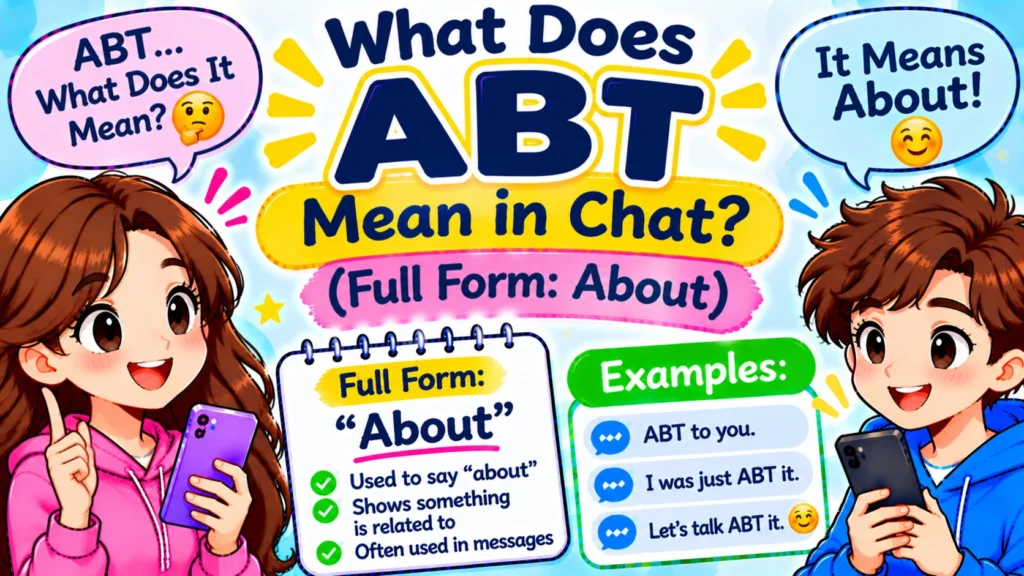
Have you ever received a message like “What abt tomorrow?” and wondered what those three letters actually mean? Online conversations are full of shortened words, and understanding them can make texting much easier.
ABT usually stands for “About” in chat and text messages. It is an informal abbreviation people use to save time while typing on WhatsApp, Instagram, Snapchat, TikTok, and other messaging platforms.
You might see it when someone asks about your plans, discusses a particular topic, or wants to know more about something. Although the abbreviation looks simple, its meaning becomes clearer when you see how it works in everyday sentences.
In this guide, you’ll learn its common meaning, real-life examples, different uses, possible misunderstandings, and natural ways to respond.
2. What Is the ABT Full Form in Chat?
The most common full form of ABT is “About.”
It is a shortened spelling used in informal digital communication. Instead of typing the complete word, people remove a few letters and use ABT to make their messages quicker.
For example:
- “What abt you?” means “What about you?”
- “Tell me abt your trip” means “Tell me about your trip.”
- “We need to talk abt this” means “We need to talk about this.”
Simple meanings of ABT include:
- About a person or topic.
- Asking for someone’s opinion.
- Discussing plans or arrangements.
- Introducing additional information.
- Asking someone to explain something.
ABT is not a separate formal English word. It is simply an informal text abbreviation.
3. How Did ABT Become Popular in Online Communication?
The Influence of Text Messaging
Shortened words became popular when mobile phones had limited keyboards and traditional text messages encouraged people to use fewer characters.
People began writing shorter versions of everyday words to make communication faster. Expressions such as ABT, BTW, THX, and MSG became familiar in informal messages.
Even though modern smartphones make typing easier, these habits remain part of digital language.
Social Media and Messaging Apps
Messaging platforms have made abbreviated language a normal part of everyday communication.
On WhatsApp, friends might write “What abt dinner?” instead of typing the complete sentence. Instagram users may also use ABT in comments or direct messages.
The abbreviation is especially convenient when people are exchanging quick updates.
How Its Use Has Changed
ABT is no longer limited to traditional SMS messages. It appears in casual online conversations, social media discussions, gaming chats, and personal messages.
However, it is still an informal spelling. In professional writing and formal documents, using the complete word “about” is generally more appropriate.
Read More : What Does Presh Mean? Meaning, Slang & Examples
4. ABT in Real-Life Conversations
Understanding an abbreviation becomes easier when you see how people use it naturally. These examples show different situations where ABT can appear.
Example 1: WhatsApp Conversation
Person A: Are you coming to the birthday party?
and,
Person B: Yes, but what abt the timing?
moreover,
Person A: It starts at 7 PM.
Here, ABT replaces “about” while asking for additional information.
Example 2: Instagram Direct Messages
Person A: I saw your vacation pictures. They look amazing!
Person B: Thank you! Want to know more abt the place?
Person A: Definitely. It looks beautiful.
The abbreviation makes the conversation feel casual and friendly.
Example 3: TikTok Comments
Person A: Everyone is talking about this new trend.
and,
Person B: What abt the original creator?
moreover,
Person A: Good point. They deserve credit too.
In this example, ABT introduces a question about another part of the discussion.
Example 4: Text Messages Between Friends
Person A: I think we should watch a movie tonight.
Person B: Sounds good. What abt dinner first?
Person A: Perfect! Let’s get something to eat.
The abbreviation helps keep a quick conversation moving.
5. What Does ABT Communicate Emotionally?
Although ABT simply means “about,” its purpose can change depending on the sentence.
It does not usually express a particular emotion on its own. Instead, it helps people ask questions, continue discussions, and show interest.
Curiosity: Someone might write, “Tell me abt your new job,” because they want to hear more about your experience.
Interest: A message such as “What abt your weekend?” can show that someone wants to include you in a conversation.
Concern: “What abt your health now?” may communicate genuine interest in someone’s well-being.
Planning: “What abt meeting tomorrow?” suggests that the sender is discussing possible arrangements.
A small everyday scenario
Imagine your friend tells you that they are moving to another city. You might reply, “What abt your studies?” This short question shows that you are thinking about how the move could affect another part of their life.
The emotional meaning comes from the complete message, not the abbreviation itself.
6. Where Is ABT Commonly Used?
Social Media
ABT can appear in Instagram comments, TikTok discussions, Snapchat messages, and Facebook conversations.
Examples:
- “What abt the second picture?”
- “Tell us abt your experience.”
- “What abt the next episode?”
Friends and Relationships
Friends often use ABT when discussing personal experiences, plans, and everyday activities.
Example: “What abt going out this weekend?”
In relationships, it can also introduce questions about feelings or shared decisions.
Work and Professional Communication
ABT may appear in informal workplace chats between colleagues who already use casual language.
Example: “Can we talk abt the project tomorrow?”
For formal emails, reports, and business documents, writing “about” is more professional and easier to understand.
Casual Versus Serious Conversations
The abbreviation is most suitable for relaxed conversations. In serious discussions, using complete words can make your message clearer and more respectful.
7. When Should You Avoid Using ABT?
ABT is useful in casual texting, but it is not suitable for every situation.
Formal emails: Use “about” when writing to clients, managers, teachers, or professional contacts.
Academic assignments: Avoid informal abbreviations in essays, research papers, and examinations unless the task specifically involves digital language.
Official documents: Contracts, reports, applications, and business proposals should use standard spelling.
Sensitive conversations: If you are discussing an emotional or serious issue, complete sentences may help communicate your intentions more clearly.
Messages to unfamiliar people: Someone who does not regularly use texting abbreviations may not immediately recognize ABT.
The easiest rule is to match your language to the person receiving your message.
8. Common Misunderstandings About ABT
Even simple abbreviations can create confusion when people encounter them in different settings.
Here are some common misunderstandings:
- Thinking ABT has only one possible meaning: “About” is its common texting meaning, but the abbreviation may represent different phrases in specialized contexts.
- Assuming it is a formal English word: ABT is informal shorthand, not the standard spelling.
- Confusing it with BTW: ABT means “about,” whereas BTW means “by the way.”
- Thinking it expresses a particular emotion: The abbreviation itself does not automatically show excitement, anger, or affection.
- Believing it is always appropriate: It works in casual messages but may look unprofessional in formal writing.
Always consider the complete sentence before deciding what an abbreviation means.
9. ABT vs. Similar Texting Abbreviations
Several abbreviations appear in similar conversations. Knowing their differences can help you understand messages more accurately.
| Abbreviation | Full Form | Main Use |
|---|---|---|
| ABT | About | Refers to a topic or subject |
| BTW | By The Way | Introduces an additional point |
| FYI | For Your Information | Shares useful information |
| WBU | What About You? | Asks about another person |
| HBU | How About You? | Asks for someone’s opinion or situation |
| TBH | To Be Honest | Introduces an honest opinion |
| IMO | In My Opinion | Shares a personal viewpoint |
| IDK | I Don’t Know | Expresses uncertainty |
| TTYL | Talk To You Later | Ends a conversation |
| ASAP | As Soon As Possible | Indicates urgency |
Key Insight
ABT is a shortened version of an ordinary English word, while most of the other expressions represent complete phrases. For example, “What abt you?” is a shorter way to write “What about you?” Understanding this distinction makes texting language easier to follow.
10. Popular Variations and Related Expressions
ABT often appears in different sentence patterns. Here are ten useful expressions that demonstrate how people use it.
1. What Abt You?
A casual way of asking another person about their situation, opinion, or experience.
2. How Abt That?
An informal way of asking for someone’s reaction to an idea or suggestion.
3. Tell Me Abt It
Used to encourage someone to explain something or share an experience.
4. Think Abt It
A shortened way of asking someone to consider an idea carefully.
5. Talk Abt It
Used when suggesting that people discuss a particular subject.
6. Worry Abt It
A casual phrase referring to concern about a situation.
7. What Abt Tomorrow?
Used when discussing plans or asking whether someone is available the following day.
8. More Abt This
A request for additional information about a subject.
9. Nothing Abt That
An informal sentence fragment that can refer to the absence of information about a particular subject.
10. Forgot Abt It
A casual shortened expression meaning that someone no longer remembers or is no longer considering something.
These examples show that ABT generally replaces the word “about” without changing the basic meaning of the sentence.
11. How to Respond When Someone Uses ABT
Your response depends on what the sender is asking. Since ABT usually appears as part of a larger sentence, read the complete message before replying.
Casual replies
- “Nothing much, what about you?”
- “Sounds good to me.”
- “Yeah, let’s do that.”
- “I’ll tell you later.”
Funny replies
- “That’s a whole different story!”
- “Where do I even begin?”
- “You really want all the details?”
- “That’s classified information!”
Mature replies
- “Let me explain it properly.”
- “I think we should discuss that.”
- “That’s an interesting point.”
- “I’ll give it some thought.”
Respectful replies
- “Thanks for asking.”
- “I’d be happy to explain.”
- “I appreciate your interest.”
- “Let me share the details with you.”
A natural response is usually more effective than trying to use another abbreviation in every message.
12. Regional and Cultural Usage of ABT
Western Culture
In the United States, Canada, and the United Kingdom, ABT may appear in informal texting and online conversations. The complete word “about” remains standard in formal English.
Asian Culture
People in many Asian countries use English abbreviations alongside their local languages. ABT may appear in conversations between friends, students, and English-speaking online communities.
Middle Eastern Culture
English texting shorthand is also used in multilingual conversations across the Middle East. ABT can be understood by people familiar with informal English, although usage differs between communities.
Global Internet Usage
International messaging has helped abbreviations travel across languages and cultures. However, not every user understands every shortened expression, particularly less common ones.
Gen Z vs. Millennials
Gen Z users often encounter abbreviations through social media, online gaming, and group chats. Millennials may also use them in everyday messages, especially when communicating quickly.
Neither generation has exclusive ownership of this expression. Individual habits matter more than age alone.
13. Is ABT Safe for Kids?
Yes. ABT is generally a harmless texting abbreviation because its common meaning is simply “about.”
Children may encounter it in school group chats, online games, social media comments, or messages from friends.
Parents can explain that shortened words are common in digital communication, but children should still learn standard spelling and grammar for schoolwork.
It is also helpful to encourage children to ask questions whenever an unfamiliar abbreviation appears. Understanding the complete message is more important than memorizing every internet expression.
14. FAQs About ABT Full Form in Chat
What is the full form of ABT in chat?
ABT usually stands for “About” in texting. It is an informal abbreviation used in messages and online conversations.
What does ABT mean on WhatsApp?
On WhatsApp, ABT generally means “about.” For example, “What abt tomorrow?” means “What about tomorrow?”
What does ABT mean on Instagram?
On Instagram, ABT usually means “about.” People may use it in comments, captions, and direct messages to discuss a topic or ask a question.
Is ABT the same as BTW?
No. ABT means “about,” while BTW stands for “by the way.” Both are common in casual texting but have different purposes.
Is ABT formal or informal?
ABT is informal shorthand. It is suitable for casual messages but should generally be replaced with “about” in professional writing.
What does “What abt you?” mean?
It means “What about you?” Someone uses it to ask about your opinion, plans, feelings, or situation.
Can I use ABT in professional messages?
It is best to write the complete word “about” in formal business communication. ABT may be acceptable in relaxed workplace chats if everyone understands it.
Conclusion
ABT is a common informal abbreviation that usually stands for “About.” People use it in text messages, social media conversations, and online chats to communicate quickly.
Whether someone writes “What abt you?” or “Tell me abt your plans,” the meaning is generally easy to understand once you recognize the shortened word.
Although it is convenient in everyday messaging, remember that ABT is not suitable for every writing situation. Use it with friends and people who understand texting shorthand, but choose the complete word in professional or academic communication.
Knowing small expressions like this can make online conversations smoother and help you feel more confident when communicating in English.



1 thought on “ABT Full Form in Chat: Meaning and Text Examples”