
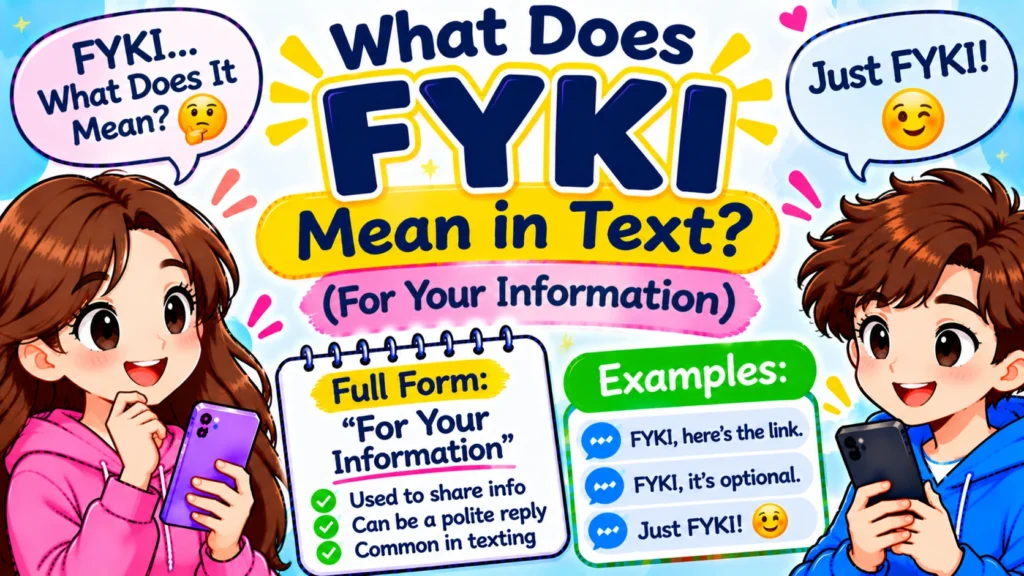
Have you ever received a message containing FYKI and wondered whether it was a casual expression, a warning, or simply another internet abbreviation? Short forms appear everywhere these days, from WhatsApp conversations to Instagram comments and workplace emails. Some are easy to understand, while others leave people guessing.
FYKI is one of those abbreviations that can be confusing at first. It is generally used to introduce information that someone believes another person should know. However, its exact meaning can depend on the conversation and the person using it.
Understanding this expression can help you follow online discussions without misunderstanding someone’s intention. It can also make your own messages clearer when you want to share useful information quickly.
2. What Does FYKI Mean in Text?
FYKI commonly stands for “For Your Knowledge.” It is an informal abbreviation used when someone wants to share information, explain a detail, or make another person aware of something.
It is similar to expressions such as “just so you know” or “for your information.”
For example:
- “FYKI, the meeting starts at 10 tomorrow.”
- “FYKI, she already submitted the assignment.”
- “FYKI, the shop closes earlier on Sundays.”
In these examples, the sender is providing information rather than necessarily asking a question.
Is FYKI the same as FYI?
Not exactly. FYI is the widely recognized abbreviation for “For Your Information.” FYKI is sometimes used to mean “For Your Knowledge,” but it is less standardized and may be unfamiliar to some readers.
The safest approach is to understand it through the surrounding sentence.
3. Where Did FYKI Come From?
The Growth of Shortened Digital Language
FYKI developed within the broader habit of shortening everyday expressions for digital communication. People regularly use abbreviations to save time, reduce typing, and make messages easier to scan.
Expressions such as FYI, BTW, IMO, and TBH became familiar across online communities. Less common variations also appeared as people adapted existing abbreviations to express slightly different ideas.
How Social Media Helped It Spread
Messaging platforms encourage quick communication. A person might send a short update in a group chat rather than write a complete explanation.
Social media comments also make abbreviations attractive because users often prefer brief responses. As a result, expressions like FYKI may appear in conversations even when their meanings are not universally understood.
Unlike FYI, however, FYKI is not a universally established internet abbreviation. Its use can vary between communities, workplaces, and individual friend groups.
Read More : NW Full Form in Chat: What Does NW Mean in Text?
4. FYKI in Real-Life Conversations
The easiest way to understand an abbreviation is to see how people use it naturally. Here are four realistic examples.
Example 1: WhatsApp Group Chat
Person A: Are we meeting at the usual place tomorrow?
Person B: Yes, but FYKI, the time has changed to 4 PM.
Person A: Thanks for letting everyone know!
Here, FYKI introduces an important update.
Example 2: Instagram Direct Message
Person A: I thought the new collection was launching next week.
Person B: FYKI, the brand announced it for Friday.
Person A: Oh, I missed that post.
The abbreviation introduces information that corrects someone’s understanding.
Example 3: TikTok Comments
Person A: This song was released just last year, right?
Person B: FYKI, it’s actually much older.
Person A: Seriously? I didn’t know that!
In this situation, the sender uses the expression to share a correction.
Example 4: Text Message Between Friends
Person A: I might visit the library after lunch.
Person B: FYKI, it closes at 2 PM today.
Person A: Good thing you told me!
The message is helpful because it gives the other person information they may need.
5. Emotional and Psychological Meaning Behind FYKI
Although FYKI looks like a simple abbreviation, the way someone uses it can communicate different attitudes.
It may express helpfulness, confidence, concern, or even mild frustration. The emotional meaning depends more on the surrounding words than on the abbreviation itself.
When someone wants to be helpful
A friend might use FYKI to prevent you from missing an important update. In this case, the expression feels thoughtful and practical.
When someone wants to correct information
Someone may use it before explaining that a detail is incorrect. The message can sound informative, although the wording may feel slightly direct.
When someone wants to emphasize a point
FYKI can also introduce information the sender considers important. If the message is written sharply, the reader might interpret it as criticism.
A small everyday scenario
Imagine that your teammate forgets to bring an important document. You send, “FYKI, the manager needs the printed copy today.” Your intention may simply be to help, not to blame.
This is why context and tone matter so much in short digital messages.
6. Different Situations Where FYKI Can Be Used
Social Media
People may use FYKI in comments, captions, or direct messages to share corrections, updates, and interesting details.
Example: “FYKI, the original video is on the creator’s profile.”
Friends and Relationships
Among friends, it can introduce useful information without requiring a long explanation.
Example: “FYKI, your favorite restaurant is offering a discount today.”
Work and Professional Communication
FYKI may appear in informal team chats when colleagues exchange updates. However, it is better to use the complete expression in formal business communication.
Example: “FYKI, the client has requested a revised version.”
Casual Versus Serious Conversations
In casual conversations, FYKI can feel natural when everyone understands the abbreviation. In serious discussions, spelling out the message usually prevents confusion.
7. When Should You Avoid Using FYKI?
Not every conversation benefits from abbreviations. Sometimes, a short expression can make a message sound less considerate than intended.
Formal emails: Avoid unfamiliar abbreviations when communicating with clients, managers, or people outside your organization.
Sensitive conversations: If someone is discussing a personal problem, using FYKI may sound cold or dismissive.
Important instructions: Write the complete phrase when accuracy matters, especially when explaining deadlines, responsibilities, or safety information.
International communication: Not everyone recognizes less common English abbreviations. Clear wording helps people from different language backgrounds understand your message.
A useful rule is simple: if the abbreviation might confuse the reader, write the complete sentence.
8. Common Misunderstandings About FYKI
Several misunderstandings can happen when people encounter this abbreviation.
- Thinking it is another spelling of FYI: FYKI is generally expanded as “For Your Knowledge,” while FYI means “For Your Information.”
- Assuming everyone knows it: FYKI is less familiar than many established texting abbreviations.
- Interpreting it as rude: The abbreviation is not automatically disrespectful. The complete message determines the tone.
- Assuming it always introduces a correction: It can also introduce a helpful update or a general piece of information.
- Treating every online abbreviation as universal: Different groups sometimes create their own shorthand.
The best way to understand FYKI is to read the complete message instead of relying on the letters alone.
9. FYKI vs. FYI and Other Similar Abbreviations
Some texting expressions have similar purposes, but their meanings are not identical.
| Abbreviation | Full Form | Main Purpose |
|---|---|---|
| FYKI | For Your Knowledge | Shares information |
| FYI | For Your Information | Provides an update |
| BTW | By The Way | Introduces an additional point |
| FWIW | For What It’s Worth | Shares an opinion or perspective |
| TBH | To Be Honest | Introduces an honest opinion |
| IMO | In My Opinion | Expresses a personal viewpoint |
| JSYK | Just So You Know | Shares information or a reminder |
| PSA | Public Service Announcement | Shares a public notice |
| IDK | I Don’t Know | Expresses uncertainty |
| TMI | Too Much Information | Describes excessive personal detail |
Key Insight
FYKI and FYI are close in meaning, but FYI is much more widely recognized. If you want your message to be understood by almost everyone, FYI or the complete phrase “just so you know” is usually the better choice.
10. Popular Variations and Related Expressions
People use several abbreviations to introduce information, share opinions, or provide updates. Here are ten useful expressions to recognize.
1. FYI – For Your Information
A common abbreviation used to share an update or important detail.
2. FYKI – For Your Knowledge
An informal way of introducing information someone may find useful.
3. JSYK – Just So You Know
Used when someone wants to make another person aware of something.
4. BTW – By The Way
Introduces an additional thought that may or may not be directly related to the main discussion.
5. FWIW – For What It’s Worth
Often used before sharing an opinion, suggestion, or personal perspective.
6. PSA – Public Service Announcement
Introduces information intended to help or inform a wider group.
7. ICYMI – In Case You Missed It
Used to share something that another person may not have seen earlier.
8. TBF – To Be Fair
Introduces a balanced point or another side of an argument.
9. IMO – In My Opinion
Signals that the following statement represents a personal view.
10. TBH – To Be Honest
Often used before an honest thought, feeling, or personal reaction.
11. How to Respond When Someone Says FYKI
Your response should depend on the information being shared and your relationship with the sender.
Casual replies
- “Thanks for the update!”
- “Good to know.”
- “Got it, thanks!”
- “I didn’t know that.”
Funny replies
- “Knowledge received!”
- “My brain has officially updated.”
- “Thanks for the information department!”
- “Another fact added to my collection.”
Mature replies
- “I appreciate you letting me know.”
- “Thanks for clarifying that.”
- “That’s useful information.”
- “I’ll keep that in mind.”
Respectful replies
- “Thank you for sharing this with me.”
- “I appreciate the heads-up.”
- “Thanks for bringing it to my attention.”
- “Understood. I’ll take note of it.”
You do not need to use another abbreviation in response. A clear, natural sentence is often the best choice.
12. Regional, Cultural, and Generational Usage
Western Culture
In the United States, Canada, and the United Kingdom, FYI is widely recognized in everyday and professional communication. FYKI may be understood by some people, but it is less established.
Asian Culture
In many Asian online communities, English abbreviations are mixed with local languages. People may understand common expressions such as FYI without being familiar with FYKI.
Middle Eastern Culture
English abbreviations are frequently used in multilingual digital conversations, particularly among people who communicate in English for study or work. However, familiarity varies between age groups and communities.
Global Internet Usage
Social media allows abbreviations to cross national boundaries. Still, a phrase that feels normal in one online community may be confusing elsewhere.
Gen Z vs. Millennials
Gen Z users often encounter new expressions through short-form videos, comments, and messaging apps. Millennials may be more familiar with workplace abbreviations such as FYI and FWIW.
These are broad tendencies, not fixed rules. Individual communication habits differ considerably.
13. Is FYKI Safe for Kids?
Yes. FYKI is generally a harmless information-sharing abbreviation. Its common expansion, “For Your Knowledge,” does not contain offensive or adult language.
Children may encounter it in online games, group chats, school discussions, or social media comments.
Parents can explain that abbreviations are simply shortened expressions and that not every online message is easy to understand. Children should also learn to ask for clarification rather than guessing when a message seems confusing.
The important lesson is to consider the full conversation, not just a few letters.
14. FAQs About FYKI Meaning in Text
What does FYKI stand for in texting?
FYKI commonly stands for “For Your Knowledge.” It is used to introduce information, updates, or details that someone thinks another person should know.
Is FYKI the same as FYI?
They have similar purposes, but their expansions differ. FYKI means “For Your Knowledge,” while FYI means “For Your Information.” FYI is much more widely recognized.
Is FYKI a rude abbreviation?
No, FYKI is not inherently rude. However, it may sound direct or slightly corrective depending on the sentence and the relationship between the people communicating.
Can I use FYKI in a professional message?
You can use it in an informal team conversation if everyone understands it. For formal emails, writing “For your information” is clearer and more professional.
What is the difference between FYKI and JSYK?
FYKI generally means “For Your Knowledge,” while JSYK means “Just So You Know.” Both introduce information, but JSYK is a more conversational expression.
Is FYKI commonly used on Instagram and WhatsApp?
It may appear in Instagram messages, WhatsApp chats, and other online conversations. However, it is less common and less standardized than FYI.
What should I reply when someone sends FYKI?
You can reply with “Thanks for letting me know,” “Good to know,” or “I appreciate the update.” Choose a response that matches the conversation.
Conclusion
FYKI is generally used to mean “For Your Knowledge.” It introduces information that someone believes may be useful, relevant, or important to another person.
Although it serves a purpose similar to FYI, it is less widely recognized. That difference matters when communicating with people who may not be familiar with informal internet language.
The best approach is to use abbreviations naturally without sacrificing clarity. If your audience understands FYKI, it can fit comfortably into a casual message. When the conversation is formal or the meaning could be unclear, the complete phrase is a better choice.
Good communication is not about using the shortest possible words. It is about making sure the other person understands what you mean.


1 thought on “FYKI Meaning in Text: Full Form and Examples”