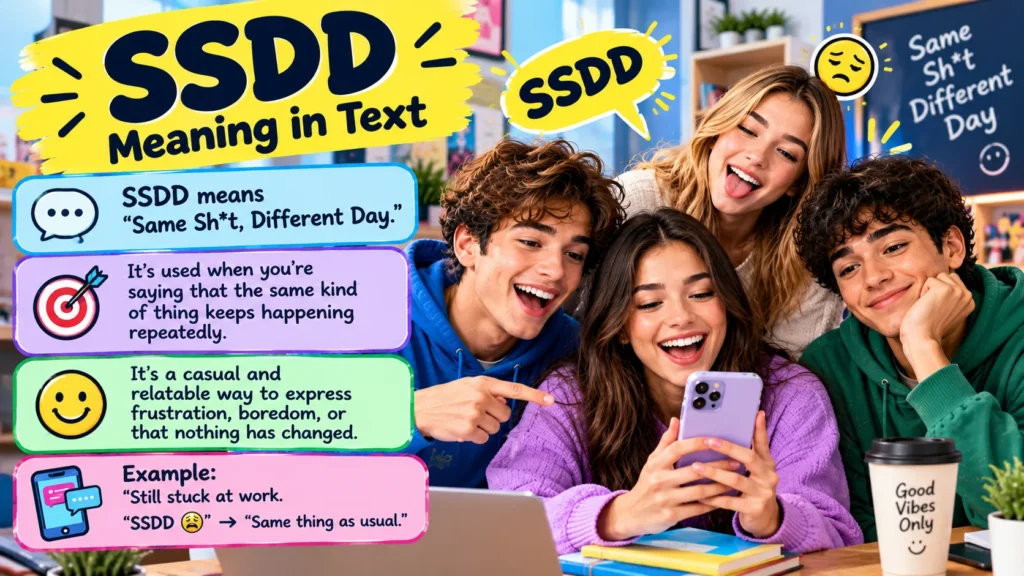
If someone sends you “SSDD” in a text, Snapchat message, Instagram DM, or group chat, it can look confusing at first. Is it an acronym, a reaction, or simply internet slang?
In everyday online communication, SSDD usually means “Same Stuff, Different Day.” It describes a situation where life feels repetitive, predictable, or unchanged.
For example, someone might ask:
“How’s work going?”
You could answer:
“SSDD 😩”
The message basically means, “Nothing new. It’s the same situation as always.”
You may also see SSDD written as “Same Sh*t, Different Day,” which carries a stronger and more frustrated tone. The exact interpretation depends on the conversation, the people involved, and whether the language is casual.
This guide explains the SSDD meaning in text, where it appears, how people use it, what emotions it can express, and how to respond naturally.
SSDD Meaning – Quick Explanation
What does SSDD stand for?
In texting and social media, SSDD commonly stands for:
“Same Stuff, Different Day.”
It is used when someone wants to say that nothing significant has changed.
The phrase can describe:
- The same daily routine
- Repeated problems
- A boring workday
- Familiar relationship drama
- Ongoing responsibilities
- A predictable situation
- The feeling that every day is similar
For example:
“How was your Monday?”
“SSDD. Meetings all day.”
Here, the person is not necessarily saying that Monday was terrible. They are simply saying that it felt like another ordinary day.
The stronger version of SSDD
Some people interpret the acronym as:
“Same Sh*t, Different Day.”
This version is more blunt and mildly vulgar. It usually expresses stronger annoyance, boredom, or frustration.
The cleaner version, “Same Stuff, Different Day,” is safer when speaking with people you do not know well.
Simple examples
“How’s college?”
“SSDD 😂 Same assignments, same stress.”
Another example:
“Anything exciting happening?”
“Not really. SSDD.”
The phrase is usually about repetition rather than a specific event.
Where Did SSDD Come From?
SSDD belongs to a broader family of expressions that describe repetitive everyday life.
The underlying idea is simple: the date changes, but the circumstances do not.
People have used similar phrases for years in spoken English, workplace conversations, entertainment, online communities, and popular culture. The acronym became especially convenient as texting and digital communication made abbreviated language common.
SSDD and internet culture
Online communication rewards short expressions.
Instead of typing:
“Nothing much has changed. I am dealing with basically the same things again.”
Someone can simply type:
“SSDD.”
That efficiency makes acronyms attractive in chats and comments.
The expression also fits internet humor because people often use it alongside emojis, reaction images, memes, and sarcastic captions.
Has social media changed its meaning?
Social media has made SSDD more flexible.
A person might use it seriously:
“Another deadline. SSDD.”
Someone else might use it humorously:
“Coffee, emails, meetings, repeat. SSDD ☕😂”
The basic meaning remains the same, but the emotional tone can range from neutral to sarcastic.
SSDD in Real-Life Conversations
Understanding an acronym becomes easier when you see it in realistic situations.
WhatsApp conversation
Person A:
How’s everything going?
Person B:
SSDD honestly 😭 Work, traffic, sleep, repeat.
and,
Person A:
At least Friday is coming.
Person B:
That’s the only thing keeping me alive 😂
Here, SSDD expresses tiredness and repetition rather than serious anger.
Instagram DM
Person A:
You disappeared. Everything okay?
Person B:
Yeah, just SSDD.
and,
Person A:
Same routine?
Person B:
Exactly. Nothing interesting lately.
In this conversation, SSDD is a quick way of saying that life has been ordinary.
TikTok comments
Person A:
Another Monday morning 😭
Person B:
SSDD 💀
The comment uses SSDD humorously to connect with people who dislike the repetitive Monday routine.
Text message
Person A:
How was your shift?
Person B:
SSDD. Busy customers, broken printer, same drama.
Person A:
So basically nothing changed?
Person B:
Nothing 😂
The acronym summarizes an entire situation without requiring a long explanation.
The Emotional and Psychological Meaning of SSDD
SSDD is more than four letters. The way someone uses it can reveal how they feel about their circumstances.
Boredom
Sometimes SSDD simply means:
“My life feels repetitive.”
A person may have the same schedule every day and use the acronym as a casual complaint.
Frustration
When someone has been dealing with the same problem repeatedly, SSDD can communicate irritation.
For example:
“Still arguing with customer support. SSDD.”
The phrase suggests that the situation has not improved.
Resignation
SSDD can also sound emotionally tired.
Someone may not be angry anymore. They may simply accept that the same situation keeps happening.
“Another delayed train. SSDD.”
The tone can feel almost like a shrug.
Humor
The acronym is frequently used as self-deprecating humor.
A person might post:
“Wake up. Work. Eat. Sleep. SSDD.”
The goal may not be to complain seriously. It can simply make an ordinary routine sound funny.
A small real-life scenario
Imagine someone who spends every weekday rushing between work, commuting, answering messages, and completing household responsibilities.
A friend asks, “What’s new?”
Instead of explaining everything, they reply:
“SSDD.”
That tiny response communicates a surprisingly large emotional idea: life is moving, but it doesn’t feel like anything is really changing.
How SSDD Is Used in Different Contexts
On social media
SSDD can work well in captions, comments, and replies.
Someone might upload a picture of their morning coffee with:
“Another day, SSDD ☕”
The phrase gives an ordinary post a slightly humorous or relatable tone.
Between friends
Friends often use SSDD when discussing school, college, work, relationships, or daily routines.
Because the acronym is casual, it usually feels natural among people who already understand each other’s communication style.
In relationships
A person might say:
“How’s everything with your family?”
“SSDD. Same arguments.”
Here, the phrase can hint at emotional exhaustion.
Context matters because SSDD may sound playful in one conversation and genuinely unhappy in another.
At work
SSDD can appear in informal workplace chats, particularly between coworkers who already have a relaxed relationship.
For example:
“How’s the project going?”
“SSDD. Still waiting for approval.”
It would generally be less suitable for formal emails or communication with clients.
Casual versus serious use
SSDD is inherently informal.
It works naturally in:
- Text messages
- Group chats
- Social media comments
- DMs
- Informal conversations
It is less appropriate in:
- Formal business emails
- Academic assignments
- Official reports
- Professional presentations
- Formal customer communication
The meaning may be understood, but the style could seem too casual.
When Should You NOT Use SSDD?
Knowing slang also means knowing when to avoid it.
In formal communication
If your manager asks for a professional project update, responding with:
“SSDD”
may appear dismissive.
A clearer response would be:
“There have been no major changes since the last update.”
The second version communicates the same general idea in a professional way.
With people unfamiliar with slang
Not everyone knows internet acronyms.
If you’re speaking with someone who may not recognize SSDD, writing the full phrase is safer.
During sensitive conversations
Imagine someone is telling you about a serious personal problem.
Responding:
“SSDD.”
could sound as though you are minimizing their feelings.
Slang depends heavily on emotional context.
When the phrase could sound disrespectful
If someone is genuinely asking for help, an SSDD response might appear uninterested.
The same four letters can sound funny between close friends but insensitive in a serious conversation.
Common Misunderstandings About SSDD
SSDD does not always mean someone hates their life
People often use the acronym casually.
Someone saying “SSDD” may simply mean:
“Nothing particularly exciting happened.”
It does not automatically indicate serious dissatisfaction.
SSDD is not always negative
The phrase can be neutral or humorous.
For example:
“Gym, smoothie, work, Netflix. SSDD 😎”
The person may actually enjoy their routine.
The context changes the tone
Compare these two messages:
“SSDD 😂”
and:
“SSDD. I’m exhausted.”
The first sounds playful.
The second sounds more emotionally serious.
It is not a universal technical abbreviation
Outside casual communication, SSDD can represent other phrases or technical concepts.
That is why the surrounding conversation matters.
SSDD Compared With Similar Expressions
| Expression | General Meaning | Typical Tone |
|---|---|---|
| SSDD | Same Stuff/Different Day | Casual, repetitive |
| Same old, same old | Nothing has changed | Neutral |
| Nothing new | No significant updates | Neutral |
| Same as usual | Situation remains familiar | Neutral |
| Here we go again | A familiar problem is happening again | Frustrated |
| Business as usual | Normal routine continues | Professional/neutral |
| Another day, another… | Repeated situation | Humorous/frustrated |
| Same routine | Daily pattern continues | Neutral |
| Groundhog Day | Life feels endlessly repetitive | Figurative |
| Everything’s the same | No meaningful change | Direct |
Key Insight
SSDD is especially useful when you want to compress an entire repetitive situation into a few characters. Its tone depends less on the acronym itself and more on the surrounding conversation.
Common SSDD Variations and Related Forms
1. Same Stuff, Different Day
This is the cleaner interpretation of SSDD.
It works well when you want to describe repetition without profanity.
2. Same Sh*t, Different Day
This version is more blunt.
People often use it when they feel annoyed, exhausted, or frustrated.
3. SSDD 😂
The laughing emoji makes the phrase lighter.
It can suggest that the speaker is joking about their repetitive routine.
4. SSDD 😩
The exhausted-face emoji gives the acronym a more frustrated feeling.
It suggests that repetition is becoming tiring.
5. SSDD 💀
The skull emoji often adds internet-style exaggeration.
It can mean that the repetitive situation is so ridiculous that the person is joking about it.
6. SSDD as a caption
Someone might use the acronym alone under a picture.
This often communicates that the photo represents another ordinary day.
7. “SSDD honestly”
Adding “honestly” can make the response sound more sincere.
It suggests that nothing particularly interesting has happened.
8. “Pretty much SSDD”
This softens the statement.
The speaker may mean that things are mostly the same, although there may be small changes.
9. “SSDD lol”
The “lol” makes the phrase more conversational.
It can prevent the message from sounding overly serious.
10. “SSDD, nothing new”
This removes much of the ambiguity.
The person directly confirms that their circumstances remain unchanged.
How to Respond When Someone Says SSDD
Your response should match their tone.
Casual replies
“I feel that 😂”
“Same here.”
“Nothing ever changes, huh?”
“Story of our lives.”
Funny replies
“At least the coffee is consistent.”
“Different calendar, same chaos.”
“We need a plot twist 😂”
“Somebody update the script.”
Mature replies
“Sounds like things have been pretty repetitive lately.”
“Hopefully something new comes along soon.”
“I understand. Sometimes every day starts feeling the same.”
Respectful replies
If the person sounds genuinely tired, avoid turning the situation into a joke.
You could say:
“That sounds exhausting. Want to talk about it?”
That response recognizes the emotion behind the acronym.
Regional and Cultural Use of SSDD
Slang does not work identically everywhere.
Western English-speaking culture
SSDD is familiar in informal English-language internet communication, particularly where users are comfortable with abbreviations and casual expressions.
The stronger “Same Sh*t, Different Day” version may also appear in humorous or frustrated conversations.
Asian digital communication
English acronyms are widely used online across many Asian communities, particularly among younger internet users.
The exact familiarity with SSDD can vary by country, age group, platform, and level of English exposure.
In some communities, the cleaner “Same Stuff, Different Day” interpretation may be preferred.
Middle Eastern online communication
English slang and acronyms can appear frequently in multilingual online conversations.
Still, familiarity is not universal. If the other person does not normally use English slang, spelling out the meaning may be clearer.
Global internet culture
TikTok, Instagram, gaming communities, Reddit, Discord, and messaging apps allow slang to travel across borders.
As a result, a phrase originally associated with one English-speaking community can become recognizable internationally.
Gen Z versus Millennials
Younger users may combine SSDD with emojis, memes, abbreviations, and ironic humor.
Millennial users may be more likely to use the phrase in its straightforward “same routine” sense, although individual communication styles vary considerably.
Age alone does not determine how someone interprets SSDD.
Is SSDD Safe for Kids?
The clean version, “Same Stuff, Different Day,” is generally harmless slang.
The phrase itself describes repetition rather than dangerous or adult content.
The alternative interpretation, “Same Sh*t, Different Day,” contains profanity. That makes it less appropriate in school assignments, formal communication, or conversations where respectful language is expected.
Parents and educators can explain both meanings without treating the acronym as automatically inappropriate.
The important factor is context.
FAQs About SSDD Meaning
What does SSDD mean in texting?
SSDD usually means “Same Stuff, Different Day.” It describes a repetitive situation where little has changed.
What does SSDD mean on Snapchat?
On Snapchat, SSDD generally means that someone is experiencing the same routine, problems, or circumstances as usual.
Is SSDD a bad word?
Not necessarily. The clean interpretation uses “Stuff,” but SSDD is also commonly understood as a shortened version of a phrase containing profanity.
What does SSDD mean from a friend?
A friend using SSDD is usually saying that nothing much has changed. Depending on the context, it can express boredom, frustration, humor, or resignation.
Is SSDD negative?
SSDD can be negative, neutral, or humorous. The surrounding message and emojis usually help reveal the intended tone.
What is another way to say SSDD?
Similar expressions include “same old, same old,” “nothing new,” “same as usual,” “same routine,” and “here we go again.”
Can I use SSDD at work?
You can use it in an informal conversation with coworkers who understand the slang. It is generally better to avoid it in formal emails, reports, or professional documents.
Conclusion: SSDD Is All About Repetition
The most common SSDD meaning in text is “Same Stuff, Different Day.” It is a compact way to describe a routine, problem, or situation that feels almost exactly the same as before.
Depending on the context, SSDD can communicate boredom, frustration, resignation, amusement, or simple familiarity.
You may see it in texts, WhatsApp conversations, Instagram DMs, TikTok comments, gaming chats, and casual social media posts.
The key is understanding the tone.
If a close friend writes “SSDD 😂,” they may simply be joking about another ordinary day. If someone says “SSDD. I’m exhausted,” the same acronym carries more emotional weight.
Once you recognize that difference, SSDD becomes easy to understand and use naturally.