
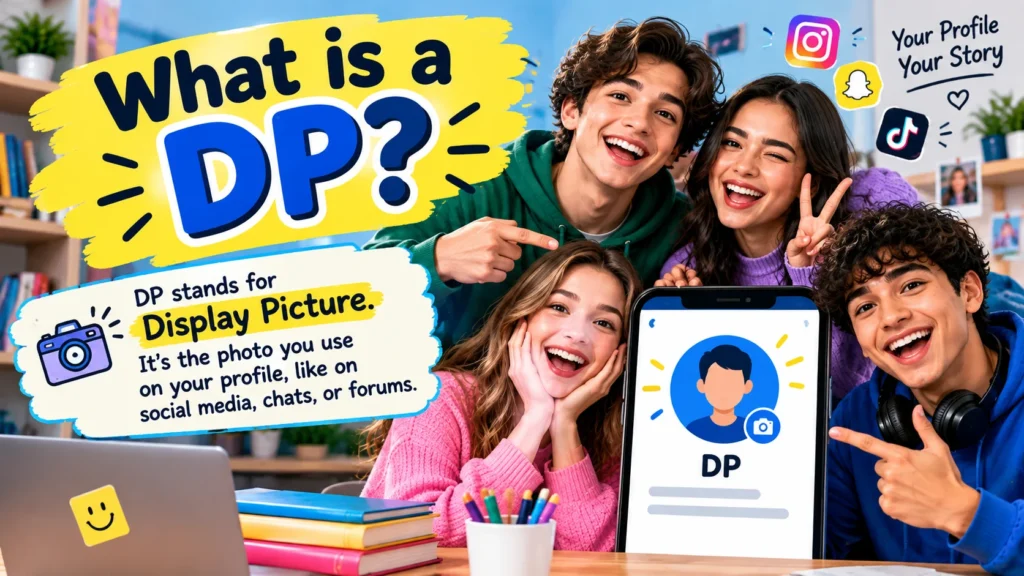
If you have ever heard someone say, “Send me your DP,” “Nice DP,” or “Change your DP,” you may have wondered what those two letters mean.
In social media and messaging, it usually means “Display Picture.” It refers to the small image shown on a person’s profile, account, or messaging application.
A DP can be a personal photograph, cartoon, logo, pet picture, artwork, landscape, celebrity image, or almost anything someone chooses to represent their online identity.
The term is especially common in South Asian English and on messaging platforms. In other English-speaking regions, people are more likely to say profile picture or profile photo.
That difference explains why someone may understand “profile picture” immediately but have never heard the term “DP.”
A DP is more than just a picture. For many people, it becomes a small visual statement about who they are, what they like, or how they want others to see them.
What Does DP Mean? Quick Explanation
DP means “Display Picture.”
It is the image associated with your profile on a social or messaging platform.
Common examples include:
“Your DP looks amazing!”
“Why did you change your DP?”
“Send me that picture for my DP.”
A DP can be used on platforms such as WhatsApp, Facebook, messaging services, forums, and other social platforms.
The exact term varies by region.
In many South Asian online conversations, it is extremely familiar. In American or British English, profile picture is generally more common.
DP vs. Profile Picture
The two terms usually refer to the same basic thing.
DP: Display Picture
Profile Picture: The image representing an online profile
So if someone asks, “What is your DP?” they are normally asking which image you are currently using as your profile picture.
Where Did the Term DP Come From?
“Display Picture” developed as a descriptive term for an image displayed alongside a person’s online profile.
The abbreviation became especially popular in messaging and social-networking communities where profile images became a normal part of digital identity.
Its popularity is particularly noticeable in South Asian English.
People in countries such as India, Pakistan, Bangladesh, and neighboring regions commonly use “DP” in everyday digital communication.
Meanwhile, many native English speakers in North America and the United Kingdom generally use profile picture, profile photo, or simply profile pic.
How Social Media Changed the Meaning of DP
Early online profiles often focused heavily on usernames and text.
As social networking evolved, profile images became an important part of personal branding.
People began changing their pictures to reflect:
- Mood
- Fashion
- Travel
- Relationships
- Special events
- Religious or cultural occasions
- Sports interests
- Professional identity
- Personal milestones
The DP therefore became a visual form of communication.
Changing a picture can sometimes say something without requiring a written message.
DP in Real-Life Conversations
The easiest way to understand the term is to see how people naturally use it.
WhatsApp Conversation
Person A:
“Hey, when did you change your DP?”
Person B:
“Yesterday. I wanted something different.”
Person A:
“It looks really good!”
Here, DP simply means the person’s WhatsApp profile image.
Instagram DM
Person A:
“Is that your new DP?”
Person B:
“Yeah, I took that photo during my trip.”
The speaker is using DP to refer to a profile image.
TikTok Comment
Person A:
“Your DP is so cute 😂”
Person B:
“Thank you!”
The commenter is complimenting the account’s profile picture.
Text Message
Person A:
“Can you send me that photo? I want to use it as my DP.”
Person B:
“Sure, I’ll send it.”
This example shows how people can use “DP” as a short form while talking about choosing a profile image.
Emotional and Psychological Meaning of a DP
A profile picture can communicate much more than people realize.
Although a DP is technically just an image, people often choose one based on how they want to present themselves.
Someone may select a bright travel photograph because they want to communicate adventure.
Another person may choose a professional headshot because they want to appear polished and trustworthy.
Someone else may use a cartoon character simply because they enjoy it.
The image becomes part of a person’s digital identity.
Why People Change Their DP
People change profile pictures for many reasons.
A new DP can represent a new phase of life, a celebration, a relationship, a personal achievement, or simply a change in taste.
Sometimes the reason is emotional.
A person may remove their photograph after a difficult experience. Someone else may choose a confident new picture after reaching an important goal.
Of course, you should not assume you know someone’s feelings just because they changed their DP.
The picture provides a clue, not a complete explanation.
A Simple Real-Life Scenario
Imagine someone changing their profile picture after graduating.
Friends may immediately notice and comment:
“New DP! Congratulations!”
The picture becomes part of the celebration even though the user never directly wrote “I graduated.”
That is one reason profile images have become such an effective form of digital expression.
How DP Is Used in Different Contexts
Social Media
On social media, a DP identifies an account visually.
Users may choose selfies, illustrations, logos, pets, landscapes, or creative designs.
Influencers and creators often use consistent profile images to make their accounts easier to recognize.
Friends and Relationships
Friends may comment on one another’s DPs as a casual way of starting a conversation.
A new picture can attract attention without the person sending a direct message.
In relationships, changing a it can sometimes become a topic of discussion, particularly when the image includes another person.
Still, a profile picture alone does not prove anything about someone’s relationship status or feelings.
Work and Professional Settings
Professional profiles often use a headshot rather than a casual selfie.
On workplace platforms, a clear profile image can help colleagues recognize people during online meetings or group discussions.
However, “it” is less formal than “profile photo” or “profile picture” in many professional settings.
Casual vs. Serious Communication
“DP” sounds casual and conversational.
In a formal email, writing “profile picture” is usually clearer.
A message to a friend might say:
“Your DP changed!”
A professional document would more naturally say:
“Please update your profile photo.”
When Not to Use the Term DP
“DP” is easy to understand in some communities but unfamiliar in others.
Formal Writing
Use profile picture or profile photo in formal documents unless your audience specifically uses DP.
International Communication
If you are speaking with someone from a region where “DP” is not common, spelling out the phrase can prevent confusion.
Customer Support
Businesses should generally use the platform’s official terminology.
If an application calls it a “profile photo,” using that wording keeps instructions clearer.
Important Instructions
When explaining how to change an account image, clarity matters more than shortening the phrase.
For example:
“Tap your profile picture to change it.”
is clearer to a global audience than:
“Tap your DP.”
Common Misunderstandings About DP
DP Always Means Display Picture
In social media and messaging contexts, that is usually what people mean.
However, it can have other meanings in completely different fields, so context remains important.
DP Means a Selfie
Not at all.
A DP can be any image.
People commonly use logos, pets, artwork, cartoons, landscapes, family pictures, or abstract designs.
A DP Shows Someone’s Real Personality
Not necessarily.
People carefully choose online images.
A profile picture can be aspirational, humorous, artistic, or simply convenient.
It should not be treated as a complete representation of someone’s personality.
Changing a DP Always Has a Hidden Meaning
This is another common assumption.
Sometimes someone changes their profile picture simply because they found a better photograph.
Not every digital action carries a secret message.
DP and Profile Picture Are Completely Different
In everyday messaging contexts, they generally refer to the same basic concept.
The biggest difference is regional usage and wording preference.
DP Compared With Similar Terms
| Term | Meaning | Common Context | Tone |
|---|---|---|---|
| DP | Display Picture | Messaging/social media | Casual |
| Profile Picture | Image representing an account | Social media | Neutral |
| Profile Photo | Photograph used on a profile | Social/professional | Neutral |
| Profile Pic | Short form of profile picture | Casual online chat | Informal |
| Avatar | Digital image representing a user | Gaming/forums/social platforms | Casual/technical |
| PFP | Profile Picture | Social media/gaming | Internet slang |
| Username | Name identifying an account | Online platforms | Neutral |
| Bio | Short profile description | Social media | Casual/neutral |
Key Insight
DP, PFP, profile picture, and profile photo can describe similar things, but the preferred term depends on the platform and region. “DP” is particularly common in South Asian digital communication, while “profile picture” is more globally recognizable.
Types of DP People Commonly Use
1. Selfie DP
A personal photograph showing the user’s face.
2. Professional DP
A polished headshot commonly used for work-related profiles.
3. Couple DP
A picture featuring two romantic partners.
4. Friends DP
A group photograph used to represent friendship or shared memories.
5. Cartoon DP
An animated character or illustrated image.
6. Pet DP
A photograph of a dog, cat, bird, or another beloved animal.
7. Aesthetic DP
A carefully styled image based on colors, mood, fashion, or visual themes.
8. Quote DP
An image containing a meaningful, funny, motivational, or emotional quote.
9. Logo DP
A brand, business, team, or creator logo used as the profile image.
10. Nature DP
A photograph of mountains, beaches, sunsets, flowers, or other natural scenery.
How to Respond When Someone Talks About Your DP
If someone compliments or asks about your DP, your response can match the tone of the conversation.
Casual Replies
- “Thanks!”
- “Glad you like it.”
- “Yeah, I just changed it.”
- “It’s one of my favorite pictures.”
Funny Replies
- “Finally noticed it? 😂”
- “The DP deserved attention!”
- “Had to upgrade the profile 😂”
Mature Replies
- “Thank you. I wanted something more professional.”
- “I appreciate that.”
- “I thought it was a good photo for my profile.”
Respectful Replies
- “Thank you so much.”
- “That’s kind of you to say.”
- “I’m glad you like the picture.”
If someone asks for your photograph, remember that you never have to share a personal image simply because they requested it.
Regional and Cultural Usage of DP
Western Culture
In the United States, Canada, the United Kingdom, and similar English-speaking environments, profile picture and profile photo are generally more familiar terms than DP.
“PFP” is also common in online communities.
Asian Culture
DP is particularly familiar in South Asian digital communication.
It appears frequently in everyday conversations involving WhatsApp, Facebook, messaging apps, and other social platforms.
Middle Eastern Culture
English digital terminology is often mixed with local-language communication.
Some users may understand it through international social-media culture, while others may prefer the platform’s local or official terminology.
Global Internet Usage
The rise of social media has made terms like DP, PFP, and avatar increasingly recognizable worldwide.
Still, familiarity varies by platform.
Gen Z vs. Millennials
Younger users often use PFP more frequently in global online communities, especially gaming and social media.
Many Millennials, particularly in South Asian communities, may be very familiar with DP.
The terms overlap, but regional habits can strongly influence which one feels natural.
Is DP Safe for Kids?
The term DP is completely harmless by itself.
The more important issue is what image a child chooses to upload and who can see it.
Parents and educators can teach children to think carefully before using a personal photograph online.
Useful digital-safety habits include:
- Avoid sharing private information in profile images.
- Be cautious about showing school uniforms, addresses, or locations.
- Check privacy settings.
- Avoid using someone else’s photograph without permission.
- Remember that online images can be copied or saved by others.
A profile picture may look small, but it can still reveal more information than expected.
FAQs About What Is a DP
What is a DP?
A DP usually means Display Picture, the image used to represent a person’s profile on a messaging or social-media platform.
What does DP stand for?
it commonly stands for Display Picture in social media and messaging contexts.
Is DP the same as a profile picture?
Yes. In most social-media conversations, DP and profile picture refer to essentially the same thing: the image representing an online account.
What is the difference between DP and PFP?
Both usually mean a profile image. it stands for Display Picture, while PFP stands for Profile Picture. Regional and platform preferences determine which term people use.
Why do people change their DP?
People change their DP for many reasons, including new photos, special occasions, personal milestones, style changes, relationships, or simply wanting a different image.
What does “nice DP” mean?
“Nice DP” is a casual compliment meaning that someone likes your profile picture or thinks it looks attractive, stylish, interesting, or appealing.
Can a DP be a cartoon or logo?
Yes. A DP does not have to be a photograph of the user. Cartoons, logos, artwork, pets, landscapes, and other images can all be used as profile pictures.
Conclusion
So, what is a DP?
In messaging and social media, DP usually means “Display Picture,” which is another term for a profile picture or profile photo.
The image might be a selfie, professional headshot, cartoon, pet, logo, landscape, or anything else someone chooses to represent their account.
The term is especially common in South Asian digital communication, while profile picture and PFP are more widely recognized across global internet culture.
A DP may seem like a small part of an online profile, but it can communicate personality, interests, memories, and identity at a glance.
The next time someone says “Nice DP,” you will know exactly what they mean.