
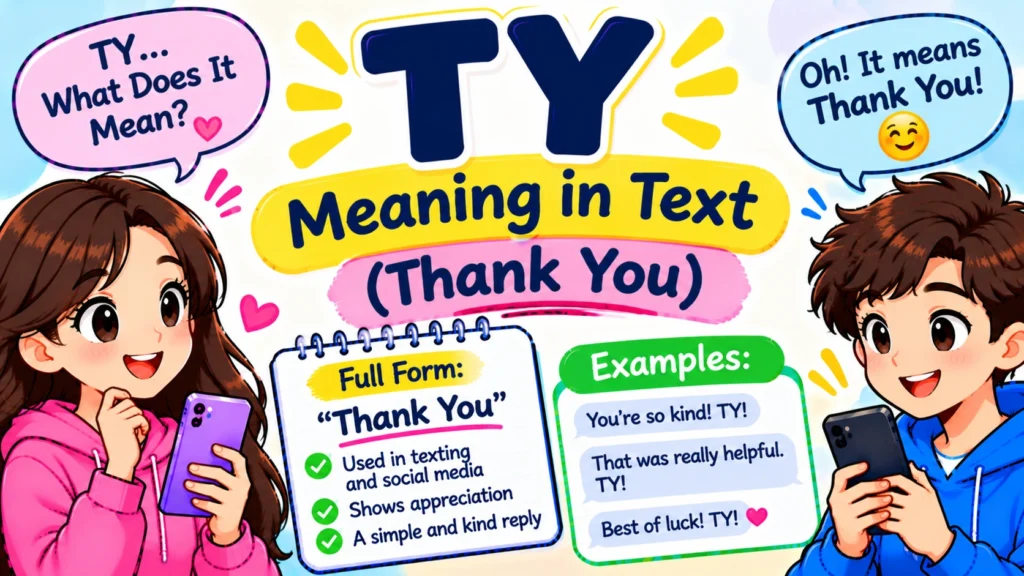
Have you ever received a short message saying “TY” and wondered whether it was just a quick reply or something more? In online conversations, two small letters can communicate appreciation without requiring a long sentence.
TY most commonly means “Thank You.” It is a friendly, informal abbreviation used in text messages, WhatsApp chats, Instagram comments, gaming conversations, and everyday digital communication.
People use it when someone helps them, shares useful information, gives a compliment, or does something thoughtful. Instead of typing the complete phrase, they simply write “TY.”
Although the meaning is straightforward, the tone can change depending on the situation. A quick “ty” between friends may feel casual, while a message such as “TY so much!” can express genuine appreciation.
Understanding this abbreviation will help you recognize everyday online expressions and respond naturally without feeling confused.
TY Meaning in Text: A Quick Explanation
TY stands for “Thank You.”
It is one of the simplest ways to express gratitude in digital communication. People often use it when they want to acknowledge someone’s help or kindness quickly.
Here are some common examples:
- “TY for helping me!” means “Thank you for helping me!”
- “TY so much!” means “Thank you very much!”
- “TY, I appreciate it.” expresses gratitude.
- “TY for the update.” acknowledges information someone has shared.
Short examples in everyday conversations
“TY for the advice!”
“TY, you’re the best.”
“Got it, ty!”
The abbreviation is informal but widely understood. It is suitable for most casual conversations, although spelling out “Thank you” is often better in professional or formal communication.
The Origin and Evolution of TY
How Short Texting Expressions Became Popular
TY became familiar through the early culture of SMS messaging and internet chat rooms. In the early days of mobile communication, people often preferred shorter messages because typing on traditional phone keypads could be slow.
Common expressions were gradually reduced to a few letters. For example, “thank you” became “TY,” “see you” became “CU,” and “talk to you later” became “TTYL.”
These shortcuts made everyday communication faster without completely changing the meaning of the original phrases.
The Influence of Online Communities
As instant messaging, gaming platforms, and social networking sites grew, TY became a familiar expression across different online communities.
People began using it in public comments, private messages, multiplayer games, and discussion forums.
Its popularity is connected to one simple fact: almost everyone needs a quick way to say thank you.
Why TY Still Matters Today
Even though modern smartphones make typing easier, short abbreviations remain part of digital culture.
People often prefer quick replies when they are busy or participating in fast-moving conversations. TY continues to serve that purpose.
It is also easy to understand across different age groups, making it more widely recognizable than many newer internet expressions.
Real-Life Conversations Using TY
The best way to understand TY is to see how it works in ordinary situations. These examples show how people use it across popular messaging platforms.
1. WhatsApp Conversation: Helping a Friend
Person A: I have sent you the notes from today’s lecture.
Person B: TY! I really needed those.
Person A: No problem. Let me know if you need anything else.
Here, TY is a quick way to thank someone for sharing helpful study material.
2. Instagram DM: Appreciating a Compliment
Person A: Your new picture looks amazing!
Person B: TY so much! That’s really sweet of you.
Person A: You deserve the compliment!
In this conversation, TY communicates appreciation after receiving a positive comment.
3. TikTok Comment: Responding to a Suggestion
Person A: You should try adding subtitles to your videos.
Person B: TY for the suggestion! I’ll try that.
The creator uses TY to acknowledge useful feedback from a viewer.
4. Gaming Chat: Quick Communication
Person A: I dropped some extra supplies near your location.
Person B: TY! That will help me finish this mission.
Person A: Good luck!
In online gaming, players often use short expressions because they need to communicate quickly while playing.
The Emotional and Psychological Meaning of TY
Although TY is only two letters, it communicates an important social message: appreciation.
People use it to recognize another person’s effort, maintain friendly relationships, and show that they have noticed an act of kindness.
It Expresses Gratitude
The most direct purpose of TY is to say thank you. It acknowledges that someone has done something helpful or thoughtful.
For example, “TY for checking on me” shows appreciation for someone’s concern.
It Helps Maintain Friendly Connections
Small expressions of gratitude can make conversations feel more positive.
When someone receives a quick thank-you, they know their effort has been recognized. This can encourage kindness and cooperation in friendships, families, and online communities.
It Makes Communication Feel Natural
Not every conversation needs a long response. Sometimes a short acknowledgment is enough.
TY works particularly well when the other person has done something simple, such as sending a link, answering a question, or sharing information.
A relatable everyday scenario
Imagine that you are preparing for an important exam and a classmate sends you a useful set of notes. You reply, “TY, this will really help me.”
Although the message is short, it communicates that you value the person’s effort. That small acknowledgment can make the friendship stronger.
How TY Is Used in Different Situations
Social Media
TY is common on Instagram, TikTok, Facebook, and other social platforms.
People use it to respond to compliments, acknowledge comments, and thank followers for sharing content.
Examples:
- “TY for the support!”
- “TY everyone for the birthday wishes.”
- “TY for watching my video.”
It is especially useful when replying to several short comments.
Friends and Relationships
Friends often use TY when sharing links, making plans, offering advice, or helping each other.
Examples:
- “TY for waiting for me.”
- “TY for listening.”
- “TY for always being there.”
In close relationships, the complete phrase may sometimes feel warmer, especially when someone has made a meaningful effort.
Work and Professional Communication
TY can be acceptable in informal workplace chats when colleagues have a relaxed communication style.
For example:
“TY for sending the report.”
However, in formal emails, client communication, or professional documents, writing “Thank you” is usually a better choice.
A complete expression can make your message feel more polished and respectful.
Casual vs. Serious Conversations
In casual chats, TY is friendly and convenient.
During serious conversations, however, a more personal response may be appropriate.
For example, if someone supports you through a difficult situation, saying “Thank you for being there for me” can communicate more warmth than simply writing “TY.”
When Should You Avoid Using TY?
TY is generally harmless and polite, but there are situations where the complete phrase works better.
Formal Emails and Business Communication
Avoid relying on abbreviations when writing to clients, managers, recruiters, or people you do not know well.
Instead of:
“TY for considering my application.”
Write:
“Thank you for considering my application.”
The second version sounds more professional.
Academic Writing
Students should avoid TY in essays, research papers, examinations, and formal assignments.
Use complete English expressions in academic work. Informal abbreviations are better suited to personal messages.
Important Personal Conversations
If someone has made a significant sacrifice or offered emotional support, a short abbreviation may feel too brief.
A thoughtful message such as “Thank you for taking the time to help me” can express genuine appreciation more effectively.
Conversations With People Who Prefer Formal Language
Some people are unfamiliar with texting shortcuts or simply prefer traditional writing.
When communicating with older relatives, teachers, or professional contacts, using the complete phrase is a safe choice.
Common Misunderstandings About TY
1. Thinking TY Is Rude
TY is not normally rude or disrespectful. It is a recognized informal way to express gratitude.
However, a very short response may seem distant in a situation that requires a more personal expression.
2. Assuming It Always Shows Deep Emotion
TY communicates appreciation, but it does not automatically mean someone feels deeply grateful or emotionally connected.
The situation and surrounding words help determine the strength of the message.
3. Confusing TY With TTYL
These abbreviations look somewhat similar but have completely different meanings.
- TY: Thank You
- TTYL: Talk To You Later
For example, “TY for your help” expresses gratitude, while “TTYL” suggests ending the conversation for now.
4. Thinking TY Is Only Used by Young People
TY is not limited to Gen Z. People from different generations use it in texts, emails, online games, and social media conversations.
Its simplicity makes it familiar to many internet users.
5. Believing It Is Always Better Than Thank You
TY is convenient, but the complete phrase can feel warmer and more thoughtful.
The best choice depends on the relationship and the importance of the situation.
TY vs. Similar Texting Abbreviations
Several internet expressions are used to show appreciation, acknowledge help, or respond politely. However, their meanings are not exactly the same.
| Abbreviation | Full Meaning | Main Purpose |
|---|---|---|
| TY | Thank You | Expressing gratitude |
| TYSM | Thank You So Much | Showing stronger appreciation |
| TQ | Thank You | Informal way to say thanks |
| THX | Thanks | Giving a quick acknowledgment |
| TIA | Thanks in Advance | Thanking someone before they help |
| NP | No Problem | Responding to someone’s thanks |
| YW | You’re Welcome | Acknowledging gratitude |
| ILY | I Love You | Expressing affection |
| BTW | By The Way | Introducing another point |
| TTYL | Talk To You Later | Ending a conversation temporarily |
Key Insight
TY is a simple expression of gratitude, while TYSM adds emphasis and TIA is used before receiving help. Choosing the right abbreviation makes your response more natural and appropriate.
Popular Variations and Types of TY
People use several related forms to express different levels of appreciation. Some are direct variations of TY, while others are common alternatives.
1. TY
Meaning: Thank You.
This is the basic abbreviation used to acknowledge help, kindness, or useful information.
2. TYSM
Meaning: Thank You So Much.
It expresses stronger appreciation and is common in friendly conversations.
3. TYSVM
Meaning: Thank You So Very Much.
This is a more emphatic version used when someone wants to show extra gratitude.
4. THX
Meaning: Thanks.
It is a quick, informal alternative often used in messages and online gaming.
5. TQ
Meaning: Thank You.
This shortened form appears in some online communities and regional texting styles.
6. TIA
Meaning: Thanks in Advance.
People use it when requesting help and thanking someone before they respond.
7. TNX
Meaning: Thanks.
It is another informal spelling used in some digital conversations.
8. TYVM
Meaning: Thank You Very Much.
This expression communicates more appreciation than a simple TY.
9. TYIA
Meaning: Thank You in Advance.
It is used when asking someone to do something and acknowledging their future help.
10. TQSM
Meaning: Thank You So Much.
This informal variation combines a shortened form of thank you with an expression of stronger gratitude.
These expressions are not equally common everywhere. TY, TYSM, THX, and TIA are generally easier for most English-language internet users to recognize.
How to Respond When Someone Uses TY
When someone sends TY, the simplest response is usually the most natural. You can choose a reply based on your relationship and the situation.
Casual Replies
Use these when chatting with friends or classmates:
- “You’re welcome!”
- “No problem!”
- “Anytime!”
- “Of course!”
- “No worries!”
Funny Replies
If you have a playful relationship, try something lighthearted:
- “You’re welcome, legend!”
- “Don’t mention it!”
- “I accept payment in snacks!”
- “Just doing my good deed for today!”
- “You owe me a coffee now!”
Mature Replies
For a thoughtful or more serious response, use:
- “You’re very welcome.”
- “I’m glad I could help.”
- “Happy to be of assistance.”
- “It was my pleasure.”
- “I’m always happy to support you.”
Respectful Replies
When responding to a teacher, manager, client, or someone you do not know well:
- “You’re most welcome.”
- “My pleasure.”
- “I’m glad I could assist.”
- “You’re welcome. Please let me know if you need anything else.”
A suitable reply does not need to be complicated. Just match the tone of the original conversation.
TY Across Different Regions and Generations
Western Culture
In the United States, Canada, the United Kingdom, and other English-speaking communities, TY is a familiar abbreviation in casual digital communication.
It is commonly used in text messages, online gaming, and social media comments.
Asian Culture
In countries such as Pakistan, India, Bangladesh, and the Philippines, English texting abbreviations are often mixed with local languages.
For example, someone might write:
“Notes send karne ke liye TY!”
This means, “Thank you for sending the notes!”
The abbreviation fits naturally into informal mixed-language conversations.
Middle Eastern Culture
English abbreviations are common in many online communities across the Middle East, particularly among people who communicate internationally.
TY can appear alongside Arabic expressions and local texting styles. Its basic meaning remains “Thank You.”
Global Internet Usage
Social media has helped make TY recognizable across international communities.
Someone can use it in a gaming chat, an Instagram comment, or a WhatsApp message, and many readers will understand the intended meaning.
Still, the complete phrase is always a safe alternative when communicating with someone unfamiliar with internet abbreviations.
Gen Z vs. Millennials
Gen Z often prefers short, quick expressions when chatting online. Millennials also use TY, particularly in everyday messages and workplace conversations.
The difference is usually personal rather than strictly generational. Both groups may switch between abbreviations and complete sentences depending on the situation.
Is TY Safe for Kids?
Yes. TY is a harmless and generally positive abbreviation because it means “Thank You.”
Children may encounter it in school group chats, online games, family messages, and social media comments.
Parents can explain that TY is simply a shorter way to express gratitude. It can also be a useful opportunity to teach children the importance of saying thank you when someone helps them.
Children should understand that abbreviations are suitable for casual messages but not always appropriate in school assignments or formal writing.
Encouraging them to use complete words in important situations helps develop stronger communication skills.
Frequently Asked Questions About TY
1. What does TY mean in texting?
TY means “Thank You.” It is a common informal abbreviation used to express gratitude in text messages, online chats, and social media conversations.
2. What does TY mean on WhatsApp?
On WhatsApp, TY usually means “Thank You.” People use it to acknowledge help, respond to a message, or appreciate something another person has done.
3. What does TY mean from a girl?
If a girl sends TY, she is generally saying “Thank You.” It does not automatically indicate romantic interest; the meaning depends on the conversation.
4. What is the difference between TY and TYSM?
TY means “Thank You,” while TYSM means “Thank You So Much.” TYSM expresses stronger appreciation or enthusiasm.
5. Is TY rude or disrespectful?
No. TY is generally polite and friendly. However, writing the complete phrase may be more appropriate in formal situations or meaningful personal conversations.
6. What should I reply when someone says TY?
You can respond with “You’re welcome,” “No problem,” “Anytime,” or “My pleasure.” Choose a reply that matches the tone of your conversation.
7. Can I use TY in professional messages?
TY may be acceptable in informal workplace chats, but “Thank you” is a better choice for formal emails, business communication, and messages to clients.
Conclusion
TY is one of the easiest and most useful abbreviations to understand in everyday digital communication. It simply means “Thank You” and allows people to express appreciation without typing the complete phrase.
You may see it in WhatsApp messages, Instagram comments, TikTok conversations, gaming chats, and everyday text messages. Its meaning is generally clear, regardless of the platform.
Although TY is perfect for casual communication, using the full phrase can make important messages feel more personal and professional.
The next time someone helps you or shares something useful, a simple “TY” can be enough to acknowledge their kindness. After all, even a small expression of gratitude can make a conversation feel warmer.

1 thought on “TY Meaning in Text: What Does TY Stand For?”