
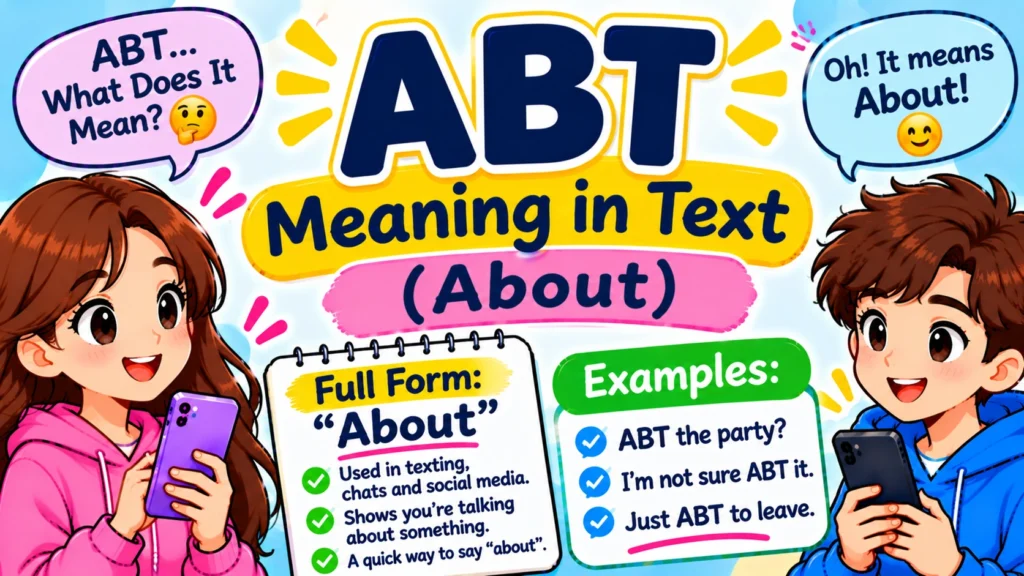
Have you ever received a message containing “ABT” and wondered what those three letters mean? Texting abbreviations can make even simple conversations confusing, especially when people shorten everyday words to save time.
In most casual messages, ABT means “about.” It is an informal abbreviation commonly used in text messages, WhatsApp chats, Instagram comments, and other online conversations.
For example, someone might write, “What abt you?” instead of “What about you?” The meaning stays the same, but the shorter version makes the message quicker to type.
Understanding this abbreviation can help you follow conversations without constantly guessing what someone is trying to say. It is also useful when you want your own messages to sound natural and relaxed.
However, context still matters. Although “about” is the most common meaning, ABT can occasionally appear as an acronym in a specific community, organization, or professional setting.
ABT Meaning in Text: A Quick Explanation
ABT usually stands for “about” in texting and online communication.
People use it as a shortcut when asking questions, discussing plans, sharing information, or continuing a conversation.
Here are a few everyday examples:
- “What abt dinner?” means “What about dinner?”
- “I’ll be there in abt 10 minutes” means “I’ll be there in about 10 minutes.”
- “Tell me abt your trip” means “Tell me about your trip.”
Three short examples in conversation
“What abt tomorrow?”
“I was thinking abt you.”
“It takes abt an hour.”
The abbreviation is informal, so it works best in relaxed conversations rather than formal writing.
Where Did ABT Come From?
The Influence of Early Text Messaging
ABT developed as part of a broader habit of shortening everyday language. When mobile phones first became popular, typing long messages was often inconvenient.
Older phones had small keypads, and users sometimes had to press the same button several times to type one letter. Short forms helped people communicate more quickly.
Abbreviations such as “u” for “you,” “b4” for “before,” and “abt” for “about” became familiar in informal digital conversations.
How Online Culture Made It Popular
As texting moved from traditional SMS to messaging apps, shortened expressions remained popular. WhatsApp, Instagram, Snapchat, and other platforms made quick, casual communication part of everyday life.
People also began using abbreviations in captions, comments, and group chats. ABT fits naturally into this style because it is short and easy to understand.
Why Its Meaning Has Stayed Simple
Unlike some internet slang that changes meaning over time, ABT generally keeps its connection to the word “about.”
Its popularity comes from convenience rather than a complicated cultural meaning. Most readers can understand it immediately when the surrounding sentence is clear.
ABT in Real-Life Conversations
The easiest way to understand an abbreviation is to see how people actually use it. These examples show how ABT can appear in everyday digital communication.
1. WhatsApp Conversation: Making Plans
Person A: Are we meeting today?
and,
Person B: Yes, what abt 6 PM?
moreover,
Person A: That works for me!
Here, ABT means “about.” Person B is suggesting approximately 6 PM as the meeting time.
2. Instagram DM: Showing Interest
Person A: I saw your travel pictures. Where did you go?
Person B: I visited Turkey last month.
Person A: Tell me abt your experience!
The abbreviation makes the message feel relaxed and friendly. The sender wants to hear more about the trip.
3. TikTok Comment: Asking a Question
Person A: This is my favorite outfit!
Person B: What abt the black one you posted yesterday?
The commenter is asking about another outfit. ABT replaces the complete word “about.”
4. Text Message: Sharing an Approximate Time
Person A: When will you reach home?
and,
Person B: In abt 20 minutes.
moreover,
Person A: Okay, drive safely!
In this example, ABT means “approximately” or “around.” It communicates that the person expects to arrive in roughly 20 minutes.
The Emotional and Psychological Meaning of ABT
ABT does not usually express a specific emotion by itself. Its purpose is mainly practical: it makes messages shorter and easier to send.
Still, the way someone uses it can contribute to the overall tone of a conversation.
It Can Make Messages Feel Casual
A message such as “What abt you?” often feels relaxed and conversational. It is the kind of wording people use with friends, classmates, and familiar contacts.
The abbreviation can make a conversation feel less formal without changing the actual meaning.
It Helps Keep Conversations Moving
Digital conversations often happen quickly. People may be replying while travelling, studying, working, or doing something else.
Using ABT can reduce typing and help someone respond without interrupting the natural flow of a discussion.
It Can Show Familiarity
When two people regularly use abbreviations, their messages may develop a shared communication style.
For example, friends who frequently write “abt,” “btw,” and “idk” may find these expressions completely normal. They do not need to spell out every word to understand each other.
A relatable everyday scenario
Imagine asking a friend whether they are free during the weekend. They reply, “Not sure yet, what abt Sunday?”
You immediately understand that they are asking whether Sunday works for you. There is no hidden emotion or secret message. It is simply a quick way to keep the conversation going.
How People Use ABT in Different Situations
The meaning usually stays the same across platforms, but the tone can change depending on the relationship and situation.
Social Media
On Instagram, TikTok, Facebook, and other platforms, ABT is often used in comments and direct messages.
Examples:
- “What abt this look?”
- “Tell us abt your new project.”
- “I posted abt it yesterday.”
It helps users write short comments without making their messages difficult to understand.
Friends and Relationships
Friends often use ABT when discussing plans, asking questions, or sharing personal experiences.
Examples:
- “What abt our movie plan?”
- “I wanted to talk abt yesterday.”
- “What abt you? How was your day?”
In these conversations, the abbreviation feels natural and friendly.
Work and Professional Communication
ABT is generally less suitable for formal emails, official reports, and professional documents.
For example, instead of writing:
“Can you send me details abt the meeting?”
A more polished version would be:
“Can you send me details about the meeting?”
In an informal workplace chat with colleagues who regularly use abbreviations, ABT may be acceptable. However, spelling out the word is usually the safer choice when communicating with clients, managers, or unfamiliar contacts.
Casual vs. Serious Conversations
In casual conversations, ABT is perfectly understandable.
During a serious discussion, however, writing the complete word may help the message feel more thoughtful and clear.
For instance, “I want to talk abt what happened” is understandable, but “I want to talk about what happened” may feel more appropriate when discussing a sensitive subject.
When Should You Avoid Using ABT?
Although ABT is widely understandable in casual texting, it is not suitable for every situation.
Formal Emails and Official Documents
Avoid using ABT in job applications, academic assignments, business proposals, and official correspondence.
The complete word “about” looks more professional and makes your writing easier to read.
Academic Writing
Students should generally avoid texting abbreviations in essays, research papers, examinations, and formal presentations.
For example:
- Informal: “This essay is abt climate change.”
- Formal: “This essay is about climate change.”
The second version follows standard written English.
Conversations With People Who May Not Know the Abbreviation
Some people are unfamiliar with modern texting shortcuts. This can include older relatives, new colleagues, or people who do not regularly communicate online.
Using the full word can prevent unnecessary confusion.
Sensitive Discussions
When discussing an emotional issue, serious disagreement, or personal problem, clear language is more important than saving a few characters.
A complete sentence can communicate care and attention more effectively.
Common Misunderstandings About ABT
Even a simple abbreviation can create confusion when people interpret it without considering the surrounding message.
1. Thinking ABT Has a Completely Different Meaning
In ordinary texting, ABT most commonly means “about.” It is not necessary to search for a complicated definition every time you see it.
However, a specialized conversation may use the same letters for a different acronym.
2. Confusing ABT With BTW
These abbreviations look similar, but they have different meanings.
- ABT: About
- BTW: By the way
For example, “What abt lunch?” asks about lunch, while “BTW, lunch is ready” introduces additional information.
3. Assuming It Expresses an Emotion
ABT does not automatically mean someone is angry, excited, upset, or interested in you.
The surrounding words and the relationship between the people provide more information about the tone.
4. Believing It Is Always a Professional Acronym
ABT can stand for different terms in specialized industries or organizations. However, when it appears in a normal text message, “about” is usually the most reasonable interpretation.
5. Thinking It Is a Typing Mistake
Someone writing “abt” instead of “about” is often using an intentional abbreviation. It is a common informal spelling rather than necessarily an error.
ABT vs. Similar Texting Abbreviations
Several texting shortcuts serve similar purposes, but their meanings are different. Understanding the differences helps you avoid confusing one expression with another.
| Abbreviation | Full Meaning | How It Is Used |
|---|---|---|
| ABT | About | Asking or talking about something |
| BTW | By the way | Introducing an additional point |
| ATM | At the moment | Describing the present situation |
| IDK | I don’t know | Expressing uncertainty |
| WBU | What about you? | Asking someone the same question |
| WYD | What are you doing? | Asking about someone’s current activity |
| FYI | For your information | Sharing useful information |
| IMO | In my opinion | Introducing a personal viewpoint |
| TBH | To be honest | Expressing an honest opinion |
| ASAP | As soon as possible | Requesting something quickly |
Key Insight
ABT is a shortened version of an ordinary English word, while many other texting abbreviations represent entire phrases. Knowing this difference makes digital conversations easier to understand.
Popular Variations and Related Ways to Write ABT
People do not always use the same spelling or sentence structure when communicating online. The following examples show common ways to use “about” and related expressions.
1. ABT
Meaning: About.
Example: “What abt your plans?”
This is the basic informal spelling.
2. About
Meaning: The complete standard word.
Example: “Tell me about your plans.”
It is suitable for both casual and formal writing.
3. What ABT
Meaning: What about.
Example: “What abt the weekend?”
It is often used when asking for someone’s opinion or suggestion.
4. WABT
Meaning: What about.
Example: “Wabt going out tonight?”
This is a less common compressed form. Because it is not widely standardized, spelling out the phrase is clearer.
5. ABT You
Meaning: About you or what about you, depending on the sentence.
Example: “I am doing well. What abt you?”
It helps return a question to the other person.
6. ABT That
Meaning: About that.
Example: “I wanted to ask abt that issue.”
It refers to a topic already mentioned.
7. ABT It
Meaning: About it.
Example: “We should talk abt it later.”
It is useful when both people already know what the subject is.
8. ABT 5 Minutes
Meaning: Approximately five minutes.
Example: “I’ll arrive in abt 5 minutes.”
Here, the abbreviation communicates an estimated amount of time.
9. ABT 20 Dollars
Meaning: Approximately 20 dollars.
Example: “The ticket costs abt 20 dollars.”
It indicates an estimated price rather than an exact amount.
10. ABT Yesterday
Meaning: About yesterday.
Example: “I wanted to talk abt yesterday’s conversation.”
It refers to something that happened previously.
How to Respond When Someone Uses ABT
Your response should depend on the question or topic rather than the abbreviation itself.
You do not need to mention that someone used ABT. Simply understand the message and reply naturally.
Casual Replies
If someone asks, “What abt you?” you can respond with:
- “I’m good too!”
- “Same here.”
- “Not sure yet.”
- “Sounds good to me.”
Funny Replies
If you are chatting with a close friend, a playful answer may fit the conversation.
- “Abt me? I’m just surviving!”
- “Nothing exciting, as usual.”
- “You already know everything!”
- “Let’s not talk abt my busy life!”
Mature Replies
For a more thoughtful conversation, use clear and complete responses.
- “I think we should discuss that properly.”
- “I understand what you’re asking.”
- “Let me check and get back to you.”
- “I would prefer to talk about it later.”
Respectful Replies
When speaking with someone you do not know very well, polite wording is a good choice.
- “Thank you for asking.”
- “Could you explain what you mean?”
- “I will share the details with you shortly.”
- “That is a good question.”
The important thing is to respond to the message’s meaning, not just the letters.
ABT Across Different Regions and Generations
ABT is understandable in many English-language digital conversations, but texting habits can differ between countries, communities, and age groups.
Western Culture
In the United States, Canada, the United Kingdom, and other English-speaking communities, shortened words are common in informal digital communication.
ABT may appear in quick messages between friends, classmates, and family members. The complete word remains more common in formal writing.
Asian Culture
In countries such as Pakistan, India, the Philippines, and Singapore, English abbreviations often appear alongside local languages.
People may mix English words with Urdu, Hindi, Tagalog, or other languages while texting. ABT can fit naturally into these mixed-language conversations.
For example:
“Kal abt 5 baje milte hain?”
This means, “Shall we meet tomorrow at about 5?”
The surrounding language changes, but the basic meaning remains understandable.
Middle Eastern Culture
English is widely used in online communication across many Middle Eastern communities, especially in international education, business, and social media.
ABT may appear in English-language chats, although people also use Arabic expressions and regional texting shortcuts.
Its meaning generally depends on the sentence rather than the country.
Global Internet Usage
Social platforms have made abbreviations easier to recognize across borders. A person from one country may understand a short form used by someone thousands of miles away.
Still, not every abbreviation is universally recognized. Context remains important when communicating with an international audience.
Gen Z vs. Millennials
Gen Z often uses short expressions and informal spellings as part of everyday digital communication. Millennials may also use ABT, especially in quick messages.
The difference is not absolute. Individual habits, workplace expectations, and personal preferences often matter more than age.
Is ABT Safe for Kids?
Yes. ABT is generally a harmless texting abbreviation because it usually means “about.”
It does not contain an inherently offensive or inappropriate meaning in ordinary conversation.
Children may encounter it in school group chats, family messages, online games, or social media comments.
Parents can explain that ABT is simply a shortened version of an English word. They can also encourage children to use complete words in school assignments and formal communication.
As with any online language, children should learn to consider context. If an abbreviation appears in a confusing or uncomfortable conversation, they should feel comfortable asking a trusted adult what it means.
Frequently Asked Questions About ABT
1. What does ABT mean in text messages?
ABT usually means “about.” It is an informal abbreviation used to shorten the word in text messages, social media conversations, and online chats.
2. What does ABT mean on WhatsApp?
On WhatsApp, ABT generally means “about.” For example, “What abt tomorrow?” means “What about tomorrow?”
3. Does ABT mean about or approximately?
It can communicate both ideas depending on the sentence. In “Tell me abt your trip,” it means “about.” In “I’ll arrive in abt 10 minutes,” it means “approximately.”
4. Is ABT considered slang?
ABT is better described as an informal texting abbreviation or shortened spelling. It is commonly used in casual digital communication rather than formal English.
5. Is ABT rude to use?
No. ABT is not normally rude or offensive. However, using it in a formal email or professional document may look too casual.
6. What is the difference between ABT and BTW?
ABT means “about,” while BTW means “by the way.” They are different abbreviations used for different purposes in online conversations.
7. Should I use ABT in professional messages?
It is usually better to write “about” in professional messages. The complete word looks more polished and is appropriate for formal emails, reports, and business communication.
Conclusion
ABT is a simple abbreviation that makes everyday digital conversations quicker and more convenient. In most texting situations, it means “about” and can be used when asking questions, discussing plans, or sharing information.
You might see it in a WhatsApp message, an Instagram DM, a TikTok comment, or a casual text from a friend. Its meaning is usually easy to understand once you look at the surrounding sentence.
Remember that ABT is best suited to informal communication. When writing an academic assignment, professional email, or official document, use the complete word instead.
The next time someone sends you “What abt you?” or “I’ll be there in abt 10 minutes,” you will know exactly what they mean. A small abbreviation can make communication faster, but understanding its context is what keeps conversations clear.



1 thought on “ABT Meaning in Text: What Does This Short Form Mean?”