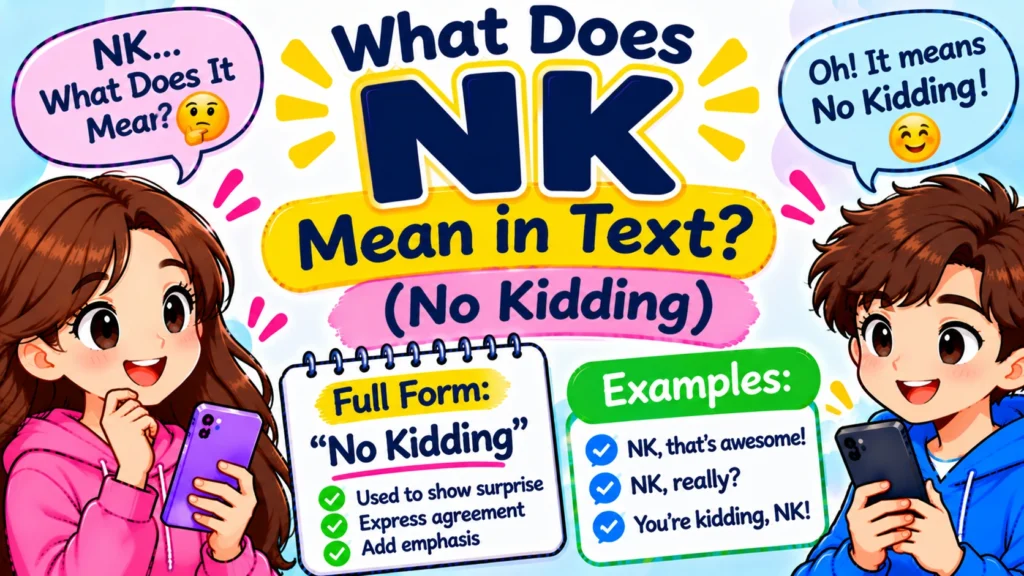
Have you ever received a message containing “NK” and wondered what the sender was trying to say? Short internet abbreviations can make ordinary conversations confusing, especially when two letters have several possible interpretations.
Unlike familiar texting shortcuts such as LOL or BRB, NK does not have one universally accepted meaning in casual messaging. Depending on the conversation, it may be used as personal shorthand, a name abbreviation, or a specialized acronym.
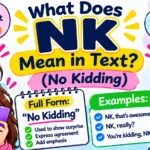
One possible interpretation is “No Kidding,” an expression people use to show surprise, agreement, or disbelief. However, this meaning is not standardized across all texting communities, so the surrounding message matters.
In this guide, you will learn how to interpret NK, recognize its possible uses, understand similar abbreviations, and respond naturally when someone sends it.
NK Meaning in Text: A Quick Explanation
NK can mean different things depending on the context. One possible informal interpretation is “No Kidding,” but it should not be treated as a universal texting definition.
Here are some ways the letters may appear:
- No Kidding: A possible casual interpretation expressing surprise or agreement.
- Initials or a nickname: Someone may use NK as a person’s initials or a shortened name.
- A specialized acronym: In technical, educational, or professional discussions, NK may represent a term specific to that subject.
- A personal abbreviation: Friends may create their own shortcuts that are understood only within their group.
Consider these illustrative examples:
“NK? That’s unbelievable!”
The sender may intend “No Kidding?” to express surprise.
“NK is joining us today.”
Here, NK could be someone’s initials or nickname.
“Check the NK section of the report.”
In this situation, NK may refer to a subject-specific term.
Important: Never assume the meaning from the letters alone. Read the complete message to understand what the sender intends.
Where Did NK Come From?
The Early Culture of Internet Abbreviations
Texting abbreviations developed because people wanted to communicate quickly. Early mobile phones had limited keyboards, making shorter expressions especially useful.
Over time, common phrases were reduced to a few letters. Expressions such as LOL, IDK, BRB, and BTW became familiar in online conversations.
Two-letter combinations like NK can also appear in informal communication, although not every combination becomes a widely recognized slang expression.
The Influence of Social Media
Messaging platforms have changed the way people communicate. WhatsApp, Instagram, Snapchat, TikTok, and online gaming communities encourage quick responses and informal language.
People sometimes invent shortcuts that make sense within their friend groups. As a result, the same abbreviation can have different meanings across communities.
Why NK Can Be Confusing
Some abbreviations have a clear and widely accepted definition. Others depend heavily on the subject and the person using them.
NK belongs to the second category in casual texting. Its meaning should be interpreted through context rather than assumed from a single online definition.
Read More : TY Meaning in Text: What Does TY Stand For?
NK in Real-Life Conversations
These examples show how NK might appear in different digital situations. They are illustrative uses, not evidence that every interpretation is universally established.
1. WhatsApp Conversation: Expressing Surprise
Person A: I finished the whole assignment in one night.
Person B: NK? That’s a lot of work!
Person A: I know, but I had no other choice.
Here, Person B may intend NK to mean “No Kidding?” The message expresses surprise at the amount of work completed.
2. Instagram DM: Reacting to Unexpected News
Person A: I just found out that our favorite singer is visiting the city.
Person B: NK! We should try to get tickets.
Person A: Definitely. It would be amazing to see them live.
In this example, NK may be intended as a surprised reaction. A clearer alternative would be “No kidding!” or “Really?”
3. TikTok Comment: Responding to a Funny Video
Person A: My brother ate the entire pizza before anyone came home.
and,
Person B: NK 😂 That’s actually hilarious.
moreover,
Person A: He didn’t even leave one slice!
The commenter may be using NK as shorthand for “No Kidding,” although writing the full expression would make the meaning clearer.
4. Text Message: Referring to Someone’s Initials
Person A: Who is coming to the event?
and,
Person B: NK and Sarah are coming too.
moreover,
Person A: Great! I’ll see you all there.
Here, NK is more likely to represent a person’s initials or nickname rather than a texting phrase.
The Emotional and Psychological Meaning of NK
An abbreviation does not always communicate a specific feeling. Its emotional meaning comes from the expression it represents and the situation in which it appears.
If someone uses NK to mean “No Kidding,” it may communicate surprise, agreement, disbelief, or playful excitement.
It Can Express Surprise
Imagine someone tells you that they won a competition without expecting to win.
A response such as “NK!” may be intended to express amazement. The sender is reacting to unexpected information.
It Can Show Agreement
In some conversations, “No kidding” is used to agree strongly with another person’s statement.
For example:
Person A: This week has been incredibly busy.
Person B: No kidding!
The second person agrees that the week has been demanding.
It Can Add Humor
People sometimes use short reactions to keep a conversation playful. An abbreviation may feel quick and relaxed when both people understand it.
However, an unclear shortcut can interrupt the conversation if the other person does not recognize it.
A relatable everyday scenario
Imagine telling a friend that you travelled for two hours because of heavy traffic. Your friend replies, “No kidding!”
You understand that they are surprised or agreeing with your frustration. If they had written only “NK,” you might need to check whether they meant the same thing.
How NK Is Used in Different Situations
Social Media
On platforms such as Instagram, TikTok, and Facebook, people use abbreviations to react quickly to posts and comments.
If NK is intended as “No Kidding,” it may appear in a conversation about surprising news, funny situations, or unexpected events.
Examples:
- “No kidding, that was amazing!”
- “NK? I didn’t expect that.”
- “Seriously? No kidding!”
Because NK is not a universally recognized shortcut, spelling out the expression is often clearer for public comments.
Friends and Relationships
Close friends sometimes develop their own abbreviations. They may understand a short expression because they have used it repeatedly.
If a friend sends NK, the surrounding conversation may help you understand whether it is a reaction, a nickname, or something else.
For emotional conversations, complete wording is usually better.
Work and Professional Communication
Avoid using unclear abbreviations in formal emails, reports, and client messages.
If NK represents a technical term or an organization’s internal abbreviation, explain it the first time it appears.
For example, instead of writing an unexplained acronym in a report, introduce its full meaning before using the shortened form.
Casual vs. Serious Conversations
Informal abbreviations can work in relaxed chats, but serious discussions require clarity.
If someone shares disappointing news, responding with an unexplained “NK” could create confusion. A complete response such as “I can’t believe that happened” communicates your reaction more clearly.
When Should You Avoid Using NK?
Formal Emails and Official Documents
Do not use an unexplained abbreviation in professional correspondence. Your readers may interpret it differently.
Write the complete phrase or explain the acronym before using it.
Academic Writing
Students should avoid informal shortcuts in essays, research papers, examinations, and presentations.
If NK is a technical term, define it according to the subject and use the accepted terminology.
Conversations With New People
A new friend or colleague may not understand your personal texting style.
Using complete expressions helps prevent unnecessary misunderstandings, especially when communicating with international audiences.
Sensitive Discussions
Avoid relying on ambiguous abbreviations when discussing personal problems, disagreements, or emotional situations.
Clear language makes it easier for the other person to understand your intentions.
Common Misunderstandings About NK
1. Assuming NK Always Means No Kidding
This is an important mistake to avoid. Although “No Kidding” is one possible interpretation, NK does not have one universally accepted meaning in casual texting.
2. Treating Every Online Definition as Official
Internet slang websites sometimes list multiple expansions without explaining how common they are.
A possible meaning is not necessarily a widely recognized meaning. Always consider the context.
3. Confusing NK With NGL
These abbreviations are different:
- NK: Context-dependent; may be used for “No Kidding.”
- NGL: Not Gonna Lie.
NGL is a widely recognized texting expression used before an honest opinion.
4. Thinking NK Is Always a Reaction
Sometimes NK may simply represent someone’s initials, a username, or a subject-specific acronym.
For example, “NK will contact you tomorrow” could refer to a person.
5. Assuming It Has a Romantic Meaning
NK does not automatically express love, attraction, or romantic interest.
The relationship between the people and the surrounding conversation provide more useful clues.
NK vs. Similar Texting Abbreviations
Understanding similar expressions can help you recognize the difference between surprise, agreement, honesty, and confusion.
| Abbreviation | Meaning | Common Use |
|---|---|---|
| NK | Context-dependent; possibly No Kidding | Surprise or agreement |
| NGL | Not Gonna Lie | Sharing an honest opinion |
| NVM | Never Mind | Withdrawing a question or comment |
| IDK | I Don’t Know | Expressing uncertainty |
| LOL | Laughing Out Loud | Reacting to something funny |
| OMG | Oh My God | Showing surprise |
| FR | For Real | Emphasizing agreement |
| TBH | To Be Honest | Introducing an honest opinion |
| BTW | By The Way | Adding another point |
| SMH | Shaking My Head | Showing disappointment or disbelief |
Key Insight
NK is less standardized than familiar expressions such as NGL, IDK, and LOL. If you see it in a message, use the surrounding words to understand whether it represents a reaction, initials, or a specialized acronym.
Variations and Related Expressions
NK does not have a widely established set of texting variations. However, the following expressions can help you communicate similar reactions more clearly.
1. No Kidding
Meaning: An expression of surprise or agreement.
It is used when something sounds surprising, impressive, or unbelievable.
2. NGL
Meaning: Not Gonna Lie.
People use it before sharing an honest opinion.
3. FR
Meaning: For Real.
It emphasizes that someone is serious or strongly agrees.
4. FRFR
Meaning: For Real, For Real.
It adds extra emphasis to an agreement or statement.
5. OMG
Meaning: Oh My God.
It expresses surprise, excitement, or disbelief.
6. Seriously?
Meaning: A question showing surprise or disbelief.
It is useful when someone shares unexpected information.
7. No Way
Meaning: An expression of disbelief or excitement.
People use it when something is difficult to believe.
8. IKR
Meaning: I Know, Right?
It shows agreement with something another person has said.
9. TBH
Meaning: To Be Honest.
It introduces a sincere opinion or observation.
10. SMH
Meaning: Shaking My Head.
It expresses disappointment, frustration, or disbelief.
These expressions are not direct expansions of NK. They are related ways to react during informal digital conversations.
How to Respond When Someone Uses NK
Your response depends on what the sender means. If the context is unclear, asking a simple question is perfectly acceptable.
Casual Replies
If you understand that the sender is expressing surprise or agreement, try:
- “I know, right?”
- “Exactly!”
- “That’s what I thought too.”
- “Pretty unbelievable, isn’t it?”
- “Right? I was surprised too.”
Funny Replies
For a playful conversation with friends, you can say:
- “I know, amazing story!”
- “Believe it or not!”
- “Life is full of surprises!”
- “You haven’t heard the best part yet!”
- “I wish I were joking!”
Mature Replies
For a more thoughtful conversation, use:
- “Yes, it was quite unexpected.”
- “I understand why you’re surprised.”
- “That’s exactly what happened.”
- “It’s difficult to believe, but it’s true.”
Respectful Replies
If you are not sure what the sender means, try:
- “Could you explain what NK means here?”
- “Just checking, what do you mean by NK?”
- “Are you using NK as an abbreviation?”
- “I want to make sure I understand your message correctly.”
There is nothing wrong with asking for clarification. Clear communication is more important than pretending to understand every abbreviation.
NK Across Different Regions and Generations
Western Culture
In the United States, Canada, and the United Kingdom, expressions such as “No kidding,” “For real,” and “Seriously?” are familiar in casual conversation.
However, NK itself is not a universally established abbreviation. People may understand it differently depending on their online community.
Asian Culture
In countries such as Pakistan, India, Bangladesh, and the Philippines, English abbreviations are often mixed with local languages.
For example, someone might write:
“NK? Ye kaise ho gaya?”
This combines an abbreviation with Roman Urdu. The sender may be expressing surprise, but the intended meaning should still be confirmed through context.
Middle Eastern Culture
English is used in many international online communities across the Middle East. People may combine English expressions with Arabic or regional texting styles.
NK does not have one established regional meaning, so the full conversation remains important.
Global Internet Usage
Social media connects people who have different language backgrounds and texting habits.
A shortcut familiar to one group may be completely new to another. Using recognizable expressions or writing complete phrases can make communication easier across cultures.
Gen Z vs. Millennials
Gen Z often experiments with new slang, short forms, and playful online expressions. Millennials also use abbreviations, but their preferences may differ.
Neither generation follows one fixed dictionary. Individual habits and online communities have a stronger influence on how people use unfamiliar shortcuts.
Is NK Safe for Kids?
NK is not inherently offensive or inappropriate. Its meaning depends on the context in which it appears.
Children may encounter it in online games, group chats, social media comments, or messages from friends.
Parents can explain that not every combination of letters has a fixed meaning. Children should look at the complete message instead of assuming an unfamiliar abbreviation is harmless or understandable.
If a message contains confusing or uncomfortable language, children should feel comfortable asking a trusted adult for help.
Frequently Asked Questions About NK
1. What does NK mean in text messages?
NK does not have one universally accepted meaning in texting. It may be used as personal shorthand, initials, or a context-specific acronym. One possible interpretation is “No Kidding.”
2. Does NK mean No Kidding?
It can be used that way by some people, but “NK” is not a widely standardized abbreviation for “No Kidding.” The surrounding conversation helps determine the intended meaning.
3. What does NK mean on WhatsApp?
On WhatsApp, NK may have different meanings depending on the sender. It could represent initials, personal shorthand, or a specialized term.
4. Is NK a popular texting abbreviation?
NK is not as widely recognized as LOL, IDK, BTW, or NGL. Many people may need clarification when they see it.
5. What is the difference between NK and NGL?
NGL means “Not Gonna Lie” and is commonly used before an honest opinion. NK is context-dependent and may be used by some people to mean “No Kidding.”
6. Is NK rude or offensive?
NK is not inherently rude or offensive. Its meaning depends on how the sender uses it and the subject of the conversation.
7. What should I reply when someone sends NK?
If the sender is expressing surprise, you can reply with “I know, right?” or “Exactly!” If you are unsure what it means, ask them to explain.
Conclusion
NK is an abbreviation that requires context because it does not have one universally accepted meaning in everyday texting. Some people may use it to express surprise through “No Kidding,” while others may use it as initials, personal shorthand, or a specialized acronym.
You might encounter it in WhatsApp messages, Instagram DMs, TikTok comments, or online group chats. The surrounding words will usually provide useful clues about what the sender intends.
Instead of guessing, look at the topic and tone of the conversation. When the meaning is still unclear, asking a quick question is the easiest way to avoid misunderstanding.
Digital communication becomes much easier when you understand not only the abbreviations people use but also the context behind them.