
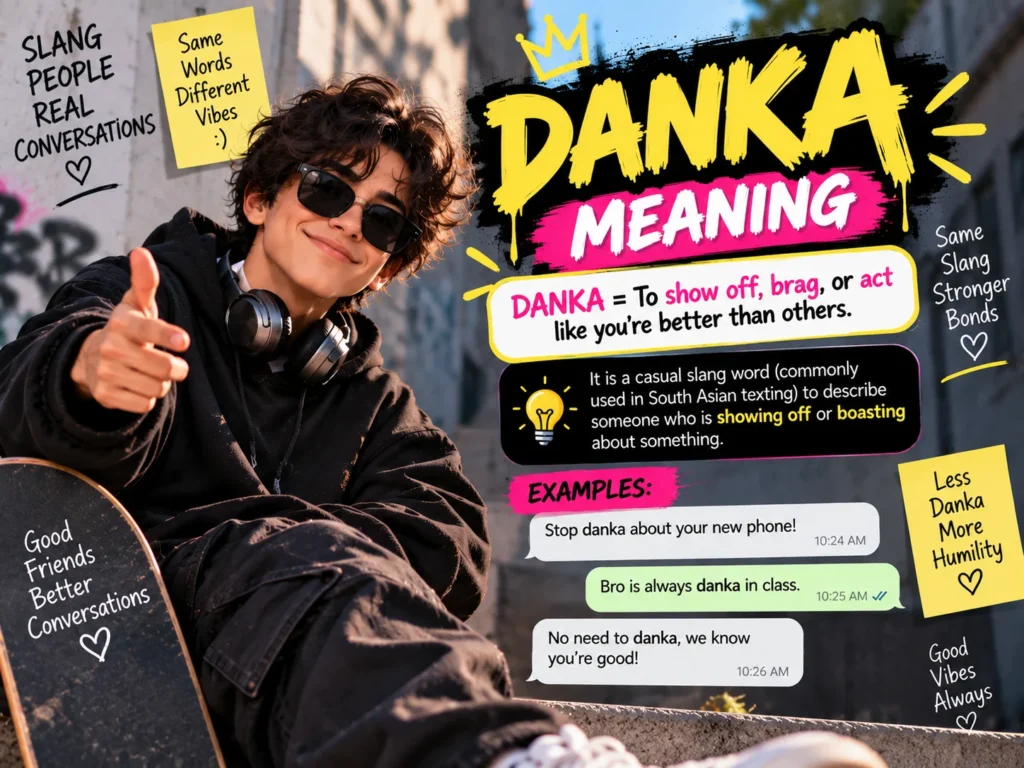
The word “danka” can be confusing because it appears in several very different contexts.
Someone familiar with Urdu or Hindi may immediately think of a large drum or kettledrum. In traditional expressions, the same word can also represent fame, public recognition, authority, or making something widely known.
Someone encountering it in an English-language chat may wonder whether it is internet slang.
That is where things become less certain.
Unlike LOL, IDK, or BRB, danka is not a widely standardized English texting abbreviation. A few informal slang sources use it playfully for something like “thank ya” or “thanks,” but this is niche rather than a universally recognized definition.
Its strongest documented meaning comes from South Asian languages and culture.
Understanding the context therefore matters much more than assuming every appearance belongs to internet slang.
Danka – Quick Meaning
In Urdu and Hindi, danka (ڈنکا / डंका) traditionally refers to a:
- large drum;
- kettledrum;
- ceremonial drum;
- drum associated historically with announcements or authority.
Rekhta defines it as a large kettle-drum and also records figurative meanings such as publicity, notoriety, fame, and prominence.
For example:
“Uska danka baj raha hai.”
Depending on context, this can figuratively suggest:
“His name or fame is spreading everywhere.”
Another expression:
“Danka bajana.”
can mean literally to beat a drum, but figuratively it can mean:
“to announce publicly”
“to make something famous”
“to proclaim something openly.”
Rekhta specifically records “danka bajana” with meanings including announce, proclaim, make public, and make famous.
In niche English slang, you may occasionally find:
“Danka!”
used jokingly like:
“Thanks!” or “Thank ya!”
but this is not a mainstream definition.
Origin & Background
Traditional South Asian Meaning
The established word belongs to older South Asian vocabulary.
Rekhta traces danka to Sanskrit and identifies it as a masculine noun referring to a large kettledrum or similar instrument.
Historically, drums had functions beyond music.
They could signal:
royal arrival;
public announcements;
military movement;
ceremonies;
celebrations;
important proclamations.
That cultural background helps explain why the word developed metaphorical associations with public attention and fame.
If something was announced with a loud drum, everybody nearby would hear about it.
Eventually, “the drum sounding” could figuratively imply:
“Everyone knows about this.”
From Drum to Fame
Language often turns physical actions into metaphors.
Think about the English phrase:
“beat the drum for someone.”
It can mean publicly promoting or supporting that person.
A similar semantic development happened with danka-related expressions.
Rekhta records danka bajna with meanings such as:
being proclaimed;
becoming famous;
creating a stir;
gaining prominence;
having one’s name widely known.
So when someone says a person’s “danka is sounding,” they may not be discussing an actual musical instrument at all.
They may be talking about reputation.
Social Media Influence
Modern South Asian social media has kept traditional expressions alive while giving them a more casual flavor.
A sports fan might say that a player’s “danka” is sounding everywhere.
A creator may use the expression to describe someone becoming famous.
A political, entertainment, or gaming discussion may use it metaphorically for dominance or influence.
The core idea remains similar:
being noticed loudly and publicly.
Real-Life Conversations
Person A: He won another competition today.
and,
Person B: Ab to uska danka baj raha hai 😂
moreover,
Person A: Seriously, everyone knows him now.
Here, the phrase refers to growing fame or recognition.
Instagram DMs
Person A: Why did you write “danka” in the caption?
Person B: I meant his name is everywhere now.
and,
Person A: Oh, like he’s become famous?
Person B: Exactly.
This is a figurative rather than literal use.
TikTok Comments
Person A: This player is dominating every match.
and,
Person B: Bhai ka danka baj raha hai 🔥
moreoever,
Person A: No one can stop him right now.
Here, the expression suggests dominance, reputation, and success.
Text Message
Person A: Thanks for sending the answer.
Person B: Danka 😂
and,
Person A: Do you mean “thank ya”?
Person B: Yeah lol.
This final example represents a niche playful usage rather than standard English slang.
Emotional & Psychological Meaning
The traditional figurative form has a strong emotional quality.
It often communicates:
admiration;
pride;
dominance;
recognition;
success;
public reputation.
If someone says:
“Uske naam ka danka baj raha hai,”
they are emphasizing that the person has become difficult to ignore.
It feels stronger than simply saying:
“He is known.”
The imagery suggests that his name is being announced loudly.
Why Drum Imagery Works
Drums are naturally attention-grabbing.
You cannot quietly beat a large ceremonial drum.
That makes the metaphor psychologically powerful.
Something associated with a danka is not hidden.
It is:
public;
noticeable;
loud;
celebrated;
widely discussed.
A Personal-Style Scenario
Imagine a young athlete from a small town begins winning national competitions.
At first, only local people know the athlete.
Then videos spread online.
News pages mention the victories.
Other athletes start discussing the performance.
Friends might proudly say:
“Ab iska danka poore mulk mein baj raha hai.”
The emotional message is:
“This person’s reputation has become impossible to ignore.”
That sense of pride and public recognition explains why the expression remains memorable.
Usage in Different Contexts
Urdu and Hindi Conversation
This is where the established meaning is strongest.
The word may literally describe a drum, but figurative expressions are extremely common.
Rekhta records related senses involving fame, proclamation, publicity, authority, and recognition.
Social Media
Users may apply the word to someone who is:
winning repeatedly;
becoming famous;
dominating a field;
receiving public attention;
building a powerful reputation.
For example:
“Is bande ka danka baj raha hai.”
The sentence may mean the person is currently extremely prominent.
Sports
Sports commentary fits the metaphor particularly well.
A fan might use the expression when a player consistently performs better than competitors.
Here, the implication is:
“Everyone is talking about this player.”
Politics and Public Life
The expression can also describe power, authority, or public influence.
Because this is figurative language, the precise emotional tone depends on whether the speaker admires or criticizes the person being discussed.
English Texting
In ordinary English chats, the term is much less standardized.
A niche slang site records “Danka” as a playful form of “thank ya” or “thanks,” but this usage should not be assumed outside the group using it.
If someone sends only:
“danka”
in an English-language conversation, asking what they mean may be the safest response.
When NOT to Use It
Avoid the term when your audience is unlikely to understand South Asian vocabulary.
For example, writing:
“His danka is everywhere”
to someone unfamiliar with Urdu or Hindi may produce confusion.
Use:
“His reputation is spreading.”
“He has become very famous.”
“Everyone is talking about him.”
Formal English Writing
The Romanized word generally does not belong in formal English documents unless you are:
explaining the term;
quoting someone;
discussing South Asian language or culture;
analyzing an idiom.
In an academic paper, define it clearly on first use.
Do Not Assume It Means Thanks
The niche “thank ya” interpretation is not established strongly enough to treat as the standard definition.
If someone unfamiliar with that slang receives:
“danka”
they may have no idea what you mean.
Do Not Confuse Similar Spellings
A particularly important example is Danke.
In German:
Danke = Thank you.
That is a completely different word.
Someone typing “danka” may occasionally be misspelling “danke,” but you should not automatically assume that.
Common Misunderstandings
Danka and Danke Are Different
This may be the biggest international confusion.
Danka is an established South Asian word.
Danke is German for “thank you.”
They look similar, but their linguistic backgrounds are different.
It Does Not Only Mean a Drum
The literal object is a drum or kettledrum.
However, figurative usage can communicate:
fame;
publicity;
power;
prominence;
public proclamation.
Rekhta documents both the literal and metaphorical senses.
It Is Not Standard English Internet Slang
Some online slang databases may list playful meanings, but there is no strong evidence that English speakers generally use danka as a widespread abbreviation.
That distinction matters for accurate interpretation.
“Danka Bajana” Is Often Figurative
Someone saying this phrase may not be telling anybody to play an instrument.
It can mean:
“make it publicly known”
or:
“spread someone’s fame.”
Danka and Danka Bajna Are Slightly Different
and,
Danka bajana involves causing the drum to sound—literally or metaphorically proclaiming something.
moreover,
Danka bajna can describe the drum sounding or, figuratively, someone’s fame or authority being established.
Rekhta records these closely related idiomatic uses separately.
Danka Compared With Related Expressions
| Term | Typical Meaning | Context |
|---|---|---|
| Danka | Kettledrum / ceremonial drum | Urdu/Hindi |
| Danka bajana | Proclaim / make famous | Figurative idiom |
| Danka bajna | Fame or recognition spreading | Figurative idiom |
| Shohrat | Fame | Urdu |
| Charcha | Public discussion / buzz | Urdu/Hindi |
| Naam hona | Become well known | Casual speech |
| Famous | Widely known | English |
| Hype | Strong public attention | Internet slang |
| Danke | Thank you | German |
| Danka | “Thank ya” in niche slang | Rare English slang |
Key Insight
The traditional South Asian meaning is much better established than the niche English-texting interpretation. If the conversation involves fame, dominance, reputation, Urdu, Hindi, or South Asian culture, the drum-based figurative meaning is usually the better clue.
Variations and Types
1. Danka
Meaning: Kettledrum or large ceremonial drum.
This is the basic dictionary meaning.
2. Danka Bajana
Meaning: To beat the drum; figuratively, to proclaim something publicly.
It can also suggest making someone or something famous.
3. Danka Bajna
Meaning: The drum is sounding; figuratively, fame or authority is spreading.
Rekhta lists senses including becoming famous and being publicly known.
4. Naam Ka Danka Bajna
Meaning: Someone’s name or reputation becomes widely known.
This is a strongly figurative expression.
5. Danka Peetna
Meaning: To beat the drum or publicly announce something.
It can suggest spreading information widely.
6. Danka Baja Kar
Meaning: Openly or publicly.
The image is of announcing something loudly instead of hiding it.
7. Danka Maarna
Meaning: To make a name or gain recognition.
Rekhta records this among related expressions.
8. Danka as Fame
Meaning: Reputation or prominence.
Here the instrument itself becomes a metaphor for social recognition.
9. Danka as Thanks
Meaning: Playful “thank ya.”
This appears in niche user-generated slang references, but it is not standard English usage.
10. Danke
Meaning: German “thank you.”
This is technically a different word, but it is worth including because people frequently confuse the spelling.
How to Respond When Someone Uses It
Your response depends on context.
If They Mean Fame or Success
You could reply:
“Absolutely, everyone knows him now.”
“He’s really made a name for himself.”
“His success is everywhere.”
“True, he’s dominating right now.”
Funny Replies
If a friend says:
“Tera danka baj raha hai 😂”
you might respond:
“Bas bas, itni bhi fame nahi 😭”
or in English:
“Don’t make me famous already 😂”
“Autographs later.”
If They Mean Thanks
You could respond:
“No problem!”
“Anytime.”
“You’re welcome.”
But only choose this interpretation if the conversation clearly supports it.
Respectful Replies
If you do not know what someone means:
“Do you mean danka as in fame/publicity?”
“Are you using it as slang for thanks?”
“What does danka mean here?”
That is especially useful in multilingual chats.
Regional & Cultural Usage
Pakistan
In Urdu-speaking Pakistani contexts, ڈنکا and expressions built around it can describe a drum, proclamation, fame, or dominance.
The figurative uses are culturally familiar even when no real instrument is involved.
India
Hindi also uses डंका for a kettledrum and figurative expressions involving fame and public announcement.
WisdomLib’s Hindi dictionary entry similarly records danka as a kettledrum and danka bajana as making something public or famous.
Western Internet Culture
The term is not a mainstream Western internet abbreviation.
Users who encounter it may interpret it as:
a foreign-language word;
a person’s name;
a typo;
or niche slang.
That uncertainty is normal.
Global Internet Usage
Social media increasingly mixes languages.
A Romanized Urdu or Hindi expression can appear inside an otherwise English post:
“Bro ka danka baj raha hai worldwide 🔥”
Such mixing is common in multilingual online culture.
Understanding the original language gives a much more accurate interpretation than searching only English acronym databases.
Gen Z vs. Millennials
Both generations may know the traditional expression in South Asian communities.
Gen Z users are more likely to combine it with internet-style English:
“Bhai ka danka baj raha fr 🔥”
while older speakers may use the idiom in more traditional Urdu or Hindi sentences.
The underlying meaning remains similar.
Is Danka Safe for Kids?
Yes.
The established Urdu/Hindi word itself is harmless.
Its literal definition refers to a drum, while figurative uses involve:
fame;
reputation;
public announcement;
success;
authority.
There is no inherent profanity or adult meaning.
A child-friendly explanation is:
“Danka is a type of large drum. When people say someone’s danka is sounding, they may mean that person has become very famous or successful.”
Children learning languages can also benefit from knowing that one literal word can develop metaphorical meanings over time.
FAQs
What does danka mean?
In Urdu and Hindi, danka commonly refers to a large kettledrum or ceremonial drum. Figuratively, it can represent fame, prominence, authority, publicity, or public proclamation.
What does danka mean in Urdu?
Urdu ڈنکا refers literally to a type of drum or naqqara. Rekhta also records figurative meanings including fame, publicity, and prominence.
What does “danka bajana” mean?
Literally, it means to beat or sound a drum. Figuratively, it can mean to announce, proclaim, make public, or spread someone’s fame.
What does “danka bajna” mean?
It can literally describe a drum sounding, but figuratively it often means becoming famous, gaining recognition, creating a stir, or establishing authority.
Does danka mean thank you?
Not in standard English, Urdu, or Hindi. A niche user-generated slang source records “danka” as a playful form of “thank ya,” but this meaning is not widely standardized.
Is danka the same as German “danke”?
No. Danke is the German word for “thank you.” Danka is a different word with established South Asian meanings.
What does “naam ka danka bajna” mean?
It refers figuratively to someone’s name becoming famous or widely recognized. The image is of a drum announcing that person’s reputation publicly.
Conclusion
Danka is much more than random internet slang.
Its strongest established meaning comes from Urdu and Hindi, where it refers to a large drum or kettledrum.
From that literal instrument grew a much richer set of figurative meanings.
A drum is loud.
It attracts attention.
Historically, it could accompany announcements, authority, ceremony, or public events.
That makes it a natural metaphor for fame and recognition.
When someone’s “danka baj raha hai,” the speaker may be saying that person’s reputation is spreading, their success is being noticed, or their influence has become impossible to ignore.
Expressions such as danka bajana can similarly communicate making something public, proclaiming it, or spreading someone’s name.
In English-language texting, you may occasionally see the word used jokingly for “thank ya,” but that interpretation is niche and should not be treated as the primary definition.
And remember one important spelling difference:
danka and danke are not the same word.
If you see the term in a South Asian conversation involving success, fame, reputation, or public attention, think of the powerful image behind it:
a drum loud enough for everyone to hear.
For high CTR (click-through rate), titles and descriptions should create curiosity, a clear benefit, and a reason to click without giving everything away.