We have all been there. You are staring at your phone, scrolling through a fast-paced group chat, and someone drops a simple, two-letter response: “ik.”
It feels abrupt. It looks minimal. Yet, it carries a mountain of unsaid context, tone, and emotion.
In a world dominated by instant messaging, language shifts faster than ever before. If you have ever wondered exactly what ik means in a text, how it changes the mood of a conversation, or why a simple lowercase acronym can feel completely different from an uppercase one, you are in the right place.
Understanding these micro-shifts in digital dialogue is no longer just about learning slang. It is about mastering the art of modern human connection. Let us dive deep into the psychology, mechanics, and unspoken rules of this essential text shorthand.
Decoding the Digital Shorthand: What “IK” Means
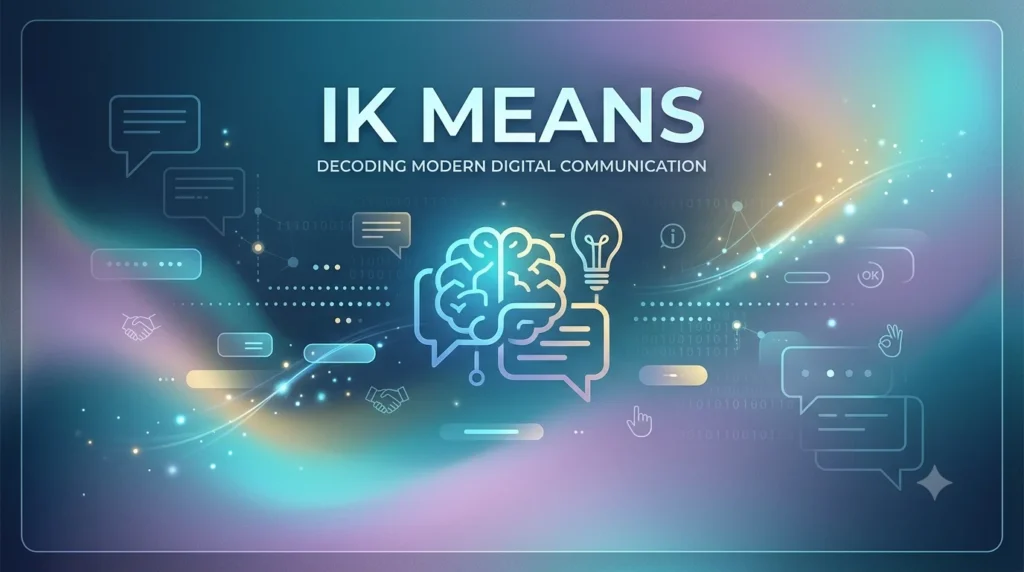
At its most basic, foundational level, ik means “I know.”
It serves as a rapid, friction-free way to acknowledge information that you are already aware of. Instead of typing out multiple words, digital native speakers use this acronym to keep the conversational momentum moving forward.
People search for this term because digital text lacks vocal tone. When someone says “I know” out loud, you can hear their warmth, their boredom, or their excitement. On a glowing screen, those two letters can look mysterious, leading to a lot of unnecessary overthinking.
“IK” Means – A Quick Guide to the Basics
Let us strip away the complexity for a moment and look at the pure definition of this ubiquitous texting abbreviation.
The Standard Definition
In everyday digital communication, ik means a quick nod of agreement or confirmation. It functions exactly like a physical head nod in a face-to-face conversation.
- IK / ik: Short for “I know.”
- Primary function: To confirm receipt of known information.
- Secondary function: To establish shared understanding or empathy.
Texting Examples in Action
“Yeah ik, we need to leave early if we want to catch the train.”
“ik right?? That plot twist at the end of the movie was completely extreme.”
“ik you’re busy, but call me whenever you get a free second.”
The Origins and Cultural Evolution of “IK”
This short acronym did not appear overnight. It has a rich history rooted in the evolution of consumer technology and shifting cultural norms.
The Dawn of T9 Word Prediction
Before smartphones with glass screens, we communicated using physical numeric keypads. Every character mattered because typing required pressing a single button multiple times. Acronyms like “ik” were born out of pure necessity to save time and finger strain.
The Social Media Explosion
As platforms like Twitter, Instagram, and TikTok emerged, character limits and fast-paced feeds forced language to become even tighter. What started as a technological workaround transformed into a stylistic choice, defining the unique voice of the internet generation.
Real-Life Conversations: “IK” in the Wild
To truly understand how this phrase functions, we need to observe it in its natural habitat. Notice how the lowercase or uppercase presentation changes the entire emotional temperature of the chat.
Scenario 1: A Casual WhatsApp Group Chat
Person A: Don’t forget that the assignment is due tonight at midnight!
and,
Person B: ik ik, I’m literally typing the final paragraph right now.
moreover,
Person A: Haha good luck, you’ve got this!
Scenario 2: An Instagram DM Exchange
Person A: That new coffee shop downtown is so pretty but the lines are huge.
Person B: ik! I waited for like twenty minutes yesterday just for an iced latte.
Person A: Oh wow, was it actually worth it though?
Scenario 3: A Fast-Moving TikTok Comment Section
Person A: The main character in this show deserves so much better.
Person B: ik ugh, I wanted to cry during the finale episode.
Scenario 4: A Late-Night Text Message
Person A: I’m really sorry for how I snapped earlier, I was just stressed.
Person B: ik, don’t worry about it. We are totally good.
The Emotional and Psychological Weight of “IK”
Texting is never just about the literal words on screen. Every keystroke carries psychological intent, reflecting our deep desire for efficiency and emotional alignment.
Efficiency vs. Empathy
When someone uses this phrase, they are balancing the need for speed with the need for connection. It shows that the person values keeping the conversation alive without weighing it down with formal phrasing.
The Power of Text Case
There is a massive psychological difference between “IK” and “ik.” Capitalizing both letters often indicates excitement, shock, or high energy. On the flip side, lowercase letters feel more relaxed, casual, or sometimes quietly detached.
A Personal Perspective on Texting Anxiety
A close friend of mine once admitted that receiving a solitary text reading “ik.” with a period made their heart sink. They assumed the recipient was angry. In reality, the sender was just rushing to catch a bus. This highlights how easily minimal text can create false narratives in our minds.
Navigating “IK” in Different Social Contexts
The appropriateness of this abbreviation depends entirely on who you are messaging and what platform you are using.
Social Media Feeds
On platforms like TikTok or X, brevity is king. Using short text forms makes you look like a natural participant in the digital ecosystem, keeping your comments sharp and engaging.
Friendships and Romantic Relationships
Between close connections, these two letters signify comfort. You do not need to perform or use perfect grammar because there is already a deep baseline of trust and mutual understanding established.
Workplace and Professional Environments
This is where you must be careful. Sending a simple “ik” to a manager or a client can easily be misread as dismissive, unprofessional, or lazy. In professional spaces, stick to polished phrases like “Understood” or “I am aware of this.”
When to Hit Pause: When NOT to Use “IK”
While incredibly convenient, there are specific boundaries where this slang term can cause serious communication breakdowns.
Heavy or Serious Situations
If someone is venting to you about a difficult breakup, a health scare, or a loss, replying with a short abbreviation feels cold and unsympathetic. Serious moments require fully spelled-out words to convey genuine human empathy.
Clearing Up Misunderstandings
When you are actively trying to resolve an argument, using ultra-short texting terms can make it seem like you are checking out of the conversation. It implies you want to end the discussion quickly rather than thoroughly listening.
Clearing Up Common Misunderstandings
Because text messaging lacks facial expressions, simple phrases are frequently misinterpreted by readers.
The Myth of Low Effort
Many people assume that short responses equal a lack of care. However, in modern texting culture, a rapid short reply often means the person wants to answer you immediately rather than making you wait for a long paragraph.
Literal Meaning vs. Text Tone
Literally, ik means “I know,” but figuratively, it can mean “I agree completely,” “Please stop reminding me,” or “I feel your pain.” Always look at the surrounding conversation to decode the true intent.
Comparing “IK” with Similar Digital Expressions
To better understand its unique place in our digital vocabulary, let us compare it to other common phrases.
| Expression | Core Meaning | Emotional Tone | Best Context |
| ik | I know | Casual, direct, neutral | Daily friendly chats |
| ikr | I know, right? | Highly agreeable, enthusiastic | Shared opinions |
| idk | I don’t know | Uncertain, open-ended | Questions, doubts |
| dw | Don’t worry | Reassuring, comforting | Calming someone down |
| Understood | I am aware | Formal, structured | Workplace, emails |
Key Insight
While terms like “ikr” inject explicit enthusiasm and agreement into a chat, “ik” remains a highly versatile, neutral tool that can adapt to almost any mood depending on punctuation and context.
The Variations: 10 Different Types of “IK” You See Daily
This acronym rarely travels alone. It frequently combines with other letters to create entirely new layers of meaning.
- ikr: Short for “I know, right?” used to show enthusiastic agreement.
- ikwum: Short for “I know what you mean,” which validates someone’s perspective.
- ikyl: Short for “I know you’re lying,” often used playfully when someone shares shocking news.
- ik rly: Short for “I know, really,” which adds emphasis to a shared truth.
- ik ik: Repeating the phrase twice to signal that you are fully aware and do not need more reminders.
- ik ty: Short for “I know, thank you,” blending acknowledgement with quick gratitude.
- ik lol: Combining the phrase with “laugh out loud” to show you find a known situation amusing.
- ik smh: Pairing it with “shaking my head” to express mutual frustration or disappointment.
- ik hms: Short for “I know, hate myself,” used humorously when admitting a bad habit.
- ik ig: Short for “I know, I guess,” which displays a reluctant or hesitant agreement.
How to Respond When Someone Texts You “IK”
The way you reply depends entirely on the energy you want to bring back to the conversation.
Casual and Easy Replies
- “Cool, just wanted to make sure!”
- “Awesome, talk to you in a bit.”
- “Perfect.”
Playful and Funny Replies
- “Oh, so you’re psychic now? 😂”
- “Just making sure your brain is working today!”
- “Brag about it why don’t you!”
Mature and Direct Replies
- “Glad we are on the same page about this.”
- “Thanks for confirming, appreciate it.”
Respectful Replies
- “Thank you, let me know if anything changes.”
- “Understood, have a great evening.”
Regional, Cultural, and Generational Differences
Language does not exist in a vacuum. It changes drastically based on who is typing behind the screen.
Western vs. Global Internet Culture
In Western digital spaces, this acronym is staple shorthand. In many Asian or Middle Eastern digital cultures, while English acronyms are widely understood, local phonetic slang or localized character combinations are often preferred for daily chatting.
The Generational Divide: Gen Z vs. Millennials
Millennials often prefer punctuation, proper capitalization, and complete sentences, sometimes viewing short abbreviations as overly curt. Gen Z, however, views lowercase acronyms as the gold standard of casual, authentic communication, viewing full sentences as overly tense or formal.
Is This Slang Safe for Kids to Use Online?
If you are a parent tracking your child’s online activity, you can breathe a sigh of relief. This acronym is entirely safe, clean, and benign.
It carries no hidden inappropriate meanings, adult connotations, or dangerous double meanings. It is a completely standard linguistic shortcut used purely for conversational speed across gaming chats, social apps, and text platforms.
Frequently Asked Questions
Does “ik” mean something rude in a text message?
Not inherently. While it is completely neutral, sending it completely on its own without any emojis or extra words can sometimes look short or blunt to sensitive readers.
What is the difference between “ik” and “ikr”?
“ik” simply states that you already possess a piece of information. “ikr” (I know, right?) goes a step further by actively agreeing with the sentiment or opinion stated by the other person.
Can I use “ik” in a professional email?
It is best to avoid it. Using casual abbreviations in business environments can look lazy or overly informal. Stick to full phrases like “Thank you for the update” or “I am aware.”
Why do people type “ik ik” twice in a row?
Repeating it usually means the person is fully aware of what you are saying and is gently asking you to stop repeating the point or reminding them about it.
Does “IK” have any other meanings outside of texting?
In specific technical fields, it can stand for Inverse Kinematics (in 3D animation) or Internet Key (in tech security), but online chatting almost always means “I know.”
Conclusion: Embracing the Future of Communication
Digital slang is not ruining our ability to communicate; it is simply evolving it. A short phrase like “ik” represents our incredible human ability to adapt, streamline, and inject emotional nuances into tiny packages of text.
By understanding the subtle differences in how these phrases are used, you can communicate more confidently, avoid digital overthinking, and keep your daily conversations flowing beautifully.