Every few years, a piece of slang breaks out of internet subcultures, leaps across social media algorithms, and firmly plants itself in our everyday vocabulary. If you have spent any time scrolling through TikTok, reading comment sections on Instagram, or watching viral news clips lately, you have likely run into a four-letter acronym that feels both intense and wildly satisfying to say.
People use it as a warning, a boast, or a blunt explanation for why someone’s bad choices backfired on them. But what exactly does it stand for, where did it come from, and how do you use it without completely misreading the room?
Understanding modern slang is about more than just translating acronyms. It is about reading the social cues, the emotional undertones, and the invisible boundaries that dictate our digital conversations. Let’s break down the FAFO full form, explore its deeply human psychology, and look at how it reshaped modern communication.
FAFO Full Form: The Quick Meaning
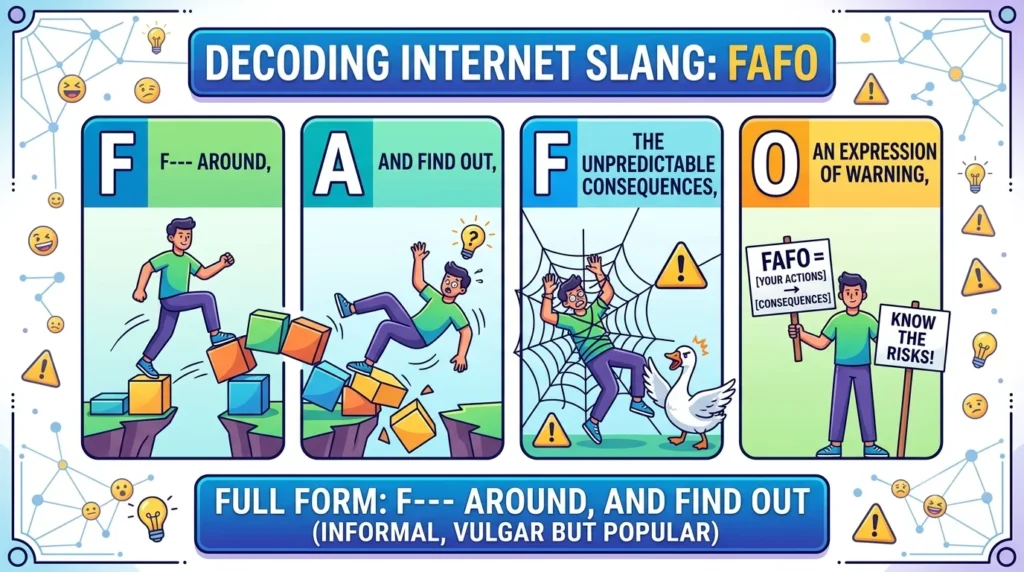
At its core, the FAFO full form stands for Fuck Around and Find Out.
It is a contemporary, street-smart idiom that serves as a direct modern equivalent to the classic proverb, “reap what you sow.” Essentially, it means that if you test boundaries, behave recklessly, or deliberately provoke a situation, you will inevitably have to face the harsh, unpleasant consequences of your actions.
A Quick Breakdown of the Phrase
- Fuck Around: To misbehave, push limits, play with danger, or act foolhardily.
- And Find Out: To experience the direct, often painful repercussions of that behavior.
“Essentially, FAFO functions as a casual law of cause and effect. It is the internet’s way of explaining karma with an aggressive, no-nonsense attitude.”
Everyday Examples in Context
- “He decided to cut off the bouncer at the club door, and well… he quickly had to FAFO.”
- “If you don’t study for this final exam and think you can just wing it, you are about to find out.”
- “They kept trolling the wrong community online until their account got deleted. Classic case of FAFO.”
Origin and Background: From Quiet Grittiness to Viral Fame
Slang rarely pops up overnight out of nowhere. It usually bubbles beneath the surface of specific communities for decades before the rest of the world catches on.
The Early Roots
While the exact physical origin is tough to pin down, language experts note that variations of “around and find out” have been used in military, law enforcement, and blues music spaces for over half a century. It was originally used as a quiet, deadly serious threat between individuals. It wasn’t a joke; it was a promise of physical or legal retaliation.
The Social Media Explosion
The phrase shifted dramatically around 2020. During a wave of political unrest, viral protests, and intense public debates, a visual chart known as the “FAFO Graph” went viral on TikTok and X (formerly Twitter).
The meme used a simple mathematical axis to show a direct correlation: the more you “fuck around,” the more you will “find out.” Suddenly, millions of users had a funny, visually striking way to label real-world failures.
The Modern Evolution
Today, the phrase has shed some of its purely aggressive edges. It has evolved into a cultural shorthand used by everyone from Gen Z TikTokers to corporate professionals speaking off-the-record. It has transitioned from a literal street warning into a grand philosophical statement about accountability in the digital age.
Real-Life Conversations: How It Looks in Your Inbox
To truly understand how a phrase breathes, you need to see it in its natural habitat. It looks entirely different depending on which app you open.
Scenario 1: The WhatsApp Group Chat (Discussing a reckless friend)
Person A: Did Alex seriously text his ex at 2:00 AM after she explicitly told him to lose her number?
Person B: Yep. She screenshot the messages, sent them to his sister, and blocked him everywhere.
Person A: Man… talk about a total FAFO moment. He brought that entirely on himself.
Scenario 2: The Instagram DM (Talking about a workplace risk)
Person A: I’m honestly thinking about replying to the manager’s passive-aggressive email with just a thumbs-up emoji.
Person B: Please don’t do that lol. She is in a terrible mood today.
Person A: Let her be mad. Sometimes you just gotta FAFO and see what happens.
Person B: RIP to your career, I’ll miss you.
Scenario 3: The TikTok Comment Section (On a video of a prank gone wrong)
User 1: The way the street performer didn’t even hesitate to grab his microphone back 😂
and,
User 2: He thought he was going to get views but got a reality check instead.
moreover,
User 3: Rule number one of the streets: Do not mess with people trying to make a living. FAFO certified.
Scenario 4: Text Messages (A casual warning between siblings)
Person A: Are you using Mom’s expensive espresso machine without asking her first?
Person B: Yeah, why? It’s just coffee.
Person A: Because she explicitly said nobody touches it. Keep messin’ around, you’re gonna find out.
Emotional and Psychological Meaning: Why We Love Saying It
There is a deep psychological satisfaction that comes with using this acronym. It taps into our innate human desire for justice, balance, and cosmic alignment.
The Craving for Accountability
We live in a chaotic world where it often feels like people get away with bad behavior, rudeness, or outright selfishness. When someone finally faces the music for their actions, saying “they found out” provides an intense sense of psychological closure. It reassures us that actions still have consequences.
A Shield of Confidence
When you use the acronym as a warning, it projects an aura of absolute boundaries. It signals that you are calm, collected, and utterly unfazed by someone else’s attempts to intimidate or provoke you. You aren’t yelling; you are simply stating a fact of life.
The Communication Pivot
In the past, setting a boundary required a long, emotionally draining conversation. Modern communication values brevity. This slang allows individuals to establish a firm, protective line instantly, wrapping their personal boundaries in a layer of contemporary humor.
A Quick Personal Perspective
A few months ago, a local business owner I know decided to publicly attack a customer who left a polite, constructive three-star review online. Instead of taking the feedback, the owner insulted the customer’s appearance.
Within forty-eight hours, hundreds of community members flooded the business page with negative reviews, forcing a public apology. Watching it unfold, the entire local community felt that exact emotion: a collective realization that the business owner had crossed a line and immediately suffered the natural consequences.
Usage in Different Contexts: Reading the Room
Like any piece of language containing a profanity, context is everything. Use it in the wrong place, and you go from sounding trendy to sounding incredibly unprofessional or unhinged.
On Social Media
This is the safest zone. On platforms like TikTok, X, and Instagram, the phrase is practically universal. You can use it in captions, comments, and memes quite freely to describe everything from politics to a cat knocking a glass vase off a counter.
Friends and Close Relationships
Among peers, it serves as a great tool for tough love. It allows you to warn a friend against making a bad dating choice or a goofy mistake without sounding like an overbearing parent. It keeps the mood light while still delivering a clear warning.
Work and Professional Settings
Proceed with extreme caution here. You should never use the literal acronym or the full vulgar phrase in formal emails, Slack channels, or client meetings.
However, if you are having a casual, off-the-clock lunch with trusted coworkers, you might use it to describe a competitor’s failed, overly aggressive marketing strategy.
Casual vs. Serious Tones
The phrase easily morphs to fit your delivery. Said with a laugh, it is a funny way to mock a minor mistake. Said with a flat, unblinking expression, it becomes a deadly serious warning that someone is crossing a line they cannot uncross.
When NOT to Use It: Setting Boundaries on the Slang
Because the phrase carries an inherently confrontational weight, there are several situations where deploying it is a terrible idea.
In True Grievances or Tragedies
If someone experiences a genuine, heartbreaking tragedy or an unfair systemic failure, using this phrase is incredibly cruel. It implies that the victim deserved what happened to them. Never use it to describe situations involving genuine suffering or unprovoked harm.
Upward Professional Communication
Do not say this to your boss, your professors, or your clients. Even if they use colorful language themselves, telling a supervisor they might “find out” sounds like a direct insubordination or a physical threat. Stick to traditional phrases like “evaluating the potential risks.”
Cross-Cultural Misunderstandings
If you are communicating with international colleagues or people who speak English as a second language, this acronym can easily confuse or alarm them. The literal translation sounds incredibly hostile out of context, leading to unnecessary defensiveness.
Common Misunderstandings: What People Get Wrong
Because internet culture moves at lightning speed, words frequently get twisted along the way.
The Misconception of Bullying
Some people mistake the phrase for an expression of pure aggression or bullying. In reality, true FAFO requires the other person to initiate the conflict. It is a defensive concept, not an offensive one. You cannot apply it if you are the one who started the trouble.
Literal vs. Figurative Confusion
When a teenager says they “fucked around and found out” that mixing soda and milk tastes awful, they are using it figuratively. They didn’t break a sacred law; they just made a silly mistake. Beginners often struggle to differentiate between a lighthearted joke and a genuine warning.
Comparing FAFO to Similar Expressions
To understand exactly where this phrase sits in the English lexicon, it helps to look at it side-by-side with its linguistic cousins.
| Expression | Core Tone | Best Used For | Intensity Level |
| FAFO | Edgy, No-Nonsense, Modern | Direct consequences of reckless provocation | High |
| Karma | Spiritual, Patient, Quiet | Cosmic, long-term balance of good and bad | Low to Medium |
| Play unwise games, win unwise prizes | Sarcastic, Witty, Academic | Foolish actions leading to obviously predictable failures | Medium |
| Reap what you sow | Traditional, Biblical, Serious | Long-term moral consequences of life choices | High |
| What goes around comes around | Conversational, Patient | Reflecting on someone’s interpersonal behavior | Medium |
Key Insight
While older terms like “karma” imply that the universe will naturally handle things in due time, FAFO implies an immediate, direct, and often human-led response to bad behavior. It replaces patient waiting with instant accountability.
10 Variations and Types of the FAFO Expression
Depending on the platform, the audience, and the level of politeness required, the phrase can change its outfits. Here are the most common variations you will encounter across the internet:
1. Around and Find Out
- Meaning: The PG-rated, cleaned-up version.
- Explanation: Used when you want to keep the exact same energy but need to avoid using explicit words on heavily moderated platforms.
2. Play Unwise Games, Win Unwise Prizes
- Meaning: The witty, slightly older cousin of the phrase.
- Explanation: Focuses heavily on the sheer predictability of the bad outcome rather than the confrontation itself.
3. The FAFO Scale / Graph
- Meaning: A reference to the viral meme format.
- Explanation: Used to visually or structurally explain how someone’s trouble increases the more they push boundaries.
4. Mess Around and Find Out
- Meaning: A softer, highly conversational alternative.
- Explanation: Perfect for text messages with family members or cousins where you want to be casual without being vulgar.
5. Poke the Bear
- Meaning: The classic idiomatic version.
- Explanation: Highlights the specific danger of provoking someone who is noticeably stronger or more powerful than you are.
6. Flying Too Close to the Sun
- Meaning: The mythological, dramatic variation.
- Explanation: Used when someone’s overconfidence or massive ego directly leads to their dramatic downfall.
7. Testing the Waters
- Meaning: The cautious, introductory stage of the phrase.
- Explanation: Refers to the initial actions someone takes right before they cross over into true trouble.
8. Digging Your Own Grave
- Meaning: The grim, long-term consequence version.
- Explanation: Emphasizes that the person is actively working toward their own destruction step by step.
9. Instant Karma
- Meaning: The rapid-response variation.
- Explanation: Specifically used when the time between the bad action and the terrible consequence is only a matter of seconds.
10. Pulling the Tail of the Tiger
- Meaning: The global, descriptive alternative.
- Explanation: Paints a vivid picture of a small, foolish entity provoking an incredibly dangerous force.
How to Respond When Someone Uses It
If someone tosses this acronym your way in a message or a comment, your response determines where the conversation goes next.
Casual Replies
- “Fair enough, point taken!”
- “Message received loud and clear.”
- “Haha, I’m backing away slowly.”
Funny Replies
- “Consider my curiosity officially cured.”
- “I looked into the abyss and the abyss told me to go home.”
- “Gonna go ahead and uninstall that idea real quick.”
Mature Replies
- “You’re right, it’s not worth pushing this any further.”
- “I appreciate the reality check before things got out of hand.”
- “Let’s step back and look at this logically instead.”
Respectful Replies
- “Understood, I will respect that boundary completely.”
- “Thank you for clarifying where the line is.”
- “I didn’t mean to push limits, I’ll adjust accordingly.”
Regional and Cultural Usage: A Global Perspective
Language changes colors as it crosses geographical borders and generational divides. The way this phrase is received depends heavily on who is listening.
Western Culture
In the United States and the United Kingdom, the phrase is deeply tied to digital internet culture, political commentary, and urban slang. It is generally understood as a sign of rugged individualism and personal accountability.
Asian Culture
In many traditional Asian communication spaces, direct confrontation is actively discouraged in favor of preserving social harmony. Consequently, using a blunt phrase like this can feel shockingly aggressive. Younger generations in cosmopolitan cities use it online, but it remains strictly confined to peer groups.
Middle Eastern Culture
Similar to Asian communication styles, respect, hospitality, and formal manners hold massive weight here. The direct translation of the phrase can easily be interpreted as a severe personal insult or an open declaration of hostility rather than a casual internet joke.
Global Internet Usage
On global platforms like Reddit or Twitch, the acronym functions as an international passport. It transcends physical borders entirely, uniting gamers, sports fans, and meme creators under a single shared understanding of internet-style justice.
Generational Differences: Gen Z vs. Millennials
- Gen Z: View the acronym as a versatile, everyday tool. They use it casually, ironically, and frequently apply it to incredibly minor, low-stakes situations for comedic effect.
- Millennials: Tend to use the phrase with a bit more intentionality. They often deploy it when discussing larger cultural events, workplace drama, or clear instances of public hypocrisy.
Is It Safe for Kids?
As an educator, this is a question I hear frequently from parents trying to keep up with their children’s text messages. The short answer is: unfiltered, no; conceptually, yes.
Because the first letter represents a major profanity, the literal phrase is inappropriate for young children, school environments, and formal assignments. However, the concept behind it—that choosing a reckless action means you must accept the consequence—is a fundamental life lesson.
If your kids are using the cleaned-up versions like “mess around and find out,” they are simply participating in modern social bonding. It is an opportunity to teach them about the power of words, the importance of context, and how to express boundaries cleanly without relying on vulgarity.
Frequently Asked Questions
Is FAFO considered a curse word?
The acronym contains a major profanity, so the full spoken version is a curse word. The written acronym is viewed as edgy slang.
What is the origin of FAFO?
The phrase grew out of mid-20th-century American military and street slang before blowing up as a viral internet meme chart around 2020.
How do you use FAFO in a sentence?
You use it to describe someone facing consequences, such as: “He kept testing his luck until he finally had to FAFO.”
What is the polite version of FAFO?
The most common polite alternatives are “play unwise games, win unwise prizes” or simply “mess around and find out.”
Why did FAFO become so popular on TikTok?
It became popular because it perfectly captures the high-energy desire for instant accountability and dark humor that defines modern internet culture.
Conclusion: The Ultimate Law of Digital Karma
At the end of the day, slang succeeds because it fills a gap in our existing vocabulary. The popularity of the phrase reveals something deeply human about our current cultural moment: we are collectively tired of people pushing boundaries without facing consequences. We crave clarity, fairness, and direct communication.
By understanding the history, the boundaries, and the emotional weight behind this phrase, you can navigate modern digital spaces with total confidence. Just remember to read the room, respect the boundaries of others, and always think twice before you decide to go out there and find out for yourself.