If you spend time on social media, messaging apps, online games, or group chats, you’ve probably come across the abbreviation STFU. It appears in memes, TikTok comments, Instagram replies, text messages, and even casual conversations among friends.
Many people search for the STFU full form in chat because they encounter it unexpectedly and aren’t sure whether it is meant as a joke, an insult, or simply internet slang. The confusion often comes from the fact that the expression can carry very different emotions depending on the context.
Sometimes it’s used playfully between close friends. In other situations, it can sound rude, aggressive, or dismissive. Understanding the meaning behind STFU helps prevent misunderstandings and allows you to communicate more effectively online.
This guide explains exactly what STFU means, where it came from, how people use it today, and when it’s best to avoid using it.
STFU Full Form in Chat – Quick Meaning
What Does STFU Mean?
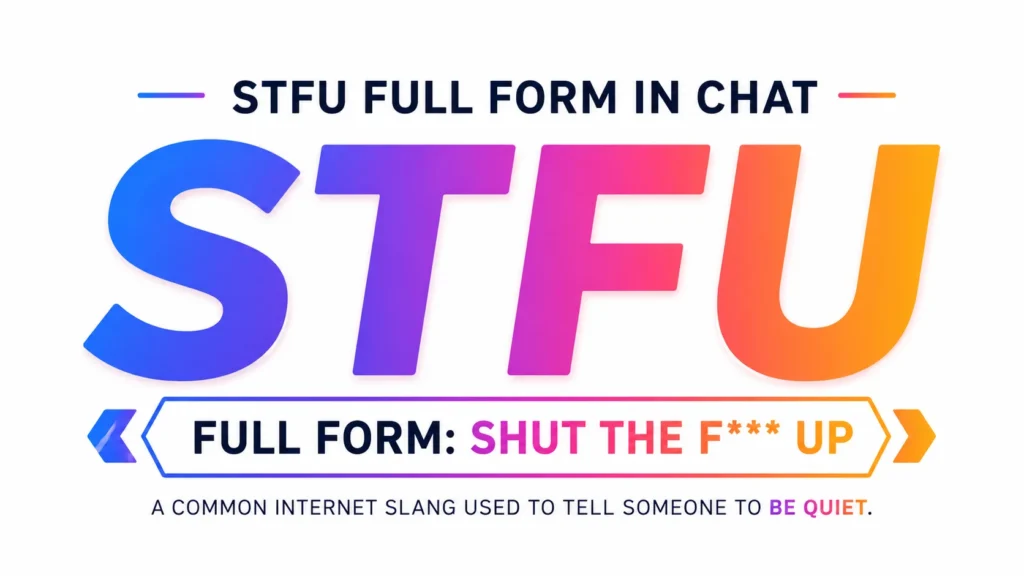
STFU stands for “Shut The F* Up.”**
It is an internet abbreviation used to tell someone to stop talking. Depending on the tone and relationship between the people involved, it can be:
- Playful
- Sarcastic
- Surprised
- Annoyed
- Angry
- Offensive
The meaning often depends more on context than on the words themselves.
Quick Definition
- Full Form: Shut The F*** Up
- Category: Internet slang
- Used In: Text messages, social media, gaming chats, forums
- Tone: Informal and often strong
- Can Be Offensive: Yes, depending on usage
Example Messages
“STFU, no way you actually met that celebrity!”
“STFU, that’s the funniest thing I’ve heard all week.”
“Please STFU and let me finish explaining.”
The first two examples show excitement and disbelief, while the third expresses frustration.
Origin & Background
Where Did STFU Come From?
The phrase “shut up” has existed in English for centuries as a direct way to tell someone to stop speaking. As internet culture expanded in the 1990s and early 2000s, users began shortening common expressions into acronyms.
STFU emerged as a faster way to type a stronger version of “shut up.”
Chat rooms, online gaming communities, and message boards helped spread the abbreviation across the internet.
Cultural Influence
Internet culture often rewards speed and brevity. Acronyms like LOL, BRB, OMG, and STFU became popular because they allowed users to communicate emotions quickly.
As online communities developed their own language, STFU became part of the shared vocabulary of digital communication.
Social Media Impact
Platforms such as Instagram, TikTok, Snapchat, X, and Discord accelerated the popularity of STFU.
Many users began using it humorously rather than aggressively. For example, someone reacting to shocking gossip might type:
“STFU, you’re kidding!”
In this context, the phrase expresses surprise rather than hostility.
How the Meaning Evolved
Originally, STFU was viewed as highly confrontational.
Today, younger internet users often use it in a playful way among friends. Nevertheless, its original meaning remains strong, so context still matters greatly.
Real-Life Conversations
WhatsApp Conversation
Person A: I just won tickets to the concert.
Person B: STFU! Seriously?
Person A: Yes, I got them this morning.
Person B: That’s amazing!
Instagram DM Conversation
Person A: Guess who followed me today?
Person B: Who?
and,
Person A: My favorite actor.
Person B: STFU. You’re so lucky.
TikTok Comments
Person A: I learned three languages in two years.
and,
Person B: STFU that’s actually impressive.
moreover
Person A: Thanks, it took a lot of practice.
Text Message Conversation
Person A: You’ve interrupted me five times already.
and,
Person B: Sorry.
Person A: Just STFU for one minute and listen.
moreover,
This example shows how the phrase can shift from playful to confrontational.
Emotional & Psychological Meaning
What Emotion Does It Express?
STFU can communicate several emotions:
- Shock
- Excitement
- Frustration
- Disbelief
- Anger
- Amusement
Because text lacks facial expressions and vocal tone, readers often interpret the emotion based on context.
Why People Use It
People use STFU because it feels emotionally powerful. It delivers a reaction instantly.
Instead of typing a long explanation, someone may write:
“STFU, that’s incredible.”
Those four letters immediately communicate strong surprise.
What It Reveals About Modern Communication
Modern digital communication values speed and emotional impact.
Acronyms like STFU allow people to react quickly while adding personality to their messages.
However, they also increase the risk of misunderstandings because tone is harder to detect through text alone.
Personal-Style Scenario
Imagine a friend texting that they just got accepted into their dream university.
Your immediate reaction might be:
“STFU! That’s incredible!”
Your intention is celebration and excitement, not rudeness. Yet someone unfamiliar with internet slang might interpret it very differently.
That illustrates why context is so important.
Usage in Different Contexts
Social Media
On social platforms, STFU often expresses surprise or excitement.
Examples:
- “STFU this outfit is amazing.”
- “STFU I can’t believe that happened.”
Many users understand it as exaggerated enthusiasm.
Friends and Relationships
Among close friends, STFU is frequently used jokingly.
The relationship determines whether it feels playful or offensive.
Friends who understand each other’s humor may use it comfortably.
Work and Professional Settings
STFU should generally be avoided in professional communication.
Emails, workplace chats, meetings, and business discussions require respectful language.
Using STFU at work may appear disrespectful and unprofessional.
Casual vs Serious Tone
Casual Usage
- Funny
- Friendly
- Surprised
- Playful
Serious Usage
- Irritated
- Dismissive
- Hostile
- Confrontational
The same acronym can create completely different impressions.
When NOT to Use It
Professional Environments
Avoid using STFU in:
- Work emails
- Client conversations
- Academic communication
- Business meetings
Professional language creates a better impression.
Conversations With Strangers
Not everyone interprets internet slang the same way.
A stranger may view STFU as an insult even if you intended humor.
Sensitive Situations
Avoid using it when discussing:
- Personal struggles
- Mental health concerns
- Family issues
- Serious conflicts
In these situations, empathy matters more than humor.
Cultural Differences
People from different backgrounds may interpret the phrase differently.
What feels playful in one community may feel offensive in another.
Common Misunderstandings
People Assume It Is Always Rude
One common misconception is that STFU always means hostility.
In reality, many users employ it jokingly or affectionately.
Tone Gets Lost in Text
Without vocal cues, readers may misunderstand the intended emotion.
A playful message can accidentally sound aggressive.
Literal vs Figurative Meaning
Literally, STFU means telling someone to stop talking.
Figuratively, it often means:
- “No way!”
- “You’re kidding!”
- “That’s unbelievable!”
The figurative use is increasingly common online.
Comparison Table
| Expression | Meaning | Tone | Common Usage |
| STFU | Shut The F*** Up | Strong | Surprise, anger, humor |
| Shut Up | Stop talking | Moderate | Casual conversation |
| OMG | Oh My God | Excited | Reaction to news |
| No Way | Expression of disbelief | Friendly | Surprise |
| Seriously? | Request for confirmation | Neutral | Doubt or shock |
| Be Quiet | Stop making noise | Polite | Formal situations |
| Listen Up | Pay attention | Directive | Group communication |
| Keep Talking | Opposite meaning | Encouraging | Supportive conversations |
Key Insight
Although STFU literally means “stop talking,” modern internet culture often uses it as an emotional reaction rather than a command. Understanding the surrounding context is essential for interpreting its true meaning.
Variations / Types
STFUH
Meaning: Shut The F*** Up, Homie
A more playful variation used among friends.
STFU Please
Meaning: Stop talking right now.
Adds emphasis while sounding slightly less abrupt.
OMG STFU
Meaning: I can’t believe what I’m hearing.
Common in reaction messages.
STFU LOL
Meaning: That’s hilarious.
Combines disbelief with laughter.
STFU Bro
Meaning: No way, dude.
Frequently used among close friends.
STFU RN
Meaning: Shut The F*** Up Right Now.
Adds urgency or stronger surprise.
STFU That’s amazing
Meaning: That sounds unbelievable.
Popular on social media.
STFU You’re Lying
Meaning: I don’t believe you.
Usually expresses shock.
STFU Stop
Meaning: You’re making me laugh too much.
Often used humorously.
STFU I Love It
Meaning: That’s amazing.
Common in fashion, entertainment, and fan communities.
How to Respond When Someone Uses It
Casual Replies
- “I know, right?”
- “Cool, isn’t it?”
- “That’s what I said.”
Funny Replies
- “I’m not stopping.”
- “You’ll hear the rest anyway.”
- “Wait until you hear part two.”
Mature Replies
- “I think you’re surprised.”
- “Let me explain further.”
- “There’s more to the story.”
Respectful Replies
- “Thanks for your reaction.”
- “Glad you found it interesting.”
- “I appreciate your excitement.”
Regional & Cultural Usage
Western Culture
In many Western countries, STFU is widely recognized internet slang.
Young people often use it humorously among friends.
Asian Culture
Some Asian users understand the acronym through global social media platforms.
However, direct translations may sound harsher than intended.
Middle Eastern Culture
Interpretations vary significantly.
In more formal or traditional settings, the phrase may be considered disrespectful.
Global Internet Usage
Across the internet, STFU often functions as a reaction rather than an insult.
Memes and viral content have contributed to this shift.
Generational Differences
Gen Z
- More likely to use it playfully
- Often treats it as a reaction phrase
Millennials
- Usually understand both meanings
- May use it cautiously depending on context
Older generations may interpret it more literally and negatively.
Is It Safe for Kids?
Understanding Context Matters
STFU contains a profanity-based expression, which means it is generally not considered ideal language for young children.
While teenagers may encounter it frequently online, parents and educators should explain both its meaning and potential impact.
Children should understand that language acceptable among close friends may not be appropriate in school, family settings, or professional environments.
Context awareness is more important than memorizing the acronym itself.
FAQs
What is the full form of STFU in chat?
STFU stands for “Shut The F* Up.”** It is commonly used in online conversations, texting, and social media.
Is STFU always offensive?
No. While it can be offensive, many people use it jokingly or to express surprise and excitement.
What does STFU mean on TikTok?
On TikTok, it often means “I can’t believe it” or “That’s amazing,” rather than a literal command to stop talking.
Can friends use STFU with each other?
Yes, many friends use it playfully. However, comfort levels differ, so understanding the relationship is important.
Should I use STFU at work?
No. Professional communication typically requires more respectful and formal language.
What is a polite alternative to STFU?
Alternatives include:
- “Please be quiet.”
- “Hold on a second.”
- “Let me finish.”
- “Can I speak for a moment?”
Why do people use STFU when they’re excited?
Many internet users use STFU as an exaggerated reaction to shocking, funny, or exciting news.
Conclusion
Understanding the STFU full form in chat is about more than learning four letters. It’s about recognizing how digital language evolves and how meaning changes depending on relationships, culture, and context.
While STFU literally means “Shut The F*** Up,” modern internet users often employ it to express surprise, excitement, disbelief, or humor. Even so, the phrase still carries strong language, which means it should be used thoughtfully.
The best communicators understand not only what words mean but also how they affect others. When you recognize the tone, setting, and audience, you’ll know exactly when STFU is harmless fun and when it’s better left unsaid.