Have you ever found yourself in the middle of a text exchange where the energy suddenly seems to fizzle out? You share a detailed story or an update about your afternoon, and the screen goes completely silent.
People constantly look up shorthand terms online because a single missed acronym can disrupt the natural pacing of an interaction. Texting strips away our natural conversational safety nets, hiding the curious tilts of the head or warm vocal inflections that keep real-world discussions moving.
Mastering these tiny pieces of digital shorthand acts as a bridge over those silent gaps, saving us from awkward conversational dead ends. Among the most popular multi-purpose abbreviations holding internet dialogue together, this simple three-letter question keeps things flowing perfectly.
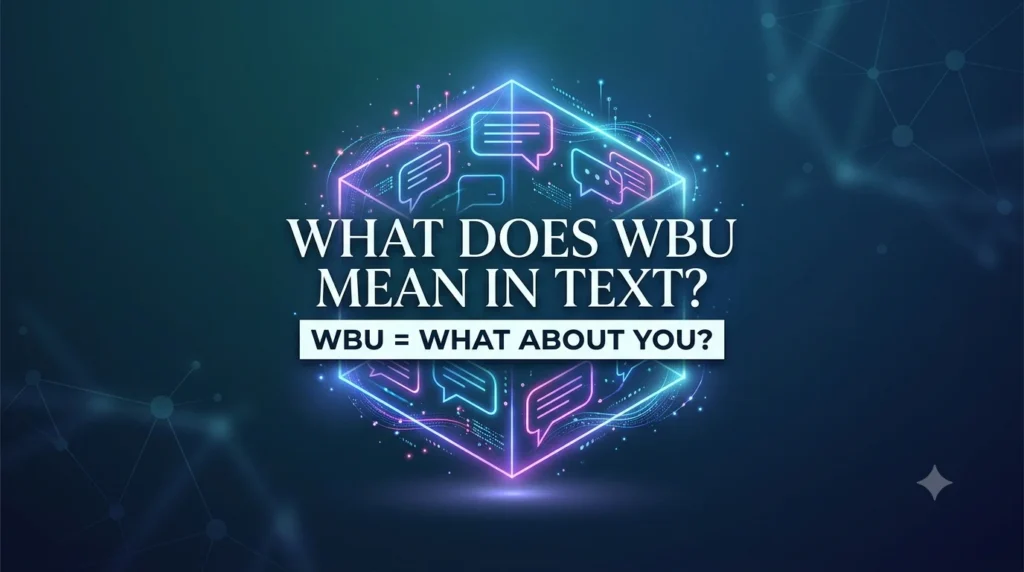
What Does WBU Mean in Text? A Quick Meaning
At its most fundamental level, WBU stands for “What about you?” It serves as an instant conversational volley, designed to pass the speaking turn back to the other person without requiring a lengthy sentence.
Think of it as the digital equivalent of tossing a tennis ball gently back across the net to your partner. By ending your thought with these three letters, you show interest in the recipient’s life, maintaining balance in your relationship.
- It checks in on the other person’s current status, emotions, or daily schedule.
- The acronym typically appears at the very end of a status update or a descriptive reply.
- It works as a direct synonym for phrases like “And yourself?” or “How about you?”
Look at how naturally these three letters slide into regular smartphone messages:
“I’m just grabbing some iced coffee before heading over to the campus library, wbu?”
“Honestly, that new action film looked pretty boring to me, wbu?”
“I finally finished editing the project proposal for tomorrow, wbu?”
Origin, Background, and the Cultural Shift of the Term
The foundational spoken phrase has been an essential part of regular social courtesy for generations, allowing individuals to show active listening skills.
The Early Days of Restricted Keypads
When mobile phones first started filling our pockets, users faced incredibly tight character limits on standard text messages. Typing out full words on old numerical keypads was a slow process that frequently felt like a chore.
Because of those hardware restrictions, early mobile users started compressing common polite inquiries into simple, quick letter patterns. The abbreviation quickly became standard code across early online messaging boards and cell networks alike.
The Rise of Continuous Feeds
As internet access transitioned onto infinite scrolling apps like Instagram and TikTok, the acronym adapted to fit the lifestyle of younger generations. It evolved from a simple time-saving trick into a natural stylistic choice for effortless digital socialization.
Real-Life Conversations: Relatable Examples
Observing how acronyms function in real text strings reveals their true emotional rhythm and structural purpose.
WhatsApp Message Thread
Person A: I’m completely stuck in a massive traffic jam near the downtown exit right now. I don’t think I’ll make it home for another hour.
Person B: Oh no, that is the absolute worst! I’m just relaxing on the sofa watching a movie, wbu?
Instagram DMs
Person A: Shares a photo of a beautifully seasoned plate of homemade street tacos.
Person B: Wow, that looks absolutely incredible! I’m stuck eating cold leftover soup tonight, wbu?
TikTok Comments Section
Person A: I have listened to this artist’s new album at least fifteen times today. It is easily their best work yet.
Person B: Same here! I’ve had track four playing on a continuous loop since midnight, wbu?
Text Messages Between Friends
Person A: Hey! Are you doing anything fun this weekend, or are you just planning to catch up on sleep?
Person B: I’m helping my uncle move some old furniture on Saturday but I’m completely free Sunday, wbu?
The Emotional and Psychological Meaning of the Acronym
Texting relies heavily on mutual effort, requiring both participants to actively participate to prevent the exchange from feeling one-sided.
The Subconscious Need for Balance
We use this specific slang term because humans have an innate social desire for reciprocal balance during deep interactions. If one person shares a personal story without asking about the other, the text exchange quickly starts to feel like a selfish monologue.
Dropping these three letters acts as an easy emotional cue that signals interest and emotional availability. It proves to your contact that you value their perspective just as much as your own thoughts.
A Lesson in Digital Etiquette
I remember chatting with an old colleague who was going through a highly stressful career transition last winter. I sent over a detailed message about my own weekend plans and thoughtlessly wrapped up the text with a quick “wbu.”
The response I received was a simple, exhausted summary of their stressful workweek, making me realize how casual that shortcut can feel. That interaction taught me that while shortcuts are incredibly useful for maintaining pace, they must match the underlying emotional weight of the conversation.
Usage in Different Contexts
Recognizing the boundaries of your social environment ensures your written communication always leaves a positive, respectful impression.
Social Media Platforms
On public timelines, this acronym is brilliant for driving engagement, encouraging followers to leave comments, and building a sense of community. It opens up the floor for casual group discussions without making the initial post feel overly formal.
Friends and Casual Relationships
Within your closest social circles, this term is an easy staple that signals comfort and shared conversational rhythms. It keeps your regular daily check-ins feeling light, effortless, and moving forward at a satisfying pace.
Professional Workplace Settings
Using this specific shortcut in an official email to an executive or on a formal Slack thread is generally improper. It can make your message look lazy or rushed, potentially signaling a lack of professional respect to colleagues.
Casual vs. Serious Tones
The casing choices you make alter how the recipient interprets your message. Leaving the abbreviation in casual lowercase letters feels very relaxed, while capitalizing it can make the question feel a bit more direct.
When You Should Not Use This Slang
While this acronym is highly functional for daily check-ins, certain scenarios demand a much more thoughtful approach.
Navigating Sensitive Situations
If a friend reaches out to tell you they are dealing with a difficult personal issue, do not reply with a casual shortcut. Wrapping up a heavy discussion with an abbreviation can look highly dismissive or emotionally cold to someone looking for real support.
Formal Business Communications
When negotiating business deals, coordinating with new clients, or emailing human resources, stick to standard language structure. Relying on casual text terms in these areas can damage your credibility as an authoritative professional.
Common Misunderstandings and Tone Confusion
Even the most common pieces of text shorthand can occasionally run into communication speed bumps if the context isn’t entirely clear.
The Problem of Looking Distant
The most frequent issue occurs when the acronym is used completely by itself as a single-word reply. Sending a lone “wbu?” can occasionally make you look bored, distant, or completely uninterested in keeping the conversation going.
Literal Interpretations Across Generations
Individuals who are completely new to modern smartphone culture might mistake the acronym for a technical typo or an unfamiliar corporate abbreviation. Ensuring your texts feature enough context clues keeps your casual check-ins from looking confusing.
Comparing Conversational Shortcuts
Looking at how this phrase contrasts with other similar pieces of texting shorthand makes it easier to select the ideal option for your chats.
| Acronym | Full Definition | Emotional Intensity | Ideal Environment |
| wbu | What about you? | Casual / Friendly | Daily text threads, friends |
| hbu | How about you? | Casual / Neutral | Social media, acquaintances |
| ikr | I know, right? | Validating / Agreeing | Reacting to shared opinions |
| rn | Right now | Informative / Clear | Giving quick timing updates |
| tbh | To be honest | Vulnerable / Frank | Sharing personal perspectives |
Key Insight
Selecting the right acronym isn’t about memorizing a rigid digital rulebook; it is about adjusting your style to match the emotional tone of your connection.
Variations and Structural Types of the Slang
Modern smartphone users frequently alter the appearance of this abbreviation to project subtle changes in style or mood.
wbu (Lowercase)
The absolute standard for casual messaging, representing a relaxed, friendly approach that fits into any everyday conversation seamlessly.
WBU (Uppercase)
Capitalizing the letters adds a clear sense of energy to the question, making it sound more enthusiastic or direct.
hbu
The most common alternative version, carrying an identical meaning that easily substitutes for the original depending on personal habit.
wbu?
Adding a punctuation mark grounds the letters as a genuine question, showing that you are truly waiting for an update.
wbu rn
Combining the phrase with the shortcut for “right now” adds a sense of immediacy, asking what your contact is doing at that exact moment.
wbu tho
Adding a conversational modifier at the end shifts the focus of the chat back to the recipient after a major topic change.
wbu lol
Including a light chuckle at the end softens the inquiry, ensuring the conversation remains playful, easygoing, and completely pressure-free.
wb u
Splitting the letters with a space is a classic typing variation often used by individuals who prefer a slightly detached visual rhythm.
How to Respond When Someone Asks “WBU”
Your reply should comfortably mirror the emotional energy of the text you received, keeping the momentum going naturally.
Casual Replies
- “Not much, just heading out to run a few quick errands around town.”
- “Just relaxing at home and finally catching up on some reading tonight.”
Funny Replies
- “Staring blankly at my laptop pretending to be highly productive! 💻”
- “Trying to convince myself that I don’t need to order takeout again!”
Mature Replies
- “I’ve had a pretty demanding week, so I’m focusing on getting some rest this evening.”
- “I’m currently working on some personal goals, but I’d love to connect later this week.”
Respectful Replies
- “I am doing well, thank you for checking in. I hope your week is going smoothly.”
- “Everything is going well on my end. I appreciate you taking the time to ask.”
Regional, Cultural, and Generational Dynamics
The way this acronym is used and understood can shift noticeably based on geography, age groups, and cultural backgrounds.
Global Variations and App Preferences
In North American texting spaces, the acronym is extremely common across all age brackets. However, across European and Asian messaging networks, regional platform alternatives sometimes take precedence.
The Generational Gap: Millennials vs. Gen Z
Millennials typically use the phrase as a practical tool to wrap up their updates efficiently. Gen Z users often drop the abbreviation into fast-moving video comment sections to build quick rapport with digital creators.
Is It Safe for Kids to Use?
For parents keeping an eye on their children’s digital literacy, this specific shortcut is entirely wholesome and safe. It contains no hidden profanities, aggressive connotations, or inappropriate double meanings.
Encouraging younger users to use terms like this can actually help them learn basic conversational turn-taking, ensuring they show healthy interest in their friends’ lives online.
Frequently Asked Questions
What does the slang term wbu mean in text?
It stands for “What about you?” and is used to ask the other person for their opinion, status update, or current plans.
What is the core difference between wbu and hbu?
There is no functional difference in meaning. “Wbu” stands for “What about you?” while “hbu” means “How about you?”—both serve the exact same social purpose.
Can I include this abbreviation in a business email?
It is generally best to avoid it, as professional communications require standard sentence structures to maintain credibility and respect.
Is using a lone wbu considered rude?
It can occasionally look a bit brief or dismissive if used entirely by itself without any surrounding words or emojis to soften the tone.
Why do people prefer abbreviations over full typing?
It saves significant time on mobile screens, allowing people to match the fast, spontaneous pace of spoken human conversation.
Conclusion: Honoring the Rhythm of Digital Dialogue
Modern language is a beautifully adaptive tool, constantly shifting to help us connect across digital spaces. Text shortcuts like this one aren’t running down our communication skills; rather, they give us a way to maintain politeness in a fast-paced world. By taking the time to learn these subtle text patterns, you ensure your personal interactions remain light, supportive, and balanced. Don’t be afraid to embrace the natural flow of modern messaging—it is the best way to keep your digital connections authentic, engaging, and beautifully human.