If you’ve ever received a text saying “OTW” and wondered what it means, you’re not alone. Modern digital communication moves fast, and abbreviations have become a normal part of everyday conversations. Among the most commonly used texting shortcuts is OTW.
People search for “what does OTW mean” because they encounter it in text messages, social media comments, WhatsApp chats, Instagram DMs, gaming communities, and even workplace conversations. While the abbreviation seems simple, its meaning can vary slightly depending on context.
Understanding ithelps you communicate more naturally, avoid confusion, and keep up with modern texting culture. Whether you’re chatting with friends, coordinating plans, or navigating online conversations, knowing how it is used can make communication smoother and more efficient.
OTW – Quick Meaning
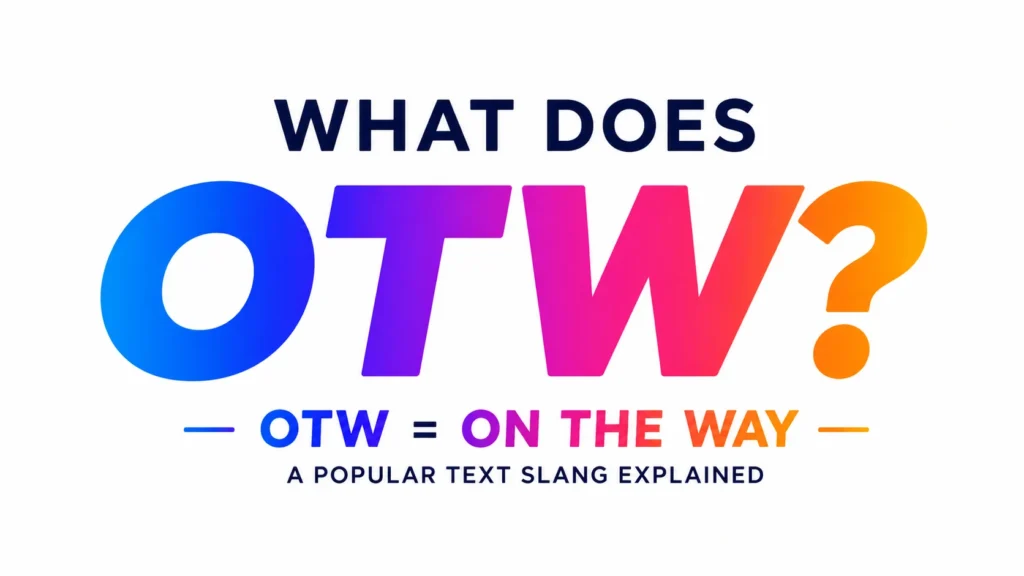
What Does OTW Mean?
it stands for “On The Way.”
It is commonly used to tell someone that a person, object, delivery, or action is currently moving toward a destination.
Simple Definition
OTW means:
- Currently traveling to a location
- Coming soon
- In progress toward completion
- Moving toward a specific goal or destination
Quick Examples
“I’m OTW, be there in 10 minutes.”
“Your package is OTW.”
“Don’t worry, food is OTW.”
In most cases, OTW communicates movement, progress, or arrival.
Origin & Background
Early Internet and SMS Culture
it became popular during the early days of text messaging. Back then, character limits encouraged people to shorten common phrases.
Instead of typing “I’m on the way,” users quickly adopted OTW to save time and effort.
Growth Through Mobile Messaging
As smartphones became common, abbreviations like LOL, BRB, IMO, and it spread rapidly. Messaging apps made short-form communication even more popular.
Social Media Influence
Platforms such as Instagram, Snapchat, TikTok, and X accelerated the use of it. Users preferred quick, informal responses rather than lengthy messages.
Today, OTW appears in:
- Text messages
- WhatsApp chats
- Instagram stories
- TikTok captions
- Gaming communities
- Workplace messaging apps
How the Meaning Evolved
Originally, it referred strictly to physical travel.
Over time, people began using it more broadly.
For example:
- “Success is OTW.”
- “Good news is OTW.”
- “The update is OTW.”
In these cases, it represents progress rather than actual movement.
Real-Life Conversations
WhatsApp Conversation
Person A:
Where are you? Everyone’s already here.
Person B:
Sorry! OTW now. Traffic is terrible.
Person A:
No worries. See you soon.
Instagram DM Conversation
Person A:
Did you send the photos?
Person B:
Yep, OTW to your inbox.
Person A:
Perfect. Thanks!
TikTok Comments
Person A:
Part 2 please!
Person B:
OTW 😂
Person A:
Can’t wait!
Text Message Conversation
Person A:
Mom said dinner starts at 7.
Person B:
I know. OTW right now.
Person A:
Drive safely.
Emotional & Psychological Meaning
More Than Just Directions
Although it literally means “On The Way,” it often carries emotional meaning.
When someone says it, they are usually reassuring another person. The message implies commitment and action.
Why People Use It
People use OTW because it:
- Saves time
- Reduces anxiety
- Confirms responsibility
- Shows reliability
- Keeps conversations efficient
What It Reveals About Modern Communication
Modern communication values speed and convenience.
Instead of writing a full explanation, people prefer quick confirmations.it provides immediate clarity with only three letters.
A Real-Life Scenario
Imagine waiting at a café for a friend who is running late. You send a message asking where they are.
The response comes back:
“OTW.”
Instantly, you know they haven’t forgotten. That brief message offers reassurance and reduces uncertainty.
Usage in Different Contexts
Social Media
On social media, OTW often signals upcoming content.
Examples:
- “New video OTW.”
- “Big announcement OTW.”
- “Merch drop OTW.”
Creators use it to build excitement and anticipation.
Friends and Relationships
Among friends, OTW usually refers to physical travel.
Examples:
- “OTW to your house.”
- “OTW to the restaurant.”
In relationships, it can also express eagerness.
Example:
“Miss you. OTW ❤️”
Work and Professional Settings
OTW occasionally appears in workplace communication.
Examples:
- “The report is OTW.”
- “The revised file is OTW.”
However, professional environments often favor complete phrases for clarity.
Casual vs Serious Tone
Casual usage:
- “OTW bro.”
Serious usage:
- “Emergency supplies are OTW.”
The meaning stays similar, but the tone changes according to the situation.
When NOT to Use It
Formal Business Communication
Avoid it in highly formal emails, proposals, and official correspondence.
Instead, write:
“The document is being delivered.”
Academic Writing
it is generally unsuitable in research papers, assignments, or scholarly discussions.
Communication With People Unfamiliar With Slang
Older individuals or people unfamiliar with texting abbreviations may misunderstand the term.
Using the full phrase can prevent confusion.
Important Instructions
During emergencies or critical situations, clarity matters more than speed.
Writing “On the way” instead of it can reduce the chance of misunderstanding.
Common Misunderstandings
Assuming Immediate Arrival
One common mistake is believing it means someone is arriving instantly.
In reality, arrival could be minutes or even hours away.
Confusing It With Delivery Status
Some people assume it guarantees immediate delivery.
However, it only indicates movement toward a destination.
Literal vs Figurative Usage
Literal:
“I’m OTW to the airport.”
Figurative:
“Good things are OTW.”
The first refers to physical travel, while the second expresses future expectations.
Tone Confusion
Sometimes OTW can sound vague.
Without additional details, people may not know exactly when something will arrive.
Comparison Table
| Expression | Meaning | Similarity to OTW |
| OTW | On The Way | Original term |
| BRB | Be Right Back | Indicates return, not travel |
| ASAP | As Soon As Possible | Focuses on urgency |
| ETA | Estimated Time of Arrival | Gives timing details |
| Coming Soon | Arriving later | Similar expectation |
| En Route | Traveling toward destination | Very similar |
| Delayed | Running late | Opposite situation |
| Stuck | Unable to move | Opposite meaning |
| In Progress | Being worked on | Related figurative meaning |
| Almost There | Near destination | Strongly related |
Key Insight
it is unique because it combines movement, progress, and reassurance. Few abbreviations communicate all three ideas so efficiently.
Variations / Types
OMW
Meaning: On My Way
Specifically refers to the speaker traveling somewhere.
En Route
Meaning: Traveling toward a destination.
Often used in professional communication.
Almost There
Meaning: Very close to arrival.
Suggests completion is near.
Coming Soon
Meaning: Expected in the near future.
Common on social media.
ETA
Meaning: Estimated Time of Arrival.
Provides timing rather than movement.
In Transit
Meaning: Currently being transported.
Common in shipping updates.
Heading Over
Meaning: Going to a location.
Casual conversational alternative.
On Route
Meaning: Traveling toward a destination.
Similar to OTW.
In Progress
Meaning: Currently underway.
Often used figuratively.
Incoming
Meaning: About to arrive.
Popular in gaming and online communities.
How to Respond When Someone Uses It
Casual Replies
- Sounds good!
- See you soon.
- Awesome, thanks.
- Great, take your time.
Funny Replies
- I’ll start the countdown.
- GPS activated.
- Better bring snacks.
- The suspense is real.
Mature Replies
- Drive safely.
- No rush, travel carefully.
- Thanks for the update.
- Looking forward to seeing you.
Respectful Replies
- Thank you for letting me know.
- Safe travels.
- I appreciate the update.
- Please message when you arrive.
Regional & Cultural Usage
Western Culture
OTW is widely understood and frequently used in texting, social media, and workplace chats.
Asian Culture
Many younger internet users recognize OTW through global digital culture. However, local messaging habits may vary.
Middle Eastern Culture
English abbreviations are commonly used among bilingual speakers, especially younger generations active online.
Global Internet Usage
OTW has become a nearly universal internet abbreviation. Users from different countries often understand it regardless of their native language.
Generational Differences
Gen Z
- Uses OTW frequently
- Comfortable with abbreviations
- Often uses it creatively
Millennials
- Understand and use OTW regularly
- May combine it with full sentences
Older generations may recognize the term less often, depending on their digital habits.
Is It Safe for Kids?
Understanding the Context
Yes, OTW is generally safe for kids.
The abbreviation simply means “On The Way” and contains no offensive, harmful, or inappropriate content.
Parents should still encourage children to understand context because abbreviations can sometimes have different meanings in specific online communities. In everyday texting, however,it is considered harmless and widely accepted.
FAQs
What does OTW mean in texting?
OTW means “On The Way.” It tells someone that a person or thing is currently moving toward a destination.
What does OTW mean on Snapchat?
On Snapchat, OTW usually means the sender is coming somewhere or that something is about to happen soon.
Is OTW the same as OMW?
Not exactly. OMW means “On My Way,” while OTW means “On The Way.” OMW specifically refers to the speaker.
Can OTW be used professionally?
Yes, but only in informal workplace communication. Formal business writing usually requires the full phrase.
What is the opposite of OTW?
Expressions such as “stuck,” “delayed,” or “not coming” generally represent the opposite idea.
Does OTW always mean physical travel?
No. It can also be used figuratively, such as “Success is OTW” or “Good news is OTW.”
Why is OTW so popular?
It is short, easy to type, widely understood, and quickly reassures others that progress is being made.
Conclusion
it is one of the simplest yet most useful abbreviations in modern communication. At its core, it means “On The Way,” but its value goes beyond a literal definition. It signals movement, commitment, progress, and reassurance in just three letters.
Whether you’re coordinating plans with friends, replying in a group chat, updating someone about a delivery, or building excitement on social media, it helps communicate efficiently without sacrificing meaning.
As digital conversations continue evolving, understanding expressions like OTW makes it easier to connect naturally with others. The next time you see OTW in a message, you’ll know exactly what it means—and when to use it confidently yourself.