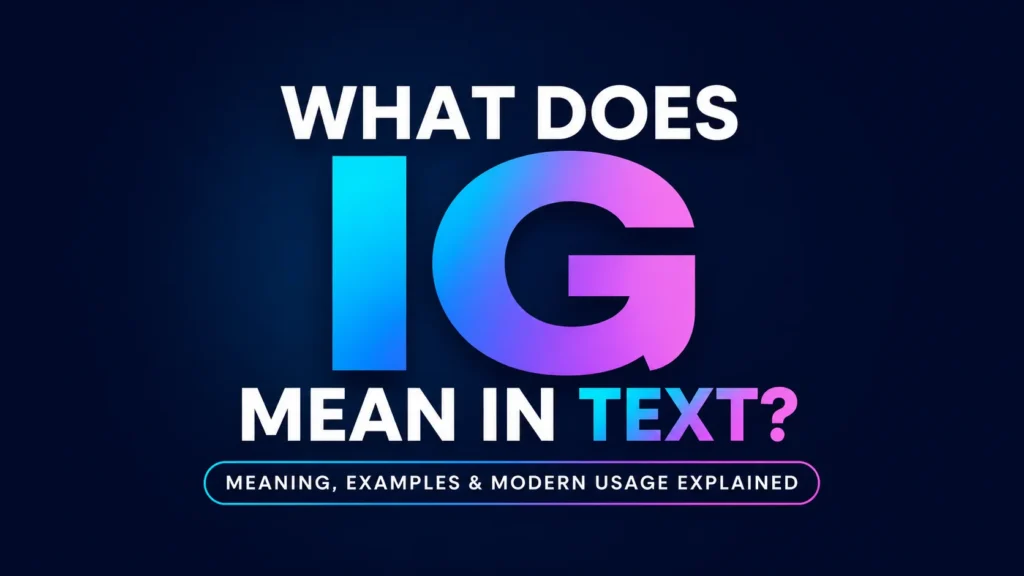
If you spend time on social media, texting apps, or online conversations, you’ve probably seen someone type “IG” and wondered what it actually means. The confusion is understandable because “it” can carry different meanings depending on the context, tone, and platform.
In most casual conversations, “it” simply means “I guess.” However, many people also use it as shorthand for Instagram. That double meaning is exactly why people search for the phrase “what does ig mean in text” so often.
Modern texting culture moves fast. People shorten words to save time, sound relaxed, or express emotions without writing long sentences. Still, abbreviations can sometimes create misunderstandings, especially between generations or in professional conversations.
This guide breaks everything down in a simple, real-world way. You’ll learn what “it” means, where it came from, how people actually use it, and when you should avoid using it altogether.
What Does IG Mean in Text? – Quick Meaning
Main Definition of IG
In texting, “IG” most commonly means:
- I guess
- A casual expression of uncertainty, hesitation, or mild agreement
People use it when they are unsure, relaxed, emotionally distant, or trying not to sound too serious.
Simple Examples
“IG we can go later.”
“That movie was good, IG.”
“IG you were right.”
In other situations, especially on social media, “IG” can also mean:
Example:
“Send me the reel on IG.”
Why Context Matters
The meaning changes based on the conversation.
If someone says:
“Follow me on IG”
They clearly mean Instagram.
But if they say:
“IG it’s fine”
They mean “I guess.”
Small details completely change the interpretation.
Origin & Background
Where “IG” Started
The abbreviation “it” became popular during the rise of mobile texting in the early 2000s. Back then, people shortened words because typing on small phone keyboards took more effort.
Short forms like:
- LOL
- BRB
- IMO
- IDK
quickly became part of digital communication. “Iit” naturally joined that trend.
Social Media Influence
When Instagram exploded in popularity, “it” gained a second identity. Suddenly, the same abbreviation represented both a feeling (“I guess”) and a platform (Instagram).
This overlap became normal online because users learned to understand meaning through context.
TikTok, Snapchat, WhatsApp, and Instagram DMs accelerated the trend even more. Short-form communication became a social style rather than just a convenience.
How the Meaning Evolved
Originally, “I guess” sounded hesitant or uncertain. Over time, younger users started using “it” more casually and even sarcastically.
For example:
“IG I’ll survive.”
That sentence may sound humorous, dramatic, or emotionally guarded depending on the relationship between the people talking.
Modern slang often carries emotional layers beneath simple words.
Real-Life Conversations
WhatsApp Conversation
Person A:
Are you still coming tonight?
Person B:
IG so. I’m just really tired after work.
Person A:
No pressure. Just wanted to know.
This use of “it” shows hesitation without sounding rude.
Instagram DM Conversation
Person A:
Did you like the new song?
Person B:
IG it’s okay, but her older music was better.
This version feels casual and slightly indifferent.
TikTok Comments
Person A:
This trend is getting annoying.
Person B:
it but I still watch every video 😂
Here, “it” softens disagreement and keeps the tone playful.
Text Message Between Friends
Person A:
You never reply fast anymore.
Person B:
IG I’ve been overwhelmed lately.
This response feels emotionally careful and slightly vulnerable.
Emotional & Psychological Meaning
What Emotion Does “IG” Express?
Although it looks simple, “IG” often reflects deeper emotions such as:
- Uncertainty
- Emotional distance
- Low-pressure agreement
- Passive acceptance
- Mild sarcasm
- Casual indifference
People sometimes use it to avoid sounding too intense.
Why People Use It
Modern communication rewards speed and emotional safety. Many people prefer short responses because they feel less vulnerable.
Typing:
“IG”
can feel emotionally easier than saying:
“I’m unsure but trying to agree.”
Short slang often acts like emotional armor.
What It Reveals About Digital Communication
Today’s texting culture values subtlety. People communicate moods through abbreviations, punctuation, emojis, and timing.
A simple “it” may quietly communicate:
- hesitation
- emotional exhaustion
- passive acceptance
- awkwardness
- low enthusiasm
That’s why tone matters more online than many people realize.
Read More: What Does NFS Mean in Text? Meaning Behind This Popular Slang
A Real-Life Style Scenario
Imagine a friend invites someone to a party after weeks of emotional distance.
Instead of replying:
“Yes, I’d love to come!”
they respond:
“IG I can make it.”
The words sound casual, yet emotionally they may signal uncertainty, social anxiety, or unresolved tension.
Tiny abbreviations can reveal surprisingly human emotions.
Usage in Different Contexts
Social Media
On TikTok, Instagram, and Snapchat, “IG” appears constantly because fast communication dominates these platforms.
Examples:
- “IG that’s true.”
- “Seen it on it.”
- “IG everyone is doing this now.”
Tone is usually relaxed and informal.
Friends & Relationships
Among close friends, “it” often sounds natural and emotionally safe.
However, in romantic situations, it can sometimes sound cold or uninterested.
Compare:
“Sure!”
vs.
“IG.”
The second response may feel emotionally distant.
Work & Professional Settings
Using “it” professionally is risky.
In work emails or business chats, abbreviations can appear careless or immature.
Instead of:
“IG we can do that.”
It’s better to write:
“I think that approach could work.”
Professional communication benefits from clarity.
Casual vs Serious Tone
“it” works best in:
- casual texting
- memes
- social media
- close friendships
It works poorly in:
- serious emotional discussions
- workplace communication
- academic writing
- formal situations
When NOT to Use It
During Serious Conversations
If someone is discussing grief, stress, or emotional pain, replying with “it” may appear dismissive.
Example:
“I’m struggling mentally lately.”
Replying:
“IG things will improve.”
can feel emotionally disconnected.
In Professional Environments
Managers, clients, and coworkers may misunderstand internet slang.
Professional settings require clarity and confidence.
When Cultural Understanding Is Limited
Not everyone understands texting slang equally. Older adults or non-native English speakers may confuse “IG” with Instagram.
Clear language avoids unnecessary confusion.
When Tone Could Be Misread
Because “IG” sounds uncertain, it may unintentionally communicate:
- laziness
- lack of interest
- passive aggression
- emotional avoidance
Sometimes a full sentence creates better emotional clarity.
Common Misunderstandings
People Assume It Always Means Instagram
This is the most common misunderstanding.
Context changes everything.
Example:
“IG you’re right.”
This obviously does not mean Instagram.
Tone Confusion
Some people use “IG” jokingly while others use it seriously.
Without voice tone or facial expression, misunderstandings happen easily.
Literal vs Figurative Meaning
“I guess” literally suggests uncertainty.
Yet online, people often use “it” sarcastically or emotionally.
Example:
“IG my life is just chaos now.”
The speaker may not actually be uncertain. They may simply be dramatic or humorous.
Comparison Table
| Expression | Meaning | Tone | Common Usage |
| IG | I guess | Casual, uncertain | Texting, social media |
| IDK | I don’t know | Neutral | Informal chats |
| IMO | In my opinion | Opinion-based | Discussions |
| TBH | To be honest | Honest/confessional | Personal conversations |
| FR | For real | Agreement/emphasis | Gen Z slang |
| NGL | Not gonna lie | Honest reaction | Casual texting |
| Sure | Direct agreement | Clear | Universal |
| Absolutely | Strong agreement | Confident | Professional & casual |
Key Insight
“IG” stands out because it softens statements emotionally. It creates distance between the speaker and the message, which is why younger generations use it so frequently in digital conversations.
Variations / Types
IG = I Guess
The most common texting meaning expressing uncertainty or mild agreement.
IG = Instagram
A shortened reference to the social media platform.
Igg
An extended playful spelling often used among close friends.
Iggg
Adds emotional exaggeration or dramatic tone.
Ig Fr
Means “I guess, for real.”
Ig Lol
Used when uncertainty is mixed with humor.
Ig Maybe
A double layer of hesitation or indecision.
IGYKYK
A variation connected to “If you know, you know.”
IG Story
Refers specifically to Instagram Stories.
Ig Idk
Combines uncertainty with confusion.
How to Respond When Someone Uses It
Casual Replies
- “Fair enough.”
- “That makes sense.”
- “No worries.”
Funny Replies
- “That sounded more dramatic than necessary 😂”
- “The confidence level here is impressive.”
- “You guessed your way through that answer.”
Mature Replies
- “Take your time deciding.”
- “I understand your hesitation.”
- “It’s okay to be unsure.”
Respectful Replies
- “Thanks for being honest.”
- “I appreciate the response.”
- “I get where you’re coming from.”
Regional & Cultural Usage
Western Culture
In the United States and Canada, “IG” is extremely common among Gen Z and younger Millennials.
It usually sounds casual, emotionally guarded, or humorous.
Asian Culture
Many English-speaking young people in Asian countries use “IG” online, especially in gaming and social media communities.
However, professional communication tends to stay more formal.
Middle Eastern Culture
Online slang is growing rapidly among younger users, though some families and workplaces still prefer more respectful language styles.
As a result, “it” may appear mostly in private chats rather than formal discussions.
Global Internet Usage
Internet culture spreads slang faster than ever. TikTok and Instagram heavily influence worldwide language trends.
Many non-native English speakers learn abbreviations through memes and online videos before hearing them in real-life conversation.
Generational Differences
Gen Z
Uses “IG” naturally and frequently.
Often mixes it with emojis, sarcasm, and humor.
Millennials
Generally understand it but may use it less often.
Older Generations
Some confuse it entirely with Instagram or find slang-heavy texting difficult to interpret.
Is It Safe for Kids?
Yes, “it” is generally safe for kids because it usually means either “I guess” or “Instagram.”
Still, parents should understand context because online slang evolves quickly. The abbreviation itself is harmless, but the conversations surrounding it may not always be age-appropriate.
Open communication matters more than policing every abbreviation.
FAQs
What does IG mean in a text message?
In most text messages, “IG” means “I guess.” It expresses uncertainty, hesitation, or casual agreement.
Does IG always mean Instagram?
No. While “IG” can mean Instagram, it also commonly means “I guess.” Context determines the meaning.
Is IG rude in conversation?
Not usually. However, it can sound emotionally distant or uninterested depending on tone and timing.
Why do Gen Z use IG so much?
Gen Z prefers fast, emotionally subtle communication. “IG” helps soften statements and keep conversations casual.
Can I use IG in professional messages?
It’s better to avoid it in professional settings. Full sentences create clearer and more respectful communication.
What is the difference between IG and IDK?
“IG” means “I guess,” showing uncertainty with a possible opinion. “IDK” means “I don’t know,” expressing complete uncertainty.
Does IG mean sarcasm sometimes?
Yes. Many people use “it” sarcastically or humorously, especially on TikTok and social media platforms.
Conclusion
Understanding what “IG” means in text is more important than it first appears. On the surface, it’s just a short abbreviation. Beneath that simplicity, though, it reflects how modern communication has become faster, emotionally layered, and socially nuanced.
Most of the time, “IG” means “I guess.” Sometimes it means Instagram. The real meaning depends on context, tone, and the relationship between the people communicating.
That’s why digital language can feel surprisingly personal. A tiny abbreviation can signal uncertainty, humor, emotional distance, or quiet honesty in just two letters.
Once you recognize those subtle differences, texting conversations become much easier to understand. Instead of feeling confused when someone types “IG,” you’ll immediately recognize the mood behind it and respond with confidence.