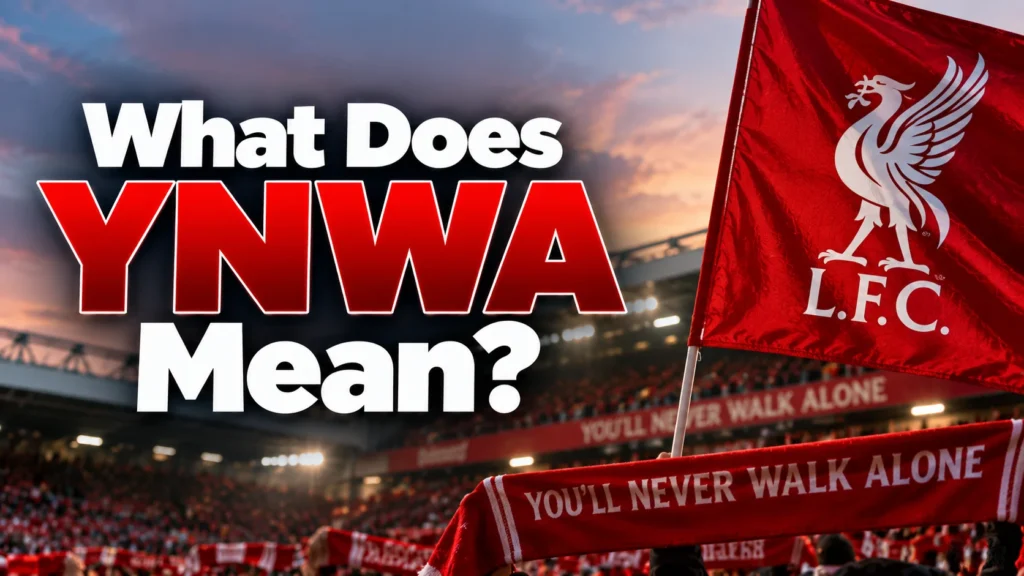
If you see YNWA underneath a Liverpool FC post, at the end of a football fan’s message, or written beside a red heart emoji, it has a very specific meaning.
YNWA stands for “You’ll Never Walk Alone.”
The abbreviation is most strongly associated with Liverpool Football Club, whose supporters have sung “You’ll Never Walk Alone” at Anfield since the early 1960s. Liverpool FC officially describes the song as its anthem and the phrase as an important part of the club’s identity.
But YNWA has grown beyond four initials and even beyond one football club.
For supporters, it can express loyalty, solidarity, hope, emotional support, and belonging. Someone ending a message with “YNWA ❤️” may essentially be saying, “We stand together,” especially during a difficult or emotional moment.
The phrase also has a fascinating history that begins not in football, but on Broadway.
YNWA Meaning – Quick Meaning
YNWA = You’ll Never Walk Alone
The abbreviation usually communicates:
- Support
- Togetherness
- Loyalty
- Encouragement
- Football identity
- Liverpool FC pride
- Hope during difficult times
- Solidarity between supporters
For example:
“What a comeback. YNWA ❤️”
Here, the writer is expressing Liverpool support and pride.
“Thinking of you and your family. YNWA.”
In this context, it has a deeper emotional meaning: you are not facing this alone.
“See you at Anfield. YNWA!”
Here, it works almost like a football-supporter sign-off.
Is YNWA slang?
Not exactly.
YNWA behaves like an internet abbreviation, but it comes from the title “You’ll Never Walk Alone.”
It is closer to a football motto, fan expression, and emotional shorthand than ordinary slang such as LOL, IDK, or FR.
Liverpool’s own brand guidelines explicitly recognize YNWA as the accepted abbreviation of “You’ll Never Walk Alone.”
Origin and Background of YNWA
YNWA’s history begins decades before Liverpool supporters adopted it.
From Broadway to football terraces
“You’ll Never Walk Alone” was written for the 1945 Rodgers and Hammerstein musical Carousel.
Oscar Hammerstein II wrote the lyrics, while Richard Rodgers composed the music. In the musical, the song appears in a moment of grief and encouragement, which helps explain why its message later worked so powerfully outside theatre.
The song was covered by numerous artists.
Then, in 1963, Liverpool band Gerry and the Pacemakers released their version.
Liverpool FC explains that records from the UK Top 10 were regularly played before matches at Anfield. When the Gerry and the Pacemakers recording entered the charts, supporters began singing along.
The song reached No. 1 in the UK charts in late October 1963 and remained there for four weeks. When it eventually disappeared from the pre-match chart playlist, supporters reportedly wanted their song back.
It never really left Anfield again.
From song to Liverpool identity
Over the following decades, “You’ll Never Walk Alone” became deeply connected with Liverpool FC.
It is sung before home matches at Anfield, with supporters traditionally joining together before kickoff. Liverpool describes the anthem as part of the club’s DNA and something used in celebration, adversity, triumph, and sorrow.
That emotional range is exactly why YNWA became more than a football chant.
It represents the idea that supporters, players, families, and communities remain connected even when circumstances are difficult.
Social media changed the form, not the meaning
On modern platforms, people rarely need to type the entire phrase.
“You’ll Never Walk Alone” becomes:
YNWA
or:
YNWA ❤️
The abbreviation allows decades of history and emotion to fit into four letters.
Real-Life Conversations Using YNWA
YNWA becomes easier to understand when you see how supporters actually use it in everyday digital conversations.
WhatsApp: After a Difficult Match
Person A: Can’t believe we lost that in the last minute.
Person B: Hurts, but we go again. YNWA ❤️
Person A: Always.
Here, YNWA means more than support for the club.
It communicates:
“We stick together even after defeat.”
Instagram DM: Encouragement
Person A: My dad’s been in hospital all week. Been a rough few days.
Person B: I’m sorry mate. Sending love to your family. YNWA ❤️
Person A: Appreciate that more than you know.
Here, YNWA leaves football behind and becomes an expression of personal solidarity.
TikTok Comments: Liverpool Moment
Video: Anfield crowd singing before a major match.
Commenter A: Goosebumps every single time.
and,
Commenter B: YNWA ❤️
moreover,
Commenter C: Nothing like Anfield on a big European night.
Here, the abbreviation identifies shared Liverpool culture and emotion.
Text Message: Fan Identity
Person A: Just got my first Liverpool shirt 😭
and,
Person B: Welcome to the family 😂 YNWA.
moreover,
Person A: Already planning the Anfield trip.
In this conversation, YNWA works almost like a welcoming phrase between supporters.
Emotional and Psychological Meaning of YNWA
The literal meaning is simple:
You’ll Never Walk Alone.
The emotional meaning is much deeper.
It tells someone:
“You have people beside you.”
“We are part of the same community.”
“We stay together when things are difficult.”
“You are supported.”
Why the phrase connects so strongly
Football creates unusually intense group identities.
Supporters may live thousands of miles apart, speak different languages, and never meet one another, yet still feel connected through the same club.
YNWA compresses that shared identity into four characters.
Imagine a Liverpool supporter watching alone from another country.
The team loses an important final.
Instead of simply closing the television, the supporter opens social media and sees thousands of posts ending:
“YNWA.”
That experience changes an individual disappointment into a shared one.
The psychology is not really about winning.
It is about belonging even when the result is bad.
Liverpool legends have repeatedly described the anthem in terms of family, pride, togetherness, and shared strength.
That explains why the phrase remains meaningful long after individual players, managers, and seasons have changed.
Usage of YNWA in Different Contexts
Social Media
On Instagram, TikTok, X, Facebook, and football forums, YNWA commonly appears:
- After Liverpool victories
- After defeats
- Before major matches
- Under transfer announcements
- In birthday messages to supporters
- During memorials
- In fan bios
- At the end of Liverpool-related posts
Example:
“Massive three points tonight. YNWA ❤️”
Friends and Relationships
Among Liverpool-supporting friends, YNWA can function as an affectionate sign-off.
“See you Saturday. YNWA.”
It may also be used when a friend is struggling.
“Keep going mate. YNWA.”
In the second example, football identity becomes emotional support.
Football Culture
YNWA is most closely associated worldwide with Liverpool FC, but the song has also become part of other football cultures.
Celtic supporters have a strong relationship with the anthem, and Celtic’s official website has documented emotionally powerful occasions when Celtic and Liverpool fans sang it together, particularly following the Hillsborough disaster.
Borussia Dortmund also uses “You’ll Never Walk Alone” before home games. The club officially describes it as one of its most emotional stadium anthems.
So YNWA belongs most visibly to Liverpool culture, but its football history is broader than Liverpool alone.
Professional Settings
YNWA is normally inappropriate in ordinary professional writing unless football is directly relevant.
A Liverpool-supporting coworker might end an informal message with YNWA, but the abbreviation would look strange in:
- Formal reports
- Business proposals
- Academic writing
- Legal documents
- Client correspondence
Context determines whether it feels meaningful or misplaced.
When NOT to Use YNWA
YNWA has a positive message, but that does not mean it fits every situation.
Avoid using it when the audience is unlikely to understand the football connection.
Someone unfamiliar with Liverpool may simply wonder what the letters mean.
Rivalry context matters
Football rivalries can be emotionally intense.
Using YNWA simply to provoke rival supporters can turn a message of solidarity into unnecessary trolling.
The expression carries decades of genuine meaning for many supporters, so using it purely as bait can feel disrespectful.
Be careful around tragedy
“You’ll Never Walk Alone” has been connected with deeply emotional moments in Liverpool’s history, including remembrance connected with the Hillsborough disaster.
Liverpool and Celtic have both documented the song’s role in moments of grief, remembrance, and solidarity.
That history deserves respectful treatment.
Common Misunderstandings About YNWA
“Liverpool wrote You’ll Never Walk Alone”
No.
The song originated in the 1945 musical Carousel and was written by Rodgers and Hammerstein.
Liverpool supporters later adopted the Gerry and the Pacemakers version.
“Gerry and the Pacemakers wrote the song”
No.
They recorded the famous 1963 version associated with Liverpool, but Richard Rodgers and Oscar Hammerstein II created the original song.
“YNWA means something different in texting”
Usually not.
If you see YNWA in football-related texting, it almost always means You’ll Never Walk Alone.
“Only Liverpool supporters sing it”
Liverpool is the club most internationally identified with YNWA, but supporters of clubs including Celtic and Borussia Dortmund also sing the song.
“YNWA only means football”
Not necessarily.
The phrase can be used as encouragement during illness, grief, hardship, or another difficult experience.
Its football history gives the message cultural depth, but its emotional meaning extends beyond the sport.
YNWA Comparison Table
| Expression | Meaning | Typical Feeling |
|---|---|---|
| YNWA | You’ll Never Walk Alone | Solidarity, loyalty |
| LFC | Liverpool Football Club | Club identification |
| COYR | Come On You Reds | Match-day encouragement |
| Allez Allez Allez | Football supporter chant | Energy, celebration |
| We Are Liverpool | Club identity | Belonging |
| Walk On | Connected with YNWA tradition | Hope, resilience |
| GG | Good Game | Sports/gaming respect |
| W | Win | Celebration |
| Together | Unity | Support |
| You’re not alone | Direct reassurance | Emotional comfort |
Key Insight
YNWA is unusual because it works simultaneously as a football abbreviation, emotional message, cultural symbol, and expression of community. Its meaning depends less on literal translation and more on the shared history behind it.
10 YNWA Variations and Related Uses
1. YNWA
Meaning: You’ll Never Walk Alone.
The standard abbreviation.
2. “YNWA ❤️”
Meaning: Liverpool support combined with affection or solidarity.
The red heart naturally reinforces Liverpool identity.
3. “YNWA Reds”
Meaning: Supportive message directed toward Liverpool players or fans.
4. “Always YNWA”
Meaning: Permanent loyalty.
Often used after disappointing results.
5. “Forever YNWA”
Meaning: Long-term attachment to Liverpool or its community.
6. “YNWA Family”
Meaning: Liverpool supporters viewed as one community.
7. “Walk On”
Meaning: Encouragement associated with the song’s wider message.
It communicates persistence and hope.
8. “You’ll Never Walk Alone”
Meaning: The full phrase.
Used when more emotional weight is desired than the acronym provides.
9. YNWA in Fan Bios
Meaning: Identity marker.
Someone writing “LFC | YNWA” in a profile is signaling Liverpool support.
10. YNWA as Support
Meaning: Reassurance outside football.
Fans may use it during personal hardship to say, “We’re with you.”
How to Respond When Someone Says YNWA
Your reply depends on whether you share the football connection.
Casual Replies
If another Liverpool supporter says:
“YNWA ❤️”
you could reply:
- “YNWA!”
- “Always ❤️”
- “Up the Reds!”
- “We go again.”
Funny Replies
Among friends:
- “YNWA… especially on match day 😂”
- “Unless you leave me waiting outside Anfield.”
- “YNWA, but please stop stressing me every weekend 😭”
Mature Replies
During an emotional conversation:
- “Thank you. That genuinely means a lot.”
- “Appreciate the support.”
- “Always together.”
- “Means more than football.”
Respectful Replies
You do not need to support Liverpool to appreciate the sentiment.
A simple:
“Thank you, I appreciate that.”
is perfectly appropriate.
Regional and Cultural Usage of YNWA
Liverpool and England
Nowhere is YNWA more culturally embedded than Liverpool.
The club says “You’ll Never Walk Alone” has been its anthem since the early 1960s and recognizes it as part of its identity and motto.
At Anfield, the collective pre-match singing creates one of football’s most recognizable rituals.
Scotland
Celtic supporters also have a longstanding association with the song.
The shared singing of YNWA by Celtic and Liverpool supporters after Hillsborough became an especially powerful example of football solidarity.
Germany
Borussia Dortmund supporters sing “You’ll Never Walk Alone” before home matches at Signal Iduna Park.
BVB says the anthem became established through a cover by the Dortmund-area group Pure Harmony and now forms part of the stadium atmosphere.
Global Internet Culture
Liverpool’s worldwide fanbase means YNWA now appears in virtually every region.
You may see it posted by supporters in:
- Asia
- Africa
- North America
- South America
- Europe
- The Middle East
- Australia
The abbreviation requires no translation among many football fans.
Gen Z vs Millennials
YNWA is not generational slang.
Millennials, Gen Z, Gen Alpha, and much older supporters use the same four letters because the tradition began decades before social media.
Digital platforms changed how fans write YNWA, not what it means.
A supporter in 1963 might have sung the full title from the Kop.
A supporter today might post:
“YNWA ❤️”
The emotion connecting the two is remarkably similar.
Is YNWA Safe for Kids?
Yes.
YNWA is completely family-friendly.
It contains no profanity, sexual meaning, or inherently inappropriate content.
In fact, its central message—supporting people so they do not feel alone—is positive.
Children who follow Liverpool may encounter YNWA on:
- Shirts
- Scarves
- Social posts
- Stadium displays
- Fan merchandise
- Football videos
Parents can explain it simply as:
“You’ll Never Walk Alone—it means supporting one another.”
The football history can be introduced later as children become interested in the club.
FAQs About YNWA Meaning
What does YNWA mean?
YNWA stands for “You’ll Never Walk Alone.” It is best known as the abbreviation of Liverpool FC’s anthem and represents loyalty, solidarity, hope, and togetherness.
What does YNWA mean in text?
In texting, YNWA normally means You’ll Never Walk Alone. Liverpool supporters may use it as a sign-off, encouragement, or expression of club loyalty.
Why do Liverpool fans say YNWA?
Liverpool supporters adopted the Gerry and the Pacemakers recording of “You’ll Never Walk Alone” in 1963. It became a lasting anthem after supporters continued demanding and singing it even after the track left the charts.
Who originally wrote You’ll Never Walk Alone?
The song was created by Richard Rodgers and Oscar Hammerstein II for the 1945 musical Carousel.
Did Gerry and the Pacemakers create YNWA?
They did not write the original song, but their 1963 recording became the version famously associated with Liverpool FC.
Do other football clubs sing YNWA?
Yes. Celtic and Borussia Dortmund are among the clubs whose supporters also have strong connections with “You’ll Never Walk Alone.”
What does YNWA ❤️ mean?
“YNWA ❤️” usually combines You’ll Never Walk Alone with affection, Liverpool support, or emotional solidarity. It can mean something close to “we’re together” or “you have our support.”
Conclusion: Why YNWA Means More Than Four Letters
The basic YNWA meaning is easy:
You’ll Never Walk Alone.
But understanding those four words explains only part of the story.
The song began in Rodgers and Hammerstein’s 1945 musical Carousel. Gerry and the Pacemakers recorded their famous version in 1963, Liverpool supporters embraced it at Anfield, and it evolved into one of football’s most recognizable anthems.
Today, YNWA means loyalty when Liverpool wins.
It means resilience when Liverpool loses.
It can mean remembrance during grief and encouragement when someone is struggling.
That emotional versatility is why the abbreviation has survived generations rather than disappearing like a short-lived internet trend.
Other football communities, including Celtic and Borussia Dortmund, have also embraced the song, showing how its message can travel beyond one stadium, city, or country.
So when you see:
YNWA ❤️
you are not simply looking at four random letters.
You are seeing shorthand for a much larger idea:
loyalty, hope, community, and the belief that difficult moments should never have to be faced alone.