You have probably typed www thousands of times without thinking about what those three letters actually represent.
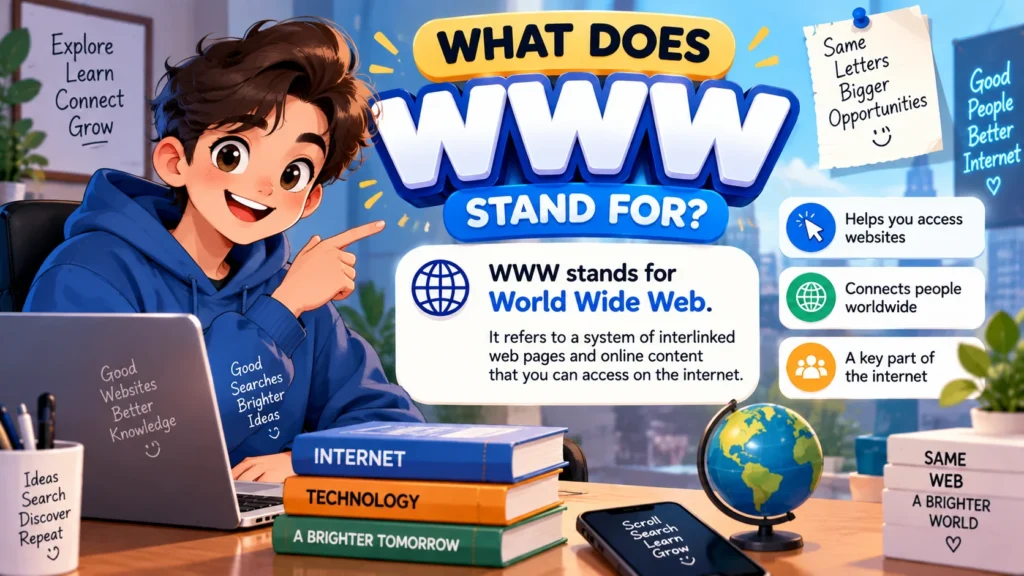
They stand for World Wide Web, the system of interconnected information and resources that people access through web browsers. The World Wide Web Consortium describes WWW as “World Wide Web” and traces the Web’s creation to Tim Berners-Lee at CERN in 1989.
However, WWW and the internet are not exactly the same thing.
The internet is the larger network infrastructure connecting computers and devices around the world. The Web is one major service that operates over that network, allowing users to visit websites, follow hyperlinks, view images, stream content, and interact with online applications.
You may also notice that many modern websites no longer show www. at the beginning of their addresses.
That does not mean the World Wide Web has disappeared.
It simply reflects how domain names and website configurations have evolved.
WWW – Quick Meaning
WWW = World Wide Web
In simple terms, it refers to the huge collection of interconnected web pages, websites, media, and other resources accessible through browsers.
For example:
“Visit www.example.com.”
Here, www traditionally identifies a web-related hostname or subdomain.
“I found it on the Web.”
This means the information was found on a website or other web resource.
“Does every website need www?”
No. Modern websites can use either a www address or a non-www address, depending on how the domain is configured. MDN notes that many domain owners use www as a subdomain for their web resource, but it is not required.
A useful distinction is:
- WWW = World Wide Web
- Web = common shorter name for the World Wide Web
- Internet = the broader global network that supports the Web and many other services
- Website = a specific collection of web pages
- URL = the address used to locate a resource online
Origin & Background
Who Created the World Wide Web?
Sir Tim Berners-Lee invented the World Wide Web while working at CERN in 1989.
The W3C records that he wrote the original proposal that year and developed the first web server and the first browser/editor during 1990. He also created early specifications for technologies that became fundamental to the Web, including HTML, HTTP, and URIs.
The original goal was practical.
Researchers needed a better way to organize and connect information stored across different computer systems.
Berners-Lee proposed a global hypertext system in which documents could link to one another rather than existing as isolated files.
Why Was It Called the World Wide Web?
The word web reflects the idea of interconnected information.
A webpage can link to another page.
That page can link somewhere else.
Those connections form something resembling a web of information rather than a simple linear filing system.
Berners-Lee later explained that he wanted a name emphasizing a global, decentralized system where things could link to other things. W3C’s historical material also notes that alternative names included ideas such as “Information Mesh” and “Mine of Information” before World Wide Web was selected.
When Did People Start Using It?
The first browser/editor, originally called WorldWideWeb, was created in 1990 and later renamed Nexus to avoid confusion between the application and the Web itself.
Web software became available over the internet in 1991.
In April 1993, CERN made the Web technology freely usable, helping encourage its rapid global adoption. W3C identifies this openness, decentralization, and reliance on shared standards as important reasons the Web grew so successfully.
By the mid-1990s, websites and graphical browsers were transforming how ordinary people used the internet.
Read More: Approximately Abbreviation: Correct Short Forms, Symbols, and Usage
Real-Life Conversations
Person A: Why do some websites start with www and others don’t?
Person B: WWW stands for World Wide Web.
and,
Person A: So does a website need it?
Person B: Not necessarily. The site owner can configure the domain with or without www.
This conversation reflects modern website behavior accurately.
Instagram DMs
Person A: I just realized I’ve never known what www actually means 😭
Person B: World Wide Web 😂
and,
Person A: I’ve been using the internet my whole life and never thought about it.
Person B: Honestly, same.
Sometimes the most familiar abbreviations are the ones people stop noticing.
Text Message
Person A: Is the Web the same as the internet?
Person B: Not exactly.
and,
Person A: What’s the difference?
Person B: The internet is the network. The Web is one system that runs on it.
That distinction is one of the most useful things to understand.
Classroom Conversation
Student: Why is it called a web?
Teacher: Because web pages can connect to one another through links.
Student: Like a giant network of information?
Teacher: Exactly.
The metaphor becomes much easier once you think about hyperlinks creating connections.
Emotional & Psychological Meaning
WWW is primarily technical terminology, but the World Wide Web has had an enormous psychological and cultural effect on everyday life.
Before the Web became widespread, accessing information often required more physical effort.
You might need to:
visit a library;
buy a newspaper;
call a business;
look through printed directories;
write letters;
wait for television news.
Today, a browser can provide access to enormous amounts of information within seconds.
That shift has changed expectations.
People now expect information to be:
fast;
searchable;
linked;
available at any time;
accessible from many devices.
A Personal-Style Scenario
Imagine you hear the name of an unfamiliar historical figure during class.
Thirty years ago, finding detailed information might have required visiting a library and locating a reference book.
Today, you can open a browser, search the name, follow links, compare sources, watch a lecture, and view digitized documents in minutes.
That experience feels normal now.
Yet it depends heavily on the linking structure that made the Web revolutionary in the first place.
The technology is so familiar that people often notice it only when their connection stops working.
Usage in Different Contexts
Website Addresses
The letters www became strongly associated with website addresses.
For example:
www.example.com
In domain terminology, www is commonly used as a subdomain or hostname label identifying a web service. MDN explains that domain owners may define a www subdomain for web resources, though doing so is not mandatory.
Web Browsing
The Web is accessed through browsers such as Chrome, Safari, Firefox, Edge, and others.
A browser requests resources from servers and displays webpages that users can navigate through links.
Search Engines
Search engines help users discover web content.
However, a search engine is not the Web itself.
Google, Bing, and other search services organize or index parts of the Web so users can find relevant pages.
Social Media
Instagram, TikTok, Facebook, Reddit, and other browser-accessible platforms are part of the wider Web when accessed through web technologies.
Their mobile apps may also use internet connections in ways that go beyond traditional webpage browsing.
Education
The Web has become central to:
online courses;
digital libraries;
research databases;
university websites;
educational videos;
learning platforms.
The information available is enormous, but source quality still matters.
When NOT to Use WWW
There is nothing wrong with using www, but it is unnecessary in some contexts.
Modern Website Addresses
Many websites are configured so that:
example.com
works without:
www.example.com
MDN advises site owners to choose a preferred canonical form—www or non-www—and use it consistently.
So if a website officially uses the shorter domain, there is no reason to manually add www.
Do Not Use WWW as a Synonym for the Entire Internet
This is one of the most important distinctions.
The internet supports more than websites.
Other internet-based systems have included email, file transfer, messaging, and other network services.
The Web is a major part of internet use, but it is not the entire internet.
Formal Technical Writing
When introducing the term in a formal paper, write:
World Wide Web (WWW)
Then use WWW later if needed.
This removes ambiguity and follows standard academic practice for abbreviations.
Common Misunderstandings
WWW and the Internet Are Not Identical
This is the most common mistake.
The internet provides the underlying global network infrastructure.
The Web is an information system that operates over networks using web technologies.
Berners-Lee described the Web as a global space of network-accessible information rather than as the physical network itself.
Every Website Does Not Need WWW
The www prefix is optional from the user’s point of view when a website is configured to work without it.
MDN specifically notes that www is a commonly chosen subdomain, not a requirement.
WWW Is Not a Web Browser
A browser is software used to access web resources.
WWW refers to the Web itself.
Chrome is a browser.
The World Wide Web is the system of linked resources the browser helps you access.
WWW Is Not a Search Engine
Google Search may help you find websites, but Google is not another name for the Web.
The distinction is similar to:
library = collection of information
catalog = tool for finding things inside that collection.
WWW Is Three Separate Words
Tim Berners-Lee’s own FAQ states that World Wide Web should officially be written as three separate words without hyphens.
That is why the abbreviation contains three Ws.
WWW Compared With Related Internet Terms
| Term | Full Meaning | Main Purpose |
|---|---|---|
| WWW | World Wide Web | Interlinked online information |
| Internet | Global computer network | Connect networks and devices |
| Website | Collection of web pages/resources | Publish information/services |
| Webpage | Individual web document | Display specific content |
| URL | Uniform Resource Locator | Identify a resource’s address |
| HTTP | Hypertext Transfer Protocol | Transfer web resources |
| HTTPS | Secure HTTP | Encrypted web communication |
| HTML | HyperText Markup Language | Structure webpage content |
| Browser | Web-access software | Display and navigate web content |
| Domain | Human-readable internet name | Identify an online location |
Key Insight
The easiest way to remember the difference is: the internet provides connectivity, while the Web provides interconnected information accessed over that connectivity. A browser helps users navigate those resources.
Variations and Types
1. WWW
Meaning: World Wide Web.
This is the standard abbreviation.
2. W3
Meaning: Another compact way of referring to the World Wide Web.
Berners-Lee noted that WWW is sometimes written as W3, which explains the name W3C — World Wide Web Consortium.
3. W3C
Meaning: World Wide Web Consortium.
Founded by Tim Berners-Lee in 1994, W3C develops open standards designed to help the Web function consistently across technologies and users.
4. www.example.com
Meaning: A domain using www as a subdomain or hostname label.
It often points to the main website.
5. example.com
Meaning: A non-www version of a domain.
Modern sites may choose this as their main address instead.
6. Web
Meaning: Shortened everyday name for the World Wide Web.
Example:
“I found it on the Web.”
7. Webpage
Meaning: A single resource or page displayed through a browser.
A website can contain many webpages.
8. Website
Meaning: A collection of related web resources usually associated with a domain.
9. Web Browser
Meaning: Software used to access and display websites.
Popular examples include Chrome, Safari, Firefox, and Edge.
10. Web Server
Meaning: Software or a system that serves web content to users.
Berners-Lee created the first World Wide Web server during the early development of the Web.
How to Respond When Someone Uses WWW
Most of the time, WWW is factual rather than emotional language, so no special response is required.
Casual Replies
If someone asks what it means:
“World Wide Web.”
“It’s the Web part of the internet.”
“Those letters stand for World Wide Web.”
Funny Replies
“Three Ws I’ve been typing my whole life 😂”
“The original internet-era acronym.”
“Imagine saying double-u double-u double-u every time.”
Mature Replies
“The Web and the internet are related but technically different.”
“WWW refers to the World Wide Web, while the internet is the underlying network.”
“You don’t necessarily need www in a modern website address.”
Respectful Replies
For students or beginners:
“WWW stands for World Wide Web. It is the system of linked websites and web resources we access through browsers.”
Simple explanations are often better than unnecessarily technical ones.
Regional & Cultural Usage
Western Culture
The World Wide Web originated at CERN in Europe and expanded rapidly through academic, research, business, and public communities during the early 1990s.
Older internet users may strongly associate website addresses with the visible www. prefix.
Asian Culture
As internet access expanded internationally, WWW became globally recognizable regardless of language.
W3C itself developed an international structure, with hosts and participation extending into Asia during the consortium’s early history.
Middle Eastern Culture
The acronym is also universally understood in technology, education, government, and business across Middle Eastern digital environments.
Local languages may use their own translations for “World Wide Web,” but WWW remains internationally recognizable.
Global Internet Usage
One of the Web’s defining characteristics is its global nature.
W3C emphasizes open standards and interoperability so web technologies can work across different devices, systems, languages, and communities.
Gen Z vs. Millennials
Older internet users may remember when typing www. before a domain felt almost automatic.
Younger users often type only a domain name or tap links from apps without ever seeing the prefix.
The technology has not disappeared.
The visible conventions around web addresses have simply changed.
Is WWW Safe for Kids?
Yes.
WWW is standard educational and technology vocabulary.
A child-friendly definition is:
“WWW means World Wide Web. It is the system of websites and linked information that you can visit using a web browser.”
The abbreviation itself is completely harmless.
However, the Web contains content created by millions of different people and organizations, so children still need normal online-safety guidance.
Useful lessons include:
checking whether information comes from a trustworthy source;
protecting personal information;
avoiding suspicious links;
using age-appropriate websites;
asking an adult when something online feels unsafe or confusing.
Learning what the Web is can be part of learning how to use it responsibly.
FAQs
What does WWW stand for?
WWW stands for World Wide Web, the system of interconnected information and resources accessible using web technologies. Tim Berners-Lee coined the term while developing the Web at CERN.
Who invented the World Wide Web?
Sir Tim Berners-Lee invented the Web at CERN in 1989 and developed the first web server and browser/editor in 1990.
Is WWW the same as the internet?
No. The internet is the broader network infrastructure connecting computers, while the Web is a system of interconnected resources that operates over that network.
Why do websites start with www?
Historically, www became a common hostname or subdomain used to identify a domain’s web service. It remains widely recognized but is not technically required for every modern website.
Do I need to type www before a website?
Usually not if the website is configured to work without it. Many sites use a non-www domain or automatically redirect visitors between the two versions.
What is the difference between a website and the World Wide Web?
A website is one collection of pages and resources. The World Wide Web is the much larger interconnected system containing websites and other web-accessible resources.
Why is it called a “web”?
The name reflects the way information can be connected through hyperlinks, creating a network or “web” of relationships between resources. Berners-Lee selected the name to emphasize a global, decentralized linking structure.
Conclusion
The answer behind those familiar three letters is World Wide Web.
It is the interconnected system of webpages, websites, links, media, and other resources that people access using web browsers.
The technology began with Tim Berners-Lee’s work at CERN in 1989 and developed rapidly during the early 1990s. Its decentralized structure, open standards, and ability to connect information through hyperlinks helped transform it into one of the most influential technologies in modern history.
Yet one distinction is worth remembering.
The Web is not the entire internet.
The internet provides the network infrastructure.
The Web is one major system that uses that infrastructure to connect information and people.
You also do not need to see www. at the beginning of every modern website address. Domain owners can configure websites to use either www or non-www versions, which is why addresses such as example.com can work perfectly well without those three familiar letters.
So the next time you see:
you will know that those first three letters are more than an old-fashioned part of a URL.
They are a reminder of the World Wide Web—the system that helped turn connected computers into the linked information space billions of people use every day.
For high CTR (click-through rate), titles and descriptions should create curiosity, a clear benefit, and a reason to click without giving everything away.