The word approximately appears everywhere in everyday writing. You may see it in reports, measurements, schedules, academic notes, maps, invoices, recipes, and technical documents.
Because the word is fairly long, writers often shorten it when space is limited.
The most common abbreviation for approximately is “approx.” You may also see “approx” without a period, especially in modern digital writing, tables, forms, and technical notes.
Another common option is the mathematical symbol ≈, which means “approximately equal to.”
Choosing the right form depends on the context. A school essay, spreadsheet, engineering calculation, social media caption, and formal report may all use different styles.
This guide explains the major short forms, their differences, real examples, common mistakes, and the best situations for using each one.
Approximately Abbreviation – Quick Meaning
The clearest abbreviation is:
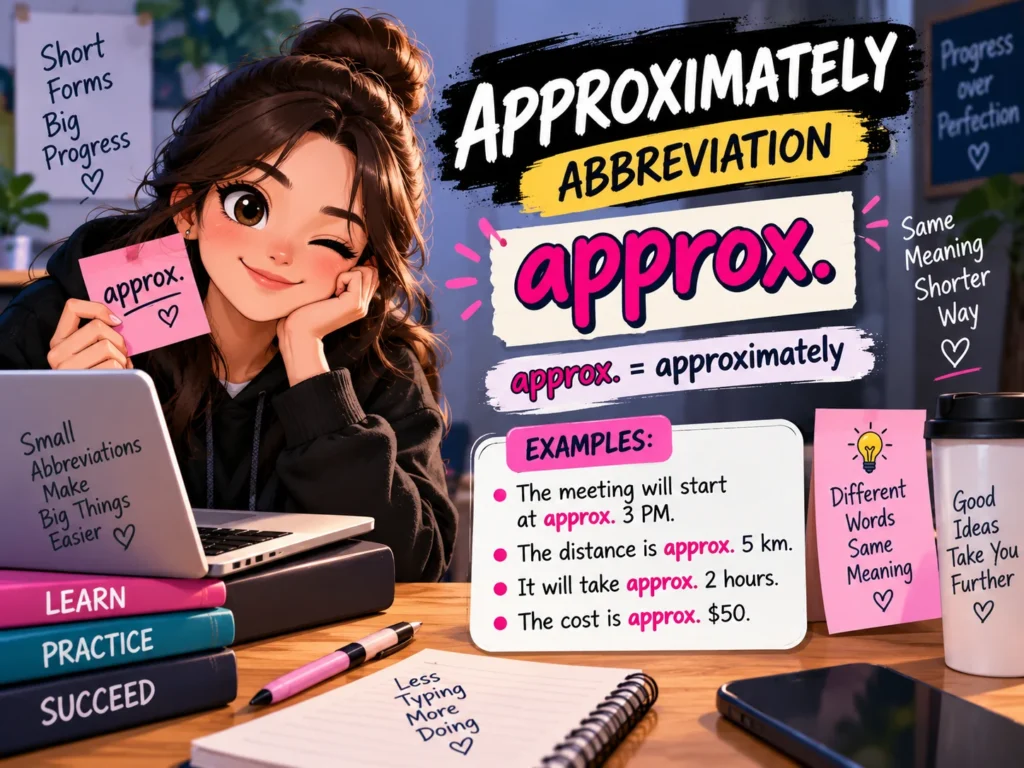
Approx. = Approximately
It means:
about, around, roughly, or close to a stated amount.
For example:
“The journey takes approx. 30 minutes.”
“The box weighs approx. 5 kg.”
“Attendance was approx. 200 people.”
You may also see:
- approx. — traditional abbreviation
- approx — modern version without punctuation
- ≈ — mathematical symbol meaning approximately equal to
- ca. — circa, mainly with dates or historical estimates
- c. — another short form of circa in historical writing
The best choice depends on whether you are writing normal prose, a table, a calculation, or a historical date.
Origin & Background
Why Approximately Gets Shortened
“Approximately” contains many letters and is frequently used before numbers.
That makes it a natural candidate for abbreviation.
Writers often need a compact form in:
tables;
charts;
labels;
maps;
engineering notes;
financial documents;
schedules.
Writing:
“approximately 15 kilometers”
takes much more space than:
“approx. 15 km.”
The shorter version keeps the meaning while reducing visual clutter.
The Role of “Approx.”
The form approx. developed through a common abbreviation pattern: keep the beginning of the word and remove the rest.
This makes it easy to recognize.
Readers see:
“approx.”
and can quickly reconstruct:
“approximately.”
The period traditionally signals that letters have been omitted.
Why Some People Write “Approx”
Modern digital writing often removes punctuation from abbreviations.
That is why you may encounter:
“approx 10 mins”
instead of:
“approx. 10 min.”
Both are usually understandable.
Style guides, organizations, and publishers may have their own preferences, so consistency matters more than forcing one format into every document.
The Mathematical Symbol
Mathematics uses:
≈
to indicate that two values are close but not exactly equal.
For example:
π ≈ 3.14
This means 3.14 is an approximate value of pi rather than its exact value.
The symbol is useful in equations, calculations, scientific notes, and technical writing.
Real-Life Conversations
Person A: How long will it take to get there?
Person B: Approx. 25 minutes.
Person A: Okay, I’ll leave at 6.
Person B: That should be fine.
Here, the abbreviation makes the message shorter without changing the meaning.
Instagram DMs
Person A: How many people came to the event?
Person B: Approx 300, I think.
and,
Person A: That’s a lot!
Person B: Yeah, it was packed.
The version without a period feels completely natural in casual digital communication.
TikTok Comments
Person A: How long did this project take?
Creator: Approx. 4 hours.
Person A: That’s actually faster than I expected.
Creator: Most of the time was editing.
Again, the shortened form works because the conversation is informal and number-focused.
Text Message
Person A: What time will you arrive?
and,
Person B: Approx 8:30.
moreover,
Person A: Perfect. I’ll wait.
The phrase communicates an estimate rather than an exact commitment.
Emotional & Psychological Meaning
“Approximately” is not emotional slang, but it affects how people interpret certainty.
Compare:
“I’ll arrive at 8:30.”
with:
“I’ll arrive at approx. 8:30.”
The first sounds exact.
The second creates flexibility.
That small difference matters psychologically because it changes expectations.
When someone uses an approximation, they are signaling:
“I am not giving you an exact figure.”
“There may be some variation.”
“This is my best estimate.”
Why People Prefer Approximate Language
Exact numbers can create unnecessary pressure.
If you say:
“The repair will take exactly 42 minutes,”
people may expect that promise to be precise.
Saying:
“The repair will take approx. 45 minutes”
allows reasonable uncertainty.
This is especially useful when dealing with:
travel time;
budgets;
crowd estimates;
delivery schedules;
measurements;
future planning.
A Personal-Style Scenario
Imagine you are organizing dinner for several friends.
Someone asks:
“What time will everyone arrive?”
You know traffic could delay them, so you reply:
“Approx. 7:30.”
That single abbreviation quietly communicates:
“Don’t expect everyone at exactly 7:30.”
Approximate language helps people make plans without pretending uncertainty does not exist.
Usage in Different Contexts
Social Media
On social media, writers often use:
“approx”
or:
“around.”
For example:
“Editing time: approx 3 hours.”
This format is compact and easy to read.
Friends & Relationships
In personal messages, natural alternatives may sound warmer:
“around 8”
“about 20 mins”
“roughly an hour.”
“Approx.” can feel slightly technical but is still perfectly understandable.
Work and Professional Settings
The shortened form is common in:
spreadsheets;
reports;
internal notes;
tables;
project timelines;
budgets.
Example:
“Approx. cost: $2,500”
This works well because the reader immediately understands the number is an estimate.
Academic Writing
In formal essays and academic prose, writing “approximately” in full is usually more polished.
For example:
“Approximately 40% of participants completed the survey.”
This looks stronger than:
“Approx. 40% of participants completed the survey.”
Abbreviations work better in tables, figures, notes, or compact technical sections.
Mathematical and Scientific Contexts
The symbol ≈ is ideal when comparing values.
For example:
1 mile ≈ 1.609 km
The symbol communicates an approximate numerical relationship without needing a word.
When NOT to Use It
Avoid abbreviating approximately when formal prose benefits from complete words.
That includes:
- academic essays;
- cover letters;
- formal business correspondence;
- legal documents;
- professional reports where style guidelines require full words;
- public-facing documents for broad audiences.
Do Not Use Approximation When Precision Is Required
The bigger issue is not always the abbreviation itself.
Sometimes approximate language is inappropriate.
For example:
A medical dosage should not be described casually as:
“Take approx. 2 tablets.”
An official deadline should not say:
“Submit at approx. 5 PM.”
Important instructions often require exact numbers and times.
Avoid Mixing Different Styles
A document can look inconsistent if you write:
“approx.”
in one section,
“approx”
in another,
and:
“approximately”
elsewhere.
Choose one style for similar situations and stick with it.
Common Misunderstandings
Approx. and Approx Mean the Same Thing
Yes.
The main difference is punctuation.
“Approx.” uses the traditional abbreviation period.
“Approx” is common in modern digital and technical writing.
≈ Does Not Mean Exactly Equal
This is important.
The symbol:
=
means exactly equal.
The symbol:
≈
means approximately equal.
For example:
1/3 ≈ 0.33
0.33 is close to one-third but not perfectly exact.
“About” Is Not an Abbreviation
“About” is a complete word.
It is simply a natural synonym for approximately.
“Circa” Is Not Used Everywhere
Circa, often shortened to ca. or c., is especially common with historical dates.
For example:
“c. 1850”
means:
“around the year 1850.”
It is usually not the best replacement for everyday estimates such as:
“approximately 20 minutes.”
Approx. Does Not Mean Estimate in Every Sense
It tells the reader that the following number or value is approximate.
It does not automatically explain how the estimate was calculated.
Comparison Table
| Form | Meaning | Best Use |
|---|---|---|
| Approx. | Approximately | General shorthand |
| Approx | Approximately | Digital/technical writing |
| ≈ | Approximately equal to | Mathematics/science |
| About | Approximately | Everyday English |
| Around | Approximately | Casual conversation |
| Roughly | Approximately | General estimates |
| Nearly | Almost | Values slightly below/near |
| Circa | Around a date | Historical writing |
| ca. | Circa | Historical notes |
| c. | Circa | Dates/history |
Key Insight
Use approx. when you need a clear written abbreviation, ≈ when working with numbers or equations, and approximately in formal prose. Everyday conversation often sounds more natural with “about” or “around.”
Variations and Types
1. Approx.
Meaning: Approximately.
This is the classic abbreviated form.
Example:
“Approx. 50 guests attended.”
2. Approx
Meaning: Approximately.
The same word without the period.
Common in tables, websites, digital forms, and informal writing.
3. APPROX.
Meaning: Approximately.
An uppercase version sometimes used in forms or technical drawings.
4. ≈
Meaning: Approximately equal to.
Used mainly in mathematics and science.
Example:
√2 ≈ 1.414
5. About
Meaning: Approximately.
Example:
“It takes about 20 minutes.”
This often sounds more natural in everyday speech.
6. Around
Meaning: Approximately.
Example:
“There were around 100 people.”
Common in informal conversation.
7. Roughly
Meaning: Approximately or not exactly.
Example:
“The project costs roughly $10,000.”
Useful when emphasizing that the figure is broad.
8. Circa
Meaning: Around or approximately.
Mostly used with dates.
Example:
“The building was constructed circa 1900.”
9. Ca.
Meaning: Abbreviation of circa.
Example:
“ca. 1750.”
10. C.
Meaning: Another short form of circa.
Example:
“c. 1200.”
This is especially common in historical and biographical writing.
How to Respond When Someone Uses It
There is usually no special response needed.
The abbreviation simply tells you that a number is an estimate.
Casual Replies
“Got it.”
“Okay, around that time.”
“Perfect.”
“Sounds good.”
Funny Replies
“Approximate enough 😂”
“So basically somewhere around there.”
“I’ll give you a five-minute grace period.”
Mature Replies
“Thanks for the estimate.”
“Understood. I’ll treat that as an approximate figure.”
“Could you confirm the exact amount when available?”
Respectful Replies
If precision matters:
“Is that an estimate or a confirmed figure?”
“How much variation should I expect?”
“Can you provide the exact number when finalized?”
This is especially useful in professional communication.
Regional & Cultural Usage
Western English
“Approx.” is widely understood throughout English-speaking countries.
British and American writers both recognize it easily.
Punctuation practices may differ depending on house style.
Asian English
English-medium schools, universities, businesses, and technical workplaces across Asia frequently use the abbreviation in tables, calculations, and notes.
Because it is highly standardized and transparent, it causes relatively little confusion.
Middle Eastern English
The same applies in professional, academic, and technical environments throughout the Middle East.
It is commonly understood in reports, schedules, measurements, and business documentation.
Global Technical Usage
The mathematical symbol ≈ is particularly international.
A scientist in one country and an engineer in another can usually interpret it without needing the English word “approximately.”
Gen Z vs. Millennials
There is little meaningful generational difference.
Younger users may prefer:
“approx”
without punctuation in texts and captions.
Formal and older styles may favor:
“approx.”
The difference is mostly about writing style rather than meaning.
Is the Abbreviation Safe for Kids?
Yes.
The shortened forms are completely appropriate for children and students.
A simple explanation is:
“Approx. means approximately, or about.”
For example:
“Approx. 10 minutes”
means:
“about 10 minutes.”
Students should also learn the difference between:
= exact equality
and:
≈ approximate equality
This distinction is useful in mathematics, science, measurement, and everyday problem solving.
FAQs
What is the abbreviation for approximately?
The most common abbreviation is approx. The form approx without a period is also widely used in modern digital and technical writing.
Is approx. correct?
Yes. Approx. is a standard and easily understood shortened form of “approximately.”
Can I write approx without a period?
Yes. “Approx” is common in informal, technical, digital, and space-limited contexts. Formal style may prefer “approx.” or the full word.
What symbol means approximately?
The mathematical symbol ≈ means approximately equal to.
For example:
10 ÷ 3 ≈ 3.33
What is the difference between ≈ and =?
= means exactly equal, while ≈ means close to equal.
That distinction is especially important in mathematics and science.
What does ca. mean before a date?
Ca. means circa, which means approximately or around.
For example:
“ca. 1800”
means:
“around the year 1800.”
Should I use approx. in formal writing?
In normal formal prose, writing approximately in full usually looks better. The abbreviation is more suitable for tables, notes, labels, technical writing, and places where space is limited.
Conclusion
The most familiar short form of approximately is approx.
You may also see approx without punctuation, especially in modern digital writing.
For mathematics and science, the symbol ≈ is often the best option because it directly means “approximately equal to.”
Other alternatives depend on context.
“About” and “around” sound natural in everyday conversation.
“Roughly” works well for broad estimates.
“Circa,” usually written as c. or ca., is particularly useful for uncertain historical dates.
The key is choosing the form that matches the situation.
Writing a formal academic paragraph?
Use approximately.
Creating a compact table?
Use approx.
Writing an equation?
Use ≈.
Discussing a historical date?
Consider circa.
Once you understand those differences, choosing the right shortened form becomes simple.
For high CTR (click-through rate), titles and descriptions should create curiosity, a clear benefit, and a reason to click without giving everything away