
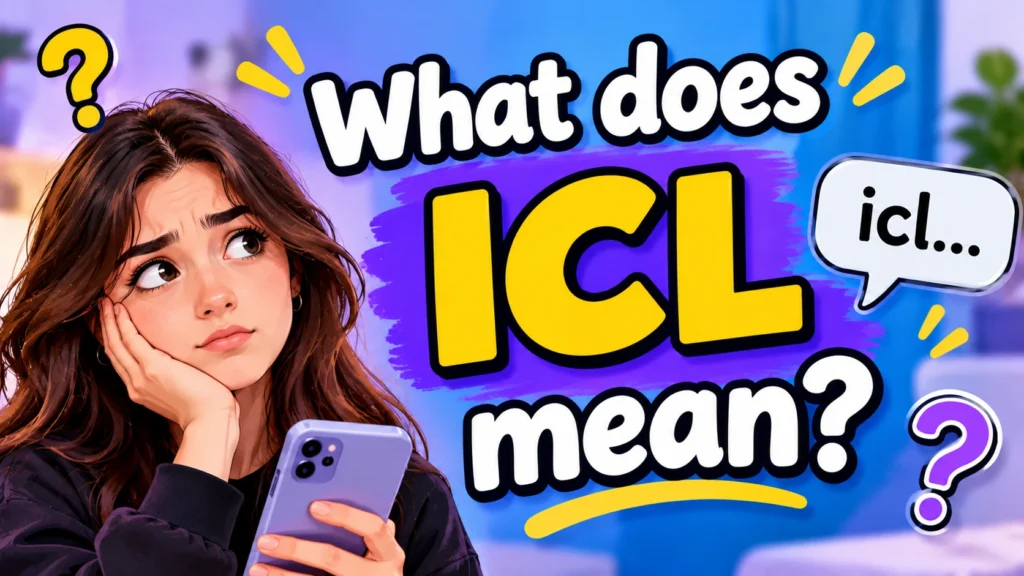
Have you ever been chatting with someone and suddenly received a message saying “ICL”? If you are unfamiliar with modern texting slang, those three letters might leave you wondering what the person actually means.
In everyday digital communication, ICL most commonly means “I Can’t Lie.” It is an informal expression people use before sharing an honest opinion, admitting something, or expressing how they genuinely feel.
For example, someone might text, “ICL, that movie was amazing.” They are essentially saying, “I can’t lie, that movie was amazing.”
You will often see this abbreviation on TikTok, Snapchat, Instagram, WhatsApp, and other social platforms. It is especially popular in casual conversations where people want to sound direct, natural, and honest.
Understanding ICL can help you follow online discussions, recognize the tone behind messages, and respond without feeling confused.
ICL Meaning in Text: A Quick Explanation
ICL stands for “I Can’t Lie.”
It is a popular informal texting abbreviation used to introduce an honest thought or personal opinion. People often write it when they want to emphasize that they are being genuine.
Here are some common examples:
- “ICL, you look amazing today.” — The sender is honestly complimenting someone.
- “ICL, I’m tired of studying.” — The sender is admitting how they really feel.
- “ICL, that game was boring.” — The sender is expressing an honest opinion.
- “ICL, I didn’t expect that.” — The sender is showing genuine surprise.
Three short examples in conversation
“ICL, this song is addictive.”
“ICL, I miss those days.”
“ICL, you were right.”
The expression does not necessarily mean someone is correcting a previous lie. It usually works as an informal way to emphasize honesty.
The Origin and Background of ICL
How Internet Slang Developed
ICL belongs to a larger group of abbreviations that became popular as online messaging grew.
People have always looked for shorter ways to communicate. Early SMS messages encouraged abbreviations because typing on traditional mobile phone keypads could be inconvenient.
As social media developed, new expressions emerged to communicate feelings, reactions, and opinions in fewer characters.
The Influence of British Internet Culture
ICL has become particularly recognizable in British online slang and youth conversations. It is frequently used in informal discussions, short videos, comments, and private messages.
The expression also fits naturally into broader English-language internet culture, where people use shortcuts such as NGL, TBH, and FR.
How TikTok and Social Media Increased Its Popularity
Short-form video platforms have helped spread modern slang between different communities.
A creator might say, “ICL, this is the best meal I’ve ever had,” in a video or caption. Viewers may then repeat the expression in their own comments and messages.
As a result, people who do not live in the same country can still recognize the same online vocabulary.
ICL in Real-Life Conversations
Understanding ICL becomes easier when you see how people use it in everyday situations. Here are four realistic examples from popular messaging platforms.
1. WhatsApp Conversation: Sharing an Honest Opinion
Person A: Did you enjoy the party last night?
and,
Person B: ICL, it was one of the best parties I’ve attended.
moreover,
Person A: Same! The music was amazing.
Here, ICL introduces a genuine opinion. Person B is emphasizing how much they enjoyed the event.
2. Instagram DM: Giving a Compliment
Person A: I’m thinking about changing my hairstyle.
and,
Person B: ICL, your current hairstyle looks perfect.
moreover,
Person A: Really? I was getting bored of it.
The abbreviation makes the compliment sound direct and personal. The sender wants to emphasize that the opinion is sincere.
3. TikTok Comment: Reacting to a Video
Person A: This is my favorite outfit from the collection!
and,
Person B: ICL, the black one is even better.
moreover,
Person A: That one is definitely getting popular!
In this example, ICL introduces a personal preference. It gives the comment a relaxed, conversational tone.
4. Text Message: Expressing Feelings
Person A: Do you still think about our school days?
and,
Person B: ICL, I miss those moments so much.
moreover,
Person A: Those memories were special.
Here, the abbreviation adds emotional honesty. The sender is openly admitting that they miss the past.
The Emotional and Psychological Meaning of ICL
ICL is more than a shortcut for three words. It can also change how a statement feels by emphasizing honesty and personal expression.
It Shows Honesty
People often use ICL when they want their opinion to sound genuine.
For example:
“ICL, you handled that situation really well.”
The sender is emphasizing that the compliment reflects what they truly think.
It Creates a Feeling of Directness
Modern digital conversations often favor straightforward language. ICL allows someone to introduce an opinion without writing a long explanation.
It can make a message feel more personal, particularly between people who already know each other.
It Can Make Conversations More Relatable
People sometimes hesitate to share their real thoughts because they worry about how others will react.
Using ICL can make an honest statement feel more natural or less formal.
However, the expression does not automatically make a statement kind or respectful. Someone can use ICL before saying something unnecessarily harsh.
A relatable everyday scenario
Imagine your friend asks whether you liked their new presentation. You genuinely think it was good, so you reply, “ICL, you did a great job. The introduction was especially strong.”
Your friend may appreciate the direct compliment because it feels personal rather than automatic.
How ICL Is Used in Different Situations
Social Media
ICL is commonly used in TikTok comments, Instagram captions, Snapchat messages, and online discussions.
Examples include:
- “ICL, this trend is getting boring.”
- “ICL, your photos look incredible.”
- “ICL, I wasn’t expecting that ending.”
- “ICL, this is the best video today.”
It helps people introduce honest reactions without making their comments sound overly formal.
Friends and Relationships
Friends often use ICL when discussing personal opinions, feelings, and everyday experiences.
Examples:
- “ICL, I miss hanging out with you.”
- “ICL, that was my favorite memory.”
- “ICL, you make everything fun.”
- “ICL, I was worried about you.”
In relationships, it can introduce sincere compliments or emotional admissions. Still, the meaning depends on the complete message rather than the abbreviation alone.
Work and Professional Communication
ICL is generally not recommended in formal business communication.
For example, instead of writing:
“ICL, the report needs more details.”
A professional version would be:
“To be honest, I think the report would benefit from additional details.”
The complete expression sounds more polished and communicates the point clearly.
In an informal team chat, ICL may be acceptable if everyone understands the slang. However, professional writing usually benefits from standard English.
Casual vs. Serious Conversations
In casual conversations, ICL feels natural and relaxed.
During serious discussions, it can help introduce a sincere opinion, but the full phrase may communicate more care.
For example, “ICL, I felt hurt by what happened” is understandable. In a sensitive conversation, “I want to be honest with you: what happened hurt me” may feel more thoughtful.
When Should You Avoid Using ICL?
Although ICL is common online, it is not suitable for every communication setting.
Formal Emails and Official Documents
Avoid ICL in job applications, business proposals, official reports, and professional emails.
Use expressions such as “Honestly,” “To be honest,” or “In my opinion” instead.
Academic Writing
Students should not use ICL in research papers, essays, examinations, or formal presentations.
Academic writing requires complete sentences and an appropriate level of formality.
Conversations With Unfamiliar People
Not everyone recognizes internet slang. Someone who rarely uses social media may not understand ICL.
When communicating with new people, using the full expression can prevent confusion.
Sensitive Discussions
ICL can introduce a strong opinion, but it should not be used as an excuse for being disrespectful.
For example, “ICL, your idea is terrible” may sound unnecessarily harsh. A more constructive version would be, “Honestly, I think we could improve this idea.”
Honesty is most useful when it is combined with kindness.
Common Misunderstandings About ICL
1. Thinking ICL Means Something Negative
ICL does not automatically express criticism or disappointment.
It can introduce a compliment, a positive opinion, a personal admission, or a negative observation.
2. Confusing ICL With NGL
Both abbreviations are closely related.
- ICL: I Can’t Lie
- NGL: Not Gonna Lie
They are often used in similar situations to introduce an honest statement.
3. Assuming It Always Means the Person Is Telling the Truth
ICL emphasizes that the sender wants to sound honest. However, the abbreviation itself cannot prove whether a statement is true.
You should still consider the person’s words, actions, and the situation.
4. Thinking It Is Only Used by Teenagers
ICL is especially visible in youth-oriented online communities, but people of different ages may use it.
Internet slang spreads through social platforms, gaming communities, and everyday conversations.
5. Believing It Always Indicates Romantic Interest
If someone writes, “ICL, you look beautiful,” it may be a compliment, but it does not automatically mean romantic attraction.
The relationship and surrounding conversation provide better clues.
ICL vs. Similar Texting Abbreviations
Several texting expressions communicate honesty, agreement, or personal opinions. Knowing their differences can make online conversations easier to understand.
| Abbreviation | Full Meaning | Main Purpose |
|---|---|---|
| ICL | I Can’t Lie | Introducing an honest statement |
| NGL | Not Gonna Lie | Sharing a genuine opinion |
| TBH | To Be Honest | Expressing an honest thought |
| IMO | In My Opinion | Sharing a personal viewpoint |
| IMHO | In My Humble Opinion | Giving a softened opinion |
| FR | For Real | Emphasizing agreement or truth |
| FRFR | For Real, For Real | Adding stronger emphasis |
| IDK | I Don’t Know | Expressing uncertainty |
| ISTG | I Swear To God | Emphasizing sincerity or frustration |
| IK | I Know | Showing understanding or agreement |
Key Insight
ICL, NGL, and TBH are particularly similar because they introduce honest opinions. However, they are not always interchangeable in tone. ICL often feels conversational and direct, while TBH can sound slightly more neutral.
Popular Variations and Related Expressions
ICL has several related forms and expressions that people use to communicate honesty, sincerity, and personal opinions.
1. ICL
Meaning: I Can’t Lie.
It introduces an honest opinion or personal admission.
2. NGL
Meaning: Not Gonna Lie.
It is commonly used before sharing a genuine thought or unexpected opinion.
3. TBH
Meaning: To Be Honest.
It introduces a sincere statement, whether positive or negative.
4. IMO
Meaning: In My Opinion.
People use it when sharing a personal viewpoint rather than presenting something as a fact.
5. IMHO
Meaning: In My Humble Opinion.
It introduces an opinion in a slightly softer or more modest way.
6. FR
Meaning: For Real.
It emphasizes agreement, seriousness, or authenticity.
7. FRFR
Meaning: For Real, For Real.
It adds extra emphasis when someone strongly agrees with a statement.
8. ISTG
Meaning: I Swear To God.
It is used to emphasize sincerity, frustration, or a strong reaction.
9. TBF
Meaning: To Be Fair.
People use it when introducing another perspective or making a balanced observation.
10. Honestly
Meaning: Speaking sincerely or truthfully.
It is the complete English expression that can replace ICL in both casual and more formal conversations.
These expressions are related in purpose, but their meanings are different. Choose the one that best matches your intended message.
How to Respond When Someone Uses ICL
Your response should depend on what the sender is saying. Sometimes they are giving a compliment, while other times they are sharing a personal opinion.
Casual Replies
Use these when chatting with friends:
- “I get you!”
- “Honestly, same.”
- “I know what you mean.”
- “That’s so true.”
- “Fair enough!”
Funny Replies
If the conversation is playful, you can respond with humor:
- “Finally, some honesty!”
- “No lies detected!”
- “The truth has entered the chat!”
- “I was waiting for this confession!”
- “You said what everyone was thinking!”
Mature Replies
For thoughtful discussions, try:
- “I appreciate your honesty.”
- “That’s a fair point.”
- “I understand your perspective.”
- “Thanks for being straightforward.”
- “I respect your opinion.”
Respectful Replies
If someone shares a sincere or emotional thought, consider:
- “Thank you for telling me.”
- “I appreciate you being open with me.”
- “I understand how you feel.”
- “I’m glad you shared that.”
- “Your honesty means a lot.”
The best response is one that acknowledges the person’s message rather than focusing only on the abbreviation.
ICL Across Different Regions and Generations
Western Culture
In the United States, Canada, and the United Kingdom, expressions such as ICL, NGL, and TBH appear in informal online conversations.
ICL is particularly recognizable in British internet slang and youth-oriented social media discussions.
Asian Culture
In countries such as Pakistan, India, Bangladesh, and the Philippines, English texting slang is often mixed with local languages.
For example:
“ICL, tumhari presentation bohat achi thi.”
This means, “I can’t lie, your presentation was really good.”
The abbreviation fits naturally into informal mixed-language conversations.
Middle Eastern Culture
English slang is used across many online communities in the Middle East, especially among people who communicate internationally.
ICL may appear in English-language chats alongside Arabic expressions and regional texting styles. Its core meaning remains the same.
Global Internet Usage
TikTok, Instagram, Snapchat, and other platforms help expressions travel between countries.
Someone in one region may learn ICL from a video created thousands of miles away. This makes modern slang increasingly international.
Gen Z vs. Millennials
Gen Z frequently uses ICL in casual conversations, particularly when reacting to trends, sharing opinions, or discussing relationships.
Millennials may recognize and use it too, although they may prefer expressions such as “honestly” or “to be honest” in some situations.
Individual communication habits matter more than age alone.
Is ICL Safe for Kids?
Yes. ICL is generally a harmless texting abbreviation because it means “I Can’t Lie.”
It does not contain an inherently offensive or inappropriate meaning. Children may encounter it in online games, group chats, social media comments, or messages from friends.
Parents can explain that ICL is an informal way of introducing an honest opinion. They should also remind children that honesty and kindness should go together.
For school assignments and formal communication, children should use complete expressions such as “To be honest” rather than internet abbreviations.
It is also useful to teach children that not every online statement is necessarily true simply because someone uses an expression about honesty.
Frequently Asked Questions About ICL
1. What does ICL mean in text messages?
ICL means “I Can’t Lie.” It is an informal abbreviation used before sharing an honest opinion, personal feeling, or genuine reaction.
2. What does ICL mean on Snapchat?
On Snapchat, ICL usually means “I Can’t Lie.” People use it in snaps and chats when they want to emphasize that they are being honest.
3. What does ICL mean on TikTok?
On TikTok, ICL is commonly used in captions and comments to introduce a genuine opinion or reaction. For example, “ICL, this trend is actually fun.”
4. Does ICL mean the same as NGL?
Yes, they have very similar meanings. ICL means “I Can’t Lie,” while NGL means “Not Gonna Lie.” Both introduce an honest statement.
5. Is ICL a positive or negative expression?
ICL can introduce either a positive or negative opinion. Its emotional meaning depends on what follows the abbreviation.
6. Is ICL flirting in text?
Not necessarily. Someone may use ICL before giving a compliment, but the abbreviation itself does not indicate romantic interest. The full message and relationship provide better context.
7. Is ICL appropriate for professional messages?
ICL is generally too informal for professional emails and official documents. Use “To be honest” or “Honestly” when communicating in a formal setting.
Conclusion
ICL is a popular internet abbreviation that means “I Can’t Lie.” People use it to introduce honest opinions, express genuine feelings, and emphasize that they are speaking sincerely.
You may see it in TikTok comments, Snapchat conversations, Instagram DMs, and everyday WhatsApp messages. Its meaning is usually easy to understand once you recognize the expression behind the letters.
Although ICL works naturally in casual conversations, it is better to use complete phrases in professional or sensitive situations. Remember that being honest does not mean being unkind.
The next time someone sends you “ICL, you’re amazing” or “ICL, that was unexpected,” you will know they are emphasizing their genuine reaction. Sometimes, a few simple letters can make an ordinary message feel more direct and personal.
1 thought on “ICL Meaning in Text: What Does ICL Stand For?”