Have you ever stared at your phone screen, watching the three blinking dots disappear, only to receive a three-letter acronym that leaves you entirely blank? Digital communication moves at a dizzying pace, transforming the way we connect, share emotions, and build relationships online.
One phrase currently dominating group chats, comment sections, and direct messages is “ATP.” If your first instinct was to recall high school biology class, you are certainly not alone. Thousands of people search for clarity on this exact term every day because its texting definition has absolutely nothing to do with science.
Misunderstanding modern slang can create accidental awkwardness or completely change the tone of an otherwise normal conversation. Unpacking these micro-expressions bridges the gap between generations and helps us communicate with absolute confidence. Let’s pull back the curtain on this viral acronym and look at how it shapes our daily digital interactions.
[What Does ATP Stand For in Text] – Quick Meaning
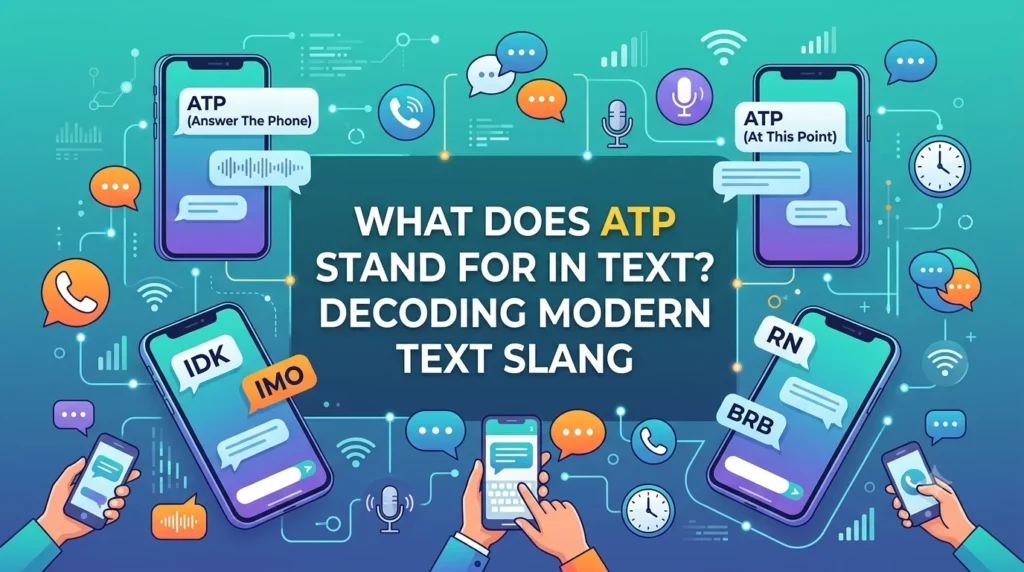
In the world of casual text messaging and social media, ATP most commonly stands for “Answer The Phone.”
It serves as a direct, fast-paced demand or urgent request when someone is ignoring your calls or taking too long to respond to an important message. However, depending on the context of the chat, it can also stand for “At This Point.”
- Primary Meaning: Answer The Phone (Urgent, action-oriented)
- Secondary Meaning: At This Point (Reflective, slightly exhausted)
“Bro ATP before I drive over there myself.”
“I’ve tried helping him three times now, but ATP I’m just done.”
“Check your notifications and ATP right now!”
Origin, Cultural Evolution, and Background
From the Biology Lab to the Smartphone
For decades, ATP belonged exclusively to textbooks as Adenosine Triphosphate, the chemical engine that powers living cells. When mobile phones first introduced character limits on SMS messaging, users began shortening everything from “laugh out loud” to “talk to you later.” The modern texting iteration of ATP emerged much later, finding its footing during the smartphone boom of the late 2010s.
The Social Media Acceleration Effect
Platforms like TikTok, Snapchat, and Instagram DMs completely altered how young people type. Speed became more important than punctuation. Typing out a full sentence like “please pick up my voice call” felt too formal and slow during high-stakes social moments.
As viral videos began showing creators frantic over missed calls, the acronym transitioned from an inside joke among tight-knit friend groups into a global shorthand. It evolved alongside the cultural shift toward instant gratification—if a friend does not answer within ninety seconds, a sender deploys these three letters to signal immediate attention.
Real-Life Conversations Across Platforms
WhatsApp Group Chat
Sarah: Are we still meeting at the cafe at 6:00 PM? The rain is getting really bad out here.
Jessica: I’m already sitting inside by the window! Where is Mike? He has the car.
Sarah: @Mike ATP we are literally waiting on you to order the food.
Instagram Direct Messages
Liam: Sends a funny, urgent meme about a shared secret
Noah: No way, did that actually happen today at school?
Liam: Bro I am calling you right now ATP!
TikTok Comments Section
User1: Did anyone else notice how awkward the vibe was between them in the background of this video?
User2: YES! Someone tag her best friend to get the real story.
User3: I am literally texting her ATP to find out what went down.
Standard Text Messages
Mom: Justin, your father and I are standing outside the grocery store and forgot the list.
and,
Mom: Justin.
moreover,
Mom: ATP your dinner depends on it!
The Emotional and Psychological Weight Behind the Slang
Impatience, Urgency, and Vulnerability
Texting is rarely just about the literal words on the screen; it is about the emotional spaces between them. Deploying “Answer The Phone” usually highlights a sudden spike in anxiety, excitement, or frustration. It indicates that text bubbles are no longer a sufficient medium for the emotional scale of the conversation.
Why We Abandon Full Sentences
Modern communication psychology reveals that long sentences can sometimes feel overly clinical or cold to younger generations. Shortening an urgent request to three letters strips away the corporate formality. It creates a raw, immediate conversational boundary that says, I need your undivided attention this exact second.
A Personal Perspective on Digital Boundaries
During my years analyzing online linguistic patterns, I watched a close colleague struggle to get ahold of her teenage daughter during a minor family emergency. She sent five long paragraphs with no response. I suggested she send a single line: “ATP it’s important.” The phone rang less than twenty seconds later. That is the psychological power of utilizing the correct cultural currency.
Usage in Different Contexts
Social Media Spaces
On public platforms like Twitter or TikTok, the acronym is frequently used in a performative, dramatic way. Users type it in capital letters to show hyper-fixation on pop culture drama or celebrity news, demanding their mutual followers discuss a topic immediately via live audio.
Friends and Intimate Relationships
Among peers, the term acts as a thermometer for the relationship’s comfort level. Between best friends, it is a playful, aggressive nudge. In romantic dynamics, however, sending it repeatedly without context can occasionally signal possessiveness or unnecessary panic if the partner is simply away from their device.
Work and Professional Settings
Warning: Never send this acronym to a supervisor, client, or corporate colleague.
In a professional environment, using this phrase comes across as demanding, rude, and deeply unprofessional. If an urgent matter requires a phone call, opt for traditional workplace etiquette instead.
Professional Alternative: “Hi Thomas, when you have a brief moment, do you mind jumping on a quick audio call to finalize these project details?”
Casual vs. Serious Tones
The tone hinges entirely on punctuation and lowercase variations. A casual message might look like a lowercase atp followed by a laughing emoji. A serious, boundary-setting text usually drops the emojis entirely and stands alone as a capital block, signaling true annoyance.
When You Should Safely Avoid Using It
High-Stress Situations
If someone is dealing with a genuine crisis or medical emergency, sending vague shorthand can cause unnecessary mental friction. The recipient might find it dismissive or confusing during a moment that requires absolute clarity.
Cross-Cultural Conversations
Linguistic barriers change drastically across different demographics. If you are texting an older family member or an international colleague, using highly localized smartphone shorthand will likely stall the conversation as they stop to look up the definition.
Common Misunderstandings and Tone Confusion
The most significant issue with this specific acronym is its dual identity. If a friend sends a message saying, “I don’t know what to do atp,” they are expressing weary resignation (at this point). If you mistake it for an angry demand to answer the phone, your response will feel completely detached from their emotional state.
Reading the room is essential. If the acronym appears at the very beginning of a sentence or stands completely alone, it is almost always an instruction to pick up a call. If it sits quietly at the very end of a long, reflective sentence, it serves as a time marker meaning right now.
Comparing Digital Shortcuts
| Slang Term | Core Meaning | Emotional Tone | Best Context |
| ATP | Answer The Phone / At This Point | Urgent, direct, or weary | Close friends, fast group chats |
| HMU | Hit Me Up | Casual, inviting, relaxed | Making weekend plans |
| BRB | Be Right Back | Informative, polite | Pausing an active chat session |
| RN | Right Now | Demanding, immediate | Expressing current feelings |
| TTYL | Talk To You Later | Concluding, warm | Ending a conversation politely |
Key Insight
The Right Tool for the Digital Moment
While terms like HMU invite a open-ended connection whenever the other person is free, ATP draws a sharp line in the sand, demanding an active transition from text typing to live spoken dialogue.
Modern Variations and Semantic Offshoots
- ATP RN: Answer the phone right now. A double layer of urgency that leaves no room for hesitation.
- Pls ATP: Please answer the phone. A slightly softer approach that mixes old-school politeness with modern speed.
- ATP Bro: Answer the phone, brother. Used heavily in male friendship groups to signal major news or gaming invites.
- Done ATP: Done at this point. Utilizing the secondary meaning to show absolute emotional exhaustion.
- Tired ATP: Tired at this point. A common social media status update signaling burnout.
- ATP Only: Voice calls only. Used in bio descriptions to tell people not to bother sending text messages.
- Gotta ATP: I have to answer the phone. A quick exit line used to abruptly leave one chat to take an incoming call from someone else.
- Why No ATP: Why are you not answering the phone? Sent after a call rings out completely to voicemail.
How to Respond Professionally and Casually
Casual & Friendly Replies
“My bad! My phone was on silent in my bag, calling you back in two seconds!”
“Just saw this, pressing dial now!”
Funny & Witty Comebacks
“I’m practicing my unplugged influencer lifestyle, leave a message after the beep.”
“Can’t chat, currently being chased by a very small, very angry chihuahua.”
Mature & Direct Responses
“Hey, I am currently in a meeting and cannot take a live call, but I can read your texts if it is urgent.”
“I need about twenty minutes to finish dinner, and then I will give you a proper ring.”
Respectful & Soft Replies
“I see you’re trying to call, let me step out into a quiet hallway so I can hear you properly.”
“I’m driving safely right now, will call the moment I park the car.”
Regional, Cultural, and Generational Adaptations
Western Smartphone Culture
In the United States, Canada, and the United Kingdom, the phrase is deeply tied to the culture of hyper-connectivity. Senders assume that because a smartphone is physically close to a person at all times, a delay in answering is an active personal choice, giving the acronym a sharper edge.
Asian and Middle Eastern Digital Spaces
In regions where voice notes and direct calling inside applications like WhatsApp or WeChat are preferred over traditional cellular calls, the acronym is frequently used to shift a text conversation into an app-based group audio stream.
The Generational Divide: Gen Z vs. Millennials
Gen Z utilizes the term natively, viewing it as a natural, fluid element of their daily vocabulary. They instinctively know which meaning applies based on the layout of the text.
Millennials, however, often view the acronym with skepticism, preferring to type out full words or simply sending a question mark to find out why someone is calling them out of the blue.
Digital Safety: Is This Term Safe for Kids?
For parents monitoring their children’s digital footprints, this acronym is entirely safe. It carries no hidden adult connotations, substance references, or dangerous double meanings. It is a utility term focused entirely on conversation speed. The only minor concern is the potential for mild digital bullying or peer pressure if a group chat repeatedly spams a child with the term to overwhelm them into responding before they are comfortable.
Frequently Asked Questions
Does ATP mean anything bad in text?
No, it does not have an inherently negative or inappropriate meaning. It is simply a functional shortcut for “answer the phone” or “at this point.” However, its tone can feel aggressive if written in all capital letters during an argument.
How can I tell which meaning of ATP someone is using?
Look closely at the placement within the sentence. If it stands alone as a single message while your phone is ringing, it means “Answer The Phone.” If it is tucked inside a descriptive sentence like, “I am so confused atp,” it means “At This Point.”
Is ATP used on Snapchat differently than TikTok?
The fundamental meaning remains identical across both platforms. On Snapchat, it is often overlaid directly on quick video snaps of a ringing phone screen. On TikTok, it is primarily found inside text comments or video captions to discuss creator drama.
Can I use ATP in a business email?
You should completely avoid using it in any professional communication. Corporate environments require full sentence structures to maintain clarity, respect, and standard workplace decorum.
What is the opposite of ATP in texting?
If the meaning is “answer the phone,” a loose opposite would be DND (Do Not Disturb) or CNR (Can Not Respond), signaling that the user is actively unavailable for voice contact.
Final Thoughts: Navigating the Future of Language
Language has never been a fixed monument; it is a living, breathing ecosystem that adapts to the tools we use to express ourselves. Shortcuts like these are not destroying our ability to connect—they are simply shifting the shape of our conversations to match the lightning speed of modern life.
The next time those three capital letters flash across your screen, you will not need to scratch your head or mentally return to biology class. You can smile, read the context, and confidently decide whether to type a quick reply or simply pick up the phone.