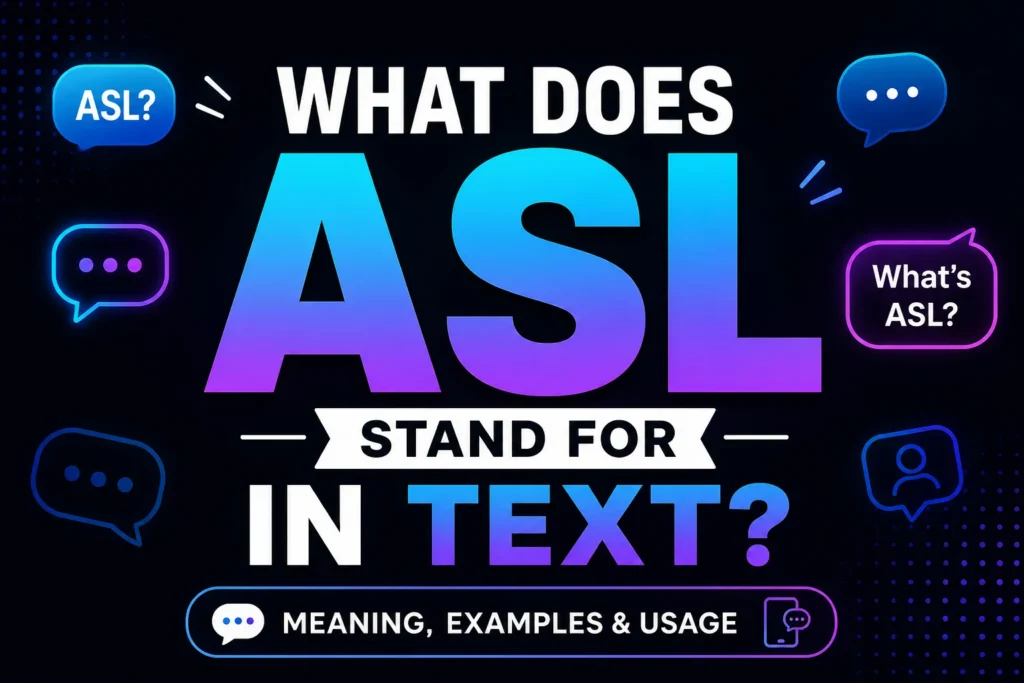
If you’ve ever received a message saying “asl?” and wondered what it meant, you’re not alone. While many people recognize ASL as American Sign Language, the abbreviation has a completely different meaning in texting and online chats.
So, what does ASL stand for in text? In most messaging apps, gaming platforms, and social media conversations, ASL stands for “Age, Sex, Location?” It’s a quick way to ask someone for basic personal information when getting to know them online.
This guide explains the texting meaning of ASL, where it came from, when people use it today, and how to respond naturally without confusion.
What Does ASL Stand for in Text?
Quick Meaning
In text messages and online chats, ASL stands for:
- A = Age
- S = Sex (or gender)
- L = Location
It is commonly used as a shortcut to ask someone three introductory questions at once.
Examples:
“Hey! ASL?”
“ASL? I’m curious where you’re from.”
“Someone asked me ASL in a game chat.”
Although the abbreviation still appears online, it’s less common than it was in the early internet era.
What Does Someone Mean by “ASL?”
When someone sends “ASL?”, they’re usually asking:
- How old are you?
- Are you male or female?
- Where do you live?
A typical response might look like:
“22, F, London.”
or
“19, M, Toronto.”
Today, many people simply answer the parts they’re comfortable sharing.
Origin & Background
Early Internet Chat Rooms
ASL became popular during the late 1990s and early 2000s when people chatted on platforms like AOL Instant Messenger (AIM), Yahoo Messenger, MSN Messenger, and IRC.
Typing “ASL?” saved time compared with asking three separate questions.
Why It Became Popular
Back then, most online users were anonymous. People wanted a quick way to learn basic information before continuing a conversation.
Instead of typing:
- How old are you?
- Are you a guy or a girl?
- Where do you live?
Users simply typed:
ASL?
Social Media Influence
Although ASL isn’t nearly as common today, it still appears in:
- Gaming chats
- Reddit discussions
- Discord servers
- Random chat websites
- TikTok comments discussing internet slang
Many younger users also encounter it while watching nostalgic internet content.
Real-Life Conversations
Person A: Hey!
Person B: Hi 😊
and,
Person A: ASL?
Person B: 24, F, Manchester.
Instagram DM
Person A: Nice photography!
Person B: Thanks!
and,
Person A: ASL?
Person B: 21, M, Australia.
TikTok Comments
Person A: Anyone remember when everyone asked “ASL?” 😂
Person B: Internet was so different back then!
Text Message
Person A: We met in the gaming lobby earlier.
Person B: Yeah!
and,
Person A: ASL?
Person B: 20, F, California.
Emotional & Psychological Meaning
Why People Use ASL
ASL usually expresses:
- Curiosity
- Interest in getting acquainted
- Starting a conversation
- Finding people with similar backgrounds
Unlike many modern slang terms, ASL isn’t emotional. Instead, it’s practical and conversational.
A Personal-Style Scenario
Imagine joining a multiplayer game for the first time. Someone messages:
“ASL?”
They’re usually trying to learn a little about you before chatting further—not necessarily being rude, though you should only share information you’re comfortable revealing.
Usage in Different Contexts
Social Media
People sometimes use ASL jokingly to reference early internet culture.
Example:
“Throwback to when every chat started with ASL.”
Friends & Relationships
Friends rarely use ASL with each other because they already know one another.
Instead, it appears when meeting someone new online.
Work & Professional Settings
Avoid using ASL in professional conversations.
Business communication should use polite, direct questions instead.
Casual vs Serious Tone
Casual
- Gaming chats
- Online communities
- Social apps
Serious
Generally not appropriate because it requests personal information.
When NOT to Use It
Avoid asking ASL when:
- Speaking with strangers who may value privacy.
- Messaging someone in a professional setting.
- Talking to children or minors.
- Entering communities where personal information shouldn’t be shared.
- The other person seems uncomfortable.
Modern internet etiquette encourages respecting privacy.
Common Misunderstandings
Confusing It with American Sign Language
This is the biggest misunderstanding.
Depending on the conversation, ASL may mean:
- American Sign Language
- Age, Sex, Location
Context determines the correct meaning.
Assuming Everyone Knows It
Many Gen Z users have never used early chat rooms and may not recognize the abbreviation.
Thinking It’s Always Appropriate
Some people view ASL as outdated because asking for age, gender, and location immediately can feel intrusive today.
Comparison Table
| Expression | Meaning | Common Use |
|---|---|---|
| ASL | Age, Sex, Location | Meeting someone online |
| A/S/L | Same meaning with slashes | Older chat rooms |
| IRL | In Real Life | Online conversations |
| DM | Direct Message | Social media |
| AMA | Ask Me Anything | Reddit and forums |
| BRB | Be Right Back | Temporary absence |
| AFK | Away From Keyboard | Gaming chats |
Key Insight
ASL isn’t really slang—it’s an internet abbreviation that became famous because it made introductions faster during the early days of online chatting.
Variations & Related Forms
1. ASL?
The classic abbreviation.
2. A/S/L
The original version using slashes.
3. Age?
Only asks for age.
4. Location?
Requests where someone lives.
5. Where are you from?
A more natural modern alternative.
6. M or F?
Only asks about gender.
7. Basic intro?
A friendlier conversation starter.
8. Tell me about yourself.
More polite and conversational.
9. Where do you live?
A direct location question.
10. How old are you?
A modern replacement for the first part of ASL.
How to Respond When Someone Uses ASL
Casual Replies
- “22, M, UK.”
- “19, F, New York.”
- “I’m 25 from Canada.”
Funny Replies
- “Old enough to pay bills 😂”
- “Planet Earth 🌍”
- “Nice try, detective 😄”
Mature Replies
- “I’d rather not share personal details yet.”
- “Let’s chat first before exchanging information.”
Respectful Replies
- “I’m comfortable sharing my age, but I’d rather keep my location private.”
Regional & Cultural Usage
Western Culture
ASL was extremely common during the AIM and MSN Messenger era.
Asian Culture
It appears less frequently today, though older internet users still recognise it.
Middle Eastern Culture
Many users prefer avoiding detailed personal information with strangers, so ASL is less common.
Global Internet Usage
The abbreviation survives mainly as nostalgic internet slang or within gaming communities.
Gen Z vs Millennials
Gen Z
- More likely to ask individual questions.
- May think ASL means American Sign Language first.
Millennials
- Often recognise ASL immediately from early chat rooms.
- Associate it with MSN, Yahoo Messenger, and AIM.
Is It Safe for Kids?
Children and teenagers should be careful when someone asks ASL online.
While the abbreviation itself isn’t offensive, it requests personal information. Young users should avoid sharing their age, exact location, or other private details with strangers and follow online safety guidelines.
FAQs
What does ASL stand for in text?
It usually stands for Age, Sex, Location, a shortcut used to ask basic introductory questions online.
Does ASL always mean Age, Sex, Location?
No. Depending on the context, ASL can also mean American Sign Language.
Is ASL still used today?
Yes, but much less than in the early 2000s. It’s mostly seen in gaming communities, nostalgic posts, and random chat platforms.
Is ASL considered slang?
Not exactly. It’s an internet abbreviation rather than a slang word.
Is it rude to ask someone ASL?
It depends. Some people don’t mind, while others prefer keeping personal information private until they know someone better.
What should I reply to ASL?
Only share the information you’re comfortable revealing. You can also politely decline if you’d rather keep your details private.
Conclusion
Understanding what does ASL stand for in text helps avoid one of the internet’s most common misunderstandings. In texting, ASL almost always means Age, Sex, Location, a classic abbreviation from the early days of online chatting.
Although it isn’t as popular as it once was, you’ll still encounter it in gaming communities, nostalgic conversations, and some social platforms. The key is remembering that context matters—sometimes ASL refers to American Sign Language, while other times it’s simply an old-school way of introducing yourself online.
By recognising both meanings and responding thoughtfully, you’ll be able to navigate online conversations with confidence.