
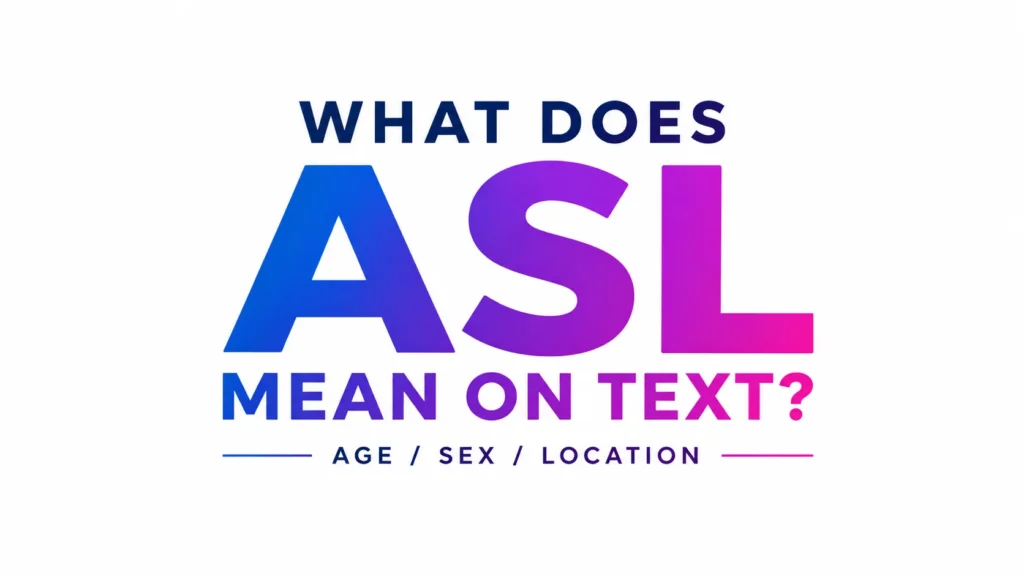
If you have spent time on TikTok, Snapchat, Instagram, or even old-school chat apps, you have probably seen someone type “ASL?” in a message and wondered what it actually means.
The confusing part is that ASL can mean different things depending on the conversation, the platform, and even the age group using it. For some people, it’s a harmless internet shortcut. For others, it can feel outdated, awkward, or even suspicious.
That’s exactly why so many people search for “what does ASL mean on text.” They want to know whether it’s friendly slang, flirtatious internet language, or something completely different.
In modern texting culture, context matters more than ever. A three-letter abbreviation can completely change tone depending on who sends it and where it appears. Understanding ASL helps you avoid awkward misunderstandings while also making you more confident in online conversations.
ASL Meaning – Quick Meaning
What Does ASL Mean in Texting?
In texting and online chat culture, ASL usually stands for:
- Age
- Sex
- Location
It became popular during early internet chatroom days when people wanted quick introductions without typing full sentences.
Someone might send:
“asl?”
What they really mean is:
“How old are you, what’s your gender, and where are you from?”
Simple Example
“ASL?”
“21/F/Chicago”
This means:
- 21 years old
- Female
- From Chicago
Another Modern Meaning of ASL
On TikTok and some social platforms, ASL can also mean:
- “As hell”
Example:
“I’m tired asl.”
Meaning:
“I’m extremely tired.”
Because both meanings exist online, context is incredibly important.
Origin & Background
The Early Internet Era
ASL became famous in the late 1990s and early 2000s during the rise of online chatrooms like AOL Instant Messenger, Yahoo Messenger, and IRC chats.
Back then, internet users wanted a fast way to identify strangers before starting conversations. Instead of asking multiple questions, people simply typed:
“asl?”
It became one of the most recognizable internet abbreviations of that era.
Why It Spread So Quickly
The internet was slower then, and typing shortcuts saved time. Teenagers especially loved internet slang because it felt casual, private, and community-driven.
ASL quickly became part of online youth culture.
Social Media Changed the Meaning
Years later, Gen Z introduced another interpretation of ASL:
“As hell”
This newer version became common on TikTok, Twitter, Instagram captions, and memes.
For example:
“That movie was funny asl.”
In this context, ASL has nothing to do with age or location.
Cultural Evolution
What makes ASL interesting is how one abbreviation evolved across generations.
Millennials often recognize the original chatroom meaning first. Gen Z users, however, may instantly think of “as hell.”
That generational shift explains why confusion happens so often online today.
Read More: IK in Chat: What It Really Means in DMs and Online Conversations
Real-Life Conversations
WhatsApp Conversation
1st Person:
“Hey, you seem cool lol”
2nd Person:
“Thanks 😂”
1st Person:
“asl?”
2nd Person:
“22/F/Lahore”
1st Person:
“Oh nice, I’m from Karachi.”
Instagram DM Example
Person A:
“You’re funny asl 😭”
Person B:
“Lmao I try.”
Here, “asl” means “as hell.”
TikTok Comment Section
1st Person:
“This song hits hard asl.”
2nd Person:
“Especially at night.”
3rd Person:
“Facts.”
Regular Text Message
1st Person:
“Why did he ask me asl?”
2nd Person:
“He probably means age, gender, and location.”
1st Person:
“Ohhh I thought it meant something rude.”
Emotional & Psychological Meaning
Why People Use ASL
People use ASL because texting culture rewards speed and simplicity.
Short slang creates a feeling of belonging. When someone understands internet shorthand, they feel socially connected and digitally aware.
The Emotional Tone Behind It
The original “Age/Sex/Location” version often signals:
- Curiosity
- Interest
- Flirting
- Casual online conversation
Meanwhile, the “as hell” version expresses:
- Strong emotion
- Humor
- Exaggeration
- Excitement
Modern Communication Habits
Online conversations move fast. People compress emotions into tiny phrases and abbreviations.
ASL reflects how internet culture values quick emotional expression over formal writing.
A Realistic Personal Scenario
Imagine joining a livestream and someone comments:
“You’re funny asl.”
Even though it’s only three letters, it feels expressive and emotionally warm. It sounds more casual and natural than typing:
“You are very funny.”
That emotional efficiency is why slang survives online.
Usage in Different Contexts
Social Media Usage
On TikTok, Snapchat, and Instagram, ASL usually means:
“As hell”
Example:
“This weather hot asl.”
It adds emphasis in a playful way.
Friends & Relationships
Among friends, ASL can sound casual and humorous.
Example:
“You dramatic asl.”
Depending on tone, it can feel teasing rather than insulting.
Dating & Online Chatrooms
In dating spaces or anonymous chats, ASL often keeps its older meaning:
“Age/Sex/Location”
People use it to quickly understand who they are talking to.
Professional Settings
ASL should generally be avoided in workplace communication.
Using slang in professional emails or office chats can appear immature or unclear.
Casual vs Serious Tone
The phrase works best in relaxed conversations.
However, in serious emotional discussions, slang may make someone feel unheard or dismissed.
When NOT to Use It
Professional Communication
Avoid using ASL in:
- Work emails
- Client messages
- Academic writing
- Professional networking
It may confuse people unfamiliar with slang culture.
Sensitive Conversations
If someone is discussing grief, mental health, or serious issues, slang like “asl” can feel emotionally disconnected.
Talking to Older Generations
Many older adults only recognize the original chatroom meaning. If you use “asl” to mean “as hell,” they may misunderstand you completely.
Stranger Safety Concerns
When ASL means “Age/Sex/Location,” it can sometimes raise privacy concerns online.
Young users should avoid sharing personal details with strangers.
Common Misunderstandings
Confusing the Two Meanings
This is the biggest issue.
Someone saying:
“That funny asl”
does not mean:
“That funny age sex location.”
Context changes everything.
Tone Misinterpretation
Some people see slang as playful. Others see it as lazy or rude.
Tone depends heavily on relationship, age group, and platform.
Assuming It’s Always Flirting
The original ASL phrase was often used flirtatiously in chatrooms. However, modern usage is frequently casual and harmless.
Thinking It’s Universal
Not everyone understands internet abbreviations equally. What feels obvious to Gen Z may confuse Millennials or older users.
Comparison Table
| Expression | Meaning | Tone | Common Platform |
| ASL | Age/Sex/Location | Curious | Chatrooms, DMs |
| ASL | As hell | Emphatic, casual | TikTok, Instagram |
| FR | For real | Agreement | Snapchat, texting |
| NGL | Not gonna lie | Honest/confessional | Social media |
| IMO | In my opinion | Personal opinion | Forums, texting |
| TBH | To be honest | Direct honesty | Instagram, chats |
| IDK | I don’t know | Casual uncertainty | Everywhere |
| LMK | Let me know | Informal request | Text messaging |
Key Insight
ASL survives because internet slang constantly reinvents itself. Even older abbreviations gain fresh meaning when younger generations adopt them in new ways.
Variations / Types
ASL = Age/Sex/Location
The classic internet meaning used in online chats.
ASL = As Hell
Modern slang meaning “very” or “extremely.”
Funny ASL
Means extremely funny.
Tired ASL
Means extremely tired.
Loud ASL
Means extremely loud.
Weird ASL
Means very weird.
Cute ASL
Means extremely cute.
Cold ASL
Means very cold.
Fast ASL
Means extremely fast.
Boring ASL
Means extremely boring.
Rich ASL
Means very rich or wealthy.
How to Respond When Someone Uses It
Casual Replies
“Haha true asl.”
“Yeah I noticed that too.”
Funny Replies
“I’m sleepy asl and still scrolling.”
“Hungry asl but too lazy to cook.”
Mature Replies
“I get what you mean.”
“That actually makes sense.”
Respectful Replies
If someone asks “ASL?” in the old chatroom sense:
“I’d rather not share personal info online.”
That keeps boundaries polite and clear.
Regional & Cultural Usage
Western Culture
In the United States and Europe, ASL is strongly associated with internet slang culture.
Younger users commonly understand both meanings.
Asian Culture
In many Asian countries, English texting slang spreads through TikTok, gaming, and pop culture.
However, not everyone immediately recognizes older internet meanings.
Middle Eastern Culture
Internet slang usage varies widely. Younger bilingual users may understand ASL easily, while others may interpret it differently depending on platform exposure.
Global Internet Usage
The “as hell” version is becoming more globally recognized because short-form video apps influence worldwide communication trends.
Generational Differences
Gen Z
Usually interprets ASL as:
“As hell”
Millennials
More likely to think of:
“Age/Sex/Location”
That difference alone causes countless online misunderstandings.
Is It Safe for Kids?
Understanding the Context Matters
The “as hell” version is generally harmless slang, although some parents may dislike the implied profanity.
However, the “Age/Sex/Location” meaning can create privacy concerns if children share personal details with strangers online.
Parents should teach kids:
- Not to reveal private information online
- To recognize internet slang safely
- To ask questions when confused
Open communication matters more than banning slang entirely.
FAQs
What does ASL mean in texting?
ASL usually means either “Age/Sex/Location” or “As hell,” depending on the context.
What does “asl” mean on TikTok?
On TikTok, ASL most commonly means “as hell.”
Example:
“Funny asl” = “extremely funny.”
Is ASL rude?
Not usually. However, it can feel inappropriate in professional or sensitive conversations.
Why do older people use ASL differently?
Older internet users often remember the original chatroom meaning from the early 2000s.
Is ASL flirting?
Sometimes. When used as “Age/Sex/Location,” it may signal curiosity or romantic interest online.
Can ASL have multiple meanings?
Yes. Context completely changes the interpretation.
Should kids respond to “ASL?” online?
Children should avoid sharing personal information with strangers online for safety reasons.
Conclusion
Understanding what ASL means on text is really about understanding internet culture itself. Language online changes fast, and abbreviations evolve with every generation.
For some people, ASL brings back memories of old chatrooms and early internet friendships. For others, it’s simply a modern slang phrase meaning “as hell.”
The key is context.
Once you recognize where and how it’s being used, the meaning becomes much easier to understand. Whether you see it in a TikTok caption, Instagram DM, or random text message, you can now respond confidently without second-guessing yourself.
Digital communication keeps evolving, but human emotion stays at the center of it. Even tiny abbreviations like ASL reveal how people connect, joke, flirt, and express themselves online every day.



1 thought on “What Does ASL Mean on Text? Uses & Social Media Context”