The word AMP appears almost everywhere—from phone chargers and guitar equipment to TikTok comments, science textbooks, and website-development discussions.
That variety is exactly what makes it confusing.
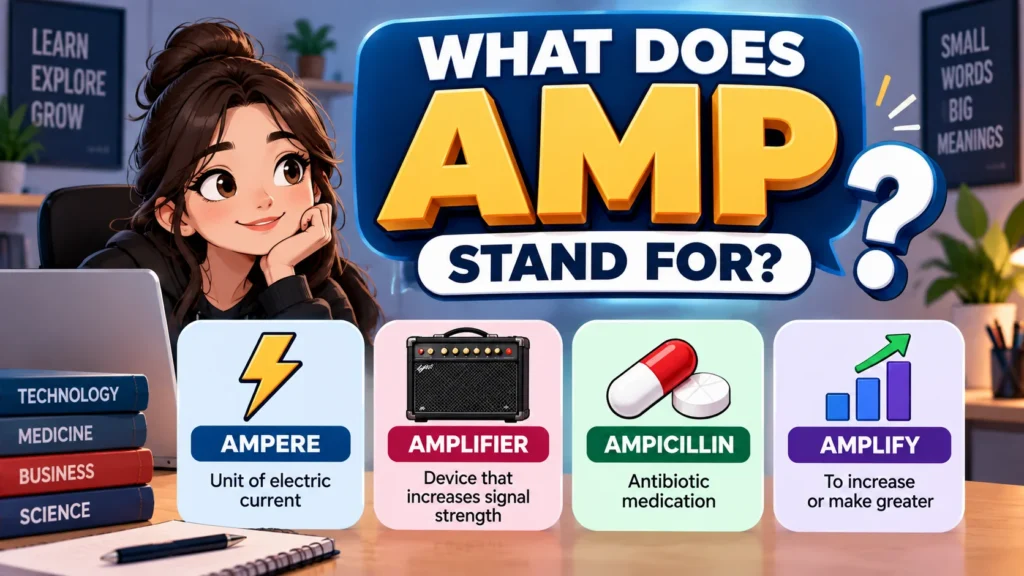
In electricity, amp is short for ampere, the standard unit used to measure electric current. In music, an amp is an amplifier, a device that makes an audio signal louder. Online, people may use AMP for “Ain’t My Problem,” while “amped” or “amped up” describes feeling excited or energized. Cambridge recognizes both ampere and amplifier as established meanings of “amp.”
There are also specialized definitions. Web developers know AMP as a web framework originally associated with Accelerated Mobile Pages, while biologists may encounter AMP as adenosine monophosphate.
So there is no useful one-word answer without context.
The best way to decode it is to ask: What is the conversation actually about?
AMP – Quick Meaning
Several definitions are common enough to know.
- Amp = Ampere: a unit measuring electric current.
- Amp = Amplifier: equipment that increases the strength of an audio signal.
- AMP = Ain’t My Problem: casual online shorthand showing that something is not the sender’s responsibility.
- Amped / Amped up: excited, energized, or highly motivated.
- AMP = web framework: technology historically expanded as Accelerated Mobile Pages.
- AMP = Adenosine Monophosphate: a nucleotide used in biology and biochemistry.
Cambridge defines an amp as both the short form of ampere and an informal shortening of amplifier.
Quick Examples
“This charger draws 2 amps.”
Here, the subject is electrical current.
“Plug the guitar into the amp.”
Here, it means an amplifier.
“They missed the deadline? AMP 😂”
In slang, this could mean “Ain’t My Problem.”
“I’m so amped for tonight!”
Here, “amped” means excited or energized.
One small word can therefore shift between science, music, technology, and slang.
Origin & Background
Ampere Came From Electrical Science
The electrical definition comes from ampere, the standard unit of electric current.
Cambridge notes that the ampere is named after French mathematician and physicist André-Marie Ampère, who lived from 1775 to 1836. Its written SI symbol is A.
In everyday speech, people shorten the word:
“10 amperes” becomes “10 amps.”
You may hear this when discussing:
car chargers;
home electrical systems;
batteries;
fuses;
power supplies;
electronics.
This is probably the oldest and most technically established use most people encounter.
Amp Became Music Vocabulary
“Amplifier” naturally became amp because musicians constantly needed to talk about amplification equipment.
An amplifier increases the strength of an electrical signal, allowing sound from instruments, microphones, stereos, or other devices to be reproduced more powerfully.
Cambridge specifically lists “amp” as the informal term for an amplifier.
That is why phrases such as:
“guitar amp”
“bass amp”
“practice amp”
and:
“tube amp”
feel completely natural.
From Amplification to Excitement
English speakers then extended the basic idea of increasing power or intensity into emotional language.
If an amplifier makes a signal stronger, something that amps you up makes your energy stronger.
Collins defines “amp” as a verb meaning to increase or intensify something and also recognizes “amp up” in the sense of excitement or arousal.
That gave us expressions such as:
“I’m amped for the concert.”
“The coach amped up the team.”
“Coffee has me completely amped.”
Social Media Added More Slang
Internet communities developed other abbreviations.
One documented texting interpretation is:
AMP = Ain’t My Problem.
It communicates emotional distance from an issue, similar to “not my problem.” CyberDefinitions and other acronym references document this use.
This use is much less universal than ampere or amplifier, so readers should not automatically assume it whenever they see capital letters.
Real-Life Conversations
Person A: Sarah forgot to submit her part of the project again.
and,
Person B: AMP 😭 I reminded her twice.
moreover,
Person A: Fair enough. She has to sort it out herself.
Here, the intended message is “Ain’t My Problem.”
The abbreviation communicates that the sender no longer considers the issue their responsibility.
Instagram DMs
Person A: Are you ready for the concert tomorrow?
Person B: I’m so amped 😭🔥
and,
Person A: Same. I’ve been waiting six months.
Person B: We’re getting there early.
Here, “amped” means extremely excited.
TikTok Comments
Person A: Why does everyone keep saying this speaker needs a better amp?
Person B: Amp means amplifier here.
and,
Person A: Ohhh, I thought it was slang.
Person B: Different context 😂
Music-related vocabulary makes the intended definition obvious.
Text Message
Person A: Can I use this charger with the new device?
Person B: Check the voltage and amp rating first.
and,
Person A: It says 5V, 2A.
Person B: Good—compare that with what the device requires.
Here, amp relates to electrical current rather than texting slang.
Emotional & Psychological Meaning
The most emotionally interesting use comes from “amped” or “amped up.”
Someone saying:
“I’m amped!”
is doing more than saying they are happy.
The phrase suggests high energy.
They may feel:
excited;
motivated;
confident;
stimulated;
eager;
emotionally charged.
That metaphor makes sense because the original technical idea is amplification—making something stronger.
Why People Say “Amped” Instead of “Excited”
“Excited” is neutral.
“Amped” feels more physical.
It suggests the person is almost buzzing with energy.
Compare:
“I’m excited for the game.”
with:
“I’m completely amped for the game.”
The second sentence feels louder and more intense.
When AMP Means “Ain’t My Problem”
The emotional message moves in the opposite direction.
Instead of increased enthusiasm, the sender communicates detachment:
“I’m not getting involved.”
“That’s their responsibility.”
“I’ve done my part.”
Sometimes it sounds humorous.
Other times, it can sound dismissive.
A Personal-Style Scenario
Imagine your friends organize a weekend trip.
You book your room, send everyone the itinerary, and remind the group twice about the departure time.
One friend still sleeps through their alarm and messages:
“Can everyone wait another hour?”
Someone in the group replies:
“AMP 😭 we warned you.”
The letters are technically shorthand, but emotionally the message means:
“We already did what we could. This is yours to fix now.”
That emotional context matters more than the acronym itself.
Usage in Different Contexts
Social Media
Online, “amp” frequently appears around excitement.
Examples:
“This trailer has me amped.”
“They really amped up the production this season.”
“Getting amped for the weekend.”
Acronym-style AMP can sometimes mean “Ain’t My Problem,” although it is less standardized than expressions such as IDK or LOL.
Friends & Relationships
Among friends, “amped” usually sounds upbeat.
“I’m amped for your birthday.”
In a relationship argument, however:
“AMP”
could sound cold if it means “Ain’t My Problem.”
Context and emotional sensitivity matter.
Music
In music, there is little ambiguity.
A guitarist asking:
“Which amp do you use?”
almost certainly means amplifier.
The same applies to bass players, audio engineers, and people discussing speakers or sound systems.
Electricity
A number followed by A or “amps” usually measures electrical current.
For example:
“15 A”
means 15 amperes.
Cambridge describes the ampere as the standard unit used to measure electric current.
Web Development
AMP also appears in website-development discussions.
One important modern detail is often missed: AMP’s official documentation now treats “AMP” as the name of the open-source web component framework.
Although Accelerated Mobile Pages was its original expansion, AMP’s own terminology guide says that expansion is now considered deprecated because the framework expanded beyond ordinary pages to areas such as stories, ads, and email.
That distinction makes an article written today more accurate than simply saying AMP always stands for Accelerated Mobile Pages.
Work and Professional Settings
Avoid ambiguous shorthand unless the context is already established.
An electrical engineer can naturally write:
“Check the amp draw.”
A developer can discuss:
“AMP components.”
A musician can mention:
“the amp.”
But sending a coworker only:
“AMP”
after they describe a problem could appear dismissive if interpreted as “Ain’t My Problem.”
When NOT to Use It
Avoid unexplained AMP when several interpretations are possible.
For example:
“We need a new AMP.”
New amplifier?
New electrical component?
A web-related implementation?
The sentence is too vague.
Formal Communication
Spell out the term on first use:
ampere (A)
amplifier
AMP framework
adenosine monophosphate (AMP)
This is particularly important in:
academic writing;
technical reports;
business documents;
training material;
international communication.
Serious Personal Conversations
Avoid “AMP” = “Ain’t My Problem” when someone is discussing something emotionally important.
If a friend says:
“I’m really struggling today,”
responding:
“AMP”
could sound cruel rather than funny.
Internet shorthand does not remove the emotional weight of a message.
Technical Safety
Do not treat amps as an isolated measure when making electrical decisions.
Voltage, current, power, device requirements, wiring, and safety standards can all matter.
If you are unsure about electrical equipment, follow manufacturer specifications or qualified professional guidance rather than guessing from one number.
Common Misunderstandings
Amp Does Not Always “Stand For” Something
This is important.
When amp means ampere or amplifier, it is essentially a shortened word.
When someone says they are “amped,” it functions as slang derived from amplification.
Only some uppercase AMP uses operate as true initialisms.
AMP Is Not Always Accelerated Mobile Pages
That expansion is historically correct, but current AMP documentation says AMP itself is now the official framework name and calls “Accelerated Mobile Pages” a deprecated term because it no longer describes the full scope of the technology.
Amp and Watt Are Not the Same
An amp measures electrical current.
A watt measures power.
They describe different electrical quantities.
Amp Does Not Always Mean Amplifier
Musicians naturally think amplifier.
Electricians naturally think ampere.
Context decides.
“Amped” Is Not Necessarily Angry
Someone saying:
“I’m amped”
usually means energized or excited.
It does not automatically mean they are angry.
& Is Something Different
Web users occasionally notice & inside code or poorly rendered text.
That is an HTML character entity representing the ampersand symbol &.
It is not the same thing as AMP the framework, amplifier, or ampere.
AMP Compared With Related Expressions
| Term | Common Meaning | Typical Context | Tone |
|---|---|---|---|
| Amp | Ampere | Electricity | Technical |
| Amp | Amplifier | Music/audio | Neutral |
| AMP | Ain’t My Problem | Texting | Dismissive/playful |
| Amped | Excited/energized | Slang | Enthusiastic |
| Amp up | Increase intensity | Everyday slang | Energetic |
| Hype | Build excitement | Social media | Excited |
| IDGAF | Strong indifference | Slang | Vulgar/dismissive |
| NMP | Not My Problem | Texting | Dismissive |
| Watt | Unit of power | Electricity | Technical |
| Volt | Unit of electrical potential | Electricity | Technical |
Key Insight
The most useful distinction is between technical amp and emotional amp. Electricity uses it for current, music uses it for amplification, while casual English extends the idea of amplification into increased energy and excitement.
Variations and Types of AMP
1. Ampere
Meaning: Unit of electrical current.
Usually shortened to “amp” in everyday speech, with the symbol A.
2. Amplifier
Meaning: Device that increases the strength of a signal.
Musicians often shorten amplifier to “amp.”
3. Amped
Meaning: Excited or highly energized.
“I’m amped for tonight” means the person is strongly looking forward to it.
4. Amped Up
Meaning: Intensely excited, stimulated, or energized.
It can describe people, crowds, events, campaigns, or even emotions.
5. Amp Up
Meaning: Increase intensity.
For example, “amp up the marketing” means make the marketing effort stronger or more energetic.
6. AMP – Ain’t My Problem
Meaning: The issue is not the sender’s responsibility.
It can be humorous among friends but dismissive in serious conversation.
7. AMP Web Framework
Meaning: Open-source web component framework.
It originated from the Accelerated Mobile Pages project, although AMP is now treated as the official standalone framework name.
8. AMP – Adenosine Monophosphate
Meaning: A nucleotide found in biological systems.
NCBI describes adenosine monophosphate as an adenine nucleotide containing one phosphate group, and PubChem also lists AMP as its abbreviation.
9. AMP in Filipino Internet Slang
Meaning: A vulgar Filipino internet interjection in some contexts.
GMA News reported that Filipino “amp” has been used as a shortened form related to amputa/ang puta, with roots traced by one academic source to the Philippine Ragnarok Online community around 2003. It can function as a curse or strong interjection.
10. AMP as Increased Intensity
Meaning: To make something stronger.
English dictionaries recognize “amp” as a verb related to increasing, enhancing, or intensifying something.
How to Respond When Someone Uses AMP
Casual Replies
If they say:
“I’m amped for tonight!”
you can reply:
“Same!”
“Can’t wait.”
“Let’s gooo 🔥”
“I’m hyped too.”
Funny Replies
If AMP means “Ain’t My Problem”:
“Cold 😭”
“You really said not my department 😂”
“Fair enough.”
“Zero responsibility accepted.”
Mature Replies
If someone seems dismissive:
“I understand it may not be your responsibility, but I was only asking for advice.”
“No problem. I’ll handle it.”
If they are excited:
“Glad you’re looking forward to it.”
“That sounds exciting.”
Respectful Replies
When the abbreviation is unclear:
“Do you mean amplifier?”
“Are you talking about electrical amps?”
“Does AMP mean ‘Ain’t My Problem’ here?”
“Are you referring to the web framework?”
A simple clarification prevents unnecessary confusion.
Regional & Cultural Usage
Western Culture
In English-speaking countries, amp is strongly associated with electricity, music equipment, and the phrase “amped up.”
A native speaker hearing:
“I bought a new amp”
will probably think of audio equipment if the conversation involves music.
Asian Culture
The technical meanings remain common throughout Asia because ampere and amplifier are internationally used terms.
The Philippines has an additional cultural twist.
As noted above, Filipino internet communities have also used “amp” as a vulgar interjection derived from local slang rather than the English “Ain’t My Problem” expansion.
That meaning should not be generalized to all Asian users.
Middle Eastern Culture
English-speaking technology, engineering, and music communities throughout the Middle East commonly encounter amp as ampere or amplifier.
Texting interpretations such as “Ain’t My Problem” are much less universal, especially among people using English as an additional language.
Writing the complete phrase is safer when clarity matters.
Global Internet Usage
The web creates unusual overlaps.
A developer may search AMP and expect web technology.
A guitarist expects equipment.
An electrician expects current.
A biochemistry student expects adenosine monophosphate.
A teenager in a group chat might mean something else entirely.
This is why search intent matters so much with short abbreviations.
Gen Z vs. Millennials
Gen Z users may encounter “amp” through gaming, TikTok, memes, creator groups, or “amped” as energetic slang.
Millennials may be especially familiar with amp through music equipment, older web-development discussions, and general internet slang.
Profession and interest usually influence interpretation more than age.
Is AMP Safe for Kids?
Usually, yes.
The most common meanings—ampere, amplifier, excitement, web technology, and adenosine monophosphate—are completely harmless.
However, context still matters.
“Ain’t My Problem” can sound rude but is not inherently explicit.
The Filipino internet use discussed earlier can represent a vulgar expression, so parents or teachers should be aware that the same letters may occasionally carry stronger language in certain communities.
A simple child-friendly explanation is:
“Amp usually means a unit of electricity or an amplifier. ‘Amped’ can also mean very excited.”
That covers the meanings children are most likely to encounter in ordinary English.
FAQs
What does AMP mean in texting?
In some texting communities, uppercase AMP can mean “Ain’t My Problem,” indicating that the sender does not consider an issue their responsibility. “Amped,” however, usually means excited or energized.
What is an amp in electricity?
An amp is short for ampere, the standard unit used to measure electric current. Its SI symbol is A.
What does amp mean in music?
In music, an amp is an amplifier, a device that strengthens an audio signal so instruments or other sound sources can be heard through speakers.
Does AMP mean Ain’t My Problem?
Yes, that abbreviation is documented in internet slang. It conveys an attitude similar to “Not My Problem,” although it is not universally understood.
What does “amped” mean in slang?
“Amped” means excited, energized, stimulated, or highly enthusiastic. The expression comes from the broader idea of amplification—making something stronger or more intense.
Does AMP still stand for Accelerated Mobile Pages?
Historically, yes. However, current official AMP terminology says AMP is now the framework’s official name, while “Accelerated Mobile Pages” is considered a deprecated expansion because the technology now covers more than standard pages.
What does AMP mean in biology?
In biology and biochemistry, AMP stands for adenosine monophosphate, a nucleotide consisting of adenosine and a phosphate group.
Conclusion
The letters AMP belong to several completely different worlds.
In electricity, an amp is an ampere, the standard unit of electric current.
and,
In music, it is an amplifier.
moreoever,
In everyday slang, “amped” means excited, energized, or ready for action.
Some text conversations use the capitalized abbreviation for “Ain’t My Problem,” usually to express detachment from someone else’s issue.
Developers encounter AMP as the name of an open-source web framework, while scientists use the same letters for adenosine monophosphate.
Even regional culture can alter the interpretation, as Filipino internet slang demonstrates.
The easiest way to decode it is not to memorize one definition.
Look for clues.
Numbers, chargers, fuses, or electrical equipment? Think ampere.
Guitars, speakers, or audio equipment? Think amplifier.
“I’m so amped”? Think excited.
A dismissive chat reply? Ain’t My Problem may fit.
Web-development discussion? Think AMP framework.
Biochemistry? Think adenosine monophosphate.
Short words become much easier to understand once you stop separating them from the conversation around them.
For high CTR (click-through rate), titles and descriptions should create curiosity, a clear benefit, and a reason to click without giving everything away.