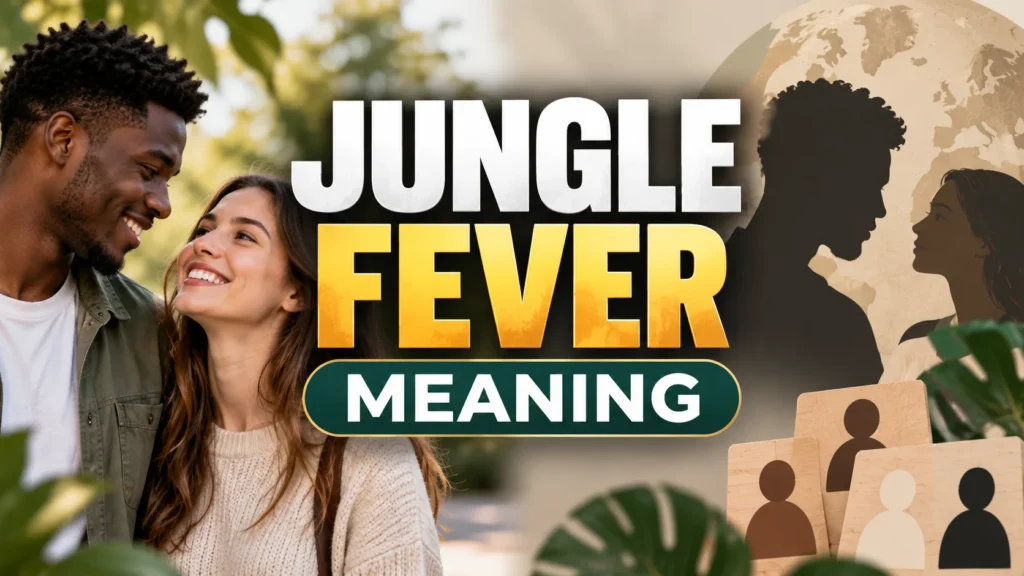
If you have seen the phrase “jungle fever” in a text, TikTok comment, movie discussion, or social media post, its meaning may not be obvious.
The expression has more than one meaning. Historically, jungle fever referred to serious tropical illnesses, particularly malaria. In modern American slang, however, it usually refers to romantic or sexual attraction between people of different races, especially attraction involving a white person and a Black person.
That slang meaning comes with an important warning: the expression can sound racially offensive, stereotypical, or fetishizing.
Understanding the phrase therefore requires more than simply knowing its dictionary definition. Tone, speaker, relationship, and cultural context all matter.
Jungle Fever Meaning – Quick Meaning
In modern slang, jungle fever means a strong romantic or sexual attraction to someone of another race, most commonly when describing a non-Black person who is attracted to Black people.
Dictionary.com labels this slang sense as sometimes offensive, particularly because it has historically been connected to racial stereotypes.
In simple terms:
- Literal/historical meaning: tropical fever or malaria.
- Slang meaning: interracial romantic or sexual attraction.
- Common association: white and Black relationships.
- Tone: informal and potentially offensive.
- Best used: mainly when explaining or discussing the expression rather than labeling someone with it.
For example:
“Someone joked that he had jungle fever because his girlfriend was Black.”
“I heard the phrase jungle fever in an old movie discussion.”
“That expression can sound offensive depending on who says it.”
The phrase does not simply mean being in love. In many contexts, it suggests that someone’s attraction is especially connected to the other person’s race.
Origin and Background
The Original Meaning
The expression existed before it became relationship slang.
Historically, “jungle fever” was used for illnesses associated with tropical regions, particularly severe forms of malarial fever. Dictionary.com dates the original phrase to around 1795–1805, while its interracial-attraction slang sense is recorded much later, around 1960–1965.
This distinction matters because people occasionally encounter the phrase in old books, military accounts, or travel writing where it has absolutely nothing to do with dating.
How It Became Relationship Slang
Over time, the word “jungle” became associated with degrading racial stereotypes about Black and African people. That history is one reason the romantic meaning of “jungle fever” can feel insulting today.
Rather than treating two individuals as people who happen to be attracted to each other, the expression may reduce one partner to their racial identity.
The Influence of the 1991 Film
The phrase became particularly visible in popular culture through Spike Lee’s 1991 film Jungle Fever.
The film follows an interracial affair involving a Black man and an Italian-American white woman and examines race, stereotypes, family pressure, class, attraction, and social divisions.
Importantly, the movie did not invent the slang expression. The phrase existed earlier.
Its title instead helped make the term recognizable to a much wider audience.
Real-Life Conversations
Real conversations show why context matters so much with this expression.
WhatsApp Conversation
Person A: Why did Jake say you have “jungle fever”?
Person B: Because I’m dating Marcus.
Person A: That’s a weird thing to say.
Person B: Exactly. I like Marcus because he’s Marcus, not because of his race.
Here, the phrase feels uncomfortable because it turns a normal relationship into a racial category.
Instagram DM
Person A: Someone commented “jungle fever 😂” under our photo.
Person B: Seriously?
Person A: Yeah. I deleted it.
Person B: Good. Being an interracial couple doesn’t mean people get to stereotype us.
The person leaving the comment may believe they are joking, while the couple may experience it as disrespectful.
TikTok Comments
Person A: What does jungle fever mean?
Person B: It’s slang people sometimes use for interracial attraction, especially white-Black attraction.
Person A: Is it offensive?
Person B: It definitely can be. “Interracial relationship” is much safer.
This is one of the most useful ways to handle the phrase online: explain it without encouraging people to casually label others with it.
Text Message
Person A: My friend said I’ve “caught jungle fever” because I like this girl.
Person B: I’d avoid that expression.
Person A: Why?
Person B: It can make someone’s race sound like a fetish instead of treating them as an individual.
The difference between teasing and disrespect sometimes comes down to what the phrase implies.
Emotional and Psychological Meaning
The deeper issue behind jungle fever slang is not interracial attraction itself.
There is nothing unusual about people of different racial backgrounds falling in love or finding each other attractive.
The problem arises when someone’s racial identity becomes the primary explanation for attraction.
Researchers have even examined “jungle fever” as a stereotype suggesting that people enter interracial relationships because of sexual curiosity about another race. One preliminary academic study found little support for that stereotype in the attitudes it examined.
Psychologically, using the phrase can therefore suggest:
- racial curiosity;
- sexual stereotyping;
- fetishization;
- fascination with perceived racial difference;
- teasing about someone’s dating preferences.
Consider a simple situation.
Imagine your friend introduces their new partner. Instead of saying, “You two look happy together,” someone says, “Looks like you’ve got jungle fever.”
The first response recognizes a relationship between two people.
The second makes race the center of the relationship.
That small difference explains why the expression can feel surprisingly personal.
Usage in Different Contexts
Social Media
On TikTok, Instagram, X, Reddit, and meme pages, people may use “jungle fever” jokingly when discussing interracial attraction.
Online humor does not remove the racial history of the expression, though.
A comment that seems funny to one person can feel insulting to another.
Friends and Relationships
Close friends sometimes use controversial slang jokingly when everyone involved understands the intention.
Even then, this phrase deserves caution.
Someone’s partner may not share the same comfort level with racial humor.
Work and Professional Settings
Avoid “jungle fever” in workplaces, classrooms, business communication, professional presentations, and formal writing unless you are specifically discussing the expression itself.
Instead, use:
“interracial relationship”
“interracial attraction”
“cross-cultural relationship”
“dating someone from a different racial background”
These phrases communicate the idea without attaching a racial stereotype.
Casual vs. Serious Tone
In casual conversation, people sometimes use the phrase as teasing slang.
In serious discussions about race and relationships, it can sound dismissive or degrading.
The more respectful the situation needs to be, the less appropriate this expression becomes.
When NOT to Use It
Avoid calling someone else’s attraction or relationship “jungle fever.”
You do not know what motivates another person’s romantic feelings, and reducing those feelings to race can easily create misunderstanding.
It is especially inappropriate:
- around strangers;
- at work;
- in school assignments unless analyzing the term;
- when describing a real interracial couple;
- when the people involved have not welcomed racial jokes;
- during serious conversations about discrimination or identity;
- as a pickup line directed toward a Black person.
Cultural sensitivity matters because words carry histories that may be invisible to someone using them casually.
If your actual meaning is simply “they are attracted to each other,” say exactly that.
Common Misunderstandings
It Does Not Mean Every Interracial Relationship
Two people dating across racial lines do not automatically have “jungle fever.”
That interpretation turns ordinary attraction into a racial stereotype.
It Is Not Simply Another Phrase for Love
The expression often carries the implication that race itself creates the attraction.
That makes it very different from saying:
“They’re in love.”
It Can Have a Literal Medical Meaning
Older texts may use “jungle fever” for tropical illnesses, particularly malaria.
Always check the context before assuming slang.
Spike Lee Did Not Create the Expression
His 1991 movie significantly increased the phrase’s cultural visibility, but dictionaries record the relationship-related slang meaning decades earlier.
“It’s Just a Joke” Does Not Guarantee It Is Harmless
Humor depends on audience, relationship, intention, and history.
A speaker may intend playful teasing while the listener hears racial objectification.
Jungle Fever Compared With Similar Expressions
| Expression | Meaning | Tone |
|---|---|---|
| Jungle fever | Attraction across racial lines, especially white-Black attraction | Slang; potentially offensive |
| Interracial attraction | Attraction between people of different races | Neutral |
| Interracial relationship | Romantic relationship involving different racial backgrounds | Neutral and respectful |
| Racial preference | Preference involving someone’s race | Neutral to sensitive |
| Fetishization | Reducing attraction to a trait, identity, or stereotype | Usually negative |
| Cross-cultural dating | Dating across different cultural backgrounds | Generally neutral |
| Mixed-race couple | Couple whose partners come from different racial groups | Usually neutral |
| Same-race relationship | Partners from broadly the same racial group | Neutral |
Key Insight
The safest replacement for “jungle fever” is usually “interracial attraction” or “interracial relationship.” These expressions describe what is happening without implying that someone’s race is an unfamiliar or sexualized characteristic.
Variations and Types of Jungle Fever Slang
The phrase appears in several forms online and in conversation.
1. Have Jungle Fever
Means someone supposedly has a particular attraction to people of another race.
2. Got Jungle Fever
A casual version of “has jungle fever,” usually used when teasing someone about their dating preferences.
3. Caught Jungle Fever
Treats the attraction jokingly like someone has “caught” an illness.
Because of that implication, it may sound especially insensitive.
4. Jungle Fever Relationship
Sometimes used online for an interracial relationship, although interracial relationship is more respectful.
5. Jungle Fever Dating
Usually refers to dating or attraction across racial lines.
The expression may appear in searches even though it is not ideal everyday language.
6. Jungle Fever Crush
Informally suggests someone’s crush involves a person from another racial group.
Again, the label can oversimplify genuine attraction.
7. Jungle Fever Joke
A joke built around interracial attraction or someone’s racial dating preference.
Whether it is offensive depends heavily on context, but caution is wise.
8. Jungle Fever Couple
Sometimes used for a white-Black interracial couple.
“Interracial couple” is the neutral alternative.
9. Jungle Fever Movie
Usually refers to Spike Lee’s 1991 film Jungle Fever, not necessarily the slang definition alone.
10. Reverse Jungle Fever
An informal internet variation sometimes used when people attempt to reverse the racial direction implied by the stereotype.
There is no need for the distinction in normal communication. “Interracial attraction” describes either direction clearly.
How to Respond When Someone Uses It
Your response can depend on the situation.
Casual Replies
“What do you mean by jungle fever?”
“You mean interracial attraction?”
“That’s one way of putting it.”
Funny Replies
“Or maybe two people just like each other.”
“Pretty sure that’s called dating.”
“Cupid doesn’t check demographics.”
These replies challenge the stereotype without automatically turning the conversation into an argument.
Mature Replies
“I understand what you mean, but that expression can come across as racially insensitive.”
“I’d probably just call it an interracial relationship.”
“Race doesn’t necessarily explain why two people are attracted to each other.”
Respectful Replies
“I know you may not mean anything bad by it, but some people find that term offensive.”
“Could we say interracial relationship instead?”
These responses correct the language while leaving room for a productive conversation.
Regional and Cultural Usage
Western Culture
The slang meaning is most strongly associated with American discussions of race, particularly Black-white relationships.
Because of America’s history of racial segregation and stereotypes surrounding interracial intimacy, the expression can carry more emotional weight than international speakers initially realize.
Asian Culture
English speakers in Asian countries may encounter the expression through American films, music, memes, or social platforms rather than everyday local speech.
Someone who learns it online may therefore use it without realizing its racial implications.
Middle Eastern Culture
The expression is not standard everyday English throughout the Middle East.
When it appears, it is often borrowed from American internet culture, entertainment, or social media.
Using the neutral phrase “interracial relationship” is clearer for international audiences.
Global Internet Usage
Internet culture spreads slang faster than its historical explanation.
A person may see “jungle fever” in a meme and assume it is harmless romantic slang.
That is why understanding context matters as much as memorizing definitions.
Gen Z vs. Millennials
Younger internet users are generally exposed to more conversations about fetishization, identity, race, and respectful terminology.
Older users may recognize “Jungle Fever” particularly through the 1991 Spike Lee film or older pop-culture references.
Neither generation uses language identically, so the speaker’s intention should always be considered alongside the term’s history.
Is Jungle Fever Safe for Kids?
Children may encounter the phrase through search engines, movies, or social media.
The literal medical meaning is not inappropriate, but the slang meaning involves adult romantic or sexual attraction and racial stereotypes.
For younger learners, a simple explanation is enough:
“It is an old slang expression sometimes used for attraction between people of different races, but it can be disrespectful, so it is better not to call people that.”
Older teenagers can also be taught why respectful language such as interracial relationship is preferable.
FAQs About Jungle Fever Meaning
What does jungle fever mean in slang?
In slang, jungle fever means romantic or sexual attraction between people of different races, particularly a non-Black person’s attraction to a Black person. The term can be offensive.
Is jungle fever a bad word?
It is not a profanity, but it can be racially insensitive or offensive because it may objectify Black people and reduce interracial attraction to racial stereotypes.
What does jungle fever mean in dating?
In dating conversations, it usually suggests that someone is particularly attracted to people of another race, especially Black partners.
Does jungle fever mean interracial relationship?
Sometimes people use it that way, but the meanings are not identical. Interracial relationship is neutral, while “jungle fever” can imply racial fixation or fetishization.
Where did the phrase jungle fever come from?
The phrase originally referred to tropical illnesses such as malaria. Its interracial-attraction slang meaning developed much later; Dictionary.com records that sense from around 1960–1965.
What does Jungle Fever mean in the movie?
Spike Lee’s 1991 Jungle Fever explores an interracial affair and the racial, cultural, family, and social tensions surrounding it. The film also questions stereotypes connected with interracial attraction.
What should I say instead of jungle fever?
Use interracial attraction, interracial relationship, or simply say that one person is attracted to another. These alternatives are clearer and more respectful.
Conclusion
Understanding jungle fever meaning requires understanding both language and history.
Literally, the phrase once referred to tropical fever or malaria. In modern slang, it generally describes interracial romantic or sexual attraction, particularly involving Black and white people.
Yet knowing a slang definition does not automatically mean it is wise to use the expression.
Because “jungle fever” can turn someone’s race into the focus of attraction and carries uncomfortable racial associations, it can easily sound stereotypical or offensive.
If you encounter it online, in a movie, or during a conversation, you can now understand what the speaker probably means. When describing real people yourself, however, “interracial relationship” or “interracial attraction” will almost always communicate the same basic idea with greater respect.
For high CTR (click-through rate), titles and descriptions should create curiosity, a clear benefit, and a reason to click without giving everything away.