
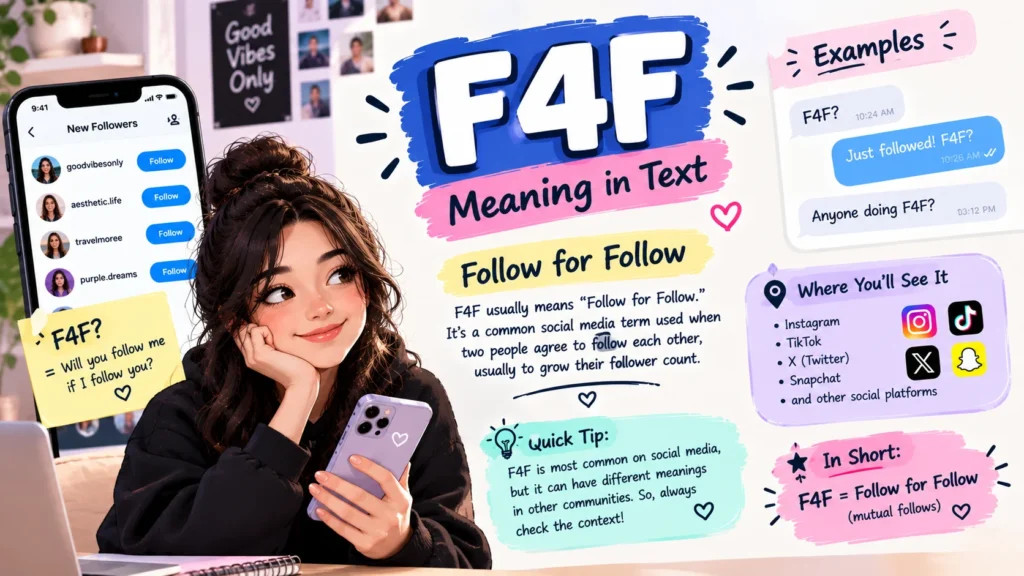
If you have seen F4F in an Instagram comment, TikTok bio, Snapchat message, or social media post, you may have wondered what those three characters actually mean.
In most online conversations, F4F means “Follow for Follow.” It describes an arrangement where two social media users agree to follow each other.
The number 4 represents the word “for,” which is common in internet shorthand. So, instead of writing “follow for follow,” someone simply writes F4F.
You may see it in comments such as:
“F4F? 👀”
or:
“Anyone doing F4F?”
The basic idea is simple: you follow me, and I’ll follow you back.
F4F became especially common when users were focused on growing their follower counts and discovering new accounts. Although the term is easy to understand, its meaning can vary slightly depending on the platform and conversation.
F4F Meaning – Quick Meaning
F4F usually means “Follow for Follow.”
It is commonly used on social media when someone wants another user to follow their account in exchange for a follow-back.
Here is the breakdown:
- F = Follow
- 4 = For
- F = Follow
Simple Examples
“F4F?”
“Do you want to follow each other?”
“F4F, just followed!”
“I followed you, so please follow me back.”
“Anyone up for F4F?”
“Is anyone interested in exchanging follows?”
F4F is usually informal. It is more likely to appear in comments, DMs, captions, bios, or casual online communities than in professional communication.
The term does not necessarily indicate a genuine friendship. Sometimes it is simply a quick way to increase visibility or connect with other users.
Origin & Background of F4F
F4F developed from the broader culture of internet shorthand.
Online users have long replaced words with numbers to make phrases shorter. The number 4 is commonly used to represent “for,” as seen in expressions such as “B4” for “before” and “4ever” for “forever.”
As social media platforms became increasingly centered around followers, likes, views, and engagement, short phrases for audience growth became common.
“Follow for follow” naturally became easier to write as F4F.
The expression has appeared across different social networks and online communities, particularly those where follower counts are visible and account discovery is important.
Its popularity has also been connected with social media growth culture. Users who wanted to reach more people could advertise reciprocal following as a simple exchange.
Over time, F4F became familiar enough that many users could understand it without seeing the phrase written out.
The meaning has remained relatively stable, although its practical value depends on the platform and the user’s goals.
Read More : Miscellaneous Abbreviation: Meaning, Uses & Examples
Real-Life Conversations Using F4F
Instagram DM
Person A:
“Hey, I found your account through the fitness page.”
Person B:
“Oh nice!”
Person A:
“F4F?”
Person B:
“Sure, just followed you.”
Here, F4F is a direct request for reciprocal follows.
TikTok Comments
Person A:
“Trying to reach 1K before summer 😭”
Person B:
“F4F?”
Person A:
“Yeah, followed!”
The users are suggesting that they follow each other’s accounts.
Snapchat Message
Person A:
“Do you have Insta?”
Person B:
“Yeah, why?”
Person A:
“F4F?”
Person B:
“Sure, send me your username.”
The shorthand keeps the conversation quick and casual.
Social Media Comment
Person A:
“New creator here! Looking for other small accounts.”
Person B:
“F4F?”
Person A:
“I’m down!”
In this situation, F4F is being used as a networking request between smaller accounts.
Emotional & Psychological Meaning of F4F
At first glance, F4F seems purely practical. It is about exchanging follows.
There can be a social element underneath it, though.
Follower counts have become visible indicators of online popularity and reach. Because of this, some users may associate gaining followers with recognition, credibility, belonging, or progress.
A person asking for F4F may simply want to grow an account. Another person may be looking for a sense of connection with people who share similar interests.
The emotional meaning therefore depends on the individual.
For some users, F4F feels like harmless networking. For others, it can feel transactional because the interaction is based on an exchange rather than a genuine relationship.
Imagine discovering a small photography account whose owner comments, “F4F?” You might interpret that as an invitation to connect with another creator.
If you actually enjoy their photographs, the initial follow exchange could develop into a genuine online connection.
The important distinction is between following someone because you are genuinely interested in their content and following purely to increase a number.
Usage in Different Contexts
F4F on Social Media
Social media is where F4F is most commonly encountered.
It may appear in comments, captions, DMs, hashtags, profile descriptions, or creator communities.
Users may use it when they want to attract new followers quickly.
F4F Between Friends
Friends can use F4F jokingly when exchanging social media accounts.
For example:
“You haven’t followed my new account yet. F4F 😂”
In a close friendship, this can simply be playful teasing.
F4F in Creator Communities
Small creators sometimes use F4F while trying to discover other accounts in the same niche.
A beauty creator might connect with another beauty account. A gaming creator might interact with other gaming profiles.
This can become more meaningful when the users also engage with each other’s actual content.
F4F in Professional Settings
F4F is generally not appropriate for formal professional communication.
A business owner seeking genuine networking would usually benefit from a clearer message explaining why they want to connect.
For example, saying:
“I enjoy your photography work and would love to connect.”
communicates more than simply saying “F4F.”
Casual vs. Serious Tone
F4F is strongly casual.
It can be suitable for social media conversations, but it may appear immature or overly transactional in a formal setting.
The surrounding platform and relationship should always guide your choice.
When NOT to Use F4F
Professional Messages
Avoid F4F when contacting a potential employer, client, professor, or business partner.
The abbreviation may make a serious networking conversation sound like a follower-count exchange.
When Someone Has Not Asked for It
Repeatedly requesting follows can become annoying.
If someone clearly does not respond, continuing to send F4F messages can make the interaction feel like spam.
In Sensitive Conversations
If someone is sharing personal news, emotional struggles, or serious information, responding with a follower request is obviously inappropriate.
Read the room before using internet shorthand.
With Unknown or Suspicious Accounts
Not every account asking for F4F has good intentions.
Users should be careful about clicking unfamiliar links, sharing personal information, or moving conversations to suspicious platforms simply because someone offers a follow exchange.
Common Misunderstandings About F4F
F4F Does Not Always Mean Friendship
Following someone does not automatically mean you know them or support everything they post.
It can simply mean that two users agreed to exchange follows.
F4F Is Not the Same as Genuine Engagement
A follow does not necessarily mean someone will read, like, comment on, or interact with your content.
The relationship may remain limited to following.
F4F Is Not Always a Permanent Agreement
Some users may follow each other temporarily and later unfollow accounts they no longer want to see.
The abbreviation itself does not guarantee a long-term relationship.
F4F Can Be Context-Dependent
Although “Follow for Follow” is the dominant social media meaning, abbreviations can have different meanings in specialized communities.
The surrounding conversation should always be considered.
F4F Compared With Similar Social Media Expressions
| Expression | Meaning | Common Context |
|---|---|---|
| F4F | Follow for Follow | Reciprocal social media follows |
| S4S | Shoutout for Shoutout | Promotional social media exchanges |
| L4L | Like for Like | Exchanging likes |
| C4C | Comment for Comment | Exchanging comments |
| FB | Follow Back / Facebook, depending on context | Social media |
| Follow Back | Follow someone after they follow you | Social networking |
| Mutuals | People who follow each other | Social media relationships |
| Collab | Collaboration | Creators and brands |
| Networking | Building useful professional/social connections | Professional and creator communities |
Key Insight
F4F focuses specifically on reciprocal following. Terms such as S4S, L4L, and C4C involve different types of social media exchanges, so they should not be treated as exact synonyms.
Variations and Types of F4F
1. F4F
Meaning: Follow for Follow.
The standard version asks another user to follow in exchange for a follow-back.
2. F4F?
Meaning: Asking whether someone wants to exchange follows.
The question mark makes the request feel brief and informal.
3. F4F Back
Meaning: Follow me and I will follow you back.
This makes the reciprocal nature especially clear.
4. F4F ASAP
Meaning: Follow for follow as soon as possible.
It adds urgency to the request.
5. F4F Anyone?
Meaning: Is anyone interested in exchanging follows?
This is often used when addressing a broader audience.
6. F4F No Unfollow
Meaning: Follow each other without immediately unfollowing.
The user is asking for a more lasting exchange.
7. F4F on Instagram
Meaning: Reciprocal Instagram following.
The abbreviation is particularly easy to understand when used around Instagram-related content.
8. F4F on TikTok
Meaning: Reciprocal TikTok following.
Creators may use it while trying to discover new accounts.
9. F4F With Mutuals
Meaning: Connecting through shared followers.
This can suggest that the users already have people or communities in common.
10. Genuine F4F
Meaning: A follow exchange between users who actually appreciate each other’s content.
This version focuses more on authentic connection than follower numbers alone.
How to Respond When Someone Uses F4F
Your response should depend on whether you are interested in following the person.
Casual Replies
You can keep it simple:
- “Sure!”
- “Just followed.”
- “Followed you back!”
- “Yeah, I’m down.”
- “Done 👍”
Funny Replies
If the conversation is playful:
“Only if your feed passes the vibe check 😂”
Or:
“Deal, but I expect good memes.”
Mature Replies
If you prefer genuine connections, you can say:
“Sure, I’ll check out your content first.”
This gives you a chance to see whether the account interests you.
Respectful Replies
If you are not interested:
“Thanks, but I don’t usually do follow-for-follow.”
That is direct without being rude.
Another option is:
“I appreciate it, but I prefer following accounts I genuinely enjoy.”
Regional & Cultural Usage of F4F
F4F is primarily associated with global internet culture rather than one specific country.
Western Culture
English-speaking social media users may recognize F4F quickly, particularly in creator communities.
The abbreviation often appears in casual comments and growth-focused discussions.
Asian Culture
F4F can appear across Asian social media communities, especially where English-based internet shorthand is commonly mixed with local languages.
Usage varies by platform, age group, and online community.
Middle Eastern Culture
Users in Middle Eastern online communities may also encounter F4F, particularly on globally used social platforms.
Local-language communication can appear alongside English abbreviations such as F4F, L4L, and S4S.
Global Internet Usage
The number-based shorthand is easy to understand because “4” is widely used online to represent “for.”
That makes F4F relatively accessible even when users speak different native languages.
Gen Z vs. Millennials
Younger users may recognize F4F alongside newer creator-growth language, hashtags, memes, and platform-specific terminology.
Millennials who have used social media for many years may associate it with older follower-exchange culture.
Neither generation uses the term in exactly the same way. Online communities create their own vocabulary quickly.
Is F4F Safe for Kids?
The abbreviation F4F itself is not inherently harmful. It generally means “Follow for Follow.”
The potential concern comes from the interaction surrounding it.
Children and younger teens may encounter strangers asking them to follow accounts, exchange personal information, or move conversations to another platform.
Parents and young users should avoid sharing private information with strangers simply because they offer a follow-back.
Privacy settings, age-appropriate social media use, and careful account selection are more important than the abbreviation itself.
FAQs About F4F Meaning
What does F4F mean in text?
F4F usually means “Follow for Follow.” It is used when someone offers to follow another social media account in exchange for receiving a follow back.
What does F4F mean on Instagram?
On Instagram, F4F usually means Follow for Follow. A person is asking another user to follow their account with the expectation that they will follow back.
What does F4F mean on TikTok?
On TikTok, F4F generally means that two users agree to follow each other’s accounts.
Is F4F the same as follow back?
They are closely related. F4F usually proposes an exchange, while “follow back” specifically means returning someone’s follow.
What does F4F stand for?
F4F stands for Follow for Follow. The number 4 is used as shorthand for the word “for.”
Is F4F a good way to gain followers?
F4F can increase a follower count, but a follow exchange does not automatically create meaningful engagement or an interested audience.
What is the difference between F4F and L4L?
F4F means Follow for Follow, while L4L means Like for Like. One focuses on exchanging follows, while the other focuses on exchanging likes.
Conclusion
So, what does F4F mean?
In most social media conversations, it means “Follow for Follow.” The phrase is a simple way to ask another user for a reciprocal follow, with the number 4 replacing the word “for.”
You may see F4F on Instagram, TikTok, Snapchat, comments, DMs, and other online communities where people connect through follower-based platforms.
The important thing is to understand the difference between a simple follower exchange and a genuine online connection. Following someone does not necessarily mean you enjoy their content or want an ongoing relationship.
When used casually and respectfully, F4F is easy to understand. When you see it online, look at the surrounding conversation and the account itself before deciding how you want to respond.




1 thought on “F4F Meaning: What Does F4F Mean on Social Media?”