
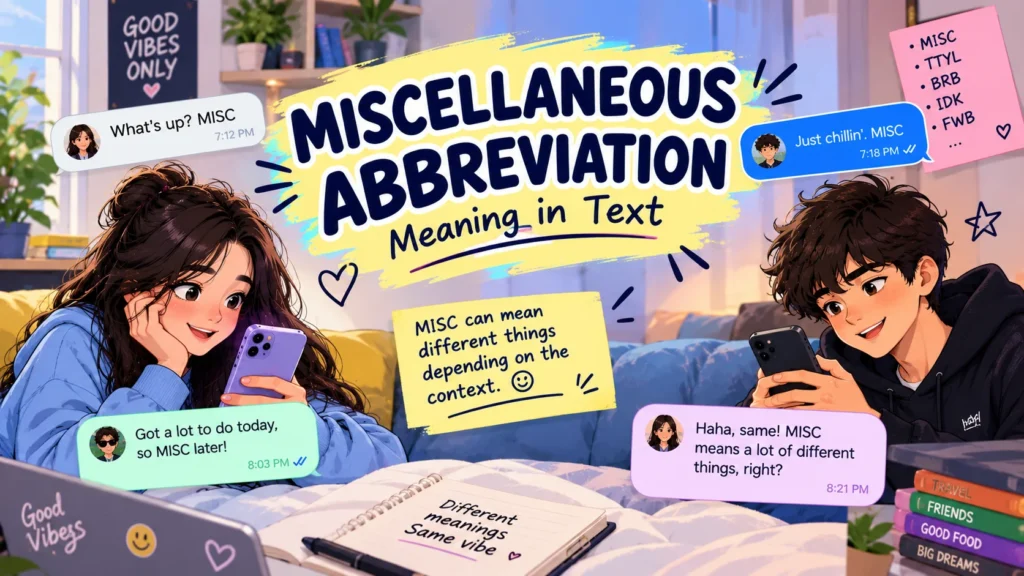
The most common abbreviation for miscellaneous is “misc.” It is widely used when several items, topics, expenses, or details do not fit neatly into a specific category.
You will often see misc. in notes, forms, invoices, budgets, school documents, storage labels, menus, and everyday writing.
For example:
- Misc. expenses = miscellaneous expenses
- Misc. items = miscellaneous items
- Misc. notes = miscellaneous notes
The word miscellaneous itself means a mixture of different things that do not belong to one particular group.
That makes its abbreviation especially useful when space is limited. Instead of writing the full eleven-letter word, people can simply use misc.
Miscellaneous Abbreviation at a Glance
The standard short form
Misc. is the most recognizable abbreviation of miscellaneous.
It is generally understood in both casual and professional writing, particularly when the surrounding context makes its meaning obvious.
Common examples
You might see:
Misc. charges
Misc. information
Misc. supplies
The abbreviation can describe almost anything that is being grouped together without a more precise category.
Is “misc” or “misc.” correct?
Both forms appear in real-world writing.
“Misc.” is the traditional abbreviation because the period signals that the word has been shortened.
“Misc” is also common, especially in digital interfaces, spreadsheets, file names, databases, and informal online writing.
The preferred form can depend on the style guide or platform.
Why Do People Abbreviate Miscellaneous?
There is a simple reason: miscellaneous is long and frequently used as a category label.
Imagine creating a spreadsheet with columns for rent, food, transportation, entertainment, and other spending.
A final column might be labeled Miscellaneous. On a narrow spreadsheet, that word takes up unnecessary space.
Changing it to Misc. makes the layout cleaner without losing meaning.
The same idea applies to folders, receipts, school notes, inventory lists, and digital menus.
The abbreviation works because readers already recognize it.
Where You Commonly See “Misc.”
In budgets and financial records
Misc. expenses is one of the most familiar uses.
It can refer to small costs that do not belong to categories such as transportation, food, rent, or utilities.
For example:
Printing: $10
Transportation: $30
Misc.: $15
Here, Misc. functions as a catch-all category.
In offices
Administrative documents may contain sections such as:
- General information
- Important dates
- Required documents
- Misc. notes
The abbreviation keeps headings short and easy to scan.
In school and college work
Students may encounter misc. in notes, assignments, reading lists, or classroom materials.
A teacher might write:
Misc. examples will be discussed tomorrow.
The meaning is simply “miscellaneous examples.”
In shopping and inventory
Stores and businesses sometimes organize less common products under Misc.
You may see labels such as:
Misc. accessories
Misc. supplies
Misc. hardware
This tells the reader that the items belong together mainly because they do not fit the major categories.
In digital folders
A computer folder named Misc. often contains files that do not have an obvious home.
For example:
Work
Photos
Projects
Misc.
The last folder acts as a temporary or general category.
Miscellaneous vs. Misc.: Understanding the Difference
The two forms have the same basic meaning, but they serve different purposes.
Miscellaneous is the complete word.
Misc. is its shortened form.
Consider this sentence:
I placed the miscellaneous documents in a separate folder.
In more compact writing, you could write:
I placed the misc. documents in a separate folder.
The first sounds slightly more formal and complete. The second is more concise.
For headings, labels, lists, and tables, Misc. is often more convenient.
Read More : F4F Meaning: What Does F4F Mean on Social Media?
Real-Life Examples of “Misc.”
Example 1: A workplace spreadsheet
Person A:
“Where should I put the conference badge costs?”
Person B:
“Put them under misc. expenses for now.”
The speaker is using misc. as a category for an expense that does not have its own section.
Example 2: A school notebook
Person A:
“What does ‘misc. reading’ mean on the syllabus?”
Person B:
“Probably extra readings that don’t belong to one of the main units.”
Here, misc. simply means “miscellaneous.”
Example 3: Online shopping
Person A:
“Which section has those little phone accessories?”
Person B:
“Check misc. accessories.”
The abbreviation saves space in the category name.
Example 4: A text message
Person A:
“Did you finish organizing the files?”
Person B:
“Almost. I still have the misc. ones.”
In casual digital communication, misc. can sound perfectly natural.
The Psychological Reason “Misc.” Feels Useful
There is an interesting communication habit behind this abbreviation.
People naturally organize information into categories. When something does not fit, we need a flexible label.
That is where miscellaneous becomes useful.
A miscellaneous category provides a mental “extra drawer.” Instead of forcing every item into an inaccurate category, you can place unusual or unrelated items together.
The abbreviation misc. makes that process even faster.
In my experience with everyday documents, labels such as Misc. are particularly useful when information is still being organized. It gives the writer a temporary home for details without requiring a new category for every small item.
How “Misc.” Is Used in Modern Digital Communication
Digital communication has made shortened labels even more common.
Phone screens, apps, spreadsheets, dashboards, and websites often have limited space. A compact abbreviation can improve readability.
You might find:
Misc. settings
Misc. files
and,
Misc. tools
Misc. options
The meaning remains the same even though the presentation changes.
Some platforms remove the period and simply display Misc because interface labels often favor shorter visual forms.
When Should You Use “Misc.”?
Use it for labels
Misc. works particularly well in headings, folders, columns, and categories.
Example:
Misc. Information
Use it when space matters
A spreadsheet column labeled Misc. is easier to fit than Miscellaneous.
Use it when the audience knows the context
If the surrounding information clearly explains the category, the abbreviation is easy to understand.
Use the full word in important formal writing
When clarity matters more than space, writing miscellaneous can be the safer choice.
For example, in a formal report, you may prefer:
Miscellaneous administrative expenses
rather than:
Misc. administrative expenses
Neither is inherently wrong; the appropriate choice depends on the document’s style.
When Not to Use the Miscellaneous Abbreviation
There are situations where shortening the word may make writing less clear.
Legal or highly formal documents
If a document has strict formatting requirements, follow its established style rather than introducing your own abbreviation.
When the audience may not understand it
Young readers, language learners, or people unfamiliar with common English abbreviations may understand miscellaneous more easily.
In an important explanation
If you are introducing the concept for the first time, spelling out the word can improve clarity.
A useful approach is to write:
Miscellaneous (misc.) expenses
After that, misc. can be used if appropriate.
Common Misunderstandings About “Misc.”
“Misc.” does not mean “unimportant”
This is one of the biggest misunderstandings.
Miscellaneous simply means mixed, varied, or not assigned to a specific category.
An item can be extremely important and still be classified as miscellaneous.
It does not mean “random” in every situation
Although miscellaneous items can appear random, the word is more accurately about categorization.
For example, a group of different office supplies may be miscellaneous because they do not belong to another defined category.
“Misc.” is not a separate word
It is an abbreviation of miscellaneous, rather than a completely different English term.
Miscellaneous Abbreviation Compared With Similar Terms
| Term | Meaning | Typical Use |
|---|---|---|
| Misc. | Miscellaneous | Mixed or uncategorized items |
| Etc. | Et cetera | More items of the same general type |
| Other | Additional items outside listed categories | Forms and lists |
| General | Broad or non-specific category | Documents and settings |
| Assorted | Mixed variety of items | Products and collections |
| Various | Several different things | General descriptions |
Key Insight
Misc. and etc. are not interchangeable.
“Etc.” means there are more examples similar to those already mentioned. Misc. identifies a category containing different items that do not fit another specific classification.
10 Useful Variations of Miscellaneous
1. Misc.
The standard abbreviated form of miscellaneous.
2. Misc
A punctuation-free version often seen in digital interfaces.
3. Misc. items
Used for assorted objects that do not belong to another category.
4. Misc. expenses
Common in accounting, budgeting, and financial records.
5. Misc. information
Used for additional details that do not fit under major headings.
6. Misc. notes
A convenient label for extra observations or reminders.
7. Misc. files
Often used for digital documents without a dedicated folder.
8. Misc. supplies
Useful for office, school, craft, or household materials.
9. Misc. charges
Common on invoices and financial statements.
10. Misc. accessories
Used for assorted add-ons or smaller related products.
How to Say Miscellaneous Correctly
The pronunciation of miscellaneous can be challenging for English learners.
It is commonly pronounced approximately as:
mis-uh-LAY-nee-us
The abbreviation misc. is generally pronounced by saying the shortened word as “misk.”
For example:
“Check the misc. section.”
In speech, however, many people simply say “miscellaneous” because the abbreviation is more common in writing than conversation.
Is “Misc.” Professional?
Yes, misc. can be professional when used appropriately.
It appears in practical documents such as spreadsheets, invoices, catalogs, reports, forms, and business records.
The key issue is not whether the abbreviation is professional. The real question is whether the document’s style supports abbreviations.
A polished business document should prioritize consistency. If other category labels are written in full, spelling out miscellaneous may look more uniform.
Miscellaneous in Different English-Speaking Contexts
American English
Misc. is widely recognized in American business, education, retail, and everyday writing.
British English
The abbreviation is also understandable in British English, although individual organizations may follow different editorial preferences.
Australian and Canadian English
Readers generally recognize misc. in practical and administrative contexts.
Global English
Because English is widely used in international business and digital communication, misc. has become easy to recognize across many regions.
The exact formatting may differ, but the basic meaning remains stable.
Gen Z, Millennials, and Older Writers
Generational differences are usually more noticeable in where the abbreviation appears than in what it means.
Younger users may encounter misc in apps, folders, games, social media interfaces, and digital lists.
Millennials and older generations may be more familiar with misc. through office documents, receipts, school materials, and administrative forms.
The underlying meaning has not dramatically changed.
The environment around the abbreviation has.
Is “Misc.” Safe for Kids?
Yes. Misc. is a neutral abbreviation for miscellaneous and has no inherently inappropriate meaning.
Children may encounter it in school worksheets, folders, educational apps, lists, or classroom instructions.
The important factor is context. If a child sees misc. online and does not understand it, the surrounding words usually make the intended meaning clear.
FAQs About the Miscellaneous Abbreviation
What is the abbreviation for miscellaneous?
The most common abbreviation is misc. The shortened form means the same thing as the full word miscellaneous.
Is “misc” a correct abbreviation?
Yes. Misc is commonly used, particularly in digital interfaces, file names, spreadsheets, and informal writing. Misc. is the traditional punctuated form.
What does misc. mean on a bill?
On a bill, misc. usually means miscellaneous. It generally refers to a charge that does not belong to one of the bill’s main categories.
What does misc. expenses mean?
Misc. expenses means miscellaneous expenses: costs that do not fit into the primary spending categories being used.
Is miscellaneous the same as random?
Not exactly. Miscellaneous means consisting of different types of things or items that do not belong to one particular category. They may be organized together for practical reasons.
Should I write misc. in a formal document?
You can, but check the document’s style requirements. In highly formal writing, spelling out miscellaneous may provide greater clarity.
Is “misc.” used in texting?
Yes. Someone might write misc. in a message when referring to miscellaneous files, tasks, expenses, or other mixed items. It is more common in practical communication than as slang.
A Simple Rule to Remember
If you are trying to remember just one thing, use this rule:
Misc. = miscellaneous = a mixture of different things that do not fit into one specific category.
Use misc. when you need a short, familiar label.
Use miscellaneous when maximum clarity or a more formal presentation matters.
The abbreviation may look small, but it solves a common communication problem: how to group different information without creating a complicated list of categories.
Conclusion
The standard abbreviation for miscellaneous is misc., although misc without a period is also common in modern digital writing.
You will find it in budgets, folders, invoices, school notes, business documents, inventory lists, and online interfaces.
The most important point is that misc. does not mean meaningless or unimportant. It simply identifies things that do not fit neatly into another defined category.
Once you understand that distinction, the abbreviation becomes easy to recognize wherever you encounter it.

1 thought on “Miscellaneous Abbreviation: Meaning, Uses & Examples”