
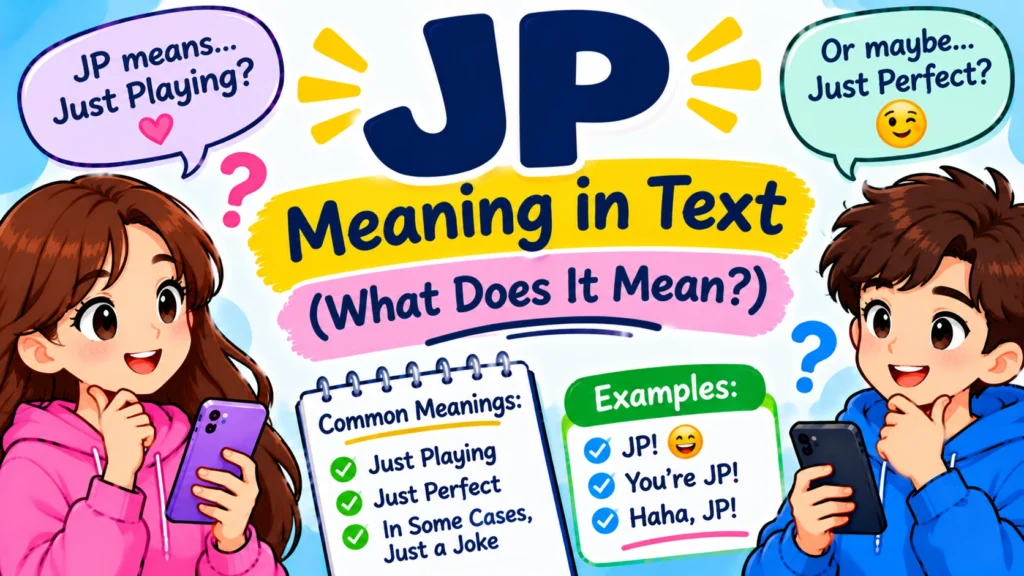
Have you received a message containing “JP” and wondered what the sender was trying to say? Short abbreviations are common in digital conversations, but not all of them have one fixed meaning.
JP can represent different phrases depending on the conversation, the relationship between the people, and the platform being used. In casual texting, one possible interpretation is “Just Playing,” which someone may use to show that a comment was meant as a joke rather than a serious statement.
However, JP can also be a person’s initials, a name abbreviation, or a reference to something specific. Understanding the surrounding message is the best way to interpret it correctly.
This guide explains the possible meanings of JP, how people use it, and how to respond naturally when it appears in a conversation.
2. JP Meaning in Text: The Quick Explanation
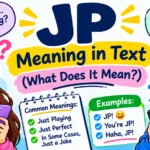
In informal conversations, JP may mean “Just Playing.” It can communicate that someone was joking, teasing, or not being completely serious.
For example:
- “You’re so annoying 😂 JP!” — The sender is teasing rather than expressing genuine frustration.
- “I don’t want to talk to you anymore… JP.” — The serious-sounding statement is being taken back as a joke.
- “You actually believed me? JP lol.” — The sender reveals that the earlier message was playful.
Important: JP is not a universally established texting abbreviation. Its meaning can vary, so don’t assume it always means “Just Playing.”
3. Where Did JP Come From? Its Background and Digital Evolution
The Rise of Short Texting Abbreviations
Text abbreviations became popular as mobile phones and online messaging developed. Early text messages encouraged people to communicate using fewer characters.
Expressions such as LOL, BRB, and JK became familiar ways to express laughter, announce a short absence, or clarify a joke.
JP can be understood within this wider habit of shortening everyday expressions. However, it is less standardized than widely recognized abbreviations such as JK, which commonly means “Just Kidding.”
Social Media and Modern Communication
Today, people communicate through WhatsApp, Instagram, Snapchat, TikTok, gaming chats, and other platforms.
Short forms help conversations move quickly. A person might use JP after a playful comment to reduce the chance of being misunderstood.
Still, many users prefer JK or LOL because those expressions are more familiar to a wider audience.
Read more : TMB Meaning in Text: What Does It Really Mean?
4. Real-Life Conversations: How People Use JP
The meaning becomes easier to understand when you see it in natural conversations.
Example 1: WhatsApp Conversation
Person A: I think you forgot my birthday.
Person B: Of course I forgot. I forget everything 😂 JP!
Person A: You scared me for a second!
Here, JP suggests that the sender was teasing rather than seriously admitting they forgot.
Example 2: Instagram Direct Messages
Person A: Your new haircut looks terrible.
and,
Person B: Wow, thanks for the support!
moreover,
Person A: JP, it actually looks amazing.
The sender uses JP to clarify that the negative comment was playful.
Example 3: TikTok Comments
Person A: This dance is so easy. Even my grandmother can do it.
Person B: JP because I tried it and nearly fell over 😭
In this example, JP helps communicate a humorous change of tone.
Example 4: Text Message Between Friends
Person A: I’m never sharing my snacks with you again.
and,
Person B: Please don’t say that!
moreover,
Person A: JP, you can have the last cookie.
The conversation shows how an abbreviation can soften a playful statement.
5. Emotional and Psychological Meaning Behind JP
Texting does not include facial expressions, voice changes, or body language. Because of that, a joke can sometimes sound more serious than the sender intended.
JP may help communicate a playful mood and prevent unnecessary tension.
It can express several emotions:
- Playfulness: The sender wants to make the conversation entertaining.
- Affection: Friends may tease each other without intending to hurt anyone.
- Relief: Someone clarifies that a worrying statement was not serious.
- Awkwardness: A person may use a short abbreviation after realizing their joke could be misunderstood.
Imagine telling a friend, “I’m blocking you forever!” After noticing their surprised reaction, you add “JP 😂” to show that you were only teasing.
That small clarification can change how the entire message feels.
However, it cannot automatically make an offensive or hurtful comment acceptable.
6. How JP Is Used in Different Communication Contexts
Social Media
On Instagram, TikTok, and Snapchat, short expressions are useful in comments, captions, and private messages.
Someone might add JP after a sarcastic remark to make their playful intention clearer. The abbreviation is informal, so it works better in relaxed online conversations.
Friends and Relationships
Close friends often use teasing as part of their communication style. JP may appear when someone makes an exaggerated statement or pretends to be annoyed.
In relationships, however, context matters. A joke about a sensitive subject may still hurt someone’s feelings, even when followed by an abbreviation.
Work and Professional Communication
JP is generally not a good choice for formal emails, workplace reports, or conversations with clients.
A clearer expression is usually better:
- “I was only joking.”
- “That was meant playfully.”
- “I didn’t mean that seriously.”
Casual vs. Serious Conversations
| Situation | Is JP suitable? |
|---|---|
| Chatting with close friends | Yes, if everyone understands it |
| Funny social media comments | Sometimes |
| Talking to a new acquaintance | Use carefully |
| Discussing sensitive feelings | Usually avoid it |
| Professional emails | Not recommended |
| Serious disagreements | Avoid using it to dismiss concerns |
7. When Should You Avoid Using JP?
Although abbreviations make conversations quicker, they are not suitable for every situation.
Avoid JP when:
- Someone is sharing a personal problem.
- You are discussing an emotional or sensitive subject.
- Your joke could embarrass or insult another person.
- You are communicating with someone unfamiliar with texting slang.
- You need to give clear instructions at work or school.
For example, telling someone “I don’t care about your problem, JP” may not feel funny to a person who is already upset.
A more thoughtful response would be: “I didn’t mean that seriously. I’m sorry if it sounded hurtful.”
8. Common Misunderstandings About JP
JP Always Means Just Playing
Not necessarily. JP can have different meanings depending on the sender and situation. It may also represent initials, a username, or a topic-specific abbreviation.
JP and JK Are Exactly the Same
They can communicate similar intentions, but they are not identical in how commonly people recognize them.
JK is widely understood as “Just Kidding.” JP may be interpreted as “Just Playing” in some informal conversations, but it is less standardized.
JP Is Always a Joke
A message containing JP may be playful, but the surrounding conversation still matters. It is possible that someone is using the abbreviation sarcastically or in a different context.
Every Person Understands JP
Not everyone knows less common abbreviations. If clarity matters, spelling out the intended phrase is the safest choice.
9. JP vs. Similar Texting Abbreviations
Here is how JP compares with other expressions people use in digital conversations.
| Abbreviation | Meaning | Main purpose |
|---|---|---|
| JP | Sometimes Just Playing | Clarifies playful intent |
| JK | Just Kidding | Shows something was a joke |
| LOL | Laughing Out Loud | Expresses amusement |
| LMAO | Laughing My Ass Off | Shows strong amusement |
| J/K | Just Kidding | Clarifies a joke |
| IDK | I Don’t Know | Expresses uncertainty |
| FR | For Real | Shows sincerity or agreement |
| NGL | Not Gonna Lie | Introduces an honest opinion |
Key Insight
JP and JK can have similar meanings in casual conversations, but JK is generally more recognizable. If you want to avoid confusion, write “just playing” or “just kidding” instead of relying on an unfamiliar abbreviation.
10. Different Meanings and Possible Uses of JP
JP does not have one universal definition. Its interpretation depends on where and how it appears.
Here are ten possible uses or interpretations:
- Just Playing: A possible informal meaning used to clarify that a comment was playful.
- Initials: JP may represent someone’s first and last initials.
- Username: People may include JP in their online gaming or social media names.
- Personal Nickname: Friends sometimes shorten a person’s name to JP.
- Japan: JP is commonly used as a country abbreviation or identifier for Japan in certain contexts.
- Japanese Language: JP may appear as a language or localization label for Japanese.
- Business Initials: A company, organization, or professional may use JP as part of its name.
- Gaming Identity: Players may use JP as a short username or team identifier.
- Personal Contact Name: Someone may save a contact using the initials JP.
- Topic-Specific Short Form: In a specialized discussion, JP may have a meaning understood only by that particular group.
The important point is that not every appearance of JP is texting slang. Look at the subject of the conversation before deciding what it means.
11. How to Respond When Someone Sends JP
Your response depends on the tone of the conversation and your relationship with the sender.
Casual Replies
- “Haha, I knew you were joking!”
- “Okay, no worries.”
- “You got me for a second.”
- “I figured 😂”
Funny Replies
- “Too late, I already believed you!”
- “Don’t scare me like that!”
- “You almost started a whole argument!”
- “I’m keeping receipts anyway 😂”
Mature Replies
- “I understand. Thanks for clarifying.”
- “I thought you were serious for a moment.”
- “No problem, I get what you meant.”
- “All good, I understand the joke.”
Respectful Replies
- “Thanks for explaining.”
- “I appreciate the clarification.”
- “I wasn’t sure how to interpret that.”
- “It’s okay, I understand now.”
If you genuinely don’t understand the abbreviation, you can simply ask, “What do you mean by JP?”
12. Regional, Cultural, and Generational Differences
Western Online Culture
In English-speaking online communities, JK is more widely recognizable as “Just Kidding.” JP may appear in individual conversations, but its interpretation is less consistent.
Asian Digital Communication
Online conversations across Asian countries include English abbreviations, local-language expressions, and mixed-language texting.
JP may be used as initials, a country or language label, or a context-specific short form. It should not automatically be interpreted as “Just Playing.”
Middle Eastern Communication
People in Middle Eastern online communities often mix English abbreviations with Arabic and other local languages.
The meaning of JP depends on the people communicating and the language around it. A short abbreviation may be familiar to one group but confusing to another.
Global Internet Usage
Gaming communities, social platforms, and international group chats bring together people with different communication habits.
As a result, the same two letters can have several meanings. The surrounding message is often more useful than the abbreviation alone.
Gen Z vs. Millennials
Gen Z users often experiment with short forms, emojis, and playful expressions in fast-moving conversations.
Millennials may be more familiar with established abbreviations such as LOL, BRB, and JK. These are broad tendencies, not strict rules; individual habits vary considerably.
13. Is JP Safe for Kids?
JP itself is not generally considered an offensive or harmful abbreviation when used to mean “Just Playing.” However, children should learn that online expressions can be misunderstood.
Parents can encourage children to:
- Ask what an unfamiliar abbreviation means.
- Avoid sharing personal information with strangers.
- Think about whether a joke might hurt someone’s feelings.
- Use clear language when discussing serious issues.
- Tell a trusted adult if an online conversation makes them uncomfortable.
The bigger lesson is not about memorizing every abbreviation. It is about understanding tone, context, and respectful digital communication.
14. FAQs About JP Meaning in Text
1. What does JP mean in text messages?
JP may mean “Just Playing” in some informal conversations. It can also represent initials or another context-specific abbreviation.
2. Does JP mean Just Playing?
It can. Some people use JP to indicate that they were joking or teasing, although this meaning is not universal.
3. Is JP the same as JK?
They can communicate similar ideas. JK is a widely recognized abbreviation for “Just Kidding,” while JP is less standardized.
4. What does JP mean on Instagram?
On Instagram, JP may be used as a personal abbreviation, initials, or a playful expression. The surrounding message helps determine its meaning.
5. What does JP mean from a girl?
A girl may use JP to suggest that a playful comment was not serious. However, it could also represent her initials, nickname, or something specific to the conversation.
6. What does JP mean from a guy?
A guy may use JP to clarify a joke or teasing comment. The meaning depends on his usual texting style and the context.
7. Should I use JP in professional messages?
It is better to avoid JP in professional communication because not everyone recognizes it. Use clear phrases such as “I was joking” or “I meant that playfully.”
Conclusion: Understand the Context Before Using JP
JP is a short abbreviation that may mean “Just Playing” in informal texting. People may use it to make a joke clearer, soften playful teasing, or show that a statement was not intended seriously.
However, it does not have one universally accepted meaning. It can also refer to initials, Japan, language labels, usernames, and other context-specific terms.
When you receive JP in a message, consider the conversation before interpreting it. When you use it yourself, remember that clear and respectful communication matters more than saving a few characters.

1 thought on “JP Meaning in Text: What Does It Really Mean?”