
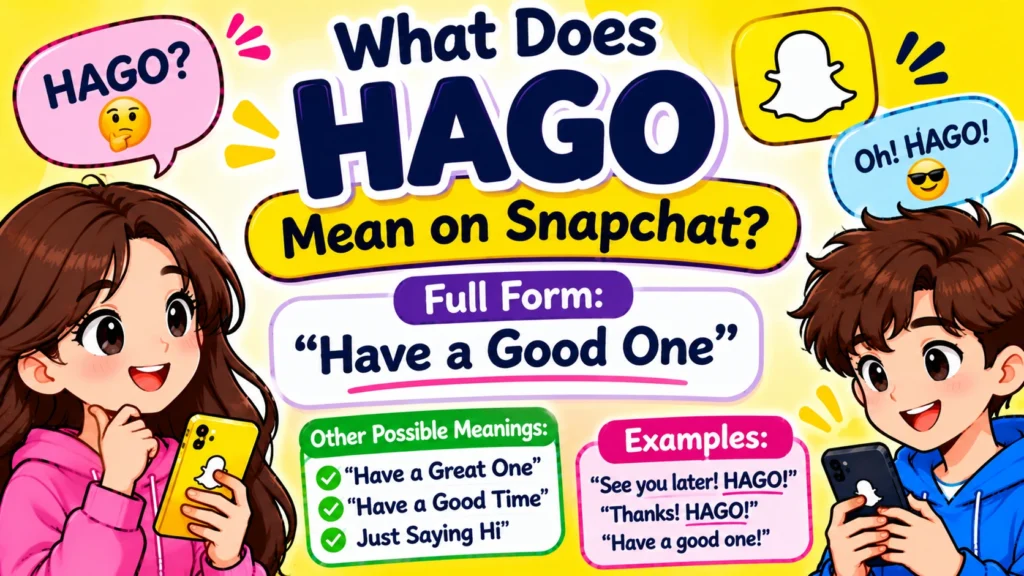
Have you received a Snapchat message containing “HAGO” and wondered what the sender was trying to say? Social media is full of shortened words, unusual expressions, and internet slang that can make everyday conversations confusing.
HAGO is one of those abbreviations whose meaning depends on the conversation. You might encounter it in Snapchat chats, Instagram DMs, WhatsApp messages, or comments on other social platforms.
Understanding the context is important because not every abbreviation has one universally accepted meaning. In casual online conversations, HAGO is sometimes used to mean “Have a Good One.” It can also be a typo or a context-specific abbreviation.
In this guide, you’ll discover its possible meanings, how people use it, realistic conversation examples, and the best ways to respond.
What Does HAGO Mean on Snapchat? – Quick Meaning
HAGO can mean “Have a Good One” in casual online communication.
It is a friendly expression used when someone wants to wish another person a pleasant day, evening, or experience.
For example:
- “I’m heading out now, HAGO!”
- “Thanks for chatting. HAGO 😊”
- “See you tomorrow, HAGO!”
However, HAGO is not a universally established Snapchat abbreviation. Its meaning can vary between conversations, and it may sometimes be a typing mistake.
Other possible interpretations include:
- Have a Good One: A friendly way to end a conversation.
- Context-specific abbreviation: A meaning understood within a particular friendship or online community.
- Typing mistake: The sender may have intended to write another word or abbreviation.
If you are unsure, asking the sender what they mean is the safest option.
Origin and Background of HAGO
Where Did HAGO Come From?
HAGO fits into the wider culture of internet abbreviations, where people shorten everyday expressions to communicate faster.
Expressions such as TTYL (Talk To You Later), GTG (Got To Go), and HAGO-style shortened phrases reflect the preference for quick digital communication.
There is no single well-established origin for HAGO as a Snapchat abbreviation. Its interpretation depends on how individual users adopt it.
Snapchat and Social Media Influence
Snapchat encourages fast conversations through disappearing messages, snaps, and short replies.
Because users often communicate quickly, abbreviations can become part of their everyday vocabulary.
A person might use HAGO as a short farewell instead of typing a complete sentence. However, you should consider the surrounding message before deciding what it means.
How Its Meaning Has Evolved
Internet expressions often change as they move between different communities.
An abbreviation that has one meaning in a private group chat may have another interpretation elsewhere. This is why checking the conversation is more reliable than assuming every user means the same thing.
Read More : MFW Meaning in Text: What Does This Slang Mean?
HAGO in Real-Life Conversations
Here are four examples showing how HAGO might appear in casual digital communication.
1. Snapchat Conversation
Person A: I’m going to sleep now. Talk tomorrow!
Person B: Okay, HAGO 😊
Person A: Thanks! You too.
Here, HAGO is interpreted as “Have a Good One,” a friendly way to end the conversation.
2. Instagram DM
Person A: Thanks for helping me with the assignment.
Person B: No problem!
and,
Person A: Have a nice evening.
Person B: HAGO!
The sender uses the abbreviation as a casual farewell.
3. WhatsApp Group Chat
Person A: I’m leaving for work now.
and,
Person B: Alright, HAGO!
moreover,
Person C: Have a great day!
The expression communicates a friendly wish.
4. Text Message Between Friends
Person A: I have to go shopping with my family.
Person B: Okay, enjoy!
and,
Person A: Thanks, talk later.
Person B: HAGO ❤️
In this situation, the abbreviation creates a relaxed and friendly ending.
Note: These are illustrative conversations showing one possible interpretation, not proof that HAGO has a standard Snapchat meaning.
Emotional and Psychological Meaning of HAGO
Short expressions can communicate warmth and friendliness even when they contain only a few letters.
When someone uses HAGO to mean “Have a Good One,” it can express several emotions.
1. Friendliness
The sender wants to end the conversation positively rather than simply disappearing.
2. Politeness
It can be a quick way to wish someone well before leaving a chat.
3. Casual Connection
Friends often prefer shortened expressions because they make communication feel relaxed and natural.
4. Positive Energy
A friendly farewell can leave the other person with a pleasant impression.
A relatable scenario:
Imagine chatting with a friend on Snapchat after a long day. They suddenly say they need to leave. Instead of writing a long goodbye, they send “HAGO!” It may simply mean they hope you have a good day.
The emotional meaning comes from the situation and the relationship, not just the abbreviation.
How HAGO Is Used in Different Contexts
Social Media
On Snapchat, Instagram, and other platforms, HAGO may appear in private messages or casual conversations as a shortened farewell.
Its meaning should be confirmed through context.
Friends and Relationships
Friends may use HAGO to end a conversation positively.
In romantic conversations, it could also sound affectionate when combined with emojis or warm language.
Work and Professional Settings
HAGO is generally not recommended in formal workplace communication because many people may not recognize it.
Instead, write:
- “Have a good day.”
- “Enjoy the rest of your day.”
- “Wishing you a pleasant evening.”
Casual vs. Serious Tone
- Casual: “I’m off now, HAGO!”
- Friendly: “Thanks for chatting, HAGO 😊”
- Polite: “Have a good one!”
- Professional: “Have a great day ahead.”
The complete phrase is usually clearer when communicating with someone unfamiliar with internet slang.
When NOT to Use HAGO
Although HAGO can be a friendly expression, it may not be appropriate in every situation.
Avoid using it in these circumstances:
- Formal emails: Use complete expressions instead of unfamiliar abbreviations.
- Academic communication: Teachers and classmates may not understand what you mean.
- Serious conversations: A shortened farewell might sound careless when someone needs emotional support.
- Professional discussions: Clear language is better when communicating with clients or colleagues.
- Unfamiliar audiences: Not everyone understands Snapchat slang.
Always consider the other person’s communication style before using an abbreviation.
Common Misunderstandings About HAGO
People can misunderstand HAGO because its meaning is not universally standardized.
1. Assuming everyone knows its meaning
Not all Snapchat users recognize HAGO as a farewell expression.
2. Thinking it always means “Have a Good One”
This is a possible interpretation, but the surrounding conversation matters.
3. Assuming it has a romantic meaning
HAGO is not inherently romantic. It may simply be a friendly way to end a conversation.
4. Confusing it with other abbreviations
People sometimes mistake unfamiliar abbreviations for established slang. Checking the spelling and context can prevent confusion.
5. Thinking it is offensive
HAGO is not inherently offensive when used as a shortened farewell.
HAGO vs. Similar Texting Abbreviations
Here is how HAGO compares with other expressions commonly seen in digital conversations.
| Abbreviation | Full Meaning | Main Purpose |
|---|---|---|
| HAGO | Have a Good One | Friendly farewell |
| TTYL | Talk To You Later | Ending a conversation |
| GTG | Got To Go | Saying you must leave |
| BRB | Be Right Back | Temporarily leaving |
| GN | Good Night | Wishing someone a good night |
| GM | Good Morning | Morning greeting |
| TC | Take Care | Showing care |
| HBU | How About You? | Asking about someone |
| HMU | Hit Me Up | Inviting someone to contact you |
Key Insight
HAGO, when used as “Have a Good One,” is a positive farewell. Expressions such as TTYL and GTG communicate that someone is leaving, while TC emphasizes wishing the other person well.
Variations and Types of HAGO
HAGO does not have a widely standardized collection of variations. However, these related expressions communicate similar feelings.
- HAGO: Have a Good One; a casual farewell.
- Have a good day: A complete expression wishing someone a pleasant day.
- Have a good night: Used when someone is ending a conversation at night.
- HAGD: Have a Good Day; a shortened farewell.
- TC: Take Care; expressing concern and friendliness.
- TTYL: Talk To You Later; suggesting another conversation.
- GTG: Got To Go; indicating that someone needs to leave.
- GN: Good Night; a common nighttime greeting.
- Take it easy: A relaxed way to say goodbye.
- See you soon: An expression suggesting that you expect to meet again.
These alternatives can help you communicate naturally without relying on an unfamiliar abbreviation.
How to Respond When Someone Uses HAGO
If someone sends you HAGO on Snapchat, you can respond according to the conversation.
Casual Replies
- “Thanks, you too!”
- “Same to you!”
- “You too 😊”
- “Have a good one!”
Funny Replies
- “Only if you do too 😂”
- “I’ll try my best!”
- “Good vibes only!”
- “Haha, you too!”
Mature Replies
- “Thank you. Wishing you a great day.”
- “I appreciate it. Take care!”
- “Thanks for the kind words.”
- “Enjoy your day as well.”
Respectful Replies
- “Thank you so much!”
- “That’s kind of you. Have a wonderful day.”
- “Thanks, take care.”
- “Wishing you the same.”
If you cannot understand the abbreviation, simply ask, “What does HAGO mean?” There is nothing wrong with asking for clarification.
Regional and Cultural Usage of HAGO
Western Culture
English-speaking social media users may understand HAGO as a shortened version of “Have a Good One.” However, it is less universally recognizable than expressions such as TTYL and BRB.
Asian Culture
In countries such as Pakistan, India, Bangladesh, and the Philippines, people frequently combine English abbreviations with local languages.
For example, someone might write, “Okay, HAGO, kal baat karte hain,” meaning they wish the other person well and will talk tomorrow.
Middle Eastern Culture
Some English-speaking social media users in Middle Eastern communities may encounter HAGO through international messaging and online conversations.
Its interpretation can vary depending on familiarity with English internet slang.
Global Internet Usage
Social media allows abbreviations to travel across countries. Nevertheless, an expression that is familiar in one online community may be unfamiliar in another.
Gen Z vs. Millennials
Gen Z users often prefer short messages, emojis, and quick digital expressions.
Millennials may also recognize internet abbreviations, but familiarity with HAGO varies between individuals rather than following a strict generational pattern.
Is HAGO Safe for Kids?
Yes, HAGO is generally harmless when used as a friendly abbreviation for “Have a Good One.”
It does not inherently contain inappropriate or offensive language.
Children may encounter it while chatting with friends on Snapchat or other social media platforms.
Parents should still encourage children to understand online communication, avoid sharing personal information with strangers, and ask questions when unfamiliar expressions appear.
The abbreviation itself is not a safety concern; the context of the conversation is what matters.
FAQs About HAGO Meaning on Snapchat
1. What does HAGO mean on Snapchat?
HAGO can mean “Have a Good One,” a casual expression used to wish someone well before ending a conversation. However, its meaning depends on context.
2. What does HAGO mean in texting?
In some informal text conversations, HAGO is used as a shortened version of “Have a Good One.” It can be a friendly way to say goodbye.
3. What does HAGO mean from a girl?
If a girl sends HAGO, she may simply be wishing you well or ending the conversation politely. It does not automatically indicate romantic interest.
4. What does HAGO mean from a guy?
When a guy sends HAGO, he may be using it as a casual farewell. The exact meaning depends on the conversation.
5. Is HAGO a popular Snapchat abbreviation?
HAGO is not as widely recognized as abbreviations such as LOL, BRB, or TTYL. Some users may understand it, while others may need clarification.
6. Is HAGO rude or offensive?
No, HAGO is not inherently rude or offensive when intended as “Have a Good One.” It is generally a friendly expression.
7. What should I reply to HAGO?
You can reply with “Thanks, you too!”, “Same to you!”, or “Have a great day!” These responses are natural and friendly.
Conclusion
Understanding Snapchat abbreviations can make online conversations easier and help you avoid unnecessary confusion.
HAGO may mean “Have a Good One” when used as a casual farewell. It can communicate friendliness, politeness, and positive feelings when someone is ending a conversation.
However, it is not a universally established Snapchat abbreviation, so context is important. If you receive HAGO and are unsure what the sender means, asking for clarification is always a good choice.
The next time you encounter this expression, look at the surrounding message before deciding how to respond.





1 thought on “What Does HAGO Mean on Snapchat? Meaning & Examples”