
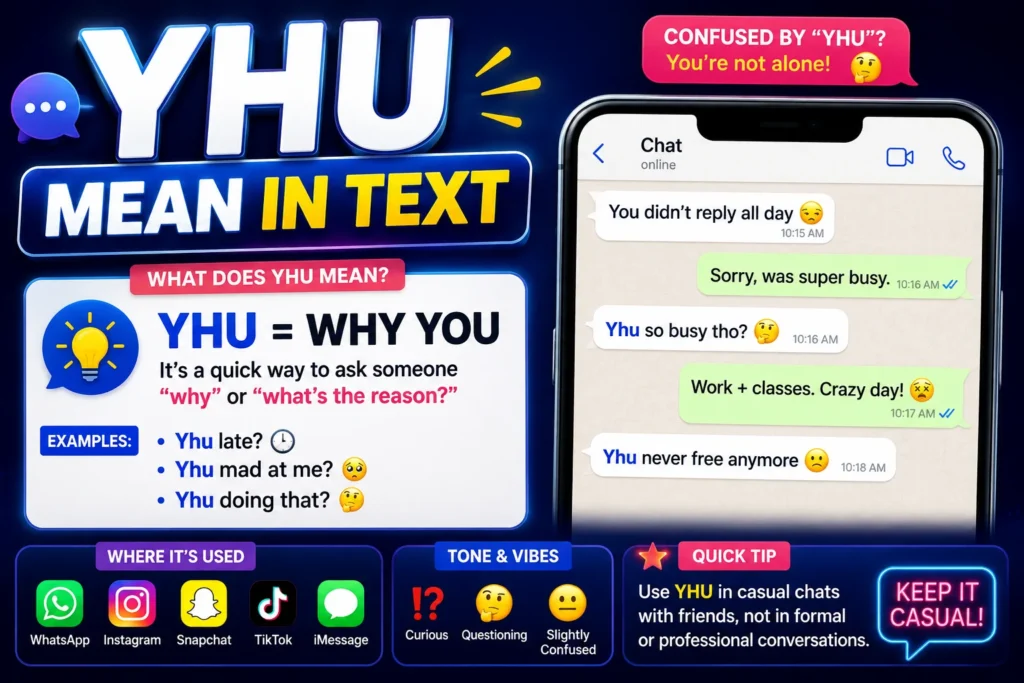
If someone texts you “yhu”, you might wonder whether it is a typo or a different way of writing “you.” In most casual online conversations, YHU simply means “you.”
It is a stylized spelling often used in texting, Snapchat, TikTok, Instagram DMs, and other social media conversations. The meaning is usually straightforward, but the spelling can make the message feel more playful, personal, or informal.
YHU Meaning in Text – Quick Explanation
What Does YHU Stand For?
YHU = You
It is not usually a separate phrase or acronym. Instead, it’s an alternative spelling of the word “you.”
For example:
“What yhu doing?”
means:
“What are you doing?”
Another example:
“I told yhu already.”
means:
“I told you already.”
Why Do People Write YHU?
People may use YHU because:
- It looks more casual.
- It reflects the way some people pronounce “you.”
- It can add personality to a message.
- It is common in certain texting styles and online communities.
- It can make a conversation feel more relaxed.
Origin and Background
Where Did YHU Come From?
YHU developed as part of informal internet and texting language. Online users often change the spelling of ordinary words to make messages sound more conversational or distinctive.
Unlike abbreviations such as LOL or BRB, YHU doesn’t represent several words. It is simply a stylized version of “you.”
Social Media Influence
The spelling can appear across:
- TikTok
- Snapchat
- X
- Text messages
- Online chats
Its popularity varies by community, age group, and individual texting style.
Is YHU a Typo?
Not necessarily.
If someone repeatedly writes “yhu” instead of “you,” they’re probably using it intentionally. A single occurrence could still be a simple typing mistake, so the surrounding conversation matters.
Real-Life Conversations
Person A: Yhu coming tonight?
Person B: Yeah, I’ll be there around 8.
Instagram DM
Person A: Why yhu ignoring me 😂?
Person B: I’m not! I’ve just been busy.
TikTok Comment
Person A: Yhu really did that 😭
Person B: I had to!
Text Message
Person A: I thought yhu were sleeping.
Person B: Nope, still awake lol.
Emotional and Psychological Meaning
What Feeling Can YHU Add?
YHU doesn’t have a fixed emotional meaning, but its unusual spelling can make a message feel:
- Playful
- Casual
- Friendly
- Affectionate
- Informal
- Expressive
The emotional tone comes mostly from the rest of the message.
Compare:
“Are you okay?”
with:
“Yhu okay? 🥺”
The second message may feel more personal or emotionally expressive.
Why Do People Change the Spelling?
Digital communication doesn’t always follow traditional spelling rules. People often modify words to reflect personality, humor, pronunciation, or community identity.
YHU is one example of how online language can become more creative and conversational.
Usage in Different Contexts
Social Media
YHU can appear naturally in comments and DMs.
“Yhu look amazing!”
Here, it simply means:
“You look amazing!”
Friends and Relationships
Close friends may use YHU as part of an informal texting style.
“Yhu better come with us 😂.”
Casual Conversations
It’s most natural when people already have a relaxed relationship.
“What yhu doing later?”
Professional Settings
Avoid YHU in professional communication.
Instead, use the standard spelling:
“Are you available later?”
Using YHU in an email or workplace message can appear overly informal.
When NOT to Use It
YHU isn’t appropriate for:
- School assignments
- Professional emails
- Job applications
- Business documents
- Formal presentations
- Official communication
Standard English is clearer in these situations.
Common Misunderstandings
Does YHU Mean Something Different From “You”?
Usually, no.
YHU generally carries the same basic meaning as “you.” The difference is primarily in spelling and style.
Is YHU a Slang Acronym?
Not exactly.
It’s better described as a stylized texting spelling rather than a traditional acronym.
Is YHU Flirty?
Not automatically.
Someone using YHU isn’t necessarily flirting. The tone depends on the complete message and the relationship between the people.
For example:
“Yhu need anything from the store?”
is simply casual.
But:
“Yhu look cute today 👀”
could have a more playful or flirtatious tone.
Comparison Table
| Term | Meaning | Tone |
|---|---|---|
| YHU | You | Casual |
| You | You | Standard |
| U | You | Very informal |
| Ya | You / Your, depending on context | Casual |
| Ur | Your / You’re, depending on context | Informal |
| Y’all | You all | Casual/group |
| Yourself | The person being addressed | Standard |
Key Insight
YHU doesn’t change the meaning of “you”; it changes the style. The spelling can make a message feel more relaxed or expressive, but context determines the emotional tone.
Variations and Related Forms
YHU
A stylized spelling of you.
U
A shortened texting form of you.
Ya
An informal form sometimes used for “you.”
Yall
A casual spelling of **you all.”
Y’all
The standard written form of the informal plural expression “you all.”
Ur
Often used online for “your” or “you’re,” although it can be ambiguous.
Yu
Another shortened or stylized spelling sometimes seen online.
You
The standard spelling and safest option for formal communication.
Yourself
A standard word used when referring back to the person being addressed.
You Guys
A casual phrase used to address a group.
How to Respond When Someone Uses YHU
Casual Replies
- “Yeah, what’s up?”
- “Nothing much 😂”
- “I’m good!”
Funny Replies
- “Why are you spelling it like that? 😂”
- “Yhu already know!”
Mature Replies
- “I’m doing well, thanks.”
- “Yes, I understand what you mean.”
Respectful Replies
- “Sure, no problem.”
- “Thanks for asking.”
Regional and Cultural Usage
Western Culture
YHU can appear in informal online conversations, although “you” remains far more common.
Asian Culture
Users who participate in English-language social media may encounter YHU through TikTok, Instagram, Snapchat, and other online communities.
Middle Eastern Culture
English-speaking social media users may recognize YHU, particularly through casual online communication.
Global Internet Usage
YHU isn’t universally used. Its popularity depends heavily on online communities and individual texting habits.
Gen Z vs. Millennials
Younger users may be more comfortable experimenting with spellings such as YHU, while many Millennials are more likely to stick with you, u, or other familiar texting shortcuts.
Is YHU Safe for Kids?
Yes.
YHU is simply a casual spelling of “you” and isn’t offensive or inappropriate by itself.
Children should still learn the difference between informal texting language and standard English so they know when each style is appropriate.
FAQs
What does YHU mean in text?
YHU usually means “you.” It is a stylized spelling commonly used in casual texting and social media.
Is YHU the same as you?
Yes. In most conversations, YHU has the same meaning as the standard word “you.”
Is YHU an abbreviation?
Not technically. YHU is better described as a stylized or alternative spelling rather than an acronym.
What does YHU mean on Snapchat?
On Snapchat, YHU generally means “you.” Its use is informal and often reflects the sender’s personal texting style.
Is YHU flirting?
Not by itself. YHU can appear in friendly, casual, humorous, or romantic conversations. The rest of the message determines the tone.
Is YHU a typo?
It can be, but repeated use usually suggests that the sender intentionally prefers the spelling.
Should I use YHU at work?
No. In professional communication, use the standard spelling “you.”
Conclusion
The YHU meaning in text is usually very simple: “you.” It is a casual, stylized spelling that people may use in texts, DMs, comments, and other informal online conversations.
YHU doesn’t automatically indicate a particular emotion or relationship. Its tone comes from the surrounding words, emojis, and situation. If someone sends you “yhu,” you can normally read it exactly as “you.”
For formal writing, though, stick with the standard spelling. It is clearer, more professional, and understood by everyone.