
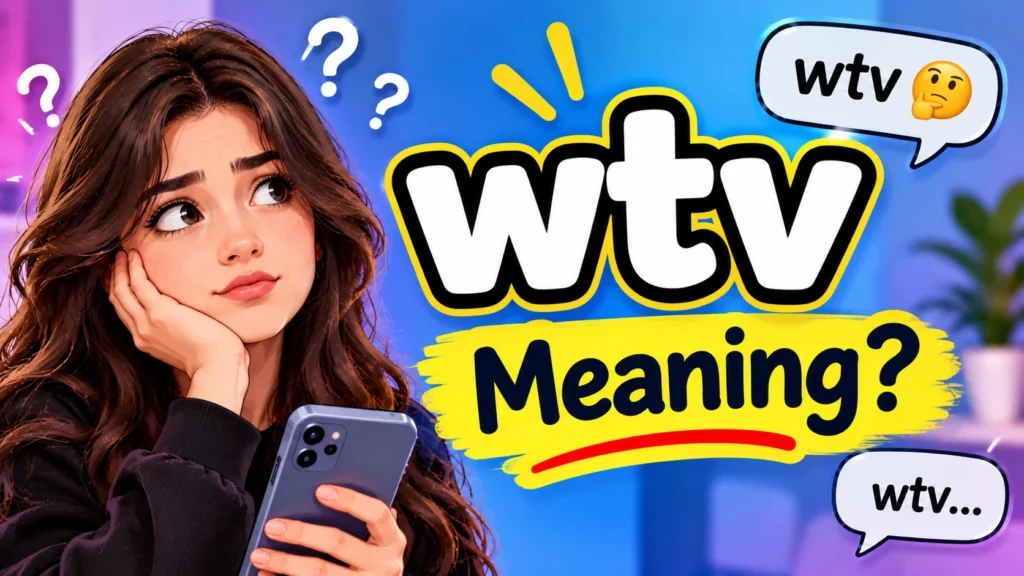
Have you ever received a message that simply says “WTV” and wondered whether the person is being casual, annoyed, or genuinely uninterested?
Texting abbreviations can make everyday conversations faster, but they can also create confusion. A short expression may carry different emotional meanings depending on who sends it and how it is used.
WTV is especially interesting because it can communicate acceptance, indifference, or a relaxed attitude. Understanding its meaning can help you read messages more accurately and respond without misunderstanding someone’s tone.
2. WTV Meaning in Text: The Quick Answer
WTV usually means “Whatever” in text messages, online chats, and social media conversations.
People use it as a shorter way to express that they do not have a strong preference, do not mind a particular choice, or are not interested in continuing a discussion.
For example:
- “WTV, I’m okay with either option.”
- “You can choose the movie, wtv works for me.”
- “WTV, I don’t want to argue about it.”
The exact tone depends on the situation. Sometimes WTV sounds friendly and relaxed. In other conversations, it can feel dismissive or slightly irritated.
Three quick examples
- “WTV you want to eat is fine.” — The person has no food preference.
- “WTV, let’s just go home.” — The person may feel frustrated.
- “WTV happens, we’ll figure it out.” — The person is accepting the situation.
3. Where Did WTV Come From?
The Evolution of Shortened Texting Language
WTV developed as part of the wider trend of shortening everyday expressions for digital communication.
When SMS messaging became popular, people began using abbreviations to save typing time. Expressions such as LOL, BRB, IDK, and BTW became familiar ways to communicate quickly.
WTV follows the same pattern. It takes the first letters of “whatever” and turns the word into a convenient texting shortcut.
Social Media Made It More Familiar
Platforms such as TikTok, Instagram, Snapchat, and X helped casual abbreviations become part of everyday online language.
You might see WTV in a comment, a private message, a caption, or a conversation between friends.
Its popularity also reflects a communication style in which people often prefer short, expressive replies rather than complete sentences.
How Its Meaning Has Evolved
Although WTV generally means “whatever,” its emotional meaning depends on context.
A friendly message can communicate flexibility, while a short reply during an argument may suggest frustration or emotional distance.
The letters remain the same, but the feeling behind them can change.
Read More: S2R Meaning in Text: What Does This Abbreviation Mean?
4. WTV in Real-Life Conversations
Understanding an abbreviation becomes easier when you see how people use it naturally.
Here are four realistic examples from everyday digital communication.
WhatsApp Conversation
Person A: “Should we meet at 5 or 6?”
Person B: “WTV works for me.”
and,
Person A: “Okay, let’s meet at 5:30.”
Person B: “Sounds good!”
Here, WTV expresses flexibility. The person does not have a strong preference about the meeting time.
Instagram DM
Person A: “Do you like the blue dress or the black one?”
Person B: “WTV you think looks better.”
and,
Person A: “I think black suits you.”
Person B: “Okay, I’ll wear that!”
In this conversation, WTV sounds relaxed and friendly.
TikTok Comments
Person A: “People are still arguing about which song is better.”
and,
Person B: “WTV, both songs are good.”
moreover,
Person A: “Honestly, I agree.”
Here, the abbreviation communicates that the person does not want to take sides.
Text Message Between Friends
Person A: “Why are you upset? I was only joking.”
Person B: “WTV. Forget it.”
Person A: “I didn’t mean to hurt you.”
Person B: “Let’s talk later.”
In this situation, WTV sounds dismissive because the sender may be frustrated or hurt.
5. The Emotional and Psychological Meaning Behind WTV
WTV is more than a shortened version of a common English word. Depending on the situation, it can communicate different emotions.
Indifference
Someone may use WTV when they genuinely do not care which option is selected.
For example, “WTV restaurant you choose is fine with me” suggests that the person is happy to follow someone else’s decision.
Acceptance
Sometimes people use it to show that they have accepted a situation they cannot control.
For example, “WTV happens, we can try again tomorrow” communicates a relaxed attitude toward disappointment.
Frustration
During an argument, WTV can become a way to end a conversation without explaining further.
A person might write “WTV, I’m done talking” when they feel emotionally tired.
Avoiding Conflict
Some people use WTV because they do not want a small disagreement to become a bigger problem.
Instead of continuing an argument, they choose a short response and move on.
A relatable situation
Imagine two friends planning a weekend trip. One prefers the beach, while the other wants to visit a shopping mall.
After discussing both choices, one friend sends, “WTV, let’s go wherever you want.”
That message may show genuine flexibility. However, if it follows a heated disagreement, it might communicate disappointment instead.
The surrounding conversation helps reveal the real emotion.
6. How WTV Is Used in Different Situations
On Social Media
WTV often appears in Instagram comments, TikTok discussions, Snapchat messages, and casual online conversations.
People use it to express an opinion without writing a long response.
Example: “WTV, everyone has their own taste.”
Between Friends
Friends commonly use WTV when making simple decisions about food, entertainment, meeting places, or weekend plans.
Example: “WTV movie you want to watch is fine.”
In Relationships
The meaning can become more sensitive in romantic conversations.
A partner who replies “WTV” during a disagreement may sound upset or emotionally distant.
It is usually better to understand the reason behind the response rather than immediately assuming the person does not care.
In Professional Communication
WTV is generally too informal for workplace emails, official messages, or conversations with clients.
Instead of writing “WTV works,” use a clearer expression such as “Either option is suitable for me.”
Casual vs. Serious Conversations
| Situation | Possible meaning | Tone |
|---|---|---|
| Choosing dinner | Any option is fine | Casual |
| Planning a trip | No strong preference | Relaxed |
| Ending an argument | I don’t want to discuss this | Frustrated |
| Responding to criticism | I don’t care | Dismissive |
| Accepting a change | Whatever happens is okay | Reassuring |
7. When Should You Avoid Using WTV?
Although WTV is common in casual conversations, it is not suitable for every situation.
Avoid it in these circumstances:
- Professional emails: It may make your communication appear careless.
- Serious relationship discussions: The other person may interpret it as emotional disinterest.
- Sensitive conversations: A short response can sound disrespectful when someone needs support.
- Important decisions: It may suggest that you are not taking the situation seriously.
- Conversations with unfamiliar people: They may misunderstand your intended tone.
For example, if a colleague asks whether you approve an important project decision, replying “WTV” is not helpful.
A better response would be, “I am comfortable with either option, provided it meets the project requirements.”
8. Common Misunderstandings About WTV
WTV Always Means Someone Is Angry
This is not true. Someone might use WTV simply because they are flexible and have no particular preference.
WTV Means the Person Does Not Care About You
The abbreviation does not automatically express a lack of affection. Its meaning depends on the relationship and conversation.
WTV and Whatever Are Always Rude
Both can sound dismissive in certain situations, but they can also be completely neutral.
WTV Is the Same as IDK
These expressions have different meanings. IDK means “I Don’t Know,” while WTV usually means “Whatever.”
Capital Letters Always Indicate Anger
People often type abbreviations in uppercase because that is their usual writing style. Capitalization alone does not prove someone is upset.
9. WTV Compared With Similar Texting Abbreviations
Several expressions are used to communicate indifference, uncertainty, or acceptance. However, their meanings are not identical.
| Expression | Full meaning | Main purpose |
|---|---|---|
| WTV | Whatever | Showing indifference or flexibility |
| IDK | I Don’t Know | Expressing uncertainty |
| IDC | I Don’t Care | Expressing a lack of concern |
| NVM | Never Mind | Taking back a request or comment |
| IMO | In My Opinion | Sharing a personal viewpoint |
| TBH | To Be Honest | Introducing an honest opinion |
| IDGAF | I Don’t Give a F*** | Strongly expressing indifference |
| FR | For Real | Showing agreement or emphasis |
| NGL | Not Gonna Lie | Introducing an honest statement |
Key Insight
WTV is generally softer than IDC and IDGAF, although it can still sound rude when used during an argument. The surrounding words and relationship determine whether it feels friendly or dismissive.
10. Different Ways People Use WTV
WTV can appear in several sentence structures. These examples show how its tone changes depending on the situation.
1. WTV
Meaning: Whatever.
Explanation: A short response showing indifference or acceptance.
2. WTV Works
Meaning: Any option is acceptable.
Explanation: Used when someone does not have a strong preference.
3. WTV You Want
Meaning: Choose whatever you prefer.
Explanation: Shows flexibility or willingness to let another person decide.
4. WTV Happens
Meaning: Accept whatever happens.
Explanation: Expresses a relaxed attitude toward an uncertain situation.
5. WTV Is Fine
Meaning: Any choice is okay.
Explanation: Often used when discussing plans or everyday decisions.
6. WTV Then
Meaning: Whatever, if that is your decision.
Explanation: May sound slightly annoyed depending on the conversation.
7. WTV Man
Meaning: Whatever, man.
Explanation: An informal expression that can communicate frustration or casual indifference.
8. WTV You Say
Meaning: Whatever you say.
Explanation: Sometimes used playfully, but it can also sound sarcastic.
9. WTV, It’s Your Choice
Meaning: You can decide.
Explanation: Gives another person freedom to choose.
10. WTV, Moving On
Meaning: Let’s stop discussing this.
Explanation: Used when someone wants to end a conversation or change the subject.
11. How to Respond When Someone Says WTV
Your response should depend on the situation and the sender’s tone.
If the person sounds relaxed, there is no reason to make the conversation complicated. If they sound upset, a little patience may be more helpful.
Casual Replies
- “Okay, sounds good!”
- “Cool, I’ll decide then.”
- “No problem!”
- “Alright, let’s do that.”
Funny Replies
- “That’s a very detailed answer!”
- “Your decision-making skills are impressive!”
- “Okay, I’ll take responsibility then.”
- “You really don’t want to choose, huh?”
Mature Replies
- “I just want to make sure we’re both comfortable.”
- “That’s fine, but I’d like to know your preference.”
- “Let’s choose something that works for both of us.”
Respectful Replies
- “Okay, I understand.”
- “No pressure. We can decide later.”
- “I hope everything is okay.”
- “Let me know if you want to discuss it.”
A thoughtful response can prevent a small misunderstanding from becoming an unnecessary disagreement.
12. WTV Across Different Cultures and Generations
Western Culture
In the United States, Canada, and the United Kingdom, WTV is commonly understood as a shortened form of “whatever.”
It may sound relaxed among friends but dismissive during serious discussions.
Asian Culture
In countries such as Pakistan, India, the Philippines, and other parts of Asia, English texting abbreviations are often mixed with local languages.
WTV may be understood by people familiar with international internet slang, although its tone can vary according to the relationship.
Middle Eastern Culture
Many young social media users across the Middle East combine English abbreviations with Arabic expressions.
WTV may appear in casual conversations, but it is generally less suitable for formal or respectful communication with elders and professional contacts.
Global Internet Usage
Social media has made abbreviations easier to recognize across borders.
However, familiarity does not guarantee that everyone interprets the emotional tone in the same way.
Gen Z vs. Millennials
Gen Z users often encounter abbreviations through TikTok, Instagram, Snapchat, and online communities.
Millennials may be more familiar with traditional SMS shortcuts, but both generations use expressions such as WTV in casual digital conversations.
Individual communication habits matter more than age alone.
13. Is WTV Safe for Kids?
Yes. WTV is generally a harmless abbreviation meaning “whatever.” It is not automatically offensive or inappropriate.
However, children should understand that the expression can sometimes sound dismissive or rude, especially when responding to parents, teachers, or friends.
Parents can explain the importance of choosing respectful words according to the situation.
For example, instead of replying “WTV” to a teacher, a child could say, “Either option is fine with me.”
Teaching children the difference between casual slang and respectful communication helps them develop stronger digital communication skills.
14. Frequently Asked Questions About WTV
What does WTV stand for in texting?
WTV stands for “Whatever.” It is an informal abbreviation used to express indifference, flexibility, or acceptance.
Does WTV mean whatever on Snapchat?
Yes. On Snapchat, WTV generally means “Whatever.” Friends may use it in messages or snaps when they do not have a particular preference.
What does WTV mean from a girl?
When a girl sends WTV, she usually means “Whatever.” Depending on the conversation, she may be relaxed, indifferent, or slightly annoyed.
What does WTV mean from a guy?
When a guy uses WTV, it generally means “Whatever.” The tone may be casual, playful, or dismissive depending on the situation.
Is WTV rude?
Not always. It can be a neutral way to express flexibility, but it may sound rude when someone uses it to dismiss another person’s feelings or end an argument.
What is the difference between WTV and IDC?
WTV means “Whatever,” while IDC means “I Don’t Care.” WTV can sound more flexible, whereas IDC often expresses a stronger lack of interest.
Can I use WTV in professional messages?
It is better to avoid WTV in formal communication. Expressions such as “Either option works for me” sound clearer and more professional.
Conclusion: Use WTV With the Right Tone
WTV is a simple texting abbreviation that usually stands for “Whatever.” People use it in everyday messages to express flexibility, indifference, or acceptance.
Its meaning is easy to understand, but its emotional tone deserves attention. A friendly WTV can make a conversation feel effortless, while the same letters during an argument may sound dismissive.
The best approach is to consider the relationship, read the surrounding messages, and choose your response carefully. Once you understand the context, using WTV becomes much easier and more natural.

1 thought on “WTV Meaning in Text: What Does WTV Stand For?”