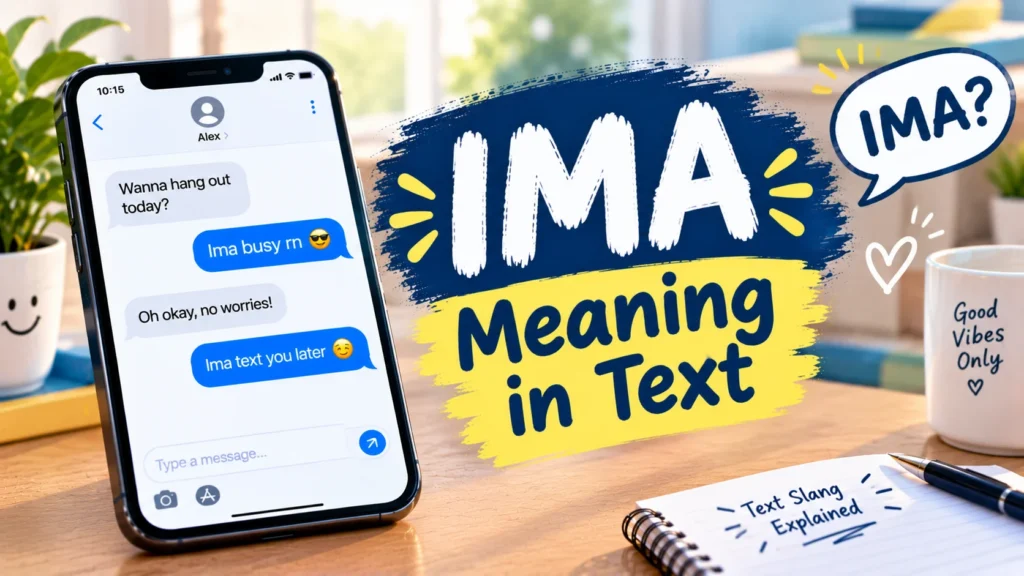
If you have seen “IMA” in a text message, social media comment, or online conversation, you might wonder what it means. Texting slang often uses shortened words and phrases to help people communicate quickly, and IMA is one abbreviation you may encounter in casual chats.
IMA usually means “I’ma,” a casual shortened form of “I’m going to.” People use it to talk about something they plan to do, intend to do, or are about to do. The expression is especially common in informal conversations, social media posts, and everyday speech.
For example, someone might text, “IMA go to sleep,” meaning “I’m going to go to sleep.”
In this guide, you’ll learn what IMA means in text, how people use it on social media, how to interpret it in different conversations, and how to reply when someone sends it to you.
What Does IMA Mean in Text?
In texting, IMA commonly represents “I’ma,” meaning “I’m going to.” It is an informal expression used to describe an intention, plan, or upcoming action.
People often use IMA because it is short, casual, and easy to type. It reflects the way many people speak in everyday conversations.
Here are a few examples:
- “IMA call you later.”
- “IMA get some food.”
- “IMA finish this tonight.”
- “IMA take a break.”
These messages communicate what the sender intends to do.
Although IMA is often written in capital letters, you may also see it as “ima” or “I’ma.” The spelling can vary depending on the person’s typing style.
What Does IMA Stand For?
In casual texting, IMA is generally a written form of the spoken expression “I’ma,” which means “I’m going to.”
For example:
- IMA leave means “I’m going to leave.”
- IMA text you means “I’m going to text you.”
- IMA try again means “I’m going to try again.”
- IMA tell you later means “I’m going to tell you later.”
The exact sentence may need a small grammatical adjustment when expanded into standard English, but the main idea is an intended or upcoming action.
IMA is informal, so it is most suitable for conversations with friends, family, or people who are comfortable with casual language.
Read More : ICL Meaning in Text: What Does ICL Mean in Chat?
How Is IMA Used in Text Messages?
People use IMA in several situations, including making plans, expressing intentions, joking with friends, and explaining what they are about to do.
1. To Talk About Future Plans
One of the most common uses of IMA is to tell someone what you plan to do.
Example:
“IMA visit my cousin this weekend.”
This means the person intends to visit their cousin during the weekend.
2. To Make a Promise or Commitment
Someone may use IMA when they want to communicate an intention to complete something.
Example:
“IMA finish the assignment before dinner.”
The sender is saying they plan to finish the assignment before dinner.
Keep in mind that IMA communicates an intention; it does not guarantee that the action will happen.
3. To Express Excitement
IMA can make a message sound enthusiastic when someone is looking forward to an activity.
Example:
“IMA finally watch that movie tonight!”
The sender is expressing a plan and excitement about watching the movie.
4. To Make a Joke
Friends sometimes use IMA in playful or exaggerated statements.
Example:
“IMA eat this whole pizza myself 😂”
The person may be joking about how much pizza they want to eat.
5. To Express Frustration
IMA can also introduce a statement made when someone is frustrated or annoyed.
Example:
“IMA log off if this game keeps lagging.”
The sender is saying they intend to leave the game if the problem continues.
The emotional tone comes from the rest of the message, not from IMA itself.
What Does IMA Mean on Snapchat?
On Snapchat, IMA usually means “I’ma,” or “I’m going to.” People use it in private messages, replies to stories, and conversations with friends.
For example:
- “IMA send you the picture.”
- “IMA sleep now.”
- “IMA reply when I get home.”
- “IMA post that later.”
In each example, the sender is describing a planned action.
Because Snapchat conversations are usually informal, abbreviations like IMA fit naturally into quick messages. However, the exact meaning should still be interpreted from the surrounding sentence.
What Does IMA Mean on TikTok?
On TikTok, IMA may appear in video captions, comments, text overlays, and conversations about trending topics.
Creators and viewers often use casual expressions to make their posts feel conversational or humorous.
For example:
- “IMA try this trend.”
- “IMA watch the whole series tonight.”
- “IMA pretend I didn’t see that.”
- “IMA learn this dance.”
In these examples, IMA introduces an intention or planned action.
You may also see the expression in memes, song-related discussions, and comments written in a conversational style.
What Does IMA Mean on Instagram?
On Instagram, IMA is commonly used in direct messages, comments, captions, and replies to stories.
Its meaning usually remains “I’ma,” or “I’m going to.”
For example:
In a direct message: “IMA call you after work.”
In a comment: “IMA try this recipe.”
In a conversation about plans: “IMA be there in ten minutes.”
The abbreviation makes the message casual and direct. If you are communicating with someone who does not use texting slang, writing the full phrase may be clearer.
What Does IMA Mean From a Girl?
If a girl texts you IMA, she is usually saying that she intends to do something. The meaning depends on the words that follow the abbreviation.
For example:
- “IMA text you later.” — She intends to message you later.
- “IMA come see you.” — She plans to visit you.
- “IMA tell you something.” — She intends to share something with you.
- “IMA go to bed.” — She is saying she plans to sleep.
IMA does not automatically mean that a girl is flirting. It is generally a casual expression of intention. To understand her feelings, consider the full message and the wider conversation.
What Does IMA Mean From a Guy?
When a guy uses IMA, he is usually describing something he plans to do.
For example:
- “IMA call you tomorrow.”
- “IMA fix it later.”
- “IMA join the game.”
- “IMA get some rest.”
The abbreviation does not have a special meaning based on gender. A guy and a girl can use it in the same way.
If a guy texts, “IMA come see you,” he is expressing an intention to visit. Whether the message has a romantic meaning depends on the relationship and the surrounding conversation.
Is IMA Positive or Negative?
IMA is neither inherently positive nor negative. It is a casual way to express an intention, and the tone depends on the complete sentence.
| Example | Tone | Meaning |
|---|---|---|
| “IMA help you.” | Positive | The sender intends to help. |
| “IMA get some food.” | Neutral | The sender plans to eat. |
| “IMA leave this group.” | Negative or serious | The sender intends to leave. |
| “IMA win this game.” | Confident | The sender expects to try to win. |
| “IMA call you later.” | Friendly | The sender plans to call. |
When interpreting IMA, pay attention to the action being described rather than assuming the abbreviation carries a particular emotion.
IMA vs. IMMA: What’s the Difference?
IMA and IMMA are informal spellings of a similar expression. Both are commonly used to represent “I’ma,” meaning “I’m going to.”
Examples:
- “IMA call you later.”
- “IMMA call you later.”
Both generally communicate the same intention.
The difference is mainly spelling and personal typing preference. Some people prefer IMA, while others use IMMA or “I’ma.”
Neither spelling is especially appropriate for formal writing, where “I am going to” or “I’m going to” is clearer.
IMA vs. GONNA: What’s the Difference?
IMA and GONNA can express similar intentions, but they are not identical in form.
- IMA: A casual written form of “I’ma,” meaning “I’m going to.”
- GONNA: An informal spelling of “going to,” commonly used in speech and casual writing.
Examples:
“IMA call you tonight.”
“I’m gonna call you tonight.”
Both messages express an intention to call someone that evening.
GONNA is more widely recognized in general informal English, while IMA reflects a particular conversational style and is especially common in some varieties of spoken English and online slang.
IMA vs. IDK: What’s the Difference?
IMA and IDK have completely different meanings.
| Abbreviation | Meaning | Example |
|---|---|---|
| IMA | I’ma / I’m going to | “IMA leave soon.” |
| IDK | I don’t know | “IDK where he went.” |
IMA expresses an intention, while IDK communicates uncertainty or a lack of knowledge.
Understanding the difference helps you interpret short messages without confusing what the sender plans to do with what they do not know.
How Do You Reply to IMA in Text?
Your response depends on what the person says they intend to do.
If Someone Says They Will Call You
Them: “IMA call you later.”
You: “Okay, talk to you then!”
If Someone Says They Are Going to Sleep
Them: “IMA sleep now.”
You: “Good night! Sleep well.”
If Someone Says They Are Coming Over
Them: “IMA come by later.”
You: “Sounds good. Let me know when you’re on your way.”
If Someone Says They Will Do Something Helpful
Them: “IMA help you with that.”
You: “Thank you! I appreciate it.”
If Someone Is Joking
Them: “IMA eat all the snacks 😂”
You: “Save some for me!”
You do not need a special reply to IMA itself. Respond naturally to the action or plan described in the message.
Is IMA Formal or Informal?
IMA is informal and is mainly used in texting, social media, and everyday conversations.
It may be suitable when chatting with friends, relatives, or people who are familiar with your communication style. However, it is usually best to avoid IMA in formal emails, academic assignments, business reports, and professional documents.
For example:
Informal: “IMA send you the file tonight.”
Formal: “I will send you the file tonight.”
The second version is more suitable for a professional situation because it uses standard written English.
Can IMA Have Other Meanings?
Yes. Although IMA commonly represents “I’ma” in casual texting, the letters IMA can also be an acronym or abbreviation in other contexts.
For example, IMA is used by some professional organizations and groups as part of their names. Its meaning may therefore differ in a business, educational, medical, or technical discussion.
If you see IMA in a sentence about someone’s plans, the texting interpretation is likely. If you encounter it in an official document or specialized conversation, consider whether it refers to an organization or technical term instead.
Common Mistakes When Understanding IMA
Even familiar texting expressions can be misunderstood. Here are a few mistakes to avoid.
Assuming IMA Is Always an Official Acronym
In casual texting, IMA is generally a spelling of “I’ma,” rather than an acronym with a separate full form.
Thinking It Always Expresses a Promise
IMA communicates an intention, but the person may change their mind or be unable to complete the action.
Confusing IMA With IDK
IMA expresses what someone intends to do, while IDK means “I don’t know.” They serve different purposes in a conversation.
Using It in Formal Writing
Although IMA is common in informal messages, standard phrases such as “I’m going to” are usually clearer in professional communication.
Frequently Asked Questions
What does IMA mean in text messages?
IMA usually means “I’ma,” a casual way of saying “I’m going to.” It is used to describe an intended or upcoming action.
What does IMA stand for in slang?
In casual texting, IMA represents “I’ma,” meaning “I’m going to.” For example, “IMA call you” means “I’m going to call you.”
What does IMA mean on Snapchat?
On Snapchat, IMA generally means “I’ma.” People use it in chats and messages to tell someone what they plan to do.
What does IMA mean on TikTok?
On TikTok, IMA usually expresses an intention or planned action. It can appear in captions, comments, and informal discussions.
Is IMA the same as IMMA?
They generally have the same meaning in informal texting. Both are used to represent “I’ma,” meaning “I’m going to.”
Is IMA grammatically correct?
IMA is informal slang rather than standard written English. In formal writing, “I’m going to” is generally the better choice.
Does IMA mean the same thing from a girl or a guy?
Yes. The abbreviation generally has the same meaning regardless of who uses it. The rest of the message determines what the person intends to communicate.
Can I use IMA in a professional message?
It is better to use standard wording in professional communication. Instead of “IMA send it tomorrow,” write “I will send it tomorrow.”
Final Thoughts
IMA usually means “I’ma,” or “I’m going to,” in text messages and online conversations. People use it to talk about their plans, express intentions, and communicate casually with friends.
You may encounter it on Snapchat, TikTok, Instagram, and other messaging platforms. Its meaning is generally easy to understand when you read the complete sentence.
Remember that IMA is informal, so it works best in casual conversations. When writing professionally, use standard expressions such as “I’m going to” or “I will” to make your message clear.
Once you recognize this abbreviation, you can understand it more easily and follow everyday texting conversations with confidence.
1 thought on “What Does IMA Mean in Text? Meaning & Examples”