
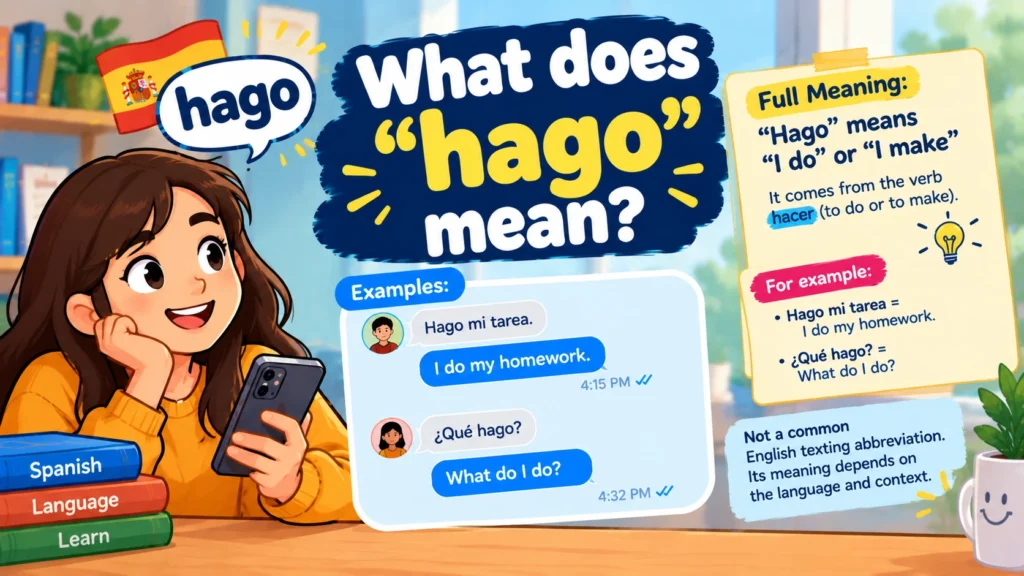
Have you seen HAGO in a text message, social media comment, or online conversation and wondered what it means? Short words and abbreviations can be confusing, especially when the same combination of letters has different meanings in different languages.
The meaning of HAGO depends on the context. In Spanish, “hago” means “I do” or “I make.” In English texting and internet slang, however, HAGO does not have one widely recognized, standard meaning.
Understanding the surrounding sentence can help you figure out what someone intended. In this guide, you will learn the Spanish meaning of HAGO, how it may appear in digital conversations, and how to respond when you encounter it.
HAGO Meaning: Quick Explanation
HAGO is a word whose meaning changes depending on the language and situation.
Here are the main points to remember:
- In Spanish: “Hago” means “I do” or “I make.”
- In English texting: HAGO has no universally accepted slang definition.
- In online communities: It may be a personal abbreviation, username, acronym, or typo.
- In everyday conversation: The words around HAGO usually provide the strongest clue.
For example, a Spanish speaker might write, “Hago ejercicio todos los días,” meaning “I exercise every day.”
By contrast, if someone sends “HAGO?” in an English-language chat, you may need to ask what they mean. It could be an abbreviation specific to their friend group rather than a common texting expression.
Example 1
Person A: “¿Qué haces después de clase?”
Person B: “Hago mi tarea.”
Meaning: “I do my homework.”
Example 2
Person A: “What does HAGO mean?”
Person B: “Where did you see it? It might depend on the conversation.”
Meaning: The person needs more context to interpret the letters accurately.
Example 3
Person A: “HAGO is in someone’s username.”
Person B: “It could be a personal name or abbreviation.”
Meaning: The letters may not be intended as slang at all.
Origin and Background of HAGO
The Spanish Language Connection
The clearest established meaning of hago comes from Spanish. It is a form of the verb hacer, which means “to do” or “to make.”
Spanish speakers use hago when talking about an action they perform. It appears in everyday sentences about school, work, hobbies, chores, and personal routines.
For example:
- “Hago café” means “I make coffee.”
- “Hago deporte” means “I play sports” or “I exercise.”
- “Hago mi trabajo” means “I do my work.”
The exact English translation depends on the sentence. Spanish does not always match English word for word, so the surrounding words matter.
How HAGO Appears Online
Digital communication encourages people to shorten words, use initials, and invent expressions for their own communities. As a result, a combination of letters can have one meaning in a particular group and a completely different meaning elsewhere.
HAGO may appear in gaming chats, social media usernames, comments, or private messages. However, its appearance online does not establish a universal slang definition.
Unlike familiar abbreviations such as LOL (“laughing out loud”) or IDK (“I don’t know”), HAGO does not have one broadly established English texting meaning.
The Influence of Social Media
Platforms such as TikTok, Instagram, Snapchat, and WhatsApp bring people from different languages and backgrounds into the same conversations.
A Spanish word might appear in an English conversation, while a private group may create its own abbreviation. That mixture can make short expressions difficult to interpret without context.
The best approach is to examine the complete message rather than assume that every unfamiliar combination of letters is internet slang.
Read More : WBY Full Form in Text: Meaning and Examples
Real-Life Conversations: How HAGO Might Be Used
The following examples illustrate how HAGO could appear in different situations. They are examples of possible conversations, not evidence that HAGO has a standard English slang meaning.
Example 1: WhatsApp Conversation
Person A: “What are you doing this afternoon?”
Person B: “Hago mi tarea primero, then I’ll call you.”
and,
Person A: “Oh, you’re doing your homework first?”
Person B: “Yes, exactly!”
Here, the Spanish word hago means “I do.” The speaker is mixing Spanish and English in a casual conversation.
Example 2: Instagram Direct Messages
Person A: “I saw HAGO in your bio. What does it mean?”
Person B: “It’s an abbreviation I use with my friends.”
and,
Person A: “Oh, I thought it was a common slang word.”
moreover,
Person B: “No, it’s just our thing.”
This example shows why it is important not to assume that a word in someone’s profile has a universal meaning.
Example 3: TikTok Comments
Person A: “Someone commented HAGO on my video. Is that slang?”
Person B: “Maybe, but it depends on the person and the video.”
and,
Person A: “Should I reply?”
moreover,
Person B: “You can ask what they meant if you’re curious.”
The commenter could be using a personal expression, another language, or an abbreviation specific to a community. More information is needed to identify the intended meaning.
Example 4: Text Message Between Friends
Person A: “You sent me HAGO. What does that mean?”
Person B: “Sorry, I meant to type something else.”
Person A: “No worries. I couldn’t figure it out.”
Person B: “I’ll send the full message again.”
Sometimes, unfamiliar text is simply a typing mistake. Asking politely is often easier than guessing.
Emotional and Psychological Meaning of HAGO
HAGO does not have a confirmed, universal emotional meaning in English texting. Whether it communicates excitement, confusion, agreement, or something else depends on the person using it and the surrounding message.
This is an important part of digital communication: the same letters do not automatically communicate the same emotion to every reader.
Why People Use Unfamiliar Abbreviations
People often create shortened expressions because they want to communicate quickly or share an inside joke. A familiar abbreviation can also make a conversation feel more personal.
In other cases, a short message may reflect a language difference, a typo, or a community-specific phrase. The letters alone cannot reliably tell you which explanation is correct.
A Realistic Scenario
Imagine receiving “HAGO” from a new friend. You search for its meaning but find several possible explanations.
Rather than assuming the message is rude or meaningful in a particular way, you reply, “Hey, what does HAGO mean here?”
Your friend explains the intended meaning, and the conversation continues without unnecessary confusion.
This simple response demonstrates a useful communication habit: ask for clarification before assigning an emotion or intention to an unfamiliar message.
HAGO in Different Contexts
HAGO on Social Media
On TikTok, Instagram, or other social platforms, HAGO might appear in a caption, comment, hashtag, or profile description.
Its meaning may depend on the creator’s language, the subject of the post, or the community following the account. If there is no clear clue, asking the creator is more reliable than relying on an unsupported definition.
HAGO Between Friends and Relationships
Friends sometimes develop their own abbreviations and expressions. A phrase that makes perfect sense to one group may be unfamiliar to everyone outside it.
If someone close to you uses HAGO, consider whether it has a personal meaning in your relationship. You can ask directly without making the conversation awkward.
HAGO in Work or Professional Settings
Avoid using HAGO in formal emails, workplace reports, or professional messages unless your team has explicitly defined it.
Because the abbreviation is ambiguous, readers may not understand what you intend. Clear wording is especially important when discussing instructions, deadlines, responsibilities, or other work-related matters.
Casual Versus Serious Communication
In a casual chat, asking about an unfamiliar abbreviation is usually enough. In a serious conversation, write the full phrase or ask for clarification before acting on the message.
The goal is not to avoid all abbreviations. It is to use language that your intended reader can understand.
When Not to Use HAGO
Since HAGO does not have a widely accepted English texting definition, using it without explanation can create confusion.
Consider avoiding it in these situations:
- Formal communication: Use complete words in professional messages.
- Important instructions: Never rely on an unclear abbreviation for safety-related or time-sensitive information.
- Conversations with strangers: The other person may not recognize your intended meaning.
- Multilingual conversations: Do not assume that everyone understands the Spanish word hago.
- Public posts: If your message depends on a specific interpretation, explain it clearly.
Cultural sensitivity matters, too. A word that is ordinary in one language may be unfamiliar to someone who speaks another language. There is no need to treat that difference as a mistake.
Common Misunderstandings About HAGO
Assuming HAGO Has One Official Slang Meaning
A common mistake is to believe every online abbreviation has a fixed definition. HAGO does not have one widely recognized English texting meaning, so a confident interpretation without context may be misleading.
Confusing Spanish With English Slang
In Spanish, hago is a regular verb form meaning “I do” or “I make.” That established meaning should not automatically be transferred to an English-language chat.
Assuming It Is a Typo
HAGO could be a typing error in some situations, but it may also be intentional. Without seeing the original message, there is no reliable way to determine which explanation applies.
Reading Emotion Into Capital Letters
Uppercase letters can be used for emphasis, usernames, abbreviations, or simple typing preferences. HAGO in capital letters does not necessarily indicate anger, excitement, or shouting.
Treating Every Online Explanation as Reliable
Slang websites and social media posts sometimes repeat unverified definitions. When a term has no established meaning, the safest interpretation is the one supported by the actual conversation.
HAGO Compared With Similar Words and Abbreviations
| Word or abbreviation | Meaning | How it differs from HAGO |
|---|---|---|
| HAGO | Context-dependent in English; “I do” or “I make” in Spanish | Its English slang meaning is not standardized |
| IDK | I don’t know | A widely recognized texting abbreviation |
| IMO | In my opinion | Introduces a personal view |
| HBU | How about you? | Commonly asks for another person’s response |
| WYD | What are you doing? | Asks about someone’s current activity |
| LOL | Laughing out loud | Often expresses amusement or a lighthearted tone |
| HAGO in Spanish | I do or I make | A normal Spanish verb form rather than English texting slang |
Key Insight
The main difference is that expressions such as IDK, IMO, and WYD have familiar meanings in English digital communication. HAGO needs more context unless it is clearly being used as the Spanish word hago.
Variations and Types of HAGO
Because HAGO has no universal English slang definition, the following examples describe different ways the letters might appear. They should not be treated as confirmed expansions of the acronym.
- HAGO in Spanish: Means “I do” or “I make,” depending on the sentence.
- HAGO in a username: May be a personal identifier, nickname, or chosen combination of letters.
- HAGO in a group chat: Could be an abbreviation that members of the group understand.
- HAGO in a gaming chat: May be a community-specific term or a typo.
- HAGO in an Instagram bio: Could represent a personal phrase, name, or private reference.
- HAGO in a TikTok comment: Its meaning may depend on the video’s language and subject.
- HAGO in a WhatsApp message: May reflect multilingual conversation or an unclear abbreviation.
- HAGO in a caption: Could be part of a Spanish sentence or a personal expression.
- HAGO as a typing mistake: May result from an unintended combination of letters.
- HAGO as a private acronym: Could stand for a phrase known only to the people who use it.
These examples illustrate possibilities, not verified dictionary definitions. The original message is essential when trying to identify a specific meaning.
How to Respond When Someone Uses HAGO
If someone sends HAGO and you cannot understand it, you do not need to guess. A short, friendly question is usually the best response.
Casual Replies
- “What does HAGO mean?”
- “Wait, what do you mean by HAGO?”
- “Can you explain that?”
- “I haven’t seen that abbreviation before.”
Funny Replies
- “My slang dictionary needs an update!”
- “I need a translation for this one.”
- “You can’t just drop four letters and disappear!”
Use humorous responses only when you know the other person will understand your tone.
Mature Replies
- “Could you clarify what HAGO means in this context?”
- “I’m not familiar with that abbreviation. What did you mean?”
- “I want to make sure I understand your message correctly.”
Respectful Replies
- “Is that a Spanish word or an abbreviation?”
- “Could you tell me what it means?”
- “I may be missing the context. Can you explain?”
These responses show curiosity without judging the sender’s language or communication style.
Regional and Cultural Usage of HAGO
Western Culture
In English-speaking communities in North America and Europe, HAGO is not a standard texting abbreviation with one broadly accepted definition.
People may still use it as a personal acronym or recognize it from a particular online community. Its meaning depends on the context rather than a universal Western convention.
Asian Culture
Many Asian countries have multilingual online communities where English abbreviations appear alongside local languages. HAGO might be encountered in an international conversation, but there is no single Asian interpretation that applies across countries and languages.
The sender’s language and the conversation’s subject are more useful clues than geography alone.
Middle Eastern Culture
English is used alongside Arabic and other languages in many digital conversations across the Middle East. A short expression such as HAGO may be unfamiliar or community-specific.
It is best not to assume that everyone in the region uses the same texting vocabulary.
Global Internet Usage
The internet brings together people who speak different languages and belong to different online communities. This creates opportunities for expressions to spread, but it also makes context more important.
A word with a clear meaning in Spanish may have no established meaning as English slang. Checking the original sentence can prevent confusion.
Gen Z Versus Millennials
Gen Z and Millennials both use abbreviations, memes, and informal expressions online. Their preferred slang may differ by platform, friendship group, and personal habits.
However, there is no reliable basis for assigning HAGO one meaning for Gen Z and another for Millennials. Neither age group should be assumed to understand it without context.
Is HAGO Safe for Kids?
HAGO is not inherently inappropriate based on its established Spanish meaning. In Spanish, it simply means “I do” or “I make.”
If a child encounters HAGO online, the important question is how the letters are being used in that particular conversation. An unfamiliar abbreviation may be harmless, but the surrounding content still matters.
Parents and teachers can encourage children to ask what unfamiliar words mean rather than guessing. They should also remind children not to share personal information or respond to uncomfortable messages from strangers.
The best approach is age-appropriate digital literacy: understand the context, check the source, and ask a trusted adult when something seems confusing or concerning.
Frequently Asked Questions About HAGO
What does HAGO mean in text messages?
HAGO has no widely accepted, standard meaning in English texting. It may be a personal abbreviation, a typo, or a term specific to a particular conversation.
What does HAGO mean in Spanish?
In Spanish, hago means “I do” or “I make.” It is the first-person singular present-tense form of the verb hacer.
Is HAGO a popular texting abbreviation?
HAGO is not as widely established as common abbreviations such as IDK, LOL, or IMO. Its meaning in a particular message needs to be interpreted from context.
What does HAGO mean on Instagram?
On Instagram, HAGO may be a personal acronym, username element, Spanish word, or context-specific expression. The caption, profile, or conversation may provide useful clues.
Does HAGO mean the same thing on TikTok and WhatsApp?
Not necessarily. The letters may be used differently by individual users or communities. The platform alone is not enough to determine the intended meaning.
How should I reply when someone texts HAGO?
Ask politely what the sender means. You could write, “What does HAGO mean here?” This avoids confusion and gives the person a chance to explain.
Is HAGO an abbreviation with a confirmed full form?
There is no single, widely recognized English full form for HAGO. Any proposed expansion should be checked against the original context rather than accepted as a universal definition.
Conclusion
HAGO is a good example of why context matters in modern communication. Its established Spanish meaning is “I do” or “I make,” while its use as English texting slang does not have one universally accepted definition.
When you see HAGO in a message, look at the surrounding words, consider the sender’s language, and ask for clarification if necessary. A quick question is often more useful than an uncertain guess.
Understanding online language is not about memorizing every combination of letters. It is about recognizing familiar expressions, respecting language differences, and communicating clearly when something is unfamiliar.



1 thought on “What Does HAGO Mean? Texting and Spanish Explained”