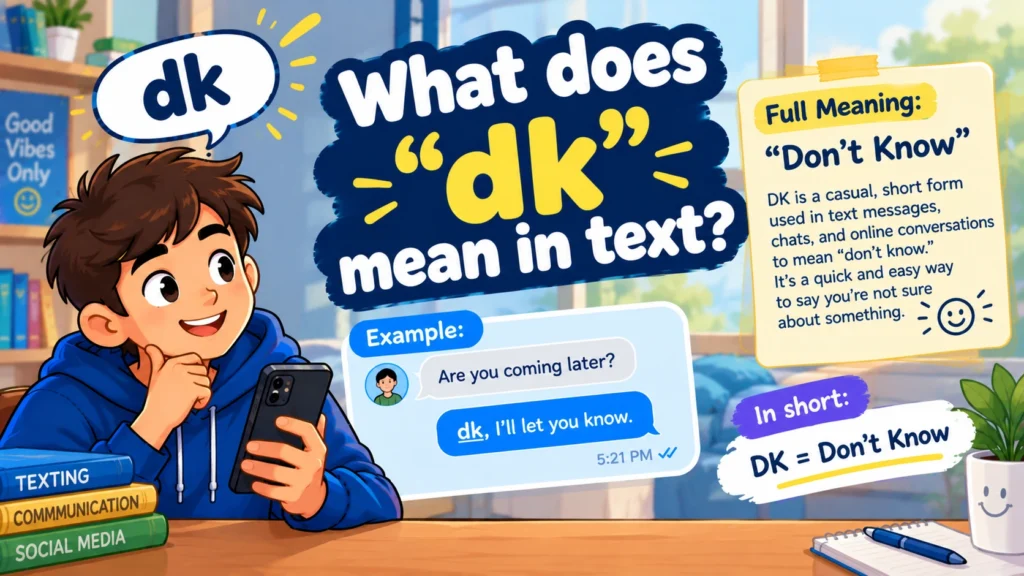
Have you ever received a message that simply says “DK” and wondered what the other person meant? Short texting abbreviations can make everyday conversations confusing, especially when the same letters appear in different situations.
In most casual text conversations, DK means “Don’t Know.” People use it when they are unsure about something, do not have an answer, or do not have enough information to respond confidently.
For example, if you ask a friend, “What time does the movie start?” and they reply, “DK, check the website,” they are telling you that they do not know the answer.
You may see DK on WhatsApp, Instagram, Snapchat, TikTok, gaming chats, and ordinary text messages. Understanding its meaning can help you interpret messages correctly and respond without unnecessary confusion.
What Does DK Mean in Text?
DK usually stands for “Don’t Know.” It is an informal abbreviation used in digital communication when someone wants to express uncertainty or explain that they lack information.
Instead of typing the complete phrase, people use two letters to keep their messages short.
Here are a few examples:
- “DK what we’re doing tonight.” — The sender does not know the plans.
- “DK, maybe ask Sarah.” — The sender is unsure and suggests asking someone else.
- “DK yet, I’ll let you know.” — The sender has not found out but may provide an answer later.
The abbreviation is usually straightforward, although the tone depends on the conversation. A short “DK” might be a neutral answer, a casual response between friends, or a sign that someone does not want to explain further.
What Does DK Stand For?
DK stands for “Don’t Know.” The letters represent the initial sounds or letters of the two words:
- D = Don’t
- K = Know
It is commonly used in informal messaging, where people prefer quick replies over complete sentences.
For example, someone might ask, “Are we meeting at 6?” and receive the response, “DK yet.” The sender means that the meeting time has not been confirmed.
Is DK the Same as IDK?
DK and IDK are closely related, but IDK is generally the more widely recognized texting abbreviation.
- DK: Don’t Know
- IDK: I Don’t Know
Both communicate uncertainty. However, IDK explicitly includes “I,” making it a more complete shorthand expression.
For example:
Person A: “Who won the game?”
Person B: “IDK.”
Person B could also reply “DK,” particularly in a very casual conversation. The intended meaning would usually be clear from context.
Origin and Background of DK
DK developed within the broader culture of abbreviated digital communication. As text messaging, online chat rooms, and instant messaging became popular, users began shortening everyday phrases to communicate quickly.
Expressions such as LOL, BRB, IDK, and IMO became familiar parts of online language. They allowed people to express reactions, uncertainty, or intentions without typing entire sentences.
DK follows the same general pattern. However, it is less standardized than IDK, which is widely recognized as the abbreviation for “I Don’t Know.”
How Social Media Influenced DK
Social media platforms encourage quick exchanges. People often reply to stories, videos, questions, and group messages with only a few words.
In that environment, DK can be a convenient response when someone does not have an answer.
For example, a friend might ask in a group chat, “Who’s bringing snacks tomorrow?” Another person could reply, “DK, ask the others.”
The meaning is easy to understand because the question provides the necessary context.
Why People Still Use Short Abbreviations
Even though modern keyboards make typing easier, people continue using abbreviations because they fit the informal rhythm of online conversations.
A short response can be practical when someone is busy or answering several messages at once. Still, brevity does not always communicate emotion clearly, which is why context matters.
Read More :IMO Meaning in Text: What It Means and How to Use It
Real-Life Conversations Using DK
Here are four realistic examples showing how DK might appear in everyday digital conversations.
1. WhatsApp Conversation Between Friends
Person A: Are we going out after class?
Person B: DK yet. I need to finish my assignment.
Person A: No worries. Let me know when you’re free.
Person B: Sure, I’ll message you later.
In this example, DK communicates uncertainty about the plans. The sender is not necessarily rejecting the invitation; they simply have not decided yet.
2. Instagram DM About a New Trend
Person A: Do you know the name of this song?
Person B: DK, but it sounds familiar.
Person A: I’ll check the comments.
Person B: Good idea!
Here, DK is a quick way to say that the person does not know the song’s name.
3. Snapchat Conversation About Weekend Plans
Person A: Are you coming to the party on Saturday?
Person B: DK yet 😭
Person A: You should come! Everyone will be there.
Person B: I’ll see if I’m free.
The abbreviation shows that the decision has not been made. The emoji adds an emotional or playful touch, but the exact feeling depends on the sender.
4. Text Message Between Classmates
Person A: When is the science project due?
Person B: DK. I missed the last class.
Person A: I’ll ask the teacher tomorrow.
Person B: Thanks, please tell me when you find out.
This conversation shows that DK can be used when someone lacks information rather than when they are unwilling to answer.
Emotional and Psychological Meaning of DK
Although DK literally means “Don’t Know,” its emotional meaning can vary. It may communicate honest uncertainty, a desire to keep a response short, or hesitation about making a decision.
DK Can Express Uncertainty
Someone may use DK when they genuinely do not have the information needed to answer a question.
For instance, if you ask a friend whether a restaurant is open, they might reply, “DK, I’ve never been there.”
This is a straightforward expression of limited knowledge.
DK Can Show Hesitation
In conversations about future plans, DK may indicate that someone has not decided yet.
“DK if I can make it tonight” means the person is unsure whether they will be available.
However, it does not automatically mean they are avoiding you. They may simply have other commitments or need more time to decide.
DK Can Sound Brief or Dismissive
A reply consisting only of “DK” may feel abrupt, particularly if the question is important to the person asking it.
That does not necessarily mean the sender is angry. They might be busy, distracted, or accustomed to short messages.
A Realistic Personal-Style Scenario
Imagine asking a friend whether they can attend an important event. They reply, “DK yet.”
It would be easy to assume that they are not interested, especially if you need an answer quickly. A more helpful approach is to ask, “No problem. Could you let me know by tomorrow?”
This gives the other person room to decide while helping you make your own plans.
DK Usage in Different Contexts
DK on Social Media
On TikTok, Instagram, Snapchat, and Facebook, DK may appear in comments, direct messages, and casual discussions.
Example: “DK who made this video, but it’s hilarious.”
The abbreviation tells readers that the user does not know the creator’s identity.
DK Between Friends and Relationships
Friends may use DK when discussing plans, sharing information, or answering everyday questions.
For example: “DK what to wear tonight. Any suggestions?”
In a romantic conversation, DK has the same basic meaning. It does not automatically indicate disinterest, annoyance, or hidden feelings.
DK in Work and Professional Settings
DK is generally better suited to casual workplace chats than formal emails.
Instead of writing “DK when the report is due,” a professional message could say, “I’m not sure when the report is due. I’ll confirm the deadline.”
The complete sentence sounds clearer and provides a more useful response.
Casual vs. Serious Conversations
In casual chats, DK can be perfectly natural. During serious discussions, it may be helpful to explain what you do not know and whether you can find out.
For example, “I’m not sure yet, but I’ll check and get back to you” is more reassuring than a bare abbreviation when the information matters.
When Not to Use DK
DK is useful in casual messaging, but there are situations where a more complete response is preferable.
- Formal emails: Write “I don’t know” or explain what information is missing.
- Workplace decisions: If a colleague needs an answer, explain whether you can confirm it.
- Sensitive conversations: A brief DK may sound uncaring when someone is asking for support.
- Important arrangements: Provide an estimated response time if you need to check your schedule.
- Conversations with unfamiliar people: They may not recognize the abbreviation.
DK is not inherently rude or inappropriate. Its suitability depends on the audience, topic, and amount of information the other person needs.
Common Misunderstandings About DK
1. Thinking DK Always Means Disinterest
DK usually means “Don’t Know.” It does not automatically mean the sender is bored, annoyed, or uninterested in the conversation.
Look at the surrounding messages before interpreting the person’s attitude.
2. Confusing DK With IDK
Both expressions communicate a lack of knowledge. IDK explicitly means “I Don’t Know” and is more widely established in internet slang.
DK is a shorter alternative that may be understood from context.
3. Assuming DK Is Always Rude
A brief response can sometimes feel blunt, but DK is not inherently disrespectful.
For example, “DK, sorry!” may sound friendly, while “DK.” in a tense conversation might feel less welcoming. Punctuation and context influence how messages are interpreted.
4. Thinking DK Means Someone Refuses to Answer
Not knowing an answer is different from refusing to provide one.
If the sender says, “DK, I’ll ask and let you know,” they are indicating that they may be able to find the answer later.
5. Confusing DK With Other Abbreviations
DK can have different meanings in specialized settings, including gaming, technical discussions, or names and labels. In ordinary texting, however, “Don’t Know” is a common interpretation.
DK vs. Similar Texting Abbreviations
| Abbreviation | Full Form | Common Use |
|---|---|---|
| DK | Don’t Know | Expressing uncertainty |
| IDK | I Don’t Know | Saying you lack an answer |
| IDC | I Don’t Care | Expressing a lack of concern |
| IMO | In My Opinion | Sharing a personal view |
| TBH | To Be Honest | Introducing a candid statement |
| NVM | Never Mind | Withdrawing or dismissing a request |
| WYD | What You Doing? | Asking about someone’s activity |
| WBU | What About You? | Returning a question |
Key Insight
DK and IDK are closely related because both express a lack of knowledge. IDC is different because it communicates a lack of concern rather than uncertainty. Understanding these distinctions can prevent confusion when a conversation moves quickly.
Variations and Types of DK
DK may appear in several informal writing styles. These examples show common ways the abbreviation can fit into a sentence.
- DK — The basic abbreviation for “Don’t Know.”
- dk — The lowercase version often used in casual chats.
- DK yet — Indicates that the answer or decision is not known at the moment.
- DK why — Means the person does not know the reason.
- DK how — Expresses uncertainty about how something works or should be done.
- DK what to do — Shows that the person is unsure how to respond to a situation.
- DK lol — Adds a playful or casual tone to an expression of uncertainty.
- DK tbh — Combines “Don’t Know” with “To Be Honest.”
- IDK — A more established alternative meaning “I Don’t Know.”
- I honestly don’t know — A complete phrase suitable when clarity matters.
These are informal examples rather than separate official definitions. The surrounding sentence helps establish what the sender means.
How to Respond When Someone Uses DK
The best reply depends on the question you asked and whether you need the information urgently.
Casual Replies
If the conversation is relaxed, you can respond with:
- “Okay, no worries!”
- “Same, I have no idea either.”
- “Let me check.”
- “All good, I’ll ask someone else.”
Funny Replies
If you are joking with a friend, try:
- “We’re both clueless 😂”
- “Mystery of the century!”
- “Google might save us.”
- “Guess we’ll find out!”
Keep the tone playful only when you know the other person is comfortable with jokes.
Mature Replies
When the answer matters, a practical response is more useful:
- “That’s okay. Could you find out?”
- “No problem. Let me know when you know.”
- “I’ll check with someone who might know.”
- “Thanks for being honest.”
Respectful Replies
If the person seems uncertain about a personal decision, give them time instead of pressuring them.
For example: “That’s fine. Take your time and let me know when you’ve decided.”
A thoughtful response acknowledges their uncertainty while keeping communication open.
Regional and Cultural Usage of DK
Texting abbreviations are used across countries, but familiarity varies by language, age, and online community. DK is generally understandable in English-language chats when the context makes its meaning clear.
Western Culture
In the United States, the United Kingdom, Canada, and Australia, people frequently use abbreviations such as IDK, IMO, and BRB in casual digital conversations.
DK may also appear, although IDK is generally more recognizable.
Asian Culture
In Asian countries where English is used for online communication, DK may appear in messages between friends, classmates, and gaming communities.
Some users mix English abbreviations with local languages, so the meaning depends on the conversation and the participants’ familiarity with internet slang.
Middle Eastern Culture
English texting abbreviations are used in some multilingual online communities across the Middle East. DK may be understood in English-language conversations, but not every person will use or recognize it.
Global Internet Usage
International social media makes it easier for abbreviations to spread between countries. Users may learn them from friends, videos, gaming communities, or online discussions.
Even so, full phrases remain useful when communicating with people who may not recognize a particular abbreviation.
Gen Z vs. Millennials
Both Gen Z and Millennials use texting abbreviations, including expressions for uncertainty. Some people prefer the shorter DK, while others consistently use IDK.
There is no strict age-based rule. Individual writing habits and social circles often determine which form someone prefers.
Is DK Safe for Kids?
Yes, DK is generally harmless texting slang. In ordinary messages, it usually means “Don’t Know” and does not contain inherently offensive or adult content.
Children can learn that abbreviations are informal shortcuts and that it is fine to ask for clarification when a message is confusing.
Parents and educators can also encourage children to communicate honestly. If they do not know an answer, they should not feel pressured to guess or share information they are unsure about.
As with any online communication, children should protect their personal information and speak to a trusted adult if a conversation makes them uncomfortable.
FAQs About DK Meaning in Text
What does DK mean in a text message?
DK usually means “Don’t Know.” It is an informal abbreviation used when someone does not know an answer or is unsure about something.
What does DK mean on Snapchat?
On Snapchat, DK generally means “Don’t Know” in casual conversations. The exact tone depends on the message and the relationship between the people chatting.
What is the difference between DK and IDK?
DK means “Don’t Know,” while IDK means “I Don’t Know.” Both express uncertainty, but IDK is the more widely recognized texting abbreviation.
Is DK rude in texting?
No, DK is not inherently rude. It can sound brief or blunt in some situations, but the sender’s tone and the surrounding conversation matter.
What does DK mean from a girl or a guy?
If someone texts DK, they usually mean they do not know the answer. The abbreviation alone does not reveal romantic feelings or personal intentions.
How should I reply when someone says DK?
You can respond with “No worries,” “Let me check,” or “Could you find out?” Choose a reply based on whether you need an answer or are simply continuing a casual conversation.
Is DK a common texting abbreviation?
DK is used in informal messages, but IDK is generally more widely recognized. Many people understand DK from context even if they do not use it themselves.
Conclusion
DK is a short texting abbreviation that usually means “Don’t Know.” It helps people express uncertainty quickly in everyday messages, social media conversations, and informal group chats.
Although its meaning is often clear from context, DK is less standardized than IDK. If you receive a message containing these letters, consider the surrounding conversation before deciding exactly what the sender intends.
Use DK when chatting casually with people who understand your writing style. For professional communication or important discussions, a complete sentence is usually the clearest choice.