Someone sends you information and you reply:
“IK.”
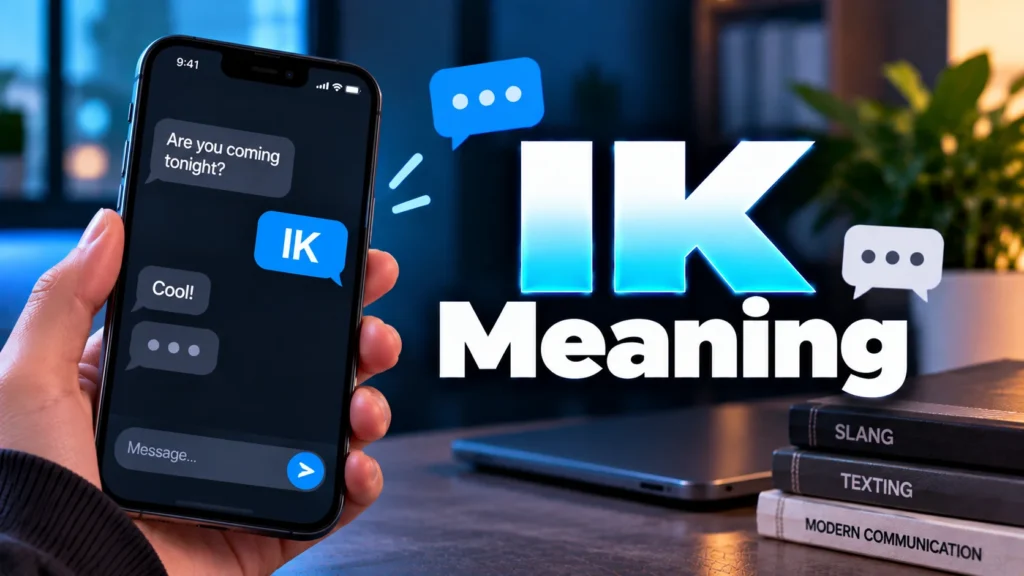
Those two letters may look vague, but in texting and internet slang, IK most commonly means “I Know.”
It is a fast way to tell someone that you already understand, have already heard the information, or agree with something they just said. Wiktionary records IK and lowercase ik as text-messaging initialisms of “I know.” Slang.net gives the same definition for online chat, gaming, and text messages.
For example:
“The test starts at 9 tomorrow.”
“IK, I set an alarm.”
Here, IK simply means:
“I know.”
Yet tone matters. A friendly “ik 😂” can show agreement, while a dry “IK.” may sound impatient or slightly annoyed.
That emotional difference is why understanding IK meaning in text involves more than expanding two letters.
IK Meaning – Quick Definition
IK = I Know
People typically use it when they:
- Already know some information
- Agree with an obvious statement
- Want to acknowledge a reminder
- Understand what another person means
- Respond quickly without typing a full sentence
Examples include:
“That restaurant is expensive.”
“IK 😭”
Meaning: “I know.”
Another example:
“You need to submit this before midnight.”
“ik, almost done.”
Meaning: “I already know, and I’m working on it.”
Wiktionary also identifies IDK — “I don’t know” — as a related contrasting expression, making IK particularly easy to remember.
IK vs IDK
This is one of the simplest slang contrasts:
IK = I Know
IDK = I Don’t Know
One extra letter completely reverses the meaning.
Origin and Background of IK
IK developed naturally from digital shorthand rather than from one viral social-media trend.
People have shortened common expressions since the early days of SMS, instant messaging, chat rooms, and online gaming.
Everyday phrases became:
“By the way” → BTW
“I don’t know” → IDK
“Be right back” → BRB
“I know” → IK
The reason is practical.
When a friend sends:
“Remember we’re leaving at six.”
typing:
“I know.”
takes little effort today, but:
“IK”
is even faster and carries a more casual online tone.
Slang.net has documented IK as “I know” in online chat, gaming, and text messaging for years, while Wiktionary continues to list the same meaning in its current entry.
Social Media Expanded Its Tone
TikTok, Snapchat, Instagram, Discord, and group chats turned IK from simple shorthand into an emotional reaction.
Compare:
“I know.”
“ik”
“IK 😭”
“IKKKK”
All communicate basic awareness, but they do not feel identical.
Lowercase can appear relaxed.
Capital letters can sound stronger.
Repeated letters add excitement.
Emojis provide emotional context.
That is how a plain abbreviation develops personality online.
Real-Life Conversations Using IK
Seeing IK inside realistic conversations makes its different tones much easier to understand.
WhatsApp: Simple Acknowledgment
Person A: Don’t forget we have class at 8 tomorrow.
and,
Person B: IK, unfortunately 😭
moreover,
Person A: I’m setting three alarms.
Here, IK means “I know.”
The crying emoji suggests the person is joking about not wanting to wake up early.
Instagram DM: Agreement
Person A: That new song is actually so good.
and,
Person B: IKRRR 😭
moreover,
Person A: The chorus has been stuck in my head all day.
Here, the person uses a related expression:
IKR = I Know, Right?
It communicates enthusiastic agreement rather than simply saying they already possess the information. Wiktionary defines IKR as an expression agreeing with a previously mentioned statement.
TikTok Comments: Shared Reaction
Commenter A: The ending was the best part.
and,
Commenter B: IK 😭 everyone keeps skipping it.
moreover,
Commenter C: Literally.
IK works as agreement: “I know, exactly.”
Text Message: Slight Annoyance
Person A: You’re going to be late if you don’t leave now.
and,
Person B: IK.
moreover,
Person A: Okay 😭
The period and lack of emoji make this version feel colder.
It may mean:
“I know. You don’t need to tell me again.”
Same abbreviation, different emotional impact.
Emotional and Psychological Meaning of IK
IK is interesting because the phrase “I know” can communicate several social emotions.
It can mean:
“I already understand.”
“I agree with you.”
“Yes, I noticed too.”
“You don’t need to remind me.”
“That’s exactly what I was thinking.”
Those meanings range from warm agreement to irritation.
Why “IK” Can Feel Dry
Imagine messaging a friend:
“You looked really happy today!”
They respond:
“IK.”
That reply may sound strange or overly confident.
Now imagine:
“You left your charger at my house again.”
“IK 😭”
Suddenly the same abbreviation feels natural and self-aware.
The emotional meaning depends on what IK responds to.
A Personal-Style Scenario
Imagine your friend has reminded you three times to bring your passport before a trip.
The fourth message says:
“PLEASE remember your passport.”
You reply:
“IKKK 😭 it’s already in my bag.”
The repeated K and emoji communicate:
“Yes, I know—you’ve reminded me enough, but I’m not seriously angry.”
Without those cues:
“IK.”
might sound irritated.
Small visual choices often replace voice tone in digital conversation.
IK Usage in Different Contexts
TikTok
TikTok users may write:
“ik 😭”
“IKR”
“IKKK”
“ik bro”
These responses often show agreement rather than simply factual knowledge.
For example:
Comment: “This character deserved better.”
Reply: “IK 😭”
The person essentially means:
“Exactly—I completely agree.”
Snapchat
IK commonly appears in private Snapchat conversations.
Example:
Person A: “You’re snapping while you should be studying.”
Person B: “ik 💀”
The skull emoji makes it humorous and self-aware.
Instagram users may use IK in DMs, comments, and story replies.
“ik she looks amazing”
means:
“I know; she looks amazing.”
It can also appear with IKR when someone strongly agrees with another user.
Relationships and Friendships
Among close friends, IK is usually harmless.
However, replying:
“IK.”
repeatedly during a disagreement can seem dismissive.
Someone explaining their feelings may want acknowledgment rather than merely being told that you already know.
Gaming
Gamers often use IK because messages must be short during gameplay.
Player A: “They’re pushing left.”
Player B: “ik”
That simply confirms awareness.
Slang.net specifically categorizes IK under online chat, text messaging, and online gaming.
Professional Settings
IK is usually too casual for formal workplace writing.
Instead of:
“IK, thanks.”
write:
“Yes, I’m aware. Thank you.”
or:
“Thanks for confirming.”
The full wording sounds clearer and more professional.
When NOT to Use IK
IK is convenient, but it can sound dismissive when someone expects a thoughtful response.
Avoid relying on it alone when:
- Someone is sharing serious feelings
- A manager gives important instructions
- You are writing to a professor
- You are dealing with a customer
- The conversation is emotionally sensitive
- You need to confirm detailed information
- Professional clarity matters
Consider:
Friend: “I feel like you haven’t been listening to me lately.”
Reply: “IK.”
That could make the situation worse.
A better response might be:
“I understand what you’re saying, and I want to talk about it properly.”
Avoid IK When Tone Could Be Misread
Short replies are easy to misunderstand.
“IK 😂”
and:
“IK.”
can feel dramatically different.
If you are worried about sounding rude, write the full sentence.
Common Misunderstandings About IK
“IK Means I Know Every Time”
Not absolutely.
In casual texting, I Know is clearly the dominant meaning, but IK also exists in specialized fields.
“IK Means I Know, Right?”
Not exactly.
IK = I Know
IKR = I Know, Right?
IKR specifically emphasizes agreement with another person’s statement.
“IK Is Always Rude”
No.
“ik 😂”
can be completely friendly.
Rudeness comes from context and tone rather than the abbreviation alone.
“IK Is New TikTok Slang”
No.
IK existed in texting and online-chat culture before TikTok became dominant. Slang.net documented the abbreviation as “I know” years ago.
“IK and IDK Are Similar”
They are related but opposite.
IK = I Know
IDK = I Don’t Know
Confusing them changes the entire message.
“IK Only Exists as Slang”
No.
In robotics and animation, IK also stands for Inverse Kinematics.
MathWorks describes inverse kinematics as determining the robot joint configuration required to move an end effector to a desired position or pose.
IK Compared With Similar Slang
| Term | Meaning | Typical Use |
|---|---|---|
| IK | I Know | Awareness/agreement |
| IKR | I Know, Right? | Strong agreement |
| IDK | I Don’t Know | Uncertainty |
| IKTR | I Know That’s Right | Enthusiastic affirmation |
| IKWYM | I Know What You Mean | Understanding |
| IKYD | I Know You Did | Acknowledgment |
| FR | For Real | Agreement/emphasis |
| FRFR | For Real, For Real | Strong agreement |
| FACTS | Strong agreement | Social media |
| EXACTLY | Complete agreement | General conversation |
| NGL | Not Gonna Lie | Honest reaction |
| TBH | To Be Honest | Opinion/introduction |
Wiktionary currently records IKTR as “I know that’s right,” while Slang.net lists several related IK-based expressions such as IKHYF, IKWYM, and IKYD.
Key Insight
IK usually says “I already know,” while IKR says “I agree with what you just said.” The difference is small but important because IKR usually feels more socially enthusiastic.
Variations and Types of IK
1. IK
Meaning: I Know.
The standard abbreviation.
2. ik
Meaning: I know.
Lowercase has the same definition but may feel more casual.
3. “IK 😭”
Meaning: I know, and I find the situation painfully funny or relatable.
The crying emoji adds emotion.
4. “IK 💀”
Meaning: Humorous acknowledgment.
Often used when the situation is ridiculous.
5. IKK
Meaning: An exaggerated “I know.”
Repeating the K can make the response feel more enthusiastic or impatient depending on context.
6. IKKK
Meaning: Stronger expressive version of IK.
Example:
“IKKK she looked amazing.”
7. IKR
Meaning: I Know, Right?
Used to strongly agree with someone.
8. IKTR
Meaning: I Know That’s Right.
Often used as an affirming response when someone says something the writer strongly agrees with.
9. IKWYM
Meaning: I Know What You Mean.
It communicates understanding rather than simple knowledge. Slang.net lists this among IK-related text abbreviations.
10. IKYD
Meaning: I Know You Did.
This can acknowledge something another person says they did, although tone can make it sound slightly dismissive.
How to Respond When Someone Says IK
You usually do not need to respond to the abbreviation itself. Continue the conversation naturally.
Casual Replies
Them: “IK.”
You could reply:
- “Okay 😂”
- “Just making sure.”
- “Bet.”
- “Cool.”
- “Got you.”
Funny Replies
If they sound slightly annoyed:
- “Okay okay, don’t attack me 😭”
- “Just checking bro 💀”
- “Message received.”
- “Damn, reminder cancelled 😂”
Mature Replies
When discussing something important:
- “Great, I just wanted to confirm.”
- “Thanks for letting me know.”
- “Perfect, then we’re on the same page.”
- “Understood.”
Respectful Replies
If “IK” feels dismissive, avoid immediately assuming bad intent.
You can say:
“I just wanted to make sure we both had the same information.”
Short messages are easily misread, so clarification often works better than conflict.
Regional and Cultural Usage of IK
Western Internet Culture
IK is especially natural in English-language texting because it directly takes the initials from I Know.
Users in the United States, UK, Canada, Australia, and other English-speaking communities can understand it easily when context is clear.
Asian Online Communities
English shorthand often mixes with local languages.
A Pakistani user might write:
“IK yaar, kal deadline hai.”
The English abbreviation becomes part of an otherwise multilingual message.
Similar code-switching occurs across South Asia and Southeast Asia through gaming, university chats, and social platforms.
Middle Eastern Online Culture
IK may appear naturally inside Arabic-English or other multilingual messaging.
Its short form makes it easy to borrow even when English is not the speaker’s first language.
Global Internet Usage
Gaming, TikTok, Instagram, Discord, and online fandoms allow abbreviations to spread internationally.
IK needs little cultural explanation because “I know” is basic English.
Gen Z vs Millennials
IK is not exclusively Gen Z slang.
Millennials used similar abbreviations during SMS and early instant-messaging culture.
Gen Z has expanded the expressive forms:
“ik”
“IKK”
“IKR 😭”
Gen Alpha may encounter the same abbreviations through gaming and short-form video.
The definition remains stable even as presentation changes.
Is IK Safe for Kids?
Yes.
IK meaning “I Know” is completely harmless and age-appropriate.
It contains no profanity or hidden sexual meaning in its standard texting use.
Young users may encounter it in:
- Gaming
- Group chats
- TikTok comments
- Snapchat
- School conversations
Parents and teachers can explain it simply as an abbreviation for “I know.”
The more useful lesson is about tone.
A short “IK” to a teacher or parent may sometimes sound dismissive even when the child does not intend disrespect.
Writing:
“Yes, I know. Thank you.”
can sound warmer when courtesy matters.
FAQs About IK Meaning
What does IK mean in text?
IK means “I Know.” It tells someone that the sender already knows, understands, or agrees with the information being discussed. Wiktionary and Slang.net both document this texting meaning.
What does IK mean on Snapchat?
On Snapchat, IK normally means I Know.
For example, “ik 😭” may mean “I know, that’s so true/funny.”
What does IK mean on TikTok?
On TikTok, IK usually means I Know, often as an agreement or reaction in comments.
Someone replying “IKR” means I Know, Right?
What does IK mean from a girl or guy?
The sender’s gender does not change the meaning.
Whether a guy or girl sends IK, it normally means I Know. Tone depends on the rest of the conversation.
Is IK rude?
Not automatically.
“IK 😂” can feel friendly, while a short “IK.” during an argument may sound impatient or dismissive.
What is the difference between IK and IKR?
IK means I Know.
IKR means I Know, Right?
IK confirms awareness, while IKR usually communicates enthusiastic agreement.
What does IK mean outside texting?
In robotics, animation, and related technical fields, IK means Inverse Kinematics. It involves calculating joint configurations needed to achieve a desired position or pose.
Conclusion: Understanding IK Without Overthinking It
The most common IK meaning in text is “I Know.”
If someone says:
“The meeting starts at nine.”
and you respond:
“IK.”
you are simply telling them that you already have that information.
The abbreviation is widely recognized in texting, online chat, and gaming, and both Wiktionary and Slang.net document I Know as its standard internet meaning.
What makes IK worth understanding is its tone.
“IK 😊” can sound friendly.
“IKKK 😭” can communicate excited agreement.
“IK.” may sound impatient.
The basic definition never changed, but the emotional message did.
Related expressions also help decode modern conversations. IKR means “I Know, Right?”, while IKTR means “I Know That’s Right.” On the opposite side, IDK means “I Don’t Know.”
There is also a completely separate technical meaning. In robotics, IK stands for Inverse Kinematics, so seeing “IK solver” in engineering software has nothing to do with texting slang.
The easiest rule is simple: if IK appears in an ordinary DM, text, gaming chat, or TikTok comment, read it as “I Know” unless the surrounding context clearly suggests otherwise.
Once you understand the tone behind those two letters, replies such as “ik,” “IKK,” and “IKR” become much easier to read naturally.