
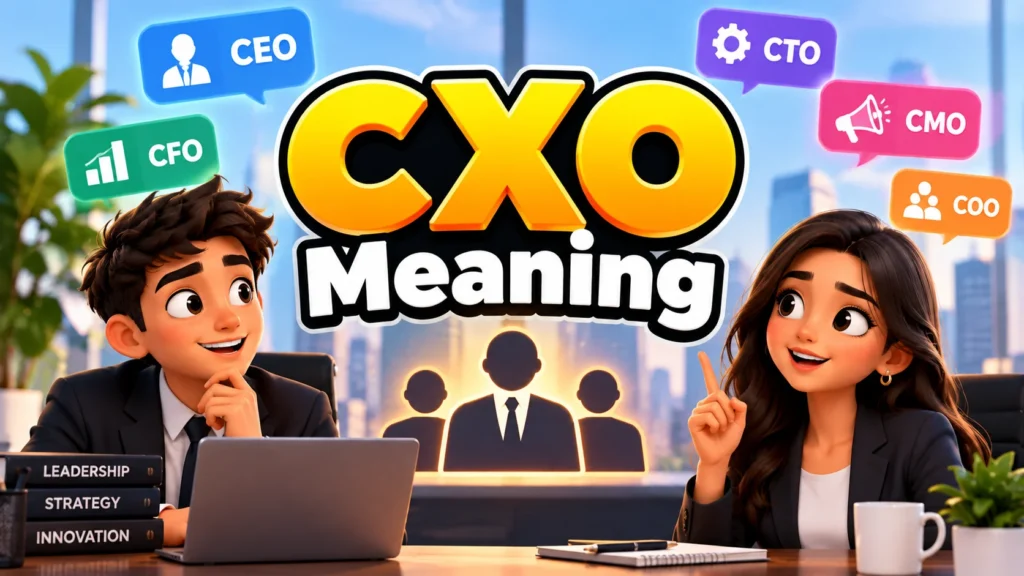
If you have noticed CXO on LinkedIn, in a corporate email, during a business conference, or inside a job description, you may wonder exactly what those three letters represent.
The answer is not always as simple as it first appears.
In many companies, CXO stands for Chief Experience Officer, a senior executive responsible for improving the overall experience customers have with a brand. In broader corporate language, however, CxO can also mean Chief X Officer, with the letter “X” acting as a placeholder for different executive functions.
That means CEOs, CFOs, CTOs, CMOs, and other senior leaders can collectively be described as CxOs.
The intended definition usually becomes clear once you look at the surrounding topic. Customer journeys suggest Chief Experience Officer, while phrases such as “CXO conference” or “CXO leadership” often refer to senior executives as a group.
Understanding this distinction makes business vocabulary much easier to follow.
CXO – Quick Meaning
CXO has two major interpretations in professional communication.
Chief Experience Officer
A Chief Experience Officer is a senior leader who focuses on how customers experience a company across different interactions.
Those interactions may include:
- visiting the website;
- using an app;
- contacting customer support;
- buying a product;
- receiving a delivery;
- visiting a physical location;
- interacting with employees;
- returning for another purchase.
The goal is to make these experiences feel consistent, useful, simple, and positive.
Chief X Officer
The second interpretation treats the X as a variable.
In this usage, CxO essentially means:
Chief [something] Officer
For example:
CEO = Chief Executive Officer
CFO = Chief Financial Officer
CTO = Chief Technology Officer
CMO = Chief Marketing Officer
When someone says:
“The event attracted more than 200 CXOs.”
they are probably talking about senior C-suite executives rather than 200 Chief Experience Officers.
Another example:
“Our new CXO is redesigning the customer journey.”
Here, the reference is probably to a Chief Experience Officer.
Context makes the difference.
Origin & Background
How the C-Suite Created CxO
Corporate organizations have long used titles beginning with Chief and ending with Officer.
CEO became one of the most recognizable examples.
As organizations became larger and more specialized, they created additional leadership positions for finance, operations, technology, marketing, information, security, data, and other areas.
This produced a recognizable pattern:
Chief + Function + Officer.
Business professionals eventually began using CxO as an umbrella expression for these positions.
Instead of writing:
“CEOs, CFOs, CIOs, CTOs, CMOs, and other senior executives,”
a company could simply say:
“CXOs.”
It saves space while clearly signaling senior corporate leadership to readers familiar with business vocabulary.
Rise of the Chief Experience Officer
The Chief Experience Officer developed from another major shift in modern business: companies began paying more attention to experience as a competitive advantage.
Customers no longer interact with businesses through only one channel.
A person may discover a brand on Instagram, visit its website, download its app, talk to customer service, make a purchase, receive emails, and later visit a physical store.
If each interaction feels completely disconnected, the customer may become frustrated even when the actual product is good.
The Chief Experience Officer role attempts to connect those different touchpoints into one coherent journey.
Why the Term Can Be Confusing
The problem is that capitalization does not always solve the ambiguity.
Some writers distinguish:
CXO = Chief Experience Officer
and:
CxO = Chief X Officer
But online articles, corporate presentations, and social posts often use capitalization inconsistently.
The sentence is therefore a stronger clue than the typography.
Real-Life Conversations
WhatsApp Work Chat
Person A: Have you seen the new customer-service plan?
Person B: Yes. The CXO is presenting it tomorrow.
Person A: Is that the Chief Experience Officer?
Person B: Exactly. She wants to improve the whole customer journey.
In this example, the customer-service topic makes the intended role obvious.
LinkedIn Messages
Person A: Are you attending the leadership summit?
Person B: Probably. They said more than 100 CXOs will be there.
Person A: CXOs as in C-suite executives?
Person B: Yeah, CEOs, CTOs, CFOs, and other senior leaders.
The plural form signals that the abbreviation is being used as an executive category.
Slack Conversation
Person A: Customers keep abandoning checkout.
Person B: Product is investigating.
and,
Person A: We should probably involve the CXO too.
Person B: Agreed. This affects the full customer experience.
Again, the discussion focuses on experience rather than general leadership.
Text Message
Person A: My brother just got promoted to CXO.
Person B: Nice! Chief Experience Officer?
Person A: Yep. He’ll oversee customer experience across the company.
Person B: That’s a major promotion.
Asking for clarification is completely normal because corporate titles can vary between organizations.
Emotional & Psychological Role of a CXO
The Chief Experience Officer role is deeply connected with how people feel while interacting with a business.
Companies often measure performance through numbers:
sales;
revenue;
conversion rates;
retention;
customer-service response times.
But customers rarely experience a company as numbers.
They experience frustration when a website repeatedly crashes.
They experience confidence when checkout feels secure.
and,
They experience relief when an employee quickly solves a problem.
They experience loyalty when a business consistently respects their time.
A strong experience strategy connects these emotional reactions with business decisions.
A Simple Real-Life Scenario
Imagine buying an expensive smartphone online.
The phone itself is excellent.
However, the website freezes during payment.
Your confirmation email arrives six hours later.
The package is delayed.
Customer support gives you three different answers.
When the phone finally arrives, everything works perfectly.
Would you describe the experience as excellent?
Probably not.
Product quality represents only one part of the relationship.
A Chief Experience Officer examines the entire journey and asks where frustration, confusion, or disappointment can be removed.
That perspective explains why experience-focused leadership has become important for many modern organizations.
Usage in Different Contexts
Corporate Leadership
In general business language, CXO often refers broadly to C-suite leaders.
You may encounter phrases such as:
“CXO priorities”
“CXO leadership”
and,
“CXO roundtable”
“CXO conference”
moreover,
“CXO insights”
“CXO networking event”
These phrases normally target senior executives across several departments.
Customer Experience
When the discussion includes customer satisfaction, loyalty, journey mapping, service design, user experience, feedback, or retention, the abbreviation is more likely to identify a Chief Experience Officer.
The executive may work closely with:
marketing;
product teams;
sales;
customer service;
UX designers;
technology teams;
operations.
Their responsibility often extends across departments because customers do not experience those departments separately.
Technology Companies
Technology businesses frequently have large executive teams.
You may see:
CEO
CTO
CIO
CISO
CDO
CPO
CXO
A Chief Experience Officer in a digital company may pay particular attention to websites, mobile apps, onboarding processes, digital support, usability, and overall customer journeys.
LinkedIn is one of the most common places to encounter the abbreviation.
A profile saying:
“CXO | Customer Experience Transformation”
probably refers to a specific experience executive.
A post titled:
“Five priorities every CXO should consider”
may instead target senior executives generally.
Social Media
CXO is different from typical internet slang such as LOL, NGL, TYSM, or BRB.
You are most likely to encounter it on business-oriented platforms, startup content, leadership podcasts, career pages, LinkedIn posts, and professional TikTok or Instagram accounts.
When NOT to Use CXO
Acronyms save time only when readers understand them.
If your audience is unfamiliar with corporate terminology, writing CXO without explanation can create unnecessary confusion.
For formal documents, introduce the complete title first:
Chief Experience Officer (CXO)
After that, CXO can be used throughout the document.
The same rule works for the broader term:
C-suite executives (CxOs)
Avoid unexplained use in:
- beginner-level educational material;
- customer-facing communication;
- academic reports;
- international documents;
- formal proposals;
- situations involving several different executive positions.
Consider this sentence:
“The CXO approved the project.”
It sounds clear until the reader asks:
Which CXO?
Chief Experience Officer?
Chief Executive Officer?
Or simply one of the company’s senior executives?
Writing the specific job title removes uncertainty.
Common Misunderstandings
CXO Does Not Have Only One Definition
This is the most common mistake.
Some readers learn that it stands for Chief Experience Officer and assume that every occurrence carries that meaning.
Others know “Chief X Officer” and assume CXO is always an umbrella term.
Both interpretations exist.
Context is essential.
CXO Is Not the Same as CEO
CEO stands for Chief Executive Officer.
A Chief Experience Officer is a different executive role.
When CxO is used as a generic term, however, a CEO can be considered one type of CxO.
CXO Is Not Automatically a Marketing Role
Customer experience and marketing overlap, but they are not identical.
Marketing may focus strongly on:
brand awareness;
promotion;
lead generation;
customer acquisition;
campaigns.
An experience executive often looks beyond promotion into the complete journey, including product use, service, support, digital interactions, and post-purchase experiences.
CXO and CCO Can Overlap
CCO may mean Chief Customer Officer.
This position can share responsibilities with a Chief Experience Officer.
Some organizations use one title.
Others use both.
The responsibilities are more important than the abbreviation alone.
Every Company Defines the Role Differently
There is no universal corporate structure requiring every CXO to perform exactly the same tasks.
One organization may focus heavily on digital UX.
Another may give the executive responsibility for customer service.
A hospitality company might emphasize guest experience.
A healthcare organization may focus on patient experience.
Always check the job description when evaluating a specific role.
CXO Compared With Other C-Suite Titles
| Title | Full Form | Main Responsibility |
|---|---|---|
| CXO | Chief Experience Officer | Customer and user experience |
| CxO | Chief X Officer | General C-suite category |
| CEO | Chief Executive Officer | Overall leadership and strategy |
| CFO | Chief Financial Officer | Finance and financial planning |
| COO | Chief Operating Officer | Business operations |
| CTO | Chief Technology Officer | Technology strategy |
| CIO | Chief Information Officer | IT and information systems |
| CMO | Chief Marketing Officer | Marketing and brand strategy |
| CCO | Chief Customer Officer | Customer strategy |
| CPO | Chief Product Officer | Product strategy |
Key Insight
The easiest way to avoid confusion is to look at the surrounding vocabulary. Customer journeys and service usually point toward Chief Experience Officer, while conferences, leadership surveys, and plural references to “CXOs” generally mean senior C-suite executives.
Variations and Types of CXO Roles
1. Chief Experience Officer
Short meaning: Customer-experience leader.
This executive works to improve how customers perceive and interact with an organization.
2. Chief Executive Officer
Short meaning: Overall organizational leader.
The CEO usually has responsibility for the company’s broader direction, strategy, and performance.
3. Chief Financial Officer
Short meaning: Senior finance leader.
The CFO oversees areas such as budgets, financial strategy, reporting, cash flow, and risk.
4. Chief Operating Officer
Short meaning: Operations leader.
A COO typically focuses on turning organizational strategy into efficient daily operations.
5. Chief Technology Officer
Short meaning: Technology strategy leader.
The CTO commonly oversees technical direction, innovation, and technology development.
6. Chief Marketing Officer
Short meaning: Marketing leader.
The CMO is normally responsible for branding, customer acquisition, campaigns, positioning, and market strategy.
7. Chief Information Officer
Short meaning: Enterprise information and IT leader.
The CIO often manages internal technology systems, infrastructure, information strategy, and digital capabilities.
8. Chief Customer Officer
Short meaning: Customer relationship leader.
This position focuses on customer value, satisfaction, retention, and organizational customer strategy.
9. Chief Product Officer
Short meaning: Product leadership executive.
The CPO oversees product vision, development priorities, and long-term product strategy.
10. Chief Data Officer
Short meaning: Data strategy leader.
The CDO may oversee data governance, analytics, data quality, and organizational use of information.
These titles demonstrate why Chief X Officer works so well as an umbrella concept. Modern organizations continue creating executive roles around increasingly specialized business functions.
How to Respond When Someone Uses CXO
You do not need a special response just because someone uses the abbreviation.
Respond according to the conversation.
Casual Replies
“Nice! What area do they oversee?”
“Is that Chief Experience Officer?”
“Sounds like a senior leadership role.”
“That’s a big responsibility.”
Funny Replies
“So many C-suite acronyms 😂”
“I need an executive-title dictionary.”
“Corporate alphabet unlocked.”
“Another three-letter title for LinkedIn.”
These work well among coworkers or friends when the tone is relaxed.
Mature Replies
“Does CXO refer to Chief Experience Officer here?”
“How does that role work within your organization?”
“Which departments report to the CXO?”
“Is the position focused primarily on customer or digital experience?”
Respectful Professional Replies
“Thank you for clarifying the Chief Experience Officer’s responsibilities.”
“I understand the CXO will oversee the customer-experience strategy.”
“Could you confirm whether CXO refers to the Chief Experience Officer or the broader C-suite team?”
A short clarification can prevent a much larger misunderstanding.
Regional & Cultural Usage
Western Business Culture
Chief-level titles are common throughout North American and European corporate environments.
Experience-focused leadership has become particularly visible in businesses where customer journeys cross physical and digital channels.
Technology, retail, hospitality, financial services, healthcare, and consumer brands may all create experience-oriented leadership roles.
Asian Business Culture
Across many Asian corporate environments, CXO is also frequently used as an umbrella expression for senior executives.
Business events may advertise:
“CXO networking”
or:
“CXO leadership summit.”
In these examples, the audience is usually broader than Chief Experience Officers alone.
Middle Eastern Business Culture
CXO terminology can be found across banking, telecom, technology, consulting, aviation, retail, and large multinational companies.
As businesses expand their digital services, customer-experience leadership is also becoming more visible.
However, titles and reporting structures differ considerably between organizations.
Global Internet Usage
Professional social networks have made corporate acronyms international.
A LinkedIn user in Pakistan, the UAE, Singapore, London, or New York may encounter the same expressions:
“CXO strategy”
“CXO insights”
and,
“CXO transformation”
“CXO priorities.”
Yet the intended role may still differ from one post to another.
Gen Z vs. Millennials
This term is better understood through professional experience rather than generation.
Gen Z professionals may first encounter it while applying for internships, using LinkedIn, following startup founders, or joining corporate environments.
Millennials and older professionals may recognize the traditional CEO, COO, CFO, and CIO structure while also seeing newer titles emerge around data, digital transformation, customer experience, security, and product strategy.
Is CXO Safe for Kids?
Yes.
CXO is normal business terminology and does not carry an inherently offensive, sexual, or inappropriate meaning.
A simple explanation for younger students would be:
“A CXO can be a Chief Experience Officer, who helps improve customer experiences. CxO can also be a general name for important company executives.”
Students interested in business, entrepreneurship, technology, or management may find C-suite terminology especially useful.
It also teaches an interesting language principle: sometimes one letter can act as a placeholder rather than representing a specific word.
FAQs
What does CXO stand for?
CXO commonly stands for Chief Experience Officer, a senior executive concerned with customer or user experience. CxO can also mean Chief X Officer, an umbrella term for C-suite executives.
What does CXO mean in business?
In business, the abbreviation may identify a Chief Experience Officer or refer collectively to senior executives such as CEOs, CFOs, CTOs, and CMOs. Context determines which definition applies.
What does a Chief Experience Officer do?
A Chief Experience Officer helps improve how customers interact with a company across websites, products, customer service, stores, apps, marketing, and other important touchpoints.
Is a CXO higher than a CEO?
Usually no. If CXO refers to Chief Experience Officer, the CEO normally remains the overall organizational leader. When CxO is used generically, the CEO is actually one member of the wider CxO category.
What is the difference between CXO and CEO?
The CEO is responsible for the overall direction of an organization. A Chief Experience Officer specializes in improving customer or user experiences across the business.
What does CXO mean on LinkedIn?
On LinkedIn, it may refer to a Chief Experience Officer. In phrases such as “CXO event,” “CXO community,” or “CXO insights,” it often represents C-suite executives more broadly.
Is CXO the same as CCO?
Not necessarily. CCO commonly means Chief Customer Officer, while CXO may mean Chief Experience Officer. The responsibilities can overlap because companies structure customer leadership differently.
Conclusion
CXO is one of those business abbreviations that becomes easy once you stop expecting it to have only one definition.
In an experience-focused discussion, it normally refers to the Chief Experience Officer—a senior leader responsible for improving how customers interact with a company throughout their journey.
In broader corporate language, CxO can work as shorthand for Chief X Officer, covering senior executives across finance, marketing, technology, operations, information, customer strategy, and other functions.
The surrounding words usually reveal which interpretation applies.
A sentence about improving checkout, support, or customer satisfaction probably points toward the experience role.
A conference promising access to “leading CXOs” is much more likely to mean executives from across the C-suite.
That distinction is more useful than memorizing a rigid definition.
Business vocabulary constantly evolves as companies create new leadership roles around changing priorities. Understanding the structure behind these titles makes future acronyms much easier to decode.
So the next time CXO appears in a job advertisement, LinkedIn post, company report, or workplace message, examine the context first.
Those three letters may describe one executive—or an entire group of the most senior decision-makers in an organization.