
If you are designing a logo, writing a business history, creating a sign, or simply trying to save space in a sentence, you may wonder about the correct abbreviation for established.
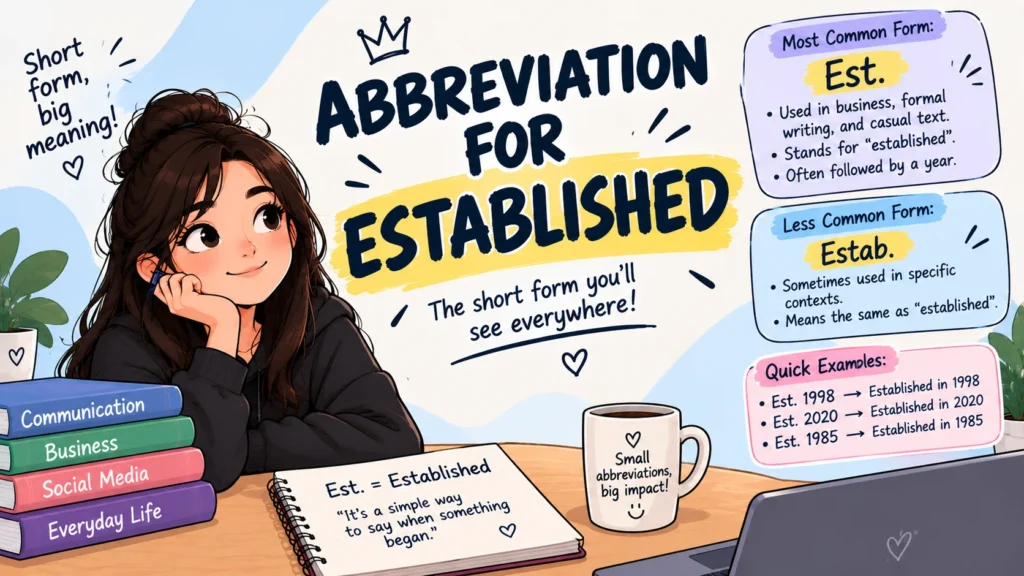
The most common abbreviation is “Est.”
For example:
Est. 1998
means:
Established in 1998.
You will often see this short form on business signs, restaurant logos, clothing labels, family businesses, sports clubs, websites, and promotional materials.
Another possible abbreviation is “Estab.”, but it is much less common. In most everyday and professional situations, “Est.” is the cleaner and more recognizable choice.
Knowing when to use each form matters because an abbreviation can look natural in one setting and awkward in another. A restaurant logo may look polished with “Est. 2010,” while a formal report may be better served by writing the complete word “established.”
Abbreviation for Established – Quick Meaning
What is the standard abbreviation?
The standard short form of established is:
Est.
It is generally written with a period when used as an abbreviation.
For example:
Est. 2005
means:
Established in 2005.
What does “established” mean?
The word established can mean founded, started, created, or officially set up, depending on context.
When used with a year, it often tells readers when an organization, business, club, institution, or brand began.
Examples include:
Est. 1987
Est. 2001
Est. 2024
The abbreviation itself does not change the meaning. It simply makes the phrase shorter.
Est. vs. Estab.
Both forms can represent “established,” but they are not equally common.
| Form | Meaning | Commonness |
|---|---|---|
| Est. | Established | Very common |
| Estab. | Established | Less common |
| Established | Full word | Most formal and clearest |
For most logos, signs, labels, and informal references, Est. is the preferred option.
Why Is “Est.” So Common?
Abbreviations exist mainly to make language more efficient.
“Established” contains eleven letters, while “Est.” contains only four characters including the punctuation mark.
That difference becomes valuable when space is limited.
Logos and branding
A business logo may need to communicate its founding year without taking attention away from the company name.
Compare:
Riverside Coffee — Established 1996
with:
Riverside Coffee — Est. 1996
The second version is shorter and often has a more traditional visual appearance.
Signs and storefronts
Restaurants, clothing brands, salons, breweries, hotels, sports clubs, and other businesses frequently use Est. alongside a founding year.
It quickly communicates a sense of history.
Social media bios
A small abbreviation also works well in profile descriptions.
For example:
Est. 2020 | Independent Clothing Brand
This gives readers useful information without using much space.
Merchandise
The abbreviation is especially popular on:
- T-shirts
- Caps
- Hoodies
- Mugs
- Bags
- Stickers
- Sports merchandise
- Business cards
The compact format works particularly well for visual designs.
The History and Style Behind “Est.”
The use of Est. reflects a broader tradition of shortening frequently used words.
Abbreviations have long been used in business writing, directories, newspapers, signs, documents, and labels where space or convenience matters.
The modern visual style of “Est. + year” is especially associated with branding and heritage design.
Why does it look traditional?
You may have noticed phrases such as:
Est. 1924
on old-fashioned restaurant signs or vintage-inspired clothing.
The format has become a design convention.
It can make a newer business look visually connected to traditional establishments without changing the factual meaning of its founding year.
Modern brands use it too
The style is not limited to old companies.
A business established recently might write:
Est. 2025
This simply identifies the year it began.
The design may feel classic, even when the organization itself is new.
Real-Life Examples of the Abbreviation
Business example
Green Valley Bakery
Est. 2008
This tells customers that the bakery was established in 2008.
Family business
Ahmed & Sons
Est. 1975
The abbreviation communicates the founding year in a compact way.
Sports club
River City Volleyball Club
Est. 2017
The format works naturally for team branding and merchandise.
Restaurant
The Corner Grill
Est. 1994
The short form fits neatly into a logo or sign.
Personal brand
Creative Studio
Est. 2022
This can be useful for freelancers, designers, photographers, and online creators.
Social media bio
Small business | Est. 2019 | Handmade goods
Here, “Est.” saves space while remaining easy to understand.
When Should You Use “Est.”?
The abbreviation is particularly useful when the word established is followed by a year.
Use it with a founding year
The most recognizable pattern is:
Est. 1990
or:
Est. 1990 | Family Owned
This is the classic usage.
Use it in visual branding
If you are designing a logo, badge, label, or sign, Est. is usually more visually efficient than the full word.
Use it in informal references
You may also see:
“The restaurant was est. in 1985.”
However, writing the full word is often clearer in ordinary prose.
Use it when space matters
Abbreviations are especially useful where character count or layout is limited.
That includes:
- Logos
- Menus
- Product packaging
- Social media bios
- Business cards
- Badges
- Posters
- Merchandise
When Should You Write “Established” Instead?
The abbreviation is not suitable for every situation.
Formal documents
In contracts, official histories, reports, academic writing, and legal documents, writing the complete word may be clearer.
For example:
The organization was established in 1985.
This sounds more formal than:
The organization was est. in 1985.
First mention in formal writing
When clarity is more important than brevity, spell out the word.
Readers should never have to guess what an abbreviation means.
Professional descriptions
A company website might say:
“Our company was established in 1998.”
This creates a natural, polished sentence.
The abbreviation is more appropriate in a logo or heading than in a detailed company history.
Est. vs. Other Ways to Say Established
There are several ways to communicate the same basic idea.
| Expression | Meaning | Best Use |
|---|---|---|
| Est. 1990 | Established in 1990 | Logos and branding |
| Established in 1990 | Founded or started in 1990 | Formal writing |
| Founded in 1990 | Began in 1990 | Business descriptions |
| Since 1990 | Operating from 1990 onward | Branding and marketing |
| Founded: 1990 | Founding year is 1990 | Profiles and directories |
| Established: 1990 | Founding year is 1990 | Formal or informational layouts |
| Serving since 1990 | Operating since 1990 | Business marketing |
Key Insight
“Est. 1990” and “Founded in 1990” communicate related information, but they are not always interchangeable. “Est.” is particularly effective as a compact branding element, while “established” or “founded” works better in complete sentences.
Common Variations of “Est.”
1. Est.
This is the most common short form.
Est. 2010
2. Estab.
This is another abbreviation for established, but it appears much less frequently.
Estab. 2010
For most branding purposes, Est. looks more natural.
3. EST
Some logos omit the period:
EST 2010
This is primarily a design choice.
4. Est. 2015
This is the classic branding format.
The abbreviation is immediately followed by the founding year.
5. Est. Since 2015
This combination is sometimes used in branding, although “Est. 2015” is cleaner because “established” already indicates the founding year.
6. Established 2015
This uses the full word and is especially clear for readers who may not recognize abbreviations.
7. Founded 2015
This is a direct alternative when referring to the year an organization began.
8. Since 2015
This is shorter and can suggest continued operation from that year.
9. Estd.
“Estd.” is another historical or regional abbreviation sometimes seen in signs and documents.
It is less common in contemporary international branding than Est.
10. Est’d
“Est’d” may occasionally appear as a shortened form, but it is much less common than “Est.”
Is “Est.” Grammatically Correct?
Yes, Est. is a recognized abbreviation for “established.”
The punctuation style can vary depending on the style guide, publication, country, or design.
In branding, you may see:
Est. 1995
or:
EST 1995
The second version is often a stylistic choice rather than a different meaning.
Does “Est.” always need a period?
In traditional abbreviation styles, the period is common:
Est. 1995
In logos and graphic design, punctuation may be removed for visual reasons:
EST 1995
Both communicate the same basic idea.
For ordinary writing, Est. is the safer conventional form.
Common Mistakes With the Abbreviation
Mistake 1: Using “Est.” without a year
The abbreviation is most recognizable when connected to a date.
Est. 2004
is immediately clear.
Simply writing:
Est.
can leave readers wondering what information is missing.
Mistake 2: Overusing it in formal writing
A business report does not need to say:
“The company was est. in 1988.”
Writing:
“The company was established in 1988.”
is smoother.
Mistake 3: Confusing “Est.” with “East”
In some visual contexts, EST can potentially be mistaken for the abbreviation for “Eastern” or “Eastern Time.”
Context normally resolves the issue.
Mistake 4: Adding unnecessary words
A logo that says:
Established Since 1990
is understandable, but “since” is unnecessary.
A cleaner version is:
Est. 1990
Regional and Cultural Usage
The abbreviation Est. is widely recognizable in English-language branding.
North America
Businesses, restaurants, sports clubs, and organizations frequently use Est. + year in logos and promotional materials.
United Kingdom
The same format appears in British business branding, heritage-style designs, pubs, restaurants, clubs, and organizations.
South Asia
“Est.” and similar forms are commonly seen on business signs, clothing, restaurants, schools, clubs, and local brands.
You may also encounter Estd., particularly in traditional or formal-looking designs.
Global branding
Because English is widely used in international branding, Est. + year has become recognizable far beyond native English-speaking countries.
The visual format often communicates history even when the audience speaks another primary language.
Abbreviation for Established in Different Contexts
For a business
Est. 2002
This is the most familiar branding use.
For a school
Est. 1965
It communicates the school’s founding year.
For a sports team
Est. 2018
This works especially well on team jerseys and badges.
For a family
Family Est. 1995
This can be used informally for personalized designs, although “established” is being used playfully rather than as an official founding designation.
For a relationship
People sometimes use:
Est. 2021
on anniversary designs or social media graphics.
Here, “established” is being used creatively to represent when a relationship began.
For a brand
Est. 2024
This is a simple way to show a brand’s founding year.
How to Choose the Right Form
Choosing the right version is easier when you think about your audience.
For a logo
Use:
Est. 2019
It is compact and visually balanced.
For a social media bio
Use:
Est. 2020 | Handmade Jewelry
It saves space.
For a formal article
Use:
The company was established in 2020.
The complete word improves readability.
For a business history
Use:
The company was founded in 1975 and has operated continuously since then.
This gives readers more information than an abbreviation.
For a vintage design
Use:
EST. 1952
The uppercase format can create a traditional visual effect.
FAQs About the Abbreviation for Established
What is the abbreviation for established?
The most common abbreviation for established is “Est.”
What does “Est. 1990” mean?
“Est. 1990” means “Established in 1990.” It usually indicates the year a business, organization, club, or institution was founded.
Is “Est.” or “Estd.” better?
Est. is generally more common and recognizable in modern English branding. Estd. can also mean established but is less common in many contemporary contexts.
Can I write “EST 2020” without a period?
Yes. EST 2020 is commonly used as a design style, particularly on logos and merchandise. The meaning is essentially the same as Est. 2020.
Is “estab.” an abbreviation for established?
Yes. Estab. can be used as an abbreviation for established, but it is less common than Est.
What is the abbreviation for established in a business logo?
The most natural choice is usually Est. followed by the founding year, such as Est. 2015.
Does “Est.” mean estimated?
It can. Est. may also abbreviate estimated in some contexts. The surrounding words determine the meaning. In “Est. 1995” on a business logo, it normally means established.
Conclusion: The Best Short Form of Established
The most common and recognizable abbreviation for established is “Est.”
When paired with a year, it creates the familiar format:
Est. 2000
which means:
Established in 2000.
You will commonly see this style on business logos, restaurant signs, clothing, sports merchandise, websites, social media profiles, and other forms of branding.
Estd. and Estab. can also represent “established,” but they are generally less common.
For formal writing, spelling out established is usually clearer. For a logo, sign, label, or compact design, Est. is simple, recognizable, and visually effective.
If your goal is to show a founding year, you usually cannot go wrong with the classic:
Est. + Year