
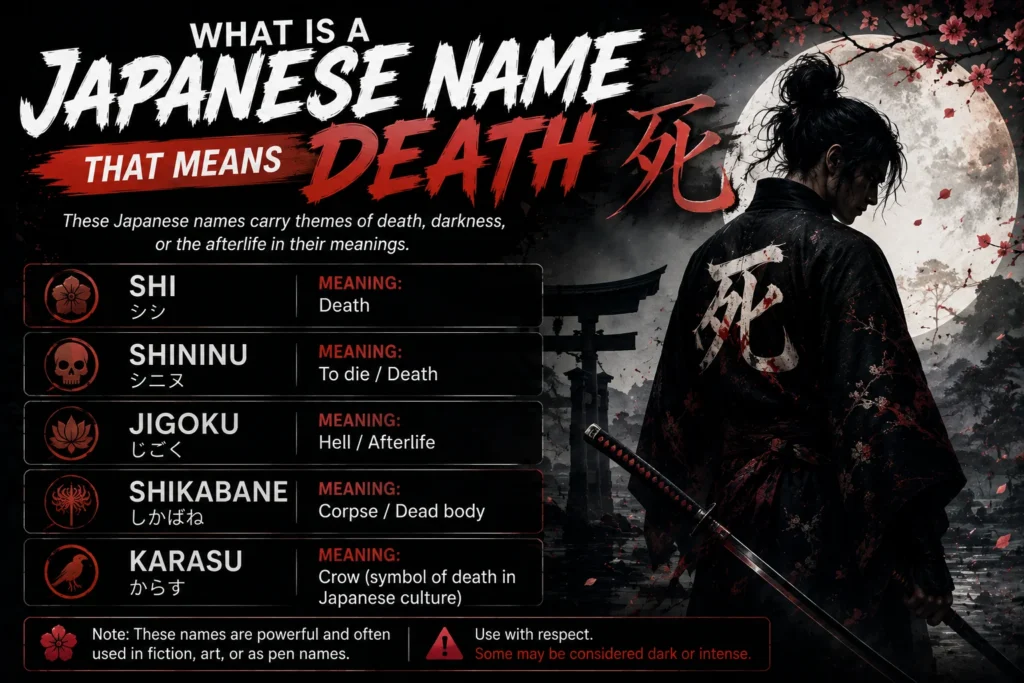
What Is a Japanese Name That Means Death?
If you’re wondering what is a Japanese name that means death, the most important answer is that there is no common everyday Japanese given name that simply means “death.” The direct Japanese word for death is 死 (shi), but it is generally not used as an ordinary personal name because of its strongly negative meaning.
Japanese names work differently from many English names. Their meanings depend heavily on the kanji characters chosen, not simply on how a name sounds when written in Roman letters.
This is why online lists claiming that dozens of normal Japanese names literally mean “death” are often misleading. Some names may evoke darkness, endings, night, spirits, impermanence, or mourning without literally meaning death.
For fictional characters, usernames, games, manga-inspired identities, or creative writing, those symbolic alternatives are usually more authentic and interesting than simply using Shi.
What Is a Japanese Name That Means Death? – Quick Meaning
The direct Japanese kanji associated with death is:
死 (shi) = death
Related Japanese vocabulary includes:
- 死 (shi) — death
- 死ぬ (shinu) — to die
- 死亡 (shibō) — death/decease
- 死者 (shisha) — deceased person/the dead
- 死神 (shinigami) — death deity or “god of death”
- 亡くなる (nakunaru) — to pass away
- 命 (inochi) — life
- 生 (sei / shō / nama, depending on context) — life, birth, living
However, Shi is not a typical Japanese personal name meaning death.
“Shi means death in Japanese.”
That statement is broadly correct when referring to 死, but it does not mean Japanese people commonly name children “Death.”
“The kanji determines the meaning.”
This is essential when interpreting Japanese names.
Why Kanji Matters
Two names can sound identical while being written with different kanji and therefore carrying different meanings.
For example, Japanese names frequently combine characters representing concepts such as beauty, light, flowers, seasons, strength, or virtue.
Looking only at Romanized spelling can hide those distinctions.
Origin & Cultural Background of Death-Related Japanese Names
Death has a complex place in Japanese language, religion, folklore, literature, and popular culture.
That does not mean death-related vocabulary is commonly used for children’s names.
Why “Shi” Has Negative Associations
The pronunciation shi is culturally notable because one reading of the number four, 四, is also shi, sounding like 死, meaning death.
This association has contributed to avoidance of the shi reading of four in certain sensitive contexts. The alternative reading yon is commonly used.
The phenomenon is sometimes compared with Western superstition surrounding the number 13, although the cultural histories are different.
Death in Japanese Folklore
Japanese folklore contains numerous supernatural beings, ghosts, spirits, and stories involving the boundary between life and death.
Terms connected with these traditions can sound appealing to people searching for dark Japanese names.
Yet a supernatural term is not automatically an authentic personal name.
That distinction is important.
Is “Shi” Actually a Japanese Name Meaning Death?
Shi – 死
Meaning: Death
Pronunciation: shi
Normal personal name? Generally, no.
If you’re creating a fictional character and deliberately call them Shi (死), Japanese readers would likely recognize the direct association with death.
That can make the choice feel extremely literal.
For a supernatural character, villain, gaming identity, or symbolic figure, that directness might be intentional.
For a realistic contemporary Japanese character, it would usually sound unnatural as a conventional given name.
Japanese Words Associated With Death
If your goal is creative naming, understanding related vocabulary gives you more possibilities.
Shinigami – 死神
Meaning: Death deity / death spirit, often translated as “god of death.”
Shinigami is familiar internationally because of Japanese fiction and anime.
However, Shinigami is a title or supernatural concept, not an ordinary Japanese given name.
Shisha – 死者
Meaning: A dead or deceased person.
Again, this is vocabulary—not a conventional personal name.
Shibō – 死亡
Meaning: Death/decease.
This is a formal word you might encounter in reporting, statistics, or official contexts. It would not function naturally as a person’s ordinary name.
Yūrei – 幽霊
Meaning: Ghost or spirit.
Yūrei are strongly associated with Japanese supernatural traditions.
It is a cultural term rather than a normal given name meaning death.
Meikai – 冥界
Meaning: The underworld or realm of the dead.
This can provide inspiration for fantasy naming but should not be presented as a standard Japanese personal name.
Real-Life Conversations About Japanese Names Meaning Death
Because these names frequently appear in anime, gaming, and creative-writing discussions, misunderstandings are common.
WhatsApp Conversation
Person A: What’s a Japanese name that literally means death?
Person B: The word is “shi,” written 死.
and,
Person A: So Shi is a normal Japanese name?
Person B: Not really. That’s the word for death, not a typical given name.
This distinction prevents a very common naming mistake.
Instagram DMs
Person A: I need a dark Japanese name for my character.
Person B: Does it actually need to mean death?
and,
Person A: Not necessarily. Just something with a mysterious vibe.
Person B: Then I’d use a real name with suitable kanji instead of literally calling them “Death.”
This approach generally creates a more believable fictional character.
TikTok Comments
Person A: Does “Shinigami” mean death?
Person B: More like a death deity/spirit.
and,
Person A: Is it a person’s name?
Person B: It’s normally a supernatural term, not an everyday given name.
Text Between Friends
Person A: I was going to name my character Shi.
Person B: Using 死?
and,
Person A: Yeah.
Person B: That’s extremely literal 😭
morover,
Person A: That’s kind of the point.
In fiction, unnatural naming can be intentional. The key is knowing what effect you’re creating.
Emotional & Psychological Meaning of Death-Themed Japanese Names
Why do people specifically search for names meaning death?
Usually, they are not looking for an ordinary baby name.
They may be creating:
- Anime-inspired characters
- Manga characters
- Game avatars
- Villains
- Fantasy warriors
- Dark usernames
- Supernatural characters
- Fictional clans
- Role-playing identities
- Gothic stories
Death carries strong symbolic meanings: endings, transformation, fear, grief, mystery, impermanence, and sometimes rebirth.
Symbolism Can Be Better Than Literal Translation
Imagine you’re writing a quiet, mysterious swordsman whose past is marked by loss.
Naming him literally Death may feel too obvious.
A legitimate Japanese name using imagery connected with night, winter, shadow, silence, or fading light may create a deeper character.
This is an important creative principle:
The strongest dark name does not necessarily contain the darkest literal word.
Japanese Names With Dark or Mysterious Associations
Rather than falsely claiming ordinary names literally mean death, it is better to distinguish real names with potentially dark imagery from actual death vocabulary.
Rei
Depending on the kanji, Rei can have multiple meanings.
It is sometimes associated online with spiritual or mysterious imagery, but you cannot accurately say “Rei means death” without specifying the kanji.
Yami
闇 (yami) means darkness.
It works well as a concept or fictional naming element, but it is not equivalent to “death” and should not automatically be presented as a normal given name.
Kage
影 (kage) means shadow.
It is excellent for fictional naming concepts, usernames, or titles, but “shadow” is not the same as death.
Yoru
夜 (yoru) means night.
Again, this provides dark imagery without literally meaning death.
Kuro
黒 (kuro) means black.
It is often used creatively in fictional or online naming, although that does not automatically make “Kuro” a conventional given name.
Death-Related Japanese Terms vs. Dark Name Ideas
| Word/Name | Japanese | Meaning | Ordinary Given Name? | Best Use |
|---|---|---|---|---|
| Shi | 死 | Death | Generally no | Fiction/symbolism |
| Shinigami | 死神 | Death deity/spirit | No | Fantasy/anime themes |
| Shisha | 死者 | Deceased person | No | Vocabulary |
| Yūrei | 幽霊 | Ghost | No | Horror/supernatural |
| Meikai | 冥界 | Underworld | No | Fantasy concepts |
| Yami | 闇 | Darkness | Not normally as a standard given name | Fiction/usernames |
| Kage | 影 | Shadow | Context-dependent as naming element | Fiction |
| Yoru | 夜 | Night | Not simply a standard “death name” | Poetic concepts |
| Kuro | 黒 | Black | Not inherently a death name | Dark aesthetics |
| Inochi | 命 | Life | Concept word | Opposite symbolism |
Key Insight
The most important distinction is between Japanese vocabulary and Japanese personal names. A word may have exactly the dark meaning you want while still sounding unnatural as a real person’s given name.
10 Japanese Death and Dark-Themed Terms for Creative Naming
1. Shi – 死
Meaning: Death.
The most direct answer, but not a conventional everyday personal name.
2. Shinigami – 死神
Meaning: Death deity or death spirit.
Best suited to supernatural concepts.
3. Yūrei – 幽霊
Meaning: Ghost.
Strongly connected with Japanese supernatural imagery.
4. Meikai – 冥界
Meaning: Underworld.
Useful inspiration for fantasy worlds or titles.
5. Yami – 闇
Meaning: Darkness.
A popular concept for dark fictional naming.
6. Kage – 影
Meaning: Shadow.
More subtle than directly referencing death.
7. Yoru – 夜
Meaning: Night.
Works for poetic or mysterious imagery.
8. Kuro – 黒
Meaning: Black.
Useful as a dark visual concept.
9. Tamashii – 魂
Meaning: Soul.
Useful when the desired theme is spiritual rather than specifically death-related.
10. Inochi – 命
Meaning: Life.
Interestingly, an opposite concept can create powerful symbolism in a story centered on death.
Japanese-Inspired Dark Names for Fictional Characters
If you’re creating fiction, you can build a name around imagery instead of pretending a vocabulary word is a standard Japanese name.
Possible thematic directions include:
- Shadow
- Night
- Moon
- Winter
- Black
- Silence
- Ghost
- Twilight
- Fading light
- Fallen flowers
- Empty sky
- Last moon
- Cold rain
- Lost soul
A character associated with winter, for instance, can symbolize death, dormancy, or emotional coldness without literally being named “Death.”
This tends to produce more sophisticated characterization.
Names Associated With Night and Darkness
Death and darkness are not synonyms, but people searching for death-themed names frequently want the overall aesthetic rather than the literal definition.
Consider themes involving:
Night
Japanese: 夜 (yoru)
Night can symbolize secrecy, solitude, dreams, danger, or peace.
Shadow
Japanese: 影 (kage)
Shadow can suggest hidden identity, secrecy, mystery, or someone living behind another person.
Darkness
Japanese: 闇 (yami)
This has a stronger and more ominous feeling than simple nighttime imagery.
Black
Japanese: 黒 (kuro)
Black can provide visual symbolism without necessarily implying death.
These words are useful for understanding Japanese vocabulary, but they should not automatically be labeled “Japanese baby names.”
Names Associated With Spirits and the Afterlife
Japanese supernatural traditions provide another source of dark imagery.
Yūrei
A yūrei is a ghost or spirit of the dead in Japanese tradition.
The concept is especially recognizable through Japanese ghost stories and horror imagery.
Shinigami
A shinigami is associated with death, although portrayals differ significantly across fiction and popular culture.
International audiences may recognize the term through manga, anime, and games.
Tamashii
魂 (tamashii) refers to the soul or spirit.
Unlike shi, it does not mean death. It focuses on the spiritual essence of a person.
Understanding these distinctions makes fictional naming much more accurate.
How to Choose a Japanese Name With a Death Theme
Start by deciding whether you need:
a literal translation, an authentic personal name, or a fictional dark identity.
These are three different goals.
For Literal Meaning
Use the correct vocabulary:
死 (shi) = death
But understand that this does not make it an ordinary personal name.
For a Realistic Japanese Character
Choose a genuine Japanese given name first.
Then research the exact kanji and ensure the combination is natural for a person’s name.
Do not rely solely on English-language “Japanese name meaning” lists.
For Anime, Manga, or Fantasy Characters
You have more creative freedom.
Words such as Kage, Yami, Yoru, or supernatural concepts such as Shinigami can inspire aliases, titles, powers, factions, or symbolic names.
For Usernames
Creative combinations can work well:
- YamiNoKage
- KageAfterDark
- YoruPhantom
- KuroShadow
- SilentYoru
- MeikaiWalker
- KageNocturne
- YamiSoul
- YoruGhost
- KuroEclipse
These are stylistic creations rather than claims about traditional Japanese personal names.
When NOT to Use Death-Related Japanese Names
A literal death term can be inappropriate in certain situations.
Baby Naming
Do not choose a Japanese character simply because an English website claims it means something attractive.
Japanese naming conventions, kanji readings, legal considerations, and cultural associations are more complex.
Tattoos
A tattoo is another situation where accuracy matters enormously.
Before permanently tattooing a kanji such as 死, have the exact wording and intended meaning checked by a fluent Japanese speaker.
Formal Japanese Communication
Using a dramatic vocabulary word as though it were someone’s normal name may sound strange or unintentionally humorous.
Cultural Sensitivity
Japanese is a living language, not merely a collection of aesthetic symbols.
Using kanji accurately shows more respect than selecting characters solely because they look mysterious.
Common Misunderstandings About Japanese Names Meaning Death
“Shi Is a Popular Japanese Name Meaning Death”
This is misleading.
死 can be read shi and means death, but that does not make it a normal popular given name.
“Any Name Containing Shi Means Death”
False.
Japanese contains many kanji with different meanings and readings.
A syllable that sounds like shi does not automatically correspond to 死.
“Kuro Means Death”
No.
黒 (kuro) means black, not death.
“Yami Means Death”
No.
闇 (yami) means darkness.
“Yūrei Is a Japanese Name”
It is primarily a word meaning ghost, not a conventional everyday personal name.
“Romanized Japanese Names Have One Fixed Meaning”
Not necessarily.
Kanji choice can completely change the meaning associated with the same pronunciation.
This is one of the biggest problems with simplistic online Japanese-name lists.
Regional & Cultural Understanding of Death Names
Japanese Cultural Context
Directly negative kanji are generally very different from the positive qualities traditionally sought in personal names.
Parents may choose characters associated with concepts such as beauty, intelligence, nature, strength, brightness, or hope.
That makes literally naming someone “death” culturally unusual.
Western Pop-Culture Context
Anime, manga, and Japanese games have introduced terms such as shinigami to huge international audiences.
As a result, some English speakers interpret Japanese supernatural vocabulary as if it were a collection of personal names.
It isn’t.
Global Internet Culture
Usernames have much looser rules.
A gamer can call themselves YamiKage because the goal is atmosphere, not realistic Japanese naming.
Problems arise only when creative constructions are presented as authentic traditional names.
Anime and Manga Influence
Fiction deliberately uses symbolism, unusual spellings, titles, nicknames, and supernatural terminology.
A fictional naming choice should therefore not automatically be treated as evidence of ordinary Japanese naming customs.
Is a Japanese Name Meaning Death Safe for Kids?
Learning words such as shi, yūrei, and shinigami in a linguistic, cultural, or fictional context is generally harmless.
For younger users choosing gaming names or fictional-character names, dark themes can simply be creative interests.
The more important lesson is accuracy: a Japanese word associated with death is not necessarily a Japanese personal name.
Understanding that difference prevents both linguistic mistakes and cultural misunderstandings.
FAQs About Japanese Names That Mean Death
What is a Japanese name that means death?
There is no common everyday Japanese given name that simply means “death.” The Japanese kanji 死 (shi) means death, but it is not generally used as a conventional personal name.
Does Shi mean death in Japanese?
Yes. 死 (shi) means death. However, other Japanese words or kanji can also have the pronunciation shi, so the sound alone does not always mean death.
Is Shi a real Japanese name?
“Shi” should not be presented as a normal Japanese given name meaning death. 死 is primarily the word/kanji for death.
What Japanese name means god of death?
Shinigami (死神) is commonly translated as “death god,” “god of death,” or “death spirit.” It is a supernatural term rather than an ordinary personal name.
What Japanese word means darkness?
闇 (yami) means darkness. It does not mean death, although it is often used in dark-themed fictional concepts.
What Japanese word means ghost?
幽霊 (yūrei) means ghost or a spirit of the dead. It is a supernatural term rather than a typical personal name.
What is a good Japanese-inspired dark name for a fictional character?
Instead of literally using “death,” consider building the character around authentic imagery such as kage (shadow), yoru (night), or yami (darkness), then choose appropriate name kanji separately if the character is meant to be realistically Japanese.
Conclusion
So, what is a Japanese name that means death? Strictly speaking, there isn’t a common everyday Japanese personal name whose straightforward meaning is simply “death.”
The direct word is 死 (shi), meaning “death.” Related terms include 死神 (shinigami) for a death deity or spirit and 幽霊 (yūrei) for a ghost. However, these are Japanese words and supernatural concepts—not ordinary given names.
If you’re creating a character, username, or fantasy identity, you don’t need to make the meaning completely literal. Shadow, night, darkness, winter, spirits, and fading light can communicate mortality in a subtler and more memorable way.
Most importantly, check the kanji rather than trusting Romanized spelling alone. In Japanese, a name’s characters are fundamental to understanding its actual meaning.