
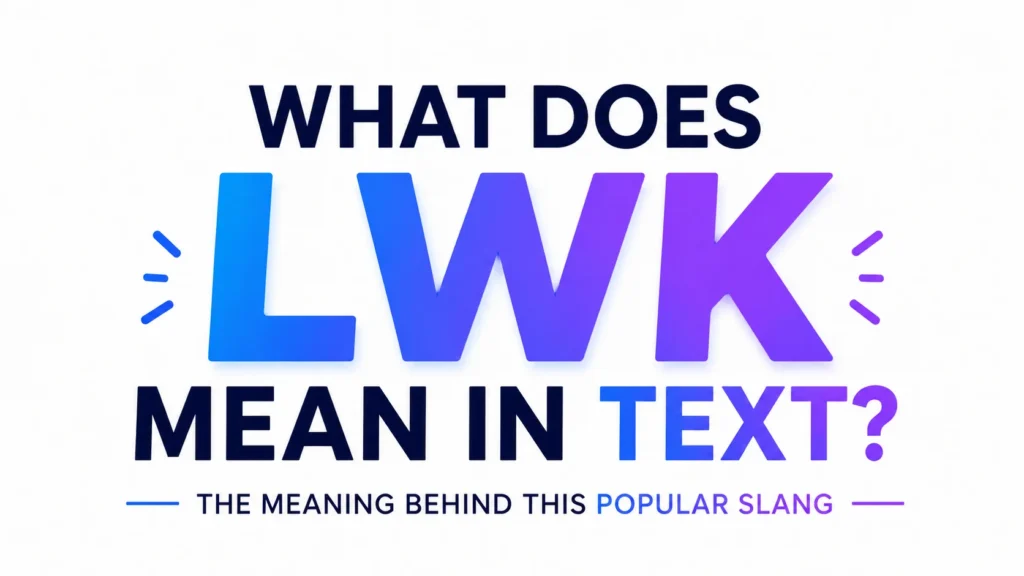
If you spend time on TikTok, Instagram, Snapchat, or texting friends late at night, chances are you’ve seen someone type “lwk” in a sentence and wondered what it actually means.
At first glance, it can look confusing. Some people assume it’s a typo, while others think it stands for a complicated phrase. In reality, “lwk” is one of those modern internet abbreviations that quietly became part of everyday digital conversation.
People search for “what does lwk mean in text” because the tone changes depending on how it’s used. Sometimes it sounds flirty. Other times it feels emotional, sarcastic, or even passive-aggressive. That uncertainty is exactly what makes slang interesting today.
Modern texting is less about perfect grammar and more about emotional shortcuts. A small word like “lwk” can completely change the feeling of a message.
This guide breaks down the meaning, emotional tone, real-life examples, cultural background, and smart ways to use it naturally without sounding awkward.
LWK Meaning in Text – Quick Meaning
Simple Definition
“LWK” usually means “lowkey” in texting and online slang.
People use it to express something subtly, quietly, secretly, or without making a huge deal about it.
It softens emotions and makes statements feel more casual.
Common Meanings of LWK
- Quietly
- Secretly
- Kind of
- Honestly
- Slightly
- Without drawing attention
Quick Examples
“I lwk miss talking to you.”
“That movie was lwk scary.”
“I’m lwk tired today.”
In all three examples, “lwk” reduces intensity while still expressing a real feeling.
Why People Use It
Instead of sounding overly emotional or dramatic, “lwk” helps people communicate feelings in a relaxed way.
That’s why it became extremely popular among Gen Z and social media users.
Origin & Background
Where “Lowkey” Came From
The word “lowkey” existed long before texting culture.
Originally, it meant something done quietly, privately, or without attracting attention. In spoken English, people might say:
“Keep it low-key.”
That phrase traditionally meant staying calm, casual, or discreet.
Over time, internet culture shortened “lowkey” into “lwk” because fast communication rewards shorter typing styles.
Social Media Influence
TikTok and Twitter played a huge role in spreading “lwk.”
Short-form content encouraged quick emotional reactions. Users began typing:
- “lwk obsessed”
- “lwk embarrassing”
- “lwk cute”
- “lwk toxic”
Soon, the abbreviation became part of meme culture and everyday texting.
How the Meaning Evolved
Originally, “lowkey” mostly described secrecy.
Now, it often softens honesty.
For example:
“I lwk want to quit my job.”
This doesn’t necessarily mean secretive. Instead, it suggests emotional hesitation or vulnerability.
That subtle emotional tone is why people connect with the term so strongly.
Read More: What Does STSU Mean on Instagram? Real Meaning and Usage
Real-Life Conversations
WhatsApp Conversation
Person A:
You disappeared yesterday. Everything okay?
Person B:
Yeah, just overwhelmed lwk.
Person A:
I figured something felt off.
Instagram DM Conversation
1st Person:
That picture of you at the beach was fire.
2nd Person:
Stoppp, I lwk almost didn’t post it.
1st Person:
Glad you did honestly.
TikTok Comments
1st Person:
This song healed me emotionally.
2nd Person:
Same. I lwk cried listening to it.
1st Person:
The bridge hits different at night.
Text Message Conversation
1stPerson:
You still mad at me?
2nd Person:
Lwk, yeah.
1st Person:
Fair enough. I deserved that.
These examples show how “lwk” adds emotional softness instead of harsh directness.
Emotional & Psychological Meaning
Why “LWK” Feels So Personal
Digital communication changed how people express emotions.
Many users avoid sounding “too intense,” especially online. “Lwk” helps people admit feelings while protecting themselves emotionally.
Instead of saying:
“I’m deeply hurt.”
Someone may say:
“I’m lwk hurt by that.”
The second version feels safer emotionally.
Emotional Functions of “LWK”
People use it to:
- Reduce vulnerability
- Sound casual
- Avoid judgment
- Express hidden emotions
- Add humor to serious feelings
Modern Communication Psychology
Today’s internet culture rewards emotional subtlety.
Direct statements sometimes feel uncomfortable online. Softening language with words like “lwk” creates emotional distance while still communicating truth.
That’s why phrases like these became common:
- “lwk jealous”
- “lwk nervous”
- “lwk attached”
- “lwk annoyed”
Personal-Style Scenario
A college student might text:
“I lwk miss home.”
That tiny abbreviation makes the message feel less heavy while still revealing genuine emotion.
Many people communicate this way because it feels emotionally safer than full honesty.
Usage in Different Contexts
Social Media Usage
On TikTok, Instagram, and Snapchat, “lwk” often appears in captions, comments, and reactions.
Examples:
- “Lwk my favorite outfit.”
- “This trend is lwk annoying.”
- “I’m lwk addicted to this song.”
The tone is casual and expressive.
Friends & Relationships
Among friends, “lwk” creates softer emotional conversations.
Examples:
- “I lwk miss hanging out.”
- “You lwk changed recently.”
- “I lwk thought you forgot me.”
In relationships, it can sound playful, emotional, or flirtatious.
Work & Professional Settings
Using “lwk” at work depends heavily on the environment.
It may be acceptable in casual team chats among younger coworkers. However, it usually feels too informal for:
- Client emails
- Professional presentations
- Formal communication
For example, avoid writing:
“I’m lwk concerned about the deadline.”
Instead, use clearer professional language.
Casual vs Serious Tone
“Lwk” works best in relaxed conversation.
It can soften serious topics, but overusing it during emotional discussions may seem immature or unclear.
Tone always matters.
When NOT to Use It
Formal Communication
Avoid “lwk” in:
- Job applications
- Academic essays
- Professional reports
- Business emails
It may appear unprofessional or confusing.
Sensitive Conversations
Sometimes emotional clarity matters more than internet slang.
For example, during serious relationship discussions, using “lwk” too much can make feelings seem indirect.
Instead of:
“I’m lwk upset.”
A clearer statement may communicate better.
Cultural Misunderstandings
Not everyone understands internet abbreviations equally.
Older generations or non-native English speakers may misunderstand the meaning completely.
Situations Where Tone Can Be Misread
Text lacks facial expressions and vocal tone.
As a result, “lwk” can accidentally sound:
- Passive-aggressive
- Sarcastic
- Emotionally distant
Context matters more than the word itself.
Common Misunderstandings
Thinking It Means Something Offensive
Some people assume “lwk” stands for a hidden phrase or inappropriate slang.
Usually, it simply means “lowkey.”
Confusing Literal vs Emotional Meaning
People often interpret it too literally.
“Lowkey” doesn’t always mean secretive anymore.
Example:
“I lwk love this song.”
The person isn’t hiding the feeling. They’re simply expressing it casually.
Tone Confusion
Depending on context, “lwk” may sound:
- Funny
- Sad
- Shy
- Flirty
- Sarcastic
That flexibility creates misunderstandings sometimes.
Assuming It’s Always Gen Z Slang
Although Gen Z popularized it online, many millennials and older users now understand and use it too.
Internet language spreads quickly across generations.
Comparison Table
| Expression | Meaning | Tone | Example |
| LWK | Lowkey/subtly | Soft, casual | “I lwk agree.” |
| Highkey | Openly/intensely | Strong, direct | “I highkey love this.” |
| TBH | To be honest | Honest/confessional | “TBH, I was nervous.” |
| IMO | In my opinion | Neutral | “IMO, that was unfair.” |
| FR | For real | Serious/emphatic | “That hurt fr.” |
| IDC | I don’t care | Dismissive | “IDC anymore.” |
| Kinda | Somewhat/slightly | Casual | “I’m kinda tired.” |
| Secretly | Hidden feeling | More serious | “I secretly liked it.” |
Key Insight
“Lwk” stands out because it combines honesty with emotional softness. It allows people to express real feelings without sounding overly dramatic.
Variations / Types
Lwk funny
Used when something is quietly amusing.
Example:
“That joke was lwk hilarious.”
Lwk sad
Expresses hidden sadness gently.
Example:
“I’m lwk emotional today.”
Lwk obsessed
Shows growing interest or attachment.
Example:
“I’m lwk obsessed with this series.”
Lwk mad
Softens anger.
Example:
“She’s lwk mad at you.”
Lwk jealous
Expresses envy casually.
Example:
“I’m lwk jealous honestly.”
Lwk toxic
Describes subtle unhealthy behavior.
Example:
“That friendship feels lwk toxic.”
Lwk cute
A compliment with relaxed tone.
Example:
“That outfit is lwk cute.”
Lwk nervous
Suggests mild anxiety.
Example:
“I’m lwk nervous for tomorrow.”
Lwk annoying
Used for frustration without sounding harsh.
Example:
“This app is lwk annoying lately.”
Lwk in love
Often playful or flirtatious.
Example:
“He’s lwk in love with her.”
How to Respond When Someone Uses It
Casual Replies
- “I get that.”
- “Same honestly.”
- “Fair enough.”
- “Lowkey true.”
Funny Replies
- “Only lwk?”
- “You mean highkey.”
- “Caught you being emotional.”
- “That sounds suspiciously honest.”
Mature Replies
- “Thanks for being real with me.”
- “I appreciate your honesty.”
- “Want to talk about it?”
Respectful Replies
- “That makes sense.”
- “I understand where you’re coming from.”
- “No judgment here.”
Your response should match the emotional energy of the conversation.
Regional & Cultural Usage
Western Culture
In the United States and Canada, “lwk” is heavily tied to Gen Z texting culture.
It’s common in casual online communication and meme culture.
Asian Culture
Many Asian internet users adopt English slang through TikTok, gaming, and K-pop communities.
However, usage may feel trend-driven rather than deeply conversational.
Middle Eastern Culture
In Middle Eastern online spaces, “lwk” appears mostly among bilingual younger users familiar with global internet slang.
Tone interpretation may vary depending on English fluency.
Global Internet Usage
Internet slang now travels faster than ever.
Platforms like TikTok create shared digital language across countries. As a result, terms like “lwk” became globally recognizable.
Generational Differences
Gen Z uses “lwk” naturally in daily texting.
Millennials may understand it but use it less frequently.
Older generations sometimes find it confusing or unnecessary.
Is It Safe for Kids?
Short Answer
Yes, generally.
“Lwk” is not considered offensive or dangerous slang.
Context Still Matters
Although harmless, the surrounding conversation matters more than the abbreviation itself.
Parents should understand that internet slang constantly evolves, and words may carry emotional meanings depending on context.
Teaching healthy communication is usually more important than policing every slang term.
FAQs
What does lwk mean in texting?
“Lwk” usually means “lowkey.” It expresses something subtly, casually, or without strong intensity.
Is lwk positive or negative?
It can be either. The tone depends on the sentence and emotional context.
Do people still use lwk in 2026?
Yes. It remains common on TikTok, Instagram, Snapchat, and casual texting.
Is lwk the same as lowkey?
Yes. “Lwk” is simply a shortened typing version of “lowkey.”
Can lwk be used in serious conversations?
Sometimes, but clarity matters. In emotional discussions, direct communication may work better.
Is lwk rude?
No. It’s generally casual and harmless unless paired with rude statements.
Why do Gen Z users say lwk so often?
It helps soften emotions and keeps conversations feeling relaxed and natural online.
Conclusion
Understanding what “lwk” means in text is really about understanding modern communication itself.
People today often balance honesty with emotional protection. Words like “lwk” allow them to express feelings without sounding too intense, vulnerable, or dramatic.
That’s why the term became so popular across texting, TikTok, Instagram, and everyday digital conversations.
Used naturally, “lwk” adds personality, softness, humor, and emotional nuance to messages. Still, context matters. Knowing when to use it — and when not to — makes communication clearer and more authentic.
Language keeps evolving online, but the reason people use slang stays surprisingly human: everyone wants to feel understood without feeling exposed.

1 thought on “What Does LWK Mean in Text? Usage & Social Media Context”