
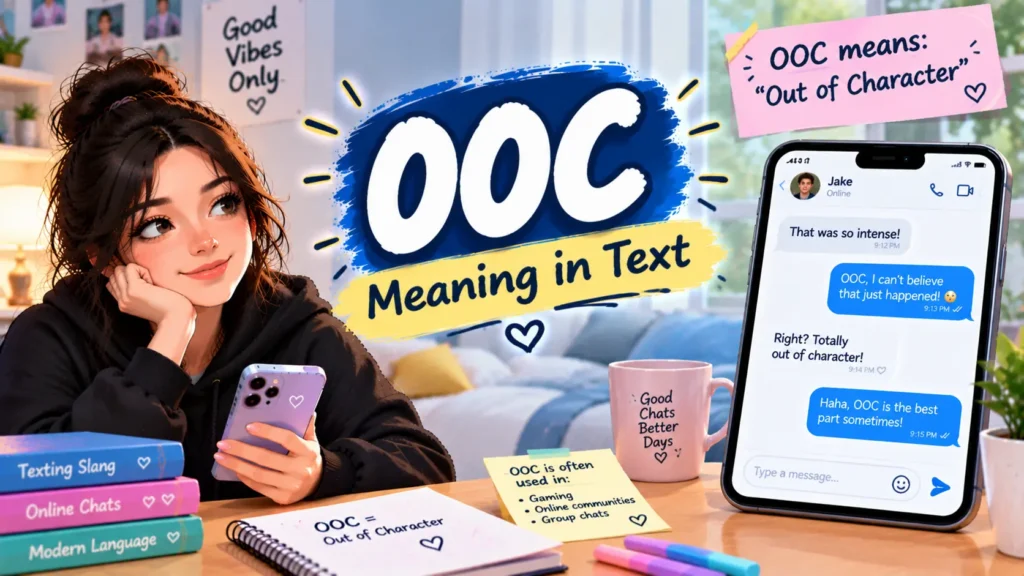
Have you ever seen OOC in a text message, online game, social media comment, or role-playing conversation and wondered what it means? Internet slang can be confusing because the same abbreviation may have different meanings depending on the situation.
In online conversations, OOC most commonly means “Out of Character.” It is used when someone wants to speak as themselves instead of acting as a fictional character in a role-play, game, or story.
For example, someone might write, “OOC, I need to leave for dinner.” This tells the other participants that the person is stepping outside the role-play to share something from real life.
In some contexts, OOC can also mean “Out of Context,” particularly when people discuss screenshots, jokes, comments, or information that has been separated from its original situation.
Understanding the conversation is the easiest way to determine which meaning applies. In this article, you will learn what OOC means in text, how people use it on social media and in gaming, how to respond to it, and how it differs from similar abbreviations.
What Does OOC Mean in Text?
The most common meaning of OOC in online role-playing and gaming conversations is “Out of Character.”
People use this abbreviation when they want to pause their character’s actions or dialogue and communicate as themselves.
For example:
Player 1: The wizard opens the ancient door.
Player 2: OOC, should we wait for another player before continuing?
In this example, the second player is temporarily stepping outside the fictional scene to ask a real-world question.
OOC is useful because role-playing conversations often mix fictional dialogue with ordinary communication. The abbreviation helps everyone understand which type of message they are reading.
It can also be used in fan communities, collaborative storytelling, online forums, and games where participants pretend to be particular characters.
What Does OOC Stand For?
OOC stands for Out of Character.
The phrase describes a moment when someone stops speaking or behaving as their fictional character and communicates in their normal voice.
Here is a simple breakdown:
- O — Out
- O — Of
- C — Character
For example, imagine that you are role-playing as a medieval knight. During the scene, you write dialogue as the knight. However, you need to tell another player that you will be unavailable for the next hour.
You might write:
“OOC: I’ll be back in an hour.”
This makes it clear that the message is about your real schedule rather than something your character would say.
The abbreviation is especially helpful when several people are contributing to the same fictional story.
Read More :What Does B4 Mean in Roblox? Meaning and Examples
How Is OOC Used in Text Messages?
Although OOC is strongly associated with role-playing, people may encounter it in other online conversations. Its meaning depends on the subject and the surrounding words.
1. Stepping Out of a Role-Play
This is one of the most common uses of OOC.
For example:
“ OOC, can we change the scene? I have another idea.”
The speaker is temporarily leaving the fictional conversation to discuss how the role-play should continue.
2. Sharing Real-Life Information
Someone may use OOC to explain a real-world situation while participating in a fictional activity.
Example:
“OOC, my internet is acting up, so I might disconnect.”
The message refers to the person’s actual internet connection, not their character’s experience.
3. Asking a Question Outside the Story
OOC can separate a practical question from the fictional dialogue.
Example:
“OOC: Are we meeting in the same game lobby tomorrow?”
The speaker is asking about real-world coordination rather than continuing the story.
4. Clarifying a Character’s Actions
Role-players sometimes use OOC to discuss a character’s behavior or the direction of a story.
Example:
“OOC, I think my character would react differently to this situation.”
The person is discussing the role-play itself instead of speaking as the character.
5. Referring to Something Out of Context
In some discussions, it may mean “Out of Context.” This interpretation is more likely when people are talking about a screenshot, quote, joke, or statement that has been removed from its original setting.
Example:
“That comment sounds strange OOC.”
The person may mean that the comment seems unusual when viewed without the surrounding conversation.
However, “Out of Context” is not the default meaning in every community. Consider the subject before interpreting the abbreviation.
OOC Meaning in Gaming
In online gaming, OOC commonly means “Out of Character,” particularly in role-playing games and multiplayer communities.
Players may use it to communicate about gameplay arrangements, technical problems, schedules, or story decisions without mixing those messages with their characters’ actions.
For example:
Player 1: The ranger enters the forest.
Player 2: OOC, I need to restart my game.
The second player is talking about a real technical issue, not describing something happening to their character.
it is particularly useful in games where players remain in character during most of their interactions. It provides a simple way to switch between fictional storytelling and ordinary conversation.
Not every gaming community uses OOC in exactly the same way, so community-specific rules may also matter.
OOC Meaning in Role-Playing Chats
Role-playing communities frequently use OOC to keep fictional stories organized and easy to follow.
Participants may act as original characters, characters from books or movies, or avatars created for a game. During a role-play, they usually write dialogue and actions that fit their characters.
However, they may need to discuss something outside the story. This is where OOC becomes useful.
For example:
In character:
Lena looks toward the castle and whispers, “We should leave before sunrise.”
Out of character:
“OOC: I need to log off in ten minutes, so can we finish this scene soon?”
The distinction allows participants to maintain the story while still communicating clearly with each other.
Some communities mark in-character dialogue with labels such as IC and use OOC for ordinary discussion. Others rely on formatting, brackets, or separate chat channels.
Always follow the conventions of the group you are participating in.
OOC Meaning on Discord
On Discord, OOC is often used in role-playing servers, gaming communities, and collaborative storytelling channels.
For example:
“OOC: Does anyone know when the next event starts?”
This indicates that the question is about the community or its schedule rather than the fictional world.
Some Discord servers have dedicated OOC channels where members can discuss rules, ask questions, share updates, and coordinate activities outside the role-play.
In other servers, members may use the abbreviation directly in a conversation.
OOC is not an official Discord feature. It is a community abbreviation, and its meaning may differ depending on the server’s topic.
OOC Meaning on Snapchat and Instagram
On Snapchat and Instagram, OOC may appear in direct messages, comments, fan communities, or conversations involving role-playing.
Its interpretation depends on the type of conversation.
For example, if two people are discussing a role-play on Instagram, one might write:
“OOC, I won’t be online tonight.”
This means the person is sharing a real-life update outside the fictional story.
In a conversation about a funny screenshot, however, OOC might refer to something being “Out of Context.”
Unlike some widely recognized texting abbreviations, OOC does not have one fixed meaning specific to Snapchat or Instagram. Look at the surrounding message to understand what the sender intends.
OOC Meaning in Fandom Communities
Fans of books, movies, television shows, anime, and video games often participate in role-playing or character discussions.
In these communities, OOC usually means “Out of Character” when someone discusses how a character behaves in a story or role-play.
For example:
“I think that response is OOC for her.”
Here, the speaker means that the character’s behavior seems inconsistent with their established personality.
This usage is slightly different from stepping out of a role-play. Instead of describing a real-life message, OOC can be used to criticize or discuss a fictional character’s actions.
For instance, a character known for being honest might suddenly lie without a convincing explanation. A fan could describe that behavior as out of character.
The precise meaning depends on whether the conversation concerns a participant’s role-play behavior or a fictional character’s personality.
What Does OOC Mean When Describing a Character?
When someone says a character is OOC, they usually mean that the character is acting in a way that does not fit their established personality, history, or usual behavior.
For example:
“His decision to abandon his friends feels OOC.”
This suggests that the decision does not match what the audience expects from the character.
OOC behavior may happen in fan fiction, collaborative storytelling, online role-playing, or discussions about movies and television shows.
However, not every unexpected action is necessarily a mistake. Characters can change, learn, or behave differently under pressure. Whether an action feels out of character depends on how well the story explains it.
OOC Meaning in Text From a Girl or a Guy
If a girl or guy sends you OOC, the meaning depends on the conversation rather than the sender’s gender.
When a Girl Says OOC
A girl participating in role-play might use OOC to explain something about her real life or discuss the story outside her character.
Example:
“OOC, I’ll be busy with school tomorrow, so I might reply late.”
She is talking about her real schedule rather than her character’s activities.
When a Guy Says OOC
A guy might use OOC to clarify a role-play detail, mention a technical problem, or discuss an upcoming scene.
Example:
“OOC, can we start the next part after dinner?”
He is coordinating with the other participants outside the fictional story.
In either case, OOC does not automatically indicate flirting, anger, or any other particular emotion. The rest of the message provides the relevant clues.
How to Reply When Someone Says OOC
Your response should match the reason the person used the abbreviation. You can usually reply naturally without using any special slang.
Here are some examples.
If someone shares a real-life update:
- “No problem, take your time.”
- “Thanks for letting me know.”
- “That’s totally fine.”
- “We can continue later.”
If someone asks a role-play question:
- “Sure, let’s change the scene.”
- “I agree with that idea.”
- “Let’s discuss the details first.”
- “We can continue from there.”
If someone says a character is acting OOC:
- “What part feels out of character?”
- “That’s a good point.”
- “Maybe we should adjust the dialogue.”
- “I can see why you think that.”
If you do not understand the abbreviation:
- “What does OOC mean here?”
- “Are you talking outside the role-play?”
- “Do you mean out of character?”
Asking for clarification is perfectly acceptable when the context is unclear.
OOC vs. IC: What Is the Difference?
OOC and IC are closely related abbreviations in role-playing communities, but they have opposite functions.
OOC means “Out of Character.”
IC means “In Character.”
The difference is simple: OOC messages come from the participant as themselves, while IC messages are written or spoken as the fictional character.
| Abbreviation | Full form | Purpose |
|---|---|---|
| OOC | Out of Character | Communicating outside the role-play |
| IC | In Character | Speaking or acting as a fictional character |
For example:
IC: “I will protect this village with my life!”
OOC: “I’ll be away from my computer for an hour.”
The first statement belongs to the fictional character. The second is a real-life message from the player.
Understanding this distinction makes role-playing conversations much easier to follow.
OOC vs. Other Texting Abbreviations
OOC may appear alongside other internet abbreviations. Learning a few related terms can help you understand online discussions more easily.
| Abbreviation | Meaning | Common use |
|---|---|---|
| OOC | Out of Character | Speaking outside a role-play |
| IC | In Character | Speaking as a fictional character |
| IRL | In Real Life | Referring to real-world experiences |
| POV | Point of View | Showing a particular perspective |
| IMO | In My Opinion | Sharing a personal opinion |
| BTW | By the Way | Introducing an additional point |
| FYI | For Your Information | Sharing useful information |
| OOTD | Outfit of the Day | Sharing or describing an outfit |
These abbreviations are not interchangeable.
For example, IRL refers to real life generally, while OOC is especially associated with stepping outside a role-play or discussing a character’s behavior.
Similarly, POV refers to a perspective rather than a switch between fictional and ordinary communication.
Is OOC Formal or Informal?
OOC is an informal abbreviation most commonly found in online communities, role-playing games, fandom discussions, and casual digital conversations.
It is appropriate when communicating with people who understand the terminology. In a formal email, workplace report, or academic assignment, writing the full phrase is usually clearer.
For example:
Informal: “OOC, I’ll be late tonight.”
Clearer formal wording: “Outside the role-play, I wanted to let you know that I’ll be late tonight.”
When discussing a fictional character in an article or review, you can also write “out of character” in full the first time before using the abbreviation later.
Common Mistakes When Understanding OOC
Although OOC is straightforward in many situations, people sometimes misunderstand it.
1. Assuming It Always Means “Out of Character”
This is the main meaning in role-playing communities, but OOC can also mean “Out of Context” in some discussions.
2. Confusing OOC With IC
IC means “In Character,” whereas OOC means “Out of Character.” The two labels identify different kinds of communication.
3. Thinking OOC Is Always About Gaming
it is common in gaming, but it also appears in fan fiction, storytelling, character analysis, and other online communities.
4. Assuming OOC Means Someone Is Angry
The abbreviation itself does not indicate anger or annoyance. Someone might use it to ask a simple question, share a schedule update, or explain a technical problem.
5. Ignoring the Surrounding Conversation
A discussion about a role-play is likely to use OOC in the “Out of Character” sense. A discussion about a screenshot or an isolated statement may use it to mean “Out of Context.”
Frequently Asked Questions About OOC
What does OOC mean in text?
OOC most commonly means “Out of Character” in role-playing and gaming conversations. It signals that someone is speaking as themselves rather than as their fictional character.
What does OOC stand for in chat?
In role-playing chats, OOC stands for “Out of Character.” In some other online contexts, it can mean “Out of Context.”
What does OOC mean in gaming?
In gaming, OOC usually means “Out of Character.” Players use it to discuss real-life matters, technical issues, or gameplay arrangements outside the fictional experience.
What does OOC mean on Discord?
On Discord, OOC is commonly used in role-playing servers and gaming communities to mark messages that are outside the fictional story.
What does OOC mean in role-play?
In role-play, OOC means that a participant is communicating outside their character. It can be used for questions, explanations, scheduling, and discussions about the story.
What does OOC mean when describing a character?
It means “out of character.” The character is behaving in a way that seems inconsistent with their established personality or usual behavior.
Does OOC mean “Out of Context”?
It can. Some people use OOC to describe a quote, image, or comment presented without its original context. However, “Out of Character” is the more common meaning in role-playing communities.
What is the difference between OOC and IC?
OOC means “Out of Character,” while IC means “In Character.” OOC messages come from the participant as themselves, and IC messages belong to the fictional role-play.
How should I respond to OOC?
Respond according to the message. You can acknowledge a real-life update, answer a role-play question, or ask for clarification if you are unsure what the sender means.
Final Thoughts
OOC usually means “Out of Character” in texting, gaming, and online role-playing communities. It helps people distinguish real-life communication from fictional dialogue and actions.
The abbreviation can also mean “Out of Context” when people discuss information that has been separated from its original setting. The topic of the conversation will usually help you identify the intended meaning.
Once you understand the difference between OOC and IC, it becomes much easier to follow role-playing conversations, communicate with other players, and understand how people use the abbreviation online.

1 thought on “OOC Meaning in Text: What Does OOC Stand For?”