
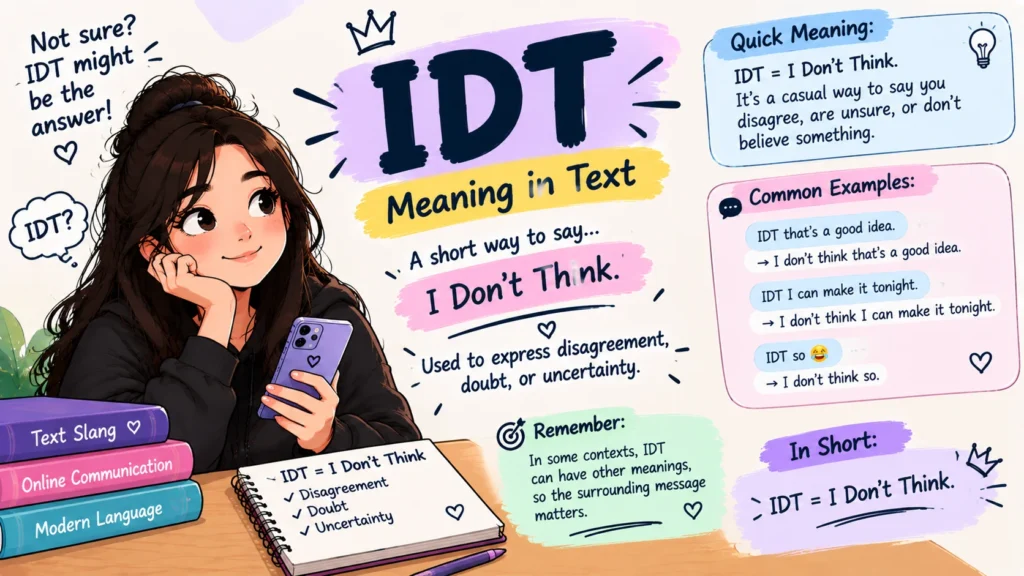
Have you ever received a message like “IDT so” or “IDT he’s coming” and wondered what those three letters meant?
In texting and social media conversations, IDT most commonly means “I Don’t Think.” It is a quick abbreviation people use when expressing doubt, disagreement, uncertainty, or a personal opinion.
Instead of typing “I don’t think so,” someone might simply write “IDT so.” The shorter version fits naturally into fast conversations on messaging apps, social platforms, gaming chats, and group discussions.
The tone can change depending on the surrounding words. “IDT 😂” may sound playful, while “IDT that’s a good idea” can communicate genuine disagreement.
Understanding the context is important because abbreviations can occasionally have different meanings in specialized communities.
IDT Meaning in Text – Quick Meaning
The most common texting meaning of IDT is:
IDT = I Don’t Think
It is generally used when someone wants to express an opinion, uncertainty, or disagreement without writing the complete phrase.
Common examples:
“IDT so.”
Meaning: “I don’t think so.”
“IDT he’ll come.”
Meaning: “I don’t think he’ll come.”
“IDT that’s right.”
Meaning: “I don’t think that’s right.”
The abbreviation is informal, so it fits better in casual conversations than in formal writing.
Where Did IDT Come From?
IDT does not have one clearly established origin as a modern slang term. It follows a much older pattern in digital communication: shortening frequently used phrases into their initial letters.
As texting became faster and more conversational, expressions such as “I don’t know,” “I don’t care,” and “I don’t think” naturally became candidates for abbreviation.
IDT follows the same logic as familiar expressions such as IDK for “I don’t know” and IMO for “in my opinion.”
The growth of smartphones, instant messaging, social media, and online communities made this style of communication increasingly familiar.
Today, IDT can appear in private messages, group chats, comments, gaming conversations, and casual online discussions.
Read More : WTP Meaning in Text: What Does WTP Mean?
IDT in Real-Life Conversations
The easiest way to understand IDT is to see how it works in ordinary conversations.
WhatsApp Conversation
Person A:
“Are you coming to the party tonight?”
Person B:
“IDT. I have too much work 😭”
Person A:
“Fair enough. Maybe next time.”
Here, IDT means “I don’t think [I am].”
Instagram DM
Person A:
“Do you think he saw my message?”
Person B:
“IDT he did. He hasn’t been online.”
The abbreviation makes the response sound relaxed and conversational.
TikTok Comments
Person A:
“Do you think this trend will still be popular next month?”
Person B:
“IDT 😂”
The short response expresses doubt without requiring a full sentence.
Text Message
Person A:
“Think we can finish everything by 6?”
Person B:
“IDT. There’s still so much left.”
The meaning is clear from the surrounding conversation.
The Emotional and Psychological Meaning of IDT
At first glance, IDT is simply an abbreviation. Its emotional effect depends heavily on how it is written.
When someone says “IDT so,” they may be gently disagreeing rather than directly saying, “You are wrong.”
That can make the expression feel less confrontational.
Compare these two messages:
“You’re wrong.”
and:
“IDT that’s correct.”
The second one presents disagreement as the sender’s perspective rather than an absolute attack.
IDT can also communicate uncertainty. Someone may genuinely lack enough information to be confident, so “I don’t think” leaves room for another possibility.
A short message from a friend once might read, “IDT you should go tonight.” That does not automatically mean they are trying to control the decision. They could simply be expressing concern based on what they know.
Tone and relationship matter.
How IDT Is Used in Different Contexts
IDT on Social Media
On Instagram, TikTok, Snapchat, and similar platforms, IDT can be used as a quick reaction to a statement or prediction.
For example:
“IDT this is real.”
or:
“IDT anyone is actually doing this.”
The abbreviation keeps the response short and informal.
IDT Between Friends
Friends often use IDT when disagreeing casually.
“IDT we have enough time.”
“IDT she’s coming.”
“IDT that movie is worth watching.”
The expression usually sounds less formal than writing the entire sentence.
IDT in Relationships
Partners may use IDT when expressing an opinion or concern.
“IDT we should argue about this again.”
“IDT he meant it that way.”
The meaning itself is simple, but emotional tone depends on the relationship and the rest of the conversation.
IDT in Work Conversations
IDT is generally more appropriate for informal workplace chats than formal emails.
A colleague might write:
“IDT we need another meeting.”
In a formal report, however, it would be better to write:
“I do not think another meeting is necessary.”
The audience should determine the level of informality.
Casual vs. Serious Use
IDT can work in both casual and serious conversations, but the surrounding wording matters.
Casual:
“IDT 😂”
More serious:
“IDT this approach will solve the issue.”
The abbreviation stays the same while the context changes its emotional weight.
When Not to Use IDT
IDT is useful shorthand, but it is not suitable everywhere.
Formal Emails
Avoid using IDT in important professional emails unless your workplace communication is highly informal.
Writing “I don’t think” is clearer and more professional.
Academic Writing
Academic assignments, research papers, and formal essays generally require complete words and sentences.
Instead of:
“IDT this argument works.”
write:
“I do not think this argument is sufficiently supported.”
Serious or Sensitive Conversations
A serious issue may deserve more thoughtful language than a three-letter abbreviation.
If someone is discussing grief, conflict, health, or another sensitive matter, a complete sentence can communicate care more effectively.
When the Reader May Not Know Slang
Not everyone recognizes texting abbreviations.
If you’re communicating with someone unfamiliar with digital slang, spelling out the phrase avoids unnecessary confusion.
Common Misunderstandings About IDT
IDT Always Means “I Don’t Think”
In ordinary texting, that is the most common interpretation. However, abbreviations can have specialized meanings in different industries, organizations, or communities.
Context remains important.
IDT Means the Person Is Angry
Not necessarily.
“IDT” can be completely neutral.
For example:
“IDT it’s going to rain.”
That is simply an opinion or prediction.
IDT Is Always a Strong Disagreement
The phrase often softens disagreement because it presents the statement as the sender’s view.
Compare:
“That’s false.”
with:
“IDT that’s correct.”
The second can sound less direct.
IDT and IDK Mean the Same Thing
They do not.
IDK means “I Don’t Know.”
IDT means “I Don’t Think.”
For example:
“IDK where he went.”
means the person does not know.
“IDT he went home.”
means the person believes he probably did not go home.
IDT Compared With Similar Expressions
| Expression | Meaning | Typical Tone |
|---|---|---|
| IDT | I Don’t Think | Doubt or disagreement |
| IDK | I Don’t Know | Uncertainty |
| IMO | In My Opinion | Personal viewpoint |
| IMHO | In My Humble Opinion | Personal viewpoint, often informal |
| TBH | To Be Honest | Direct opinion |
| NGL | Not Gonna Lie | Honest reaction |
| I Guess | Uncertain opinion | Casual |
| I Don’t Think So | Expressing doubt | Direct but usually mild |
| Maybe Not | Possible disagreement | Soft |
| Probably Not | Low likelihood | More confident doubt |
Key Insight
IDT is usually a softer way to express doubt than making a blunt statement. It tells the reader, “This is how I see it,” while leaving some room for another possibility.
Common Variations of IDT
IDT So
Meaning: I don’t think so.
This is one of the most recognizable uses of IDT.
IDT Tbh
Meaning: I don’t think so, to be honest.
Adding TBH makes the response feel more candid.
IDT TBH
Meaning: I don’t think, to be honest.
The exact interpretation depends on the rest of the sentence.
IDT He Will
Meaning: I don’t think he will.
Usually used when discussing someone’s expected action.
IDT She Knows
Meaning: I don’t think she knows.
Used when expressing uncertainty about another person’s knowledge.
IDT That’s Right
Meaning: I don’t think that’s correct.
Often used during a disagreement or correction.
IDT We Can
Meaning: I don’t think we can.
Useful when discussing whether something is possible.
IDT It Matters
Meaning: I don’t think it matters.
Can be casual or serious depending on context.
IDT So Tbh
Meaning: I don’t think so, to be honest.
This gives the message a more conversational tone.
IDT Anymore
Meaning: I don’t think so anymore.
This can suggest that the sender has changed their previous opinion.
How to Respond When Someone Uses IDT
Your response should match the situation.
Casual Replies
“Yeah, maybe you’re right.”
“Fair enough.”
“I was thinking the same thing.”
Funny Replies
“IDT is fighting words 😂”
“Okay, professor of predictions 😂”
“We’ll see about that 👀”
Mature Replies
“I understand why you think that.”
“That’s fair. I see it differently, though.”
Respectful Replies
“I understand your point. Let’s see what happens.”
“That’s possible. We may need more information.”
If You Want Clarification
“What makes you think that?”
This is especially useful when the person’s opinion matters and you want to understand their reasoning rather than immediately disagreeing.
Regional and Cultural Usage of IDT
Western Online Communication
IDT fits naturally into casual English-language texting and social media communication.
Its use is influenced more by digital habits and familiarity with abbreviations than by nationality alone.
Asian Digital Communication
English texting abbreviations are common in many online communities across Asia, particularly among people who regularly use English alongside another language.
The exact frequency of IDT varies between communities and age groups.
Middle Eastern Digital Communication
English abbreviations can also appear in multilingual online conversations, especially when English is commonly used for digital communication.
Local language and platform culture can influence how frequently such shorthand appears.
Global Internet Usage
Social media has made digital abbreviations increasingly recognizable across borders.
A person may understand IDT even if English is not their first language because they have encountered it repeatedly online.
Gen Z vs. Millennials
Both Gen Z and Millennials use abbreviations, although individual preferences differ.
Younger users may be especially comfortable with compressed communication, while some older users prefer complete phrases.
There is no universal age rule for understanding IDT.
Is IDT Safe for Kids?
IDT is generally harmless when it means “I Don’t Think.”
The abbreviation itself does not indicate inappropriate content.
The important factor is the context in which it appears. Children may encounter unfamiliar abbreviations online, so they should consider the entire conversation rather than assuming every abbreviation has only one meaning.
Parents and educators can encourage children to ask about unfamiliar online language instead of responding based on a guess.
FAQs About IDT Meaning in Text
What does IDT mean in texting?
IDT most commonly means “I Don’t Think.” People use it to express doubt, uncertainty, or disagreement in casual digital conversations.
What does IDT mean on Instagram?
On Instagram, IDT usually means “I Don’t Think.” It can appear in DMs, comments, or group conversations.
What does “IDT so” mean?
“IDT so” means “I don’t think so.” It is a short way to express disagreement or doubt.
Is IDT a slang word?
IDT is better described as a texting abbreviation rather than a traditional slang word. It is mainly used in informal digital communication.
What is the difference between IDT and IDK?
IDT means “I Don’t Think,” while IDK means “I Don’t Know.” IDT usually expresses an opinion or belief, whereas IDK expresses a lack of knowledge.
Can IDT sound rude?
IDT is not inherently rude. However, a very short response such as “IDT” can sometimes feel dismissive depending on the relationship and conversation.
Should I use IDT in formal writing?
It is better to avoid IDT in formal writing. Use the complete phrase “I don’t think” or “I do not think” instead.
Conclusion: Understanding IDT in Modern Texting
IDT most commonly means “I Don’t Think” in text messages, chats, and social media.
People use it when they want to express doubt, disagreement, uncertainty, or a personal opinion without typing the complete phrase.
Its meaning is simple, but its tone can change considerably depending on the message surrounding it. “IDT so 😂” may feel playful, while “IDT this is the right decision” can communicate a serious opinion.
The best way to understand IDT is to look beyond the three letters. Consider the conversation, the relationship, and the emotion behind the message.
Once you recognize those clues, IDT becomes one of those small texting abbreviations that is easy to understand and even easier to use naturally.


1 thought on “IDT Meaning in Text: What Does IDT Mean?”