
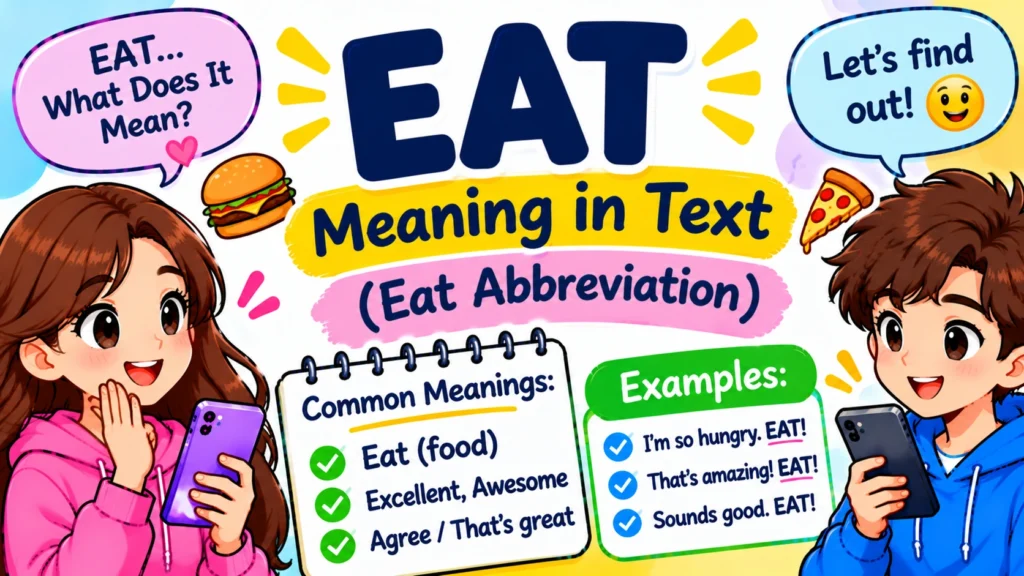
Have you ever come across the abbreviation EAT in a message, online discussion, workplace document, or social media post and wondered what it means? Unlike many popular texting abbreviations, EAT can have several meanings depending on where it appears.
In everyday English, EAT is primarily a regular verb meaning to consume food. However, when someone searches for the EAT abbreviation, they may be looking for its meaning in business, education, technology, communication, or online conversations.
Understanding the surrounding context is essential because the same three letters can represent different expressions in different fields.
This guide explores the common meanings of EAT, its possible interpretations, practical examples, and how to understand it correctly.
EAT Abbreviation – Quick Meaning
EAT does not have one universal full form. Its meaning depends on the context in which it is used.
Here are some interpretations you may encounter:
- EAT – Estimated Arrival Time: An informal or organization-specific abbreviation for an expected arrival time; ETA is the standard and more widely recognized form.
- EAT – East Africa Time: A recognized time-zone abbreviation used in several East African countries.
- EAT – Employee Assistance Team: A possible organizational abbreviation for a workplace support team.
- EAT – Education and Training: A possible shortened label used in educational or professional settings.
- EAT – Eating: In ordinary English, the word refers to consuming food.
The most important distinction is that some meanings are established terms, while others are context-specific abbreviations.
Origin and Background of EAT
Where Did EAT Come From?
The word “eat” comes from Old English etan, which referred to consuming food. It has Germanic roots and is related to similar words in other European languages.
Over time, EAT became a familiar everyday English word used in conversations, instructions, recipes, and descriptions of daily activities.
Its use as an uppercase abbreviation developed separately through organizations, professional terminology, and specialized communication.
How Digital Communication Influenced Its Use
Online communication encourages people to shorten words and phrases.
Three-letter combinations are particularly common because they are quick to type and easy to recognize within familiar communities.
However, capitalization alone does not prove that a word is an abbreviation. EAT may simply be written in uppercase for emphasis or because of formatting.
EAT in Modern Communication
Today, EAT can appear in different environments:
- Workplace documents and internal team messages.
- International time-zone schedules.
- Educational materials.
- Social media conversations.
- Food-related discussions and online content.
The surrounding sentence usually provides the strongest clue to its meaning.
Read More : What Is a Glizzy? Slang Meaning, Origin & Examples
EAT in Real-Life Conversations
Here are four realistic examples showing how EAT might appear in different situations.
1. WhatsApp Conversation
Person A: Are you coming to dinner tonight?
and,
Person B: Yes, I’ll be there around 8.
Person A: Great! Don’t forget to eat something before coming.
Person B: Haha, I definitely will!
Here, EAT is the ordinary English verb, not an abbreviation.
2. Workplace Chat
Person A: What time is the international meeting?
and,
Person B: The schedule says 10:00 EAT.
moreover,
Person A: Thanks! I’ll adjust my calendar.
Here, EAT means East Africa Time.
3. Instagram DM
Person A: This restaurant looks amazing!
Person B: I know! The food looks delicious.
Person A: I could eat everything on that menu 😂
Person B: Same! Let’s visit this weekend.
In this conversation, EAT is used in its ordinary meaning.
4. Professional Text Message
Person A: Has the delivery team confirmed the schedule?
and,
Person B: They have shared an expected arrival time.
moreover,
Person A: Perfect. Please update the team.
This example illustrates why ETA is generally preferable to EAT when discussing arrival schedules.
Emotional and Psychological Meaning of EAT
Although EAT is a simple word, its meaning can connect with several everyday emotions and experiences.
1. Comfort and Enjoyment
Food is closely connected with happiness, family gatherings, celebrations, and personal comfort.
People often use the word EAT when discussing enjoyable experiences with friends and relatives.
2. Care and Concern
When someone says, “Don’t forget to eat,” they may be expressing concern about another person’s well-being.
It can be a small but meaningful way of showing affection.
3. Social Connection
Sharing meals is an important social activity across many cultures.
Talking about eating can naturally create opportunities for friendship, family bonding, and conversation.
4. Everyday Communication
In professional contexts, an abbreviation such as EAT may simply communicate technical information without expressing an emotion.
A relatable scenario: Imagine a friend who has been studying all day without taking a break. You might message, “You’ve been working for hours. Please eat something.” Although the sentence is simple, it communicates genuine concern.
How EAT Is Used in Different Contexts
Social Media
On Instagram, TikTok, and Facebook, EAT commonly appears as an ordinary English word.
For example:
- “Let’s eat!”
- “Eat well and stay happy.”
- “I could eat this every day.”
It may also appear in uppercase captions for emphasis.
Friends and Relationships
Friends and partners often use EAT when discussing meals, making plans, or reminding each other to take care of themselves.
For example:
“Have you eaten yet?”
This question can communicate care and interest.
Work and Professional Settings
In professional communication, EAT may refer to East Africa Time when discussing schedules.
Other interpretations may be specific to a company’s internal terminology.
Always define unfamiliar abbreviations when communicating with people outside your organization.
Casual vs. Serious Tone
- Casual: “Let’s eat something!”
- Friendly: “Don’t forget to eat.”
- Professional: “The meeting starts at 10:00 EAT.”
- Informational: “Eating a balanced diet supports general health.”
The meaning changes according to the subject and surrounding words.
When NOT to Use EAT as an Abbreviation
EAT should not be used as an unexplained abbreviation when your audience may misunderstand it.
Avoid these situations:
- Formal emails: Spell out unfamiliar abbreviations the first time you use them.
- International scheduling: Make sure recipients understand which time zone EAT represents.
- Academic writing: Use the established terminology required by your subject.
- Business communication: Avoid inventing full forms without checking organizational definitions.
- Casual texting: If you simply mean eating food, write the sentence naturally rather than presenting EAT as a mysterious acronym.
Clear communication is more important than using shortened expressions.
Common Misunderstandings About EAT
Several mistakes can occur when people encounter EAT without enough context.
1. Assuming EAT has only one full form
EAT can represent different things in specialized environments. There is no single universal expansion.
2. Confusing EAT with ETA
ETA means “Estimated Time of Arrival.” EAT is not the standard abbreviation for this expression.
3. Thinking every uppercase word is an acronym
People sometimes write ordinary words in capital letters for emphasis. EAT may simply mean the verb “eat.”
4. Confusing East Africa Time with a food-related expression
When EAT appears beside a clock time, date, or meeting schedule, it may refer to the East Africa Time zone.
5. Assuming workplace meanings apply everywhere
An organization may use EAT for an internal team or project. That does not make the expansion universally recognized.
EAT vs. Similar Abbreviations and Expressions
Understanding similar abbreviations can help you avoid confusion.
| Term | Full Form or Meaning | Main Context |
|---|---|---|
| EAT | East Africa Time | Time zones |
| ETA | Estimated Time of Arrival | Travel and deliveries |
| ETD | Estimated Time of Departure | Travel schedules |
| UTC | Coordinated Universal Time | Global timekeeping |
| GMT | Greenwich Mean Time | Timekeeping |
| EST | Eastern Standard Time | North American time |
| PST | Pacific Standard Time | North American time |
| EDT | Eastern Daylight Time | North American time |
Key Insight
EAT and ETA may look similar, but they serve different purposes. EAT is a recognized time-zone abbreviation for East Africa Time, whereas ETA refers to an estimated arrival time.
Variations and Types of EAT
EAT does not have a fixed list of universally accepted variations. However, these related terms and expressions are useful to understand.
- EAT – East Africa Time: A time zone used in several East African countries.
- EAT – Eating: The ordinary English activity of consuming food.
- ETA – Estimated Time of Arrival: An expected arrival time.
- ETD – Estimated Time of Departure: An expected departure time.
- UTC – Coordinated Universal Time: The international reference standard for time.
- GMT – Greenwich Mean Time: A time standard associated with the zero-degree longitude meridian.
- Food intake: The amount of food a person consumes.
- Meal time: The time when someone usually eats.
- Eat out: To have a meal at a restaurant rather than at home.
- Eat up: To finish all the food on a plate or consume something completely.
These expressions are related to EAT through everyday English or time-related communication, rather than being official spelling variations of the abbreviation.
How to Respond When Someone Uses EAT
Your response should depend on the meaning and situation.
Casual Replies
- “Sure, let’s eat!”
- “I’m hungry too!”
- “Sounds good!”
- “What are we having?”
Funny Replies
- “Food is always a good idea 😂”
- “You read my mind!”
- “My stomach agrees!”
- “Let’s make it a feast!”
Mature Replies
- “Thanks for reminding me.”
- “I’ll grab something to eat shortly.”
- “That timing works for me.”
- “Thanks for confirming the schedule.”
Respectful Replies
- “Thank you for letting me know.”
- “I appreciate the information.”
- “Could you clarify which time zone you mean?”
- “Thanks, I’ll adjust my schedule accordingly.”
If someone uses EAT in a technical conversation, asking for clarification is better than guessing.
Regional and Cultural Usage of EAT
Western Culture
In the United States, Canada, and the United Kingdom, EAT is commonly recognized as the ordinary English word for consuming food.
In international business communication, people may also encounter it as a time-zone abbreviation.
Asian Culture
In countries such as Pakistan, India, Bangladesh, and the Philippines, EAT may appear in international meeting schedules or online discussions.
The ordinary English word is also familiar to many English learners.
Middle Eastern Culture
EAT may appear in international business schedules, especially when coordinating meetings with East African countries.
Food-related uses are also common in everyday English communication.
African Culture
East Africa Time has particular relevance in countries such as Kenya, Tanzania, Uganda, and Ethiopia.
It is commonly used when communicating schedules, arranging meetings, and coordinating regional activities.
Global Internet Usage
International communication has made time-zone abbreviations increasingly important.
People working remotely or communicating across countries should always check the intended time zone rather than assuming everyone follows the same local clock.
Gen Z vs. Millennials
Gen Z and Millennials commonly use EAT as an ordinary word in social media captions and casual conversations.
Their familiarity with its time-zone meaning may depend more on work, education, and international communication than on age.
Is EAT Safe for Kids?
Yes, EAT is a harmless English word and abbreviation in its common uses.
Children may encounter it in school materials, food-related conversations, online content, and international schedules.
Parents and teachers can explain the difference between an ordinary English word and an abbreviation.
For example, children can learn that “eat your breakfast” uses EAT as a verb, while “9:00 EAT” may refer to East Africa Time.
Understanding context helps children develop stronger reading and communication skills.
FAQs About EAT Abbreviation
1. What does EAT stand for?
EAT can stand for East Africa Time, a recognized time-zone abbreviation. It can also have organization-specific meanings, while the lowercase word “eat” means to consume food.
2. What does EAT mean in texting?
In ordinary texting, eat usually refers to consuming food. If written as EAT in a schedule or technical message, it may represent East Africa Time or a context-specific abbreviation.
3. Is EAT the same as ETA?
No. EAT commonly refers to East Africa Time, while ETA stands for Estimated Time of Arrival. They have different meanings and uses.
4. What does EAT mean in a time schedule?
In a time schedule, EAT usually means East Africa Time, which is UTC+3.
5. Which countries use East Africa Time?
Countries including Kenya, Tanzania, Uganda, Ethiopia, and Somalia use East Africa Time (UTC+3).
6. Is EAT a texting slang word?
EAT is not a widely established texting slang abbreviation with one universal meaning. People may use it as an ordinary word or as a context-specific abbreviation.
7. How can I understand EAT correctly?
Look at the surrounding sentence. If it appears beside a time or meeting schedule, it may mean East Africa Time. If it appears in a food-related conversation, it probably refers to eating.
Conclusion
EAT is a useful example of how one short combination of letters can have different meanings across everyday communication and specialized fields.
Its recognized time-zone meaning is East Africa Time, while the ordinary English word refers to consuming food. Other expansions may exist within particular workplaces or communities, but they should not be treated as universal meanings.
The easiest way to understand EAT is to examine the surrounding conversation. Once you recognize the context, choosing the correct interpretation becomes much simpler.
Good communication is not about knowing every abbreviation. It is about understanding what someone is trying to expres.



1 thought on “EAT Abbreviation: Meaning, Full Form & Common Uses”