What It Really
If you spend any time texting, scrolling through social media, or reading online comments, you’ve probably come across the abbreviation SMH. It appears everywhere—from casual text messages and Instagram comments to viral TikTok videos and online discussions.
Many people search for the meaning of SMH in chat because the abbreviation can seem confusing at first. Unlike some internet slang that directly expresses a feeling, SMH often communicates an emotional reaction without clearly stating it. As a result, people may wonder whether it means disappointment, frustration, disbelief, or something else entirely.
The good news is that SMH is actually quite simple once you understand the context behind it. More importantly, learning how people use it can help you better understand modern digital communication and avoid misunderstandings when chatting online.
Meaning of SMH in Chat – Quick Meaning
What Does SMH Mean?
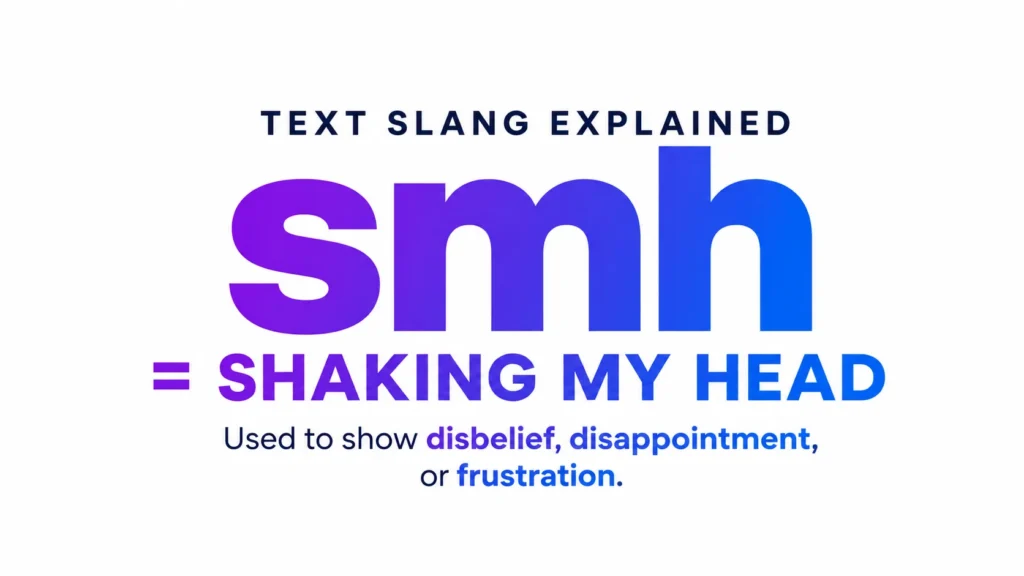
SMH stands for “Shaking My Head.”
People use it when they are disappointed, annoyed, surprised, embarrassed for someone else, or unable to believe what they just saw or heard.
In simple terms, it represents the action of physically shaking your head in disbelief or frustration.
Quick Definition
- SMH = Shaking My Head
- Expresses disappointment, disbelief, frustration, or annoyance
- Common in texting, social media, and online chats
- Usually used informally
Examples
“You forgot your passport again? SMH.”
“He spent all his money on that? SMH.”
“People are still falling for that scam, SMH.”
In each example, the writer is expressing disbelief or disappointment without typing a long explanation.
Origin & Background
Where Did SMH Come From?
SMH emerged during the early years of internet messaging and online forums. As texting became more popular, users began shortening common phrases to communicate faster.
Just as “LOL” replaced “laughing out loud” and “BRB” replaced “be right back,” SMH became a convenient way to express a reaction that would otherwise require several sentences.
Early Internet Culture
Before social media dominated communication, internet users frequently chatted in forums, chat rooms, and instant messaging platforms. Abbreviations helped conversations move quickly.
SMH gained popularity because it captured a universal human reaction. Nearly everyone has experienced a moment that makes them shake their head in disbelief.
Social Media Influence
As platforms like Twitter, Instagram, TikTok, and Facebook grew, SMH spread rapidly.
Its popularity increased because it allowed users to react instantly to:
- Strange news stories
- Viral videos
- Celebrity controversies
- Unexpected personal updates
- Everyday mistakes
How the Meaning Evolved
Originally, SMH mainly represented frustration.
Over time, however, its meaning expanded. Today, it can communicate:
- Mild disappointment
- Playful teasing
- Serious frustration
- Amusement mixed with disbelief
- Sympathy toward a poor decision
The exact meaning depends heavily on context.
Real-Life Conversations
WhatsApp Conversation
Person A: I studied for the wrong exam chapter.
Person B: SMH. How did that even happen?
Person A: I downloaded last year’s syllabus.
Instagram DM Conversation
Person A: I accidentally liked a photo from 2018.
moreover,
Person B: SMH 😂
and,
Person A: Now I have to disappear forever.
TikTok Comments
Person A: He jumped into the pool before checking if there was water.
Person B: SMH people really do anything for views.
Text Message Conversation
Person A: I missed my flight because I overslept.
Person B: SMH. That’s rough.
Person A: Setting ten alarms next time.
These examples show that SMH can be used seriously, humorously, or somewhere in between.
Emotional & Psychological Meaning
What Emotion Does SMH Express?
Although SMH literally means “shaking my head,” emotionally it often communicates:
- Disappointment
- Frustration
- Disbelief
- Mild judgment
- Embarrassment
- Sympathy
The abbreviation helps people express emotions quickly without writing long explanations.
Why People Use It
Modern communication moves fast.
Instead of typing:
“I cannot believe you actually did that.”
Someone may simply write:
“SMH.”
The emotion is immediately understood.
What It Reveals About Modern Communication
SMH reflects how digital communication relies on shared cultural understanding.
People often communicate emotions through abbreviations, emojis, memes, and short reactions rather than lengthy descriptions.
As a result, a single abbreviation can carry significant emotional weight.
A Realistic Scenario
Imagine a friend telling you they ignored multiple reminders and missed an important deadline.
Your immediate reaction might be to shake your head while thinking, “Why would you do that?”
Online, that reaction becomes:
“SMH.”
In many situations, those three letters communicate everything needed.
Usage in Different Contexts
Social Media
On social media, SMH is commonly used when reacting to:
- Viral videos
- News stories
- Celebrity behavior
- Trending discussions
Example:
“Another influencer promoting fake products. SMH.”
Friends & Relationships
Friends often use SMH playfully.
Example:
“You ordered food and forgot to place the actual order? SMH.”
The tone is usually friendly rather than harsh.
Work and Professional Settings
Using SMH at work can be risky.
While some coworkers may understand it, others may view it as unprofessional or disrespectful.
Example:
Instead of writing:
“SMH at this mistake.”
It’s usually better to write:
“Let’s review what happened and prevent it in the future.”
Casual vs Serious Tone
The tone changes based on context.
Casual:
“SMH, you forgot your keys again.”
Serious:
“People continue spreading false information online. SMH.”
Understanding the situation helps determine how strong the expression feels.
When NOT to Use It
Professional Communication
Avoid SMH in:
- Job applications
- Business emails
- Formal reports
- Academic writing
The abbreviation can appear unprofessional.
Sensitive Situations
Avoid using SMH when discussing:
- Personal tragedies
- Serious illnesses
- Emotional crises
- Loss and grief
People may interpret it as insensitive.
Cultural Differences
Not everyone understands internet slang.
Older adults or individuals unfamiliar with online culture may misinterpret SMH.
High-Stakes Conversations
When clarity matters, use complete sentences instead of abbreviations.
Direct communication reduces misunderstandings.
Common Misunderstandings
Thinking It Means Anger
SMH does not automatically mean anger.
Often it represents disappointment or disbelief rather than rage.
Assuming It Is Always Negative
Sometimes SMH is used jokingly.
Example:
“SMH, you’re too funny.”
The phrase may express affection and amusement.
Taking It Literally
Most users are not actually shaking their heads.
The abbreviation symbolically represents that reaction.
Ignoring Context
Context determines meaning.
The same abbreviation can express humor in one conversation and frustration in another.
Comparison Table
| Expression | Meaning | Tone | Similarity to SMH |
| SMH | Shaking My Head | Disappointed, frustrated | Main expression |
| Facepalm | Embarrassment or disbelief | Humorous | Very similar |
| OMG | Oh My God | Surprise | Related reaction |
| WTF | Extreme confusion or shock | Stronger | More intense |
| LOL | Laughing Out Loud | Humor | Different emotion |
| Sigh | Frustration or exhaustion | Softer | Similar feeling |
| BRUH | Disbelief or annoyance | Casual | Often overlaps |
| Proud Of That | Approval | Positive | Opposite meaning |
Key Insight
SMH occupies a unique place in online communication because it expresses disappointment or disbelief without requiring a long explanation. It is often softer than direct criticism but stronger than simple surprise.
Variations / Types
SMH
Standard version meaning “Shaking My Head.”
SMDH
“Shaking My Damn Head.”
A stronger version showing greater frustration.
SMFH
“Shaking My F***ing Head.”
Used when expressing intense disbelief.
SMH LOL
Combines disappointment with humor.
SMH 😂
Suggests the situation is ridiculous but funny.
SMH Honestly
Adds emphasis to the speaker’s reaction.
SMH Bro
Common among friends and younger users.
SMH Again
Expresses repeated frustration about the same issue.
SMH Seriously
Shows stronger disbelief.
SMH Right Now
Highlights an immediate emotional reaction.
How to Respond When Someone Uses It
Casual Replies
- “I know, right?”
- “I messed up.”
- “Can’t argue with that.”
- “Fair point.”
Funny Replies
- “I’m trying my best here.”
- “Please stop judging me.”
- “My life is a comedy show.”
- “Don’t expose me like that.”
Mature Replies
- “You’re right. I’ll do better next time.”
- “I understand why you feel that way.”
- “That’s a fair criticism.”
Respectful Replies
- “Thanks for pointing it out.”
- “I appreciate the feedback.”
- “I’ll think about that.”
Regional & Cultural Usage
Western Culture
In North America and many Western countries, SMH is widely understood and frequently used across social media and texting platforms.
Asian Culture
Usage varies significantly.
Many younger internet users understand SMH, especially those active on global platforms. However, local slang often remains more common.
Middle Eastern Culture
SMH appears mainly among younger users who engage with English-language content online.
Global Internet Usage
Today, SMH has become part of international internet culture.
Even non-native English speakers often recognize it due to its widespread use on social media.
Generational Differences
Gen Z
- Uses SMH frequently
- Understands multiple meanings
- Often combines it with emojis and memes
Millennials
- Commonly understand and use it
- Tend to use it more literally
Older generations may recognize the abbreviation less often and sometimes need clarification.
Is It Safe for Kids?
Understanding the Context
Yes, SMH is generally considered safe for children.
The abbreviation itself contains no offensive language and is commonly used to express disappointment or disbelief.
However, parents should still pay attention to the surrounding conversation because context always matters more than the abbreviation itself.
In most cases, SMH is harmless internet slang similar to expressions like “LOL” or “OMG.”
FAQs
What is the full form of SMH?
SMH stands for “Shaking My Head.”
Is SMH rude?
Not necessarily. It can be playful, humorous, or mildly critical depending on context.
What emotion does SMH express?
It usually expresses disappointment, disbelief, frustration, or annoyance.
Can SMH be positive?
Rarely, but it can be used humorously among friends without negative intent.
Is SMH popular with Gen Z?
Yes. Gen Z frequently uses SMH in texting, social media posts, comments, and memes.
What is the difference between SMH and Facepalm?
Both express disbelief. Facepalm emphasizes embarrassment, while SMH often focuses on disappointment or frustration.
Should I use SMH in business emails?
Generally no. Professional communication benefits from clear and complete language.
Conclusion
Understanding the meaning of SMH in chat is about more than learning a simple abbreviation. It offers a glimpse into how modern digital communication works. A short expression like SMH can communicate disappointment, disbelief, frustration, humor, or even affection depending on the situation.
Because online conversations move quickly, people often rely on shorthand expressions that capture emotions instantly. SMH remains one of the most recognizable examples of this trend.
Whether you’re reading social media comments, texting friends, or trying to understand internet slang, knowing how SMH works can help you interpret conversations more accurately and communicate with greater confidence. The next time you see someone type “SMH,” you’ll understand the feeling behind those three simple letters.